Yorkshire Tea, the Bettys Family Bet That Worked — At a Glance
| Field | Value | Source |
|---|---|---|
| Brand launch year | 1977 (Yorkshire Tea as a black tea blend) | Bettys & Taylors official timeline |
| Parent company | Bettys and Taylors of Harrogate Limited (family-owned, fourth generation) | Wikipedia / Bettys & Taylors |
| Taylors of Harrogate founded | 1886 by Charles Edward Taylor and his brother | Wikipedia / Bettys & Taylors |
| Bettys tea rooms founded | 1919 by Swiss confectioner Frederick Belmont in Harrogate | Bettys & Taylors official history |
| 1962 merger | Bettys acquired C.E. Taylor & Co (the tea-and-coffee business) | Bettys & Taylors official timeline |
| 1994 family constitution | Articulated as: “Working together to build a great Yorkshire Family Business, creating prosperity and pride by doing what the family believes in” | Bettys & Taylors official history |
| Turnover (FY 2025) | £325.7 million | Wikipedia / Companies House |
| Revenue (recent reporting) | £300M+ (first crossing, per The Grocer) | The Grocer reporting on FY2023 results |
| Number of countries Yorkshire Tea is sold in | ~40 (export from UK core market) | Yorkshire Tea corporate site |
| Headquarters | Harrogate, North Yorkshire, England (Plompton Square; Pagoda House is the Taylors flagship) | Yorkshire Tea corporate site |
| Tea room count | 5 Bettys tea rooms (Harrogate, York, Northallerton, Ilkley, Harlow Carr) | Bettys & Taylors official history |
| Family ownership generation | 4th (descendants of Frederick Belmont) | Wikipedia / Bettys & Taylors |
| Royal warrant | Yes, granted by the then Prince of Wales in 2009 | Royal Warrant Holders Association |
| UK supermarket position | Top 3 UK black tea brand by volume, behind PG Tips and Tetley | Industry reporting / The Grocer |
Yorkshire Tea is a 49-year-old black tea blend sold in 40 countries by a 139-year-old family business that did not exist in its current form until 1962. The brand is the largest and most recognisable of the three operating under the Bettys and Taylors of Harrogate group, and it is the only top-five UK tea brand that remains family-owned. PG Tips (Lipton Teas and Infusions, formerly Unilever), Tetley (now Tata Consumer Products), Twinings (Associated British Foods), and the supermarket own-label economy lines that dominate UK volume sales — all of them are subsidiaries of multinational conglomerates. Yorkshire Tea is a fourth-generation family business based in Harrogate, North Yorkshire, employing the great-grandchildren of the Swiss confectioner who opened the first Bettys tea room in 1919.
The article below walks through the three-family structure (Swiss Bettys, English Taylors, the Cairns/Belmont descendants who own both), the 1977 launch of the Yorkshire Tea blend, the 1994 family constitution that has guided the business through three decades of growth, and how Yorkshire Tea went from a regional Yorkshire brand to a national top-three player without selling the family ownership.
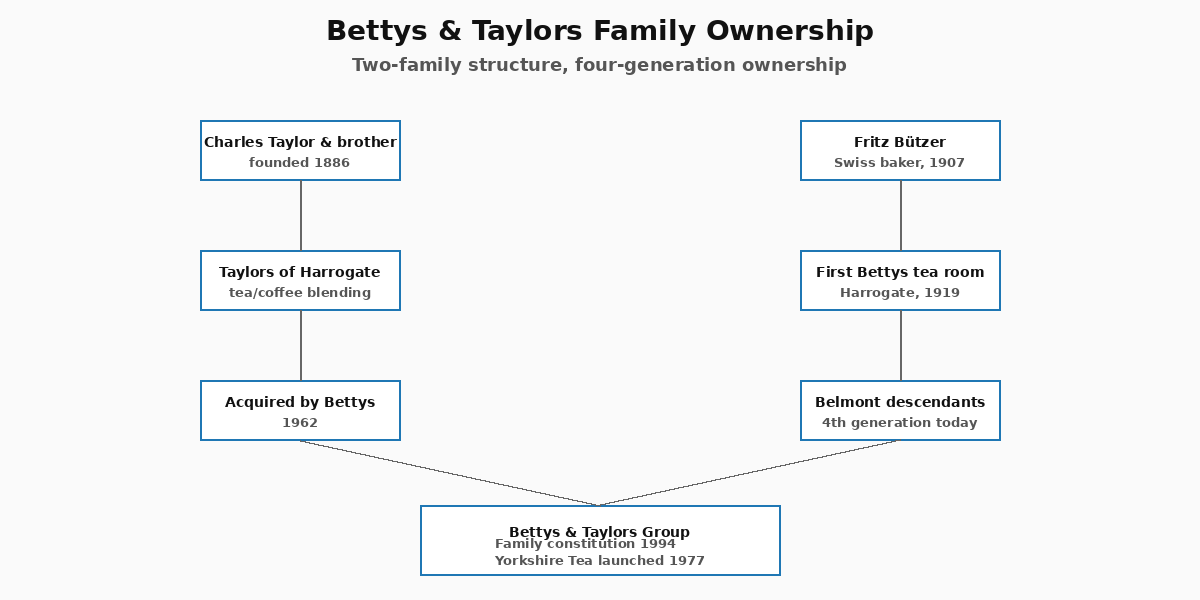
The Three Families, Bettys, Taylors, and the Belmont Descendants
Yorkshire Tea sits inside a structure that took 56 years to assemble and that the current ownership treats as a deliberate architectural choice rather than an accident of history. The Bettys and Taylors group has three constituent businesses, each with its own origin story, that merged through the 20th century into the family-owned operation that owns Yorkshire Tea today.
The first is Taylors of Harrogate, the tea-and-coffee business. Charles Edward Taylor and his brother founded it in 1886, specialising in blending tea and coffee for grocers who would sell the blends as their own house brand. Taylor had a specific skill that became the company’s reputation: matching tea blends to the local water. Yorkshire water is famously hard (high calcium and magnesium content), and the company’s signature was to create blends that tasted consistent regardless of which Yorkshire town’s water was used to brew them. The company set up tea and coffee kiosks in towns around Yorkshire, with a flagship store at 1 Parliament Street, Harrogate.
The second is Bettys, the tea-room business. In 1907, a young Swiss baker and confectioner named Fritz Bützer left his native Alps and travelled to England with the intention of opening a business. In 1919 he opened the first Bettys Café Tea Room in Harrogate, on the model of the Swiss confectionery and tea-room culture he had grown up in. The tea room served Swiss pastries, Yorkshire tea, and a small selection of chocolates that became the company’s signature.
The third is the Belmont family, who own and run the combined group. Frederick Belmont (Fritz Bützer’s grandson) is the third-generation descendant whose family took the company from the original Swiss confectioner through to its current fourth-generation ownership. In 1962, the Bettys business acquired C.E. Taylor & Co (the tea-and-coffee business), creating the Bettys and Taylors group under the Belmont family’s ownership.
The current ownership is the fourth generation of the Belmont family, who run the combined group with a Family Constitution (formalised in 1994) that articulates the long-term vision as “Working together to build a great Yorkshire Family Business, creating prosperity and pride by doing what the family believes in.” The constitution is the governance mechanism by which the family maintains ownership through generational handovers without selling out to a strategic or financial buyer.
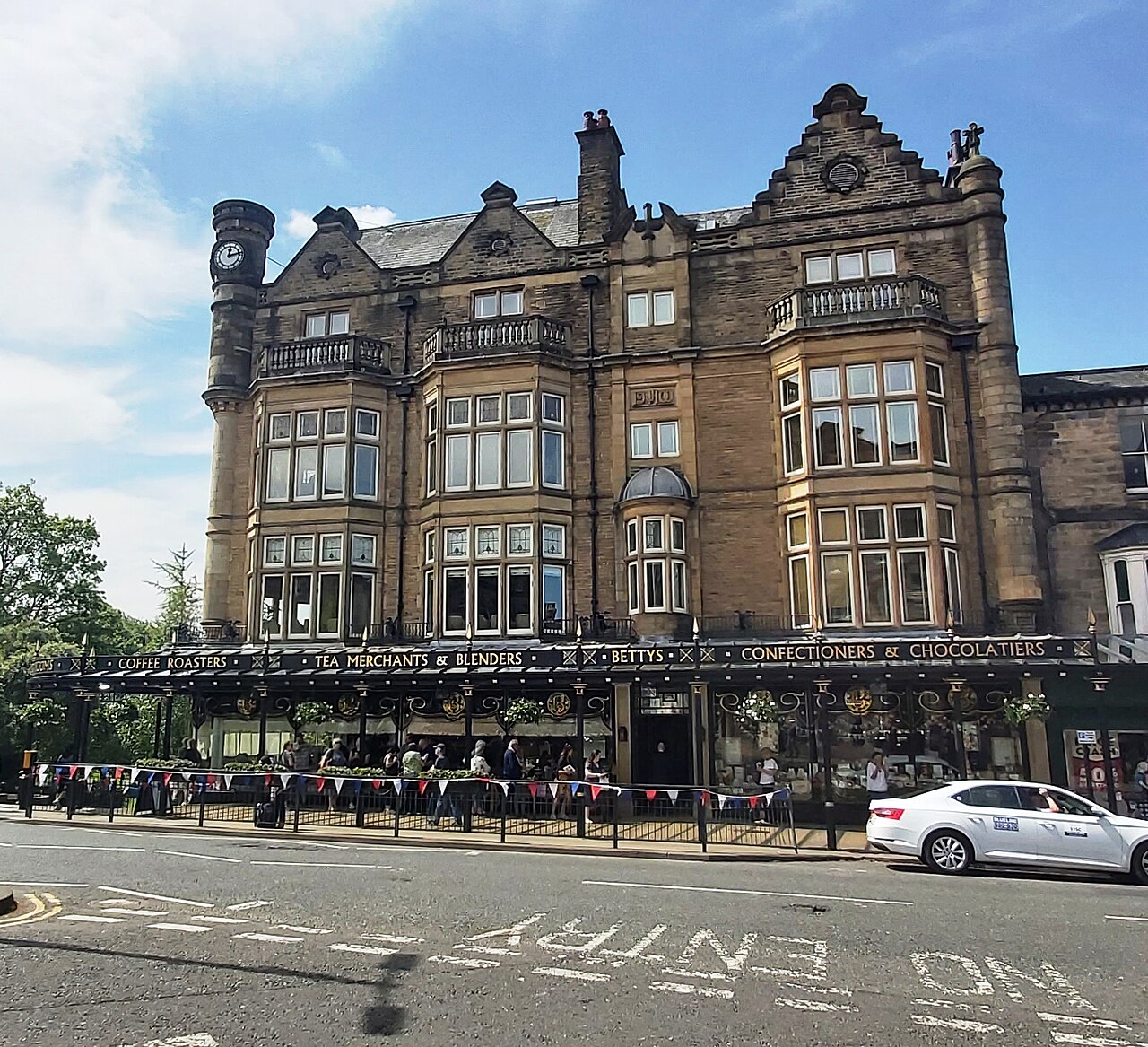
Yorkshire Tea Launches, 1977
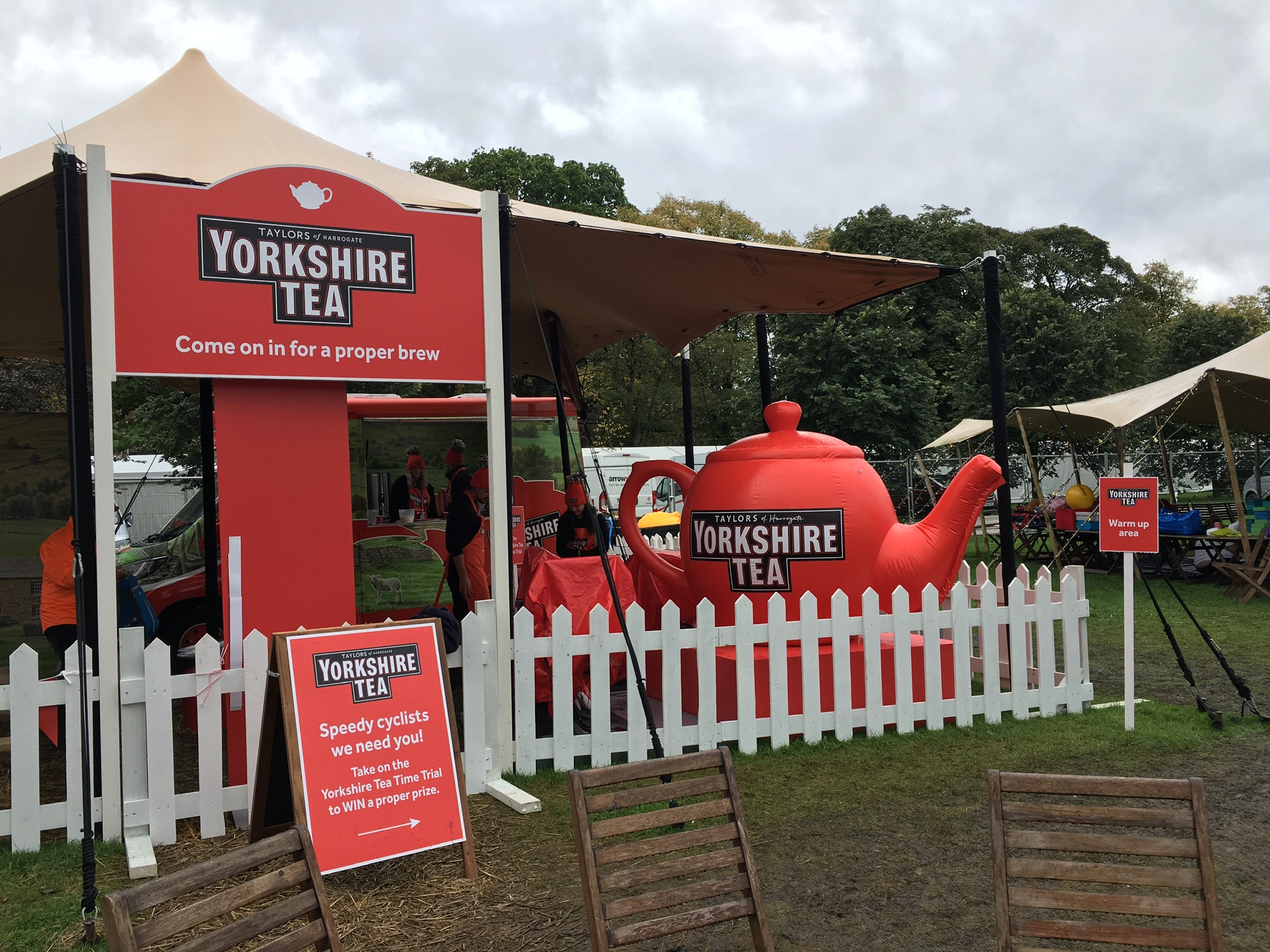
The Yorkshire Tea blend was launched in 1977, fifteen years after the Bettys and Taylors merger. The company had been blending tea for grocers and tea rooms since 1886, but the 1977 launch was the first time it put a consumer-facing brand in the supermarket channel under its own name.
The launch was, by every subsequent account, a small regional gamble. Yorkshire Tea went into Yorkshire supermarkets first, sold primarily through the regional grocery chains that dominated British food retail in the 1970s. The blend was created to be tolerant of Yorkshire’s hard water, the same water-matching skill that had defined Charles Taylor’s work since 1886. The brand identity, packaging, and pricing were set up for the regional Yorkshire market first.
The brand grew through the 1980s and 1990s by word-of-mouth and through the reputation of the tea rooms (which served Yorkshire Tea as the default black tea). As UK food retail consolidated into the big four supermarket chains (Tesco, Sainsbury’s, Asda, Morrisons) in the 1990s and 2000s, Yorkshire Tea gained national distribution without having to run a national marketing campaign. The brand grew as the supermarket channel grew, and the supermarket buyers stocked Yorkshire Tea as the regional brand with strong consumer loyalty in its home territory.
The 1994 Family Constitution
In 1994, Bettys and Taylors formalised its governance with a Family Constitution. The text articulates a vision for the business that is unusual in British consumer goods for being explicit about the role of family ownership in long-term decision-making.
The 1994 constitution is also the year the company became a third-generation family business in the strict sense — the founder’s original Swiss confectioner had been succeeded by his son, who had been succeeded by the founder’s grandson, and the 1994 constitution was the governance mechanism by which the third generation would hand over to the fourth.
The constitution’s commitments include: long-term thinking over short-term financial optimisation, refusal to sell to outside buyers, employee welfare as a primary consideration, regional Yorkshire identity as a brand asset, and explicit commitment to the family tea-room and baking heritage. The company has held to all of these through 30 years of ownership transitions, two recessions, and a global pandemic.
The constitution’s effect on Yorkshire Tea specifically is that the brand has been grown as a long-term asset rather than sold off or licensed. In an industry where most UK tea brands have been acquired by multinationals (PG Tips went from Brooke Bond to Unilever to Lipton Teas and Infusions in 2022; Tetley went to Tata Consumer Products in 2000; Twinings went to Associated British Foods in 1964), Yorkshire Tea is the only top-five UK black tea brand still under family ownership.
Revenue and Growth
Bettys & Taylors Group turned over £325.7 million in the year to 31 October 2025, up from £319.2 million a year earlier, according to its accounts filed at Companies House. FY 2024 was the first year sales passed £300 million. Our guide to who owns Yorkshire Tea charts the figures since 2020.
The revenue growth has been driven primarily by Yorkshire Tea’s expansion outside its Yorkshire heartland. The brand is sold in approximately 40 countries today, including the UK (its largest market), Ireland, the US, Canada, Australia, New Zealand, and a number of European markets. International expansion has been steady rather than aggressive — the company has historically opened new markets through distribution partnerships rather than direct investment, which keeps the capital intensity low and preserves the family ownership structure.
Within the UK, Yorkshire Tea competes in the same supermarket aisle as PG Tips (the long-time market leader), Tetley, Twinings, and the supermarket own-label lines. Yorkshire Tea overtook PG Tips to become Britain’s best-selling tea in 2019, and the group’s 2025 accounts put its share of the UK black tea market by value at a record 41.6%. The Grocer reporting in 2023 noted that the brand had gained market share in both the teabag and loose-tea categories.
The Supply Chain
Yorkshire Tea sources its tea from a small number of origins, with Kenya, Assam (India), and Rwanda as the primary sources for the black tea blend. The company has been a notable supporter of the Ethical Tea Partnership (ETP), the industry coalition that monitors working conditions on tea estates in major tea-growing regions.
The company’s supply chain disclosures are limited compared to larger multinational competitors, but its family-ownership structure and Yorkshire regional identity have positioned it as a credible mid-market alternative to the dominant supermarket own-label brands. Yorkshire Tea does not publish annual sustainability reports with the same granularity as Twinings’ Sourced with Care program, but the company’s stated values include “fairness” as a primary commitment.
The supply chain has been tested by the same tea price inflation that has affected all UK tea brands in the 2022-2024 period. Kenya, the largest source of commodity black tea, saw production declines due to drought and currency movements. Assam saw yield reductions due to weather events. The company’s response was to absorb the cost increases rather than fully pass them on to consumers — a decision that the family-ownership structure made easier, since quarterly margin pressure from public-market shareholders does not apply.
The Tea Rooms as a Brand Asset
The Bettys tea rooms are a separate division from Yorkshire Tea but are functionally a brand asset for the group. Bettys currently operates five tea rooms in Yorkshire and northern England (Harrogate, York, Northallerton, Ilkley, and Harlow Carr), each serving Yorkshire Tea as the default black tea alongside the Swiss pastries and chocolates that have been the brand’s signature since 1919.
The tea rooms serve approximately 1.5 million customers per year, per the company’s own published figure. They are a destination for tourists, day-trippers, and special occasions, and they provide a physical retail expression of the brand that no amount of supermarket marketing can replicate. The tea rooms are also profitable as standalone units; the company has not closed a tea room in living memory and has opened the Harlow Carr location (in the grounds of the RHS Harlow Carr garden) relatively recently.
The tea rooms’ role in Yorkshire Tea’s brand is structural: the blend was first sold commercially through the tea rooms and the Harrogate shop from 1977 onwards, and the tea rooms continue to serve the blend to a national visitor audience that includes people who would not otherwise encounter the brand in a supermarket. The tea rooms are, in effect, a permanent marketing channel for Yorkshire Tea that the family-ownership structure has preserved.
International Expansion
Yorkshire Tea is sold in approximately 40 countries today. The brand’s international presence grew through three waves: a Commonwealth push in the 1980s and 1990s (Canada, Australia, New Zealand), a US specialty-channel push in the 2000s and 2010s (Whole Foods, Wegmans, independent grocers), and a more recent European and Middle East push since 2020 (Germany, France, the Gulf states).
The international expansion has been steady rather than aggressive, and the company has not opened wholly-owned subsidiaries in any market outside the UK. Distribution is handled through local partners, which keeps the capital intensity low and preserves the family-ownership structure. The international revenue is not separately disclosed but is estimated by industry observers at 15-20% of group revenue.
The brand’s international appeal is anchored in the same identity that drives UK sales: a regional British identity, a family-business story, and a blend that has been tuned for hard water. The “Yorkshire” name is itself an asset in international markets, where the county has strong cultural recognition (the Yorkshire Dales, the Yorkshire Moors, James Herriot, the Bronte sisters, cricket at Headingley). The international marketing emphasises the brand’s Yorkshire identity rather than its parent group’s Swiss or English heritage.
Yorkshire Tea vs the Multinationals
The four other UK top-five black tea brands — PG Tips, Tetley, Twinings, and Yorkshire Tea . Are now owned by four different multinationals and one family. PG Tips is owned by Lipton Teas and Infusions, which was created in 2022 when CVC Capital Partners acquired Unilever’s tea business for €4.5 billion. Tetley is owned by Tata Consumer Products, the Indian conglomerate’s consumer arm, which acquired the brand from Tata Tea (formerly the merged Tata Tea and Tetley group) in 2000. Twinings is owned by Associated British Foods, the Weston family’s conglomerate, which acquired it in 1964. Yorkshire Tea is owned by the fourth generation of the Belmont family.
The ownership structures have real consequences for how each company invests, prices, and plans. PG Tips’ ownership by a private equity firm (CVC) creates quarterly financial discipline that does not apply to a family-owned business. Tetley’s ownership by Tata Consumer Products subjects it to the capital allocation decisions of an Indian conglomerate with multiple consumer brands. Twinings’ ownership by ABF subjects it to the segment-level reporting of a £19.5 billion revenue group, even though Twinings is one of its most international brands. Yorkshire Tea’s family ownership means long-term thinking can take precedence over short-term margin pressure, and capital allocation is decided by the family rather than by external shareholders.
That ownership structure is the single most important fact about Yorkshire Tea as a business. It explains why the brand has been grown rather than sold, why the company has been willing to absorb cost increases rather than fully pass them on, why the tea rooms have been preserved as a brand asset rather than closed and monetised, and why the brand has expanded internationally through partnerships rather than direct investment. The family ownership is the strategy.
Fact-vs-Claim Verdict
| Claim | Verdict | Source / note |
|---|---|---|
| Yorkshire Tea was launched in 1977 | Verifiable | Bettys & Taylors official timeline |
| Bettys acquired C.E. Taylor & Co in 1962 | Verifiable | Wikipedia / Bettys & Taylors |
| Taylors of Harrogate was founded in 1886 | Verifiable | Wikipedia / Bettys & Taylors |
| Bettys tea room was founded in 1919 by Frederick Belmont | Verifiable | Bettys & Taylors official history (Belmont was the grandson of Fritz Bützer) |
| 1994 Family Constitution exists with stated values | Verifiable | Bettys & Taylors official history |
| Bettys and Taylors is family-owned in its fourth generation | Verifiable | Wikipedia / Bettys & Taylors |
| FY 2025 turnover: £325.7 million | Verifiable | Companies House (via Wikipedia citation) |
| FY 2023 revenue: £300M+ (first crossing) | Verifiable | The Grocer reporting on FY2023 results |
| Yorkshire Tea is sold in 40+ countries | Company claim | Yorkshire Tea corporate site |
| 5 Bettys tea rooms currently operate | Verifiable | Bettys & Taylors official history |
| Yorkshire Tea is the only top-5 UK black tea brand under family ownership | Industry-press characterisation | PG Tips → Lipton Teas and Infusions (CVC Capital); Tetley → Tata Consumer Products; Twinings → ABF (Weston family). Only Yorkshire Tea remains family-owned at the brand level. |
| Tea rooms serve approximately 1.5 million customers per year | Company claim | Bettys & Taylors published figure |
| International revenue is 15-20% of group revenue | Estimate, not directly disclosed | Industry observer estimate; Bettys and Taylors does not break out segment revenue |
| Yorkshire Tea is a top-3 UK black tea brand by volume | Industry-press characterisation | The Grocer reporting; rankings vary slightly by quarter |
For the company behind the brand today, its owners and its accounts, see who owns Yorkshire Tea.
Frequently Asked Questions
Yorkshire Tea Ownership, 2026
Yorkshire Tea is owned by Bettys and Taylors of Harrogate Limited, a fourth-generation family business. The ownership descends from Frederick Belmont, the Swiss-origin founder of the original Bettys tea room, through his family. The 1994 Family Constitution formalised the family’s commitment to long-term ownership and has held through three subsequent ownership transitions. Yorkshire Tea has never been sold to an outside buyer.
The Yorkshire Tea vs PG Tips vs Tetley Comparison
Yorkshire Tea has been the UK’s best-selling black tea brand since 2019. PG Tips, its long-time rival, is owned by Lipton Teas and Infusions (the company created in 2022 when CVC Capital Partners acquired Unilever’s tea business for €4.5 billion). Tetley is owned by Tata Consumer Products (acquired 2000). Yorkshire Tea is the only top-five UK black tea brand under family ownership. Twinings (ABF, Weston family) rounds out the top four.
The 1977 Brand Launch
Yorkshire Tea launched in 1977 as a black tea blend sold initially in Yorkshire supermarkets. The brand grew through the 1980s and 1990s by word-of-mouth and through Bettys tea room distribution, then expanded nationally as the UK supermarket chains consolidated in the 1990s and 2000s. The blend was created to be tolerant of Yorkshire’s hard water, the same water-matching skill that had defined Taylors’ blending since 1886.
The Family Constitution
The Bettys and Taylors Family Constitution, formalised in 1994, articulates the long-term vision for the business as “Working together to build a great Yorkshire Family Business, creating prosperity and pride by doing what the family believes in.” The constitution commits the family to long-term thinking, refusal to sell to outside buyers, employee welfare, regional Yorkshire identity, and the family tea-room and baking heritage.
Revenue Disclosed
Bettys & Taylors Group turned over £325.7 million in the year to 31 October 2025, per its accounts at Companies House, having first passed £300 million in FY 2024. Yorkshire Tea’s standalone revenue is not separately disclosed but is estimated at 60-70% of group revenue, given that the brand is the largest single revenue driver in the group.
The Tea Rooms
Bettys currently operates five tea rooms: Harrogate (the original 1919 location), York, Northallerton, Ilkley, and Harlow Carr (in the grounds of the RHS Harlow Carr garden). The tea rooms serve approximately 1.5 million customers per year and serve Yorkshire Tea as the default black tea alongside the Swiss pastries and chocolates that have been the brand’s signature since 1919. The tea rooms are a brand asset for Yorkshire Tea and are not separately sold.
Sources
- Bettys and Taylors , About Us official timeline , Primary source for the 1907 founding by Fritz Bützer, the 1919 opening of the first Bettys tea room, the 1962 acquisition of C.E. Taylor & Co, the 1977 launch of Yorkshire Tea, the 1994 Family Constitution, and the 2019 centenary. The company’s own account is the authoritative source for these milestones.
- Yorkshire Tea , Who the family is , Primary source for the “Taylors of Harrogate, a third generation Yorkshire family business born in 1886” framing, the Harrogate Parliament Street heritage, and the company’s stated values of fairness, flavour and quality.
- Wikipedia , Bettys and Taylors of Harrogate , Secondary source for the fourth-generation family ownership, and the structural history of the merged entities.
- Encyclopedia.com , Bettys & Taylors of Harrogate Ltd. , Secondary source for the historical context of the Bettys and Taylors merger, the 1977 Yorkshire Tea launch context, and the family governance framework.
- The Grocer , Yorkshire Tea owner Bettys and Taylors sees sales top £300m for first time , Primary source for the FY 2023 revenue crossing the £300 million threshold.
- Leeds University Business Partnerships , Bettys and Taylors Group , Secondary source for the family-owned classification and the regional Yorkshire identity.
- Growjo , Bettys and Taylors of Harrogate revenue estimate , Industry estimate of $358.3M annual revenue (consistent with the £300M+ FY 2023 figure at then-prevailing GBP/USD).
- Bettys , The Story of Bettys , Primary source for the Bettys tea-room history and the 1964 onwards expansion timeline.
Last updated: 11 October 2026. Sources are linked in the text.