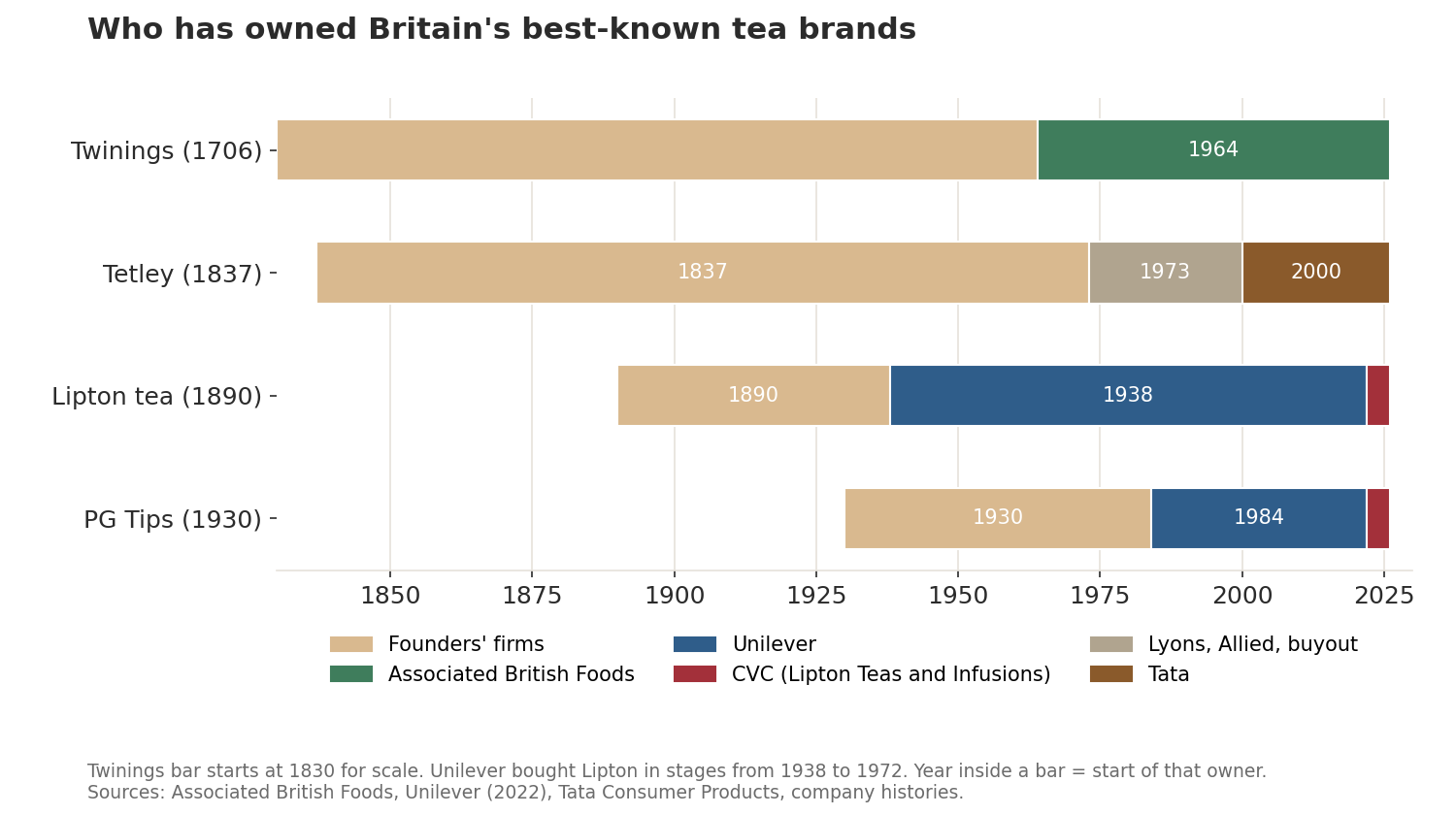
Most of the tea on supermarket shelves comes from a handful of owners. Lipton Teas and Infusions, controlled by the private equity firm CVC since 2022, owns Lipton, PG Tips, Brooke Bond, Pukka, TAZO and T2. India’s Tata Consumer Products owns Tetley. Associated British Foods, controlled by the Weston family’s holding company, owns Twinings. Yorkshire Tea is one of the few big names still family-run, by Bettys & Taylors of Harrogate.
Who owns which tea brand
| Brand | Owner | Owner based in | Since |
|---|---|---|---|
| Lipton | Lipton Teas and Infusions (CVC Capital Partners) | Amsterdam, Netherlands | 2022 |
| PG Tips | Lipton Teas and Infusions (CVC Capital Partners) | Amsterdam, Netherlands | 2022 |
| Brooke Bond, Pukka, TAZO, T2 | Lipton Teas and Infusions (CVC Capital Partners) | Amsterdam, Netherlands | 2022 |
| Tetley | Tata Consumer Products | Mumbai, India | 2000 |
| Tata Tea, Good Earth, teapigs | Tata Consumer Products | Mumbai, India | Various |
| Twinings | Associated British Foods | London, UK | 1964 |
| Yorkshire Tea, Taylors | Bettys & Taylors of Harrogate (family) | Harrogate, UK | Family since 1886 |
| Typhoo | Supreme plc | UK | 2024 |
| Clipper | Ecotone (PAI Partners and Charles Jobson) | Lyon, France | 2012 |
| Celestial Seasonings | Hain Celestial Group | New York, US | 2000 |
| Harney & Sons | Harney family | Millerton, New York, US | Founded 1983 |
| Dilmah | Fernando family | Colombo, Sri Lanka | Founded 1988 |
| Mighty Leaf | Peet’s Coffee | California, US | 2014 |
The big three owners
Lipton Teas and Infusions, the world’s largest tea company
For most of the 20th century, the biggest name in tea was Unilever, the Anglo-Dutch maker of Dove soap and Hellmann’s mayonnaise. It built its tea business by buying Lipton in stages from 1938 to 1972 and Brooke Bond, the maker of PG Tips, in 1984. In 2020 it put its tea brands into a separate unit called ekaterra and sold it to CVC Capital Partners, a private equity firm.
Unilever completed the sale on 1 July 2022. The deal, worth €4.5 billion, included Lipton, PG Tips, Pukka, T2 and TAZO, but not Unilever’s tea business in India, Nepal and Indonesia or its share of the Pepsi Lipton ready-to-drink joint ventures. In 2023 the new company changed its name from ekaterra to LIPTON Teas and Infusions, headquartered in Amsterdam. In 2024 it agreed to transfer its tea estates in Kenya, Rwanda and Tanzania to Browns Investments of Sri Lanka, which also became one of its largest suppliers.
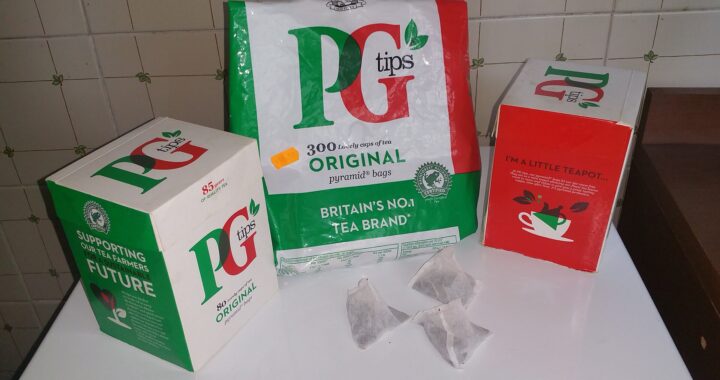
That split explains why the same logo can have different owners. A box of Lipton Yellow Label tea bags in Europe belongs to CVC’s company, a bottle of Lipton Iced Tea comes from PepsiCo’s joint venture, and Lipton tea in India is still Unilever’s. Our guide to who owns Lipton untangles it, and our PG Tips ownership guide covers the UK’s best-selling tea bag.
Tata Consumer Products, owner of Tetley
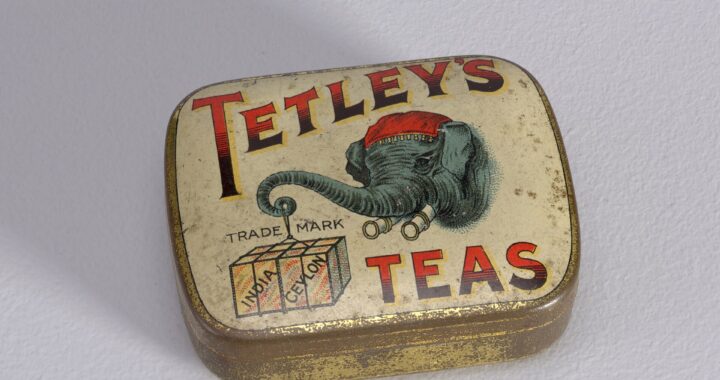
In February 2000, India’s Tata Tea bought the Tetley Group for £271 million. It was a leveraged buyout, and Business Today later called it the deal that set the stage for big Indian takeovers abroad. Tetley, founded in Yorkshire in 1837, brought the first tea bags to Britain in 1953. Today it sits inside Tata Consumer Products, alongside Tata Tea, the best-selling tea in India, Good Earth in the United States and teapigs in the UK. Our Tetley ownership guide has the full story.
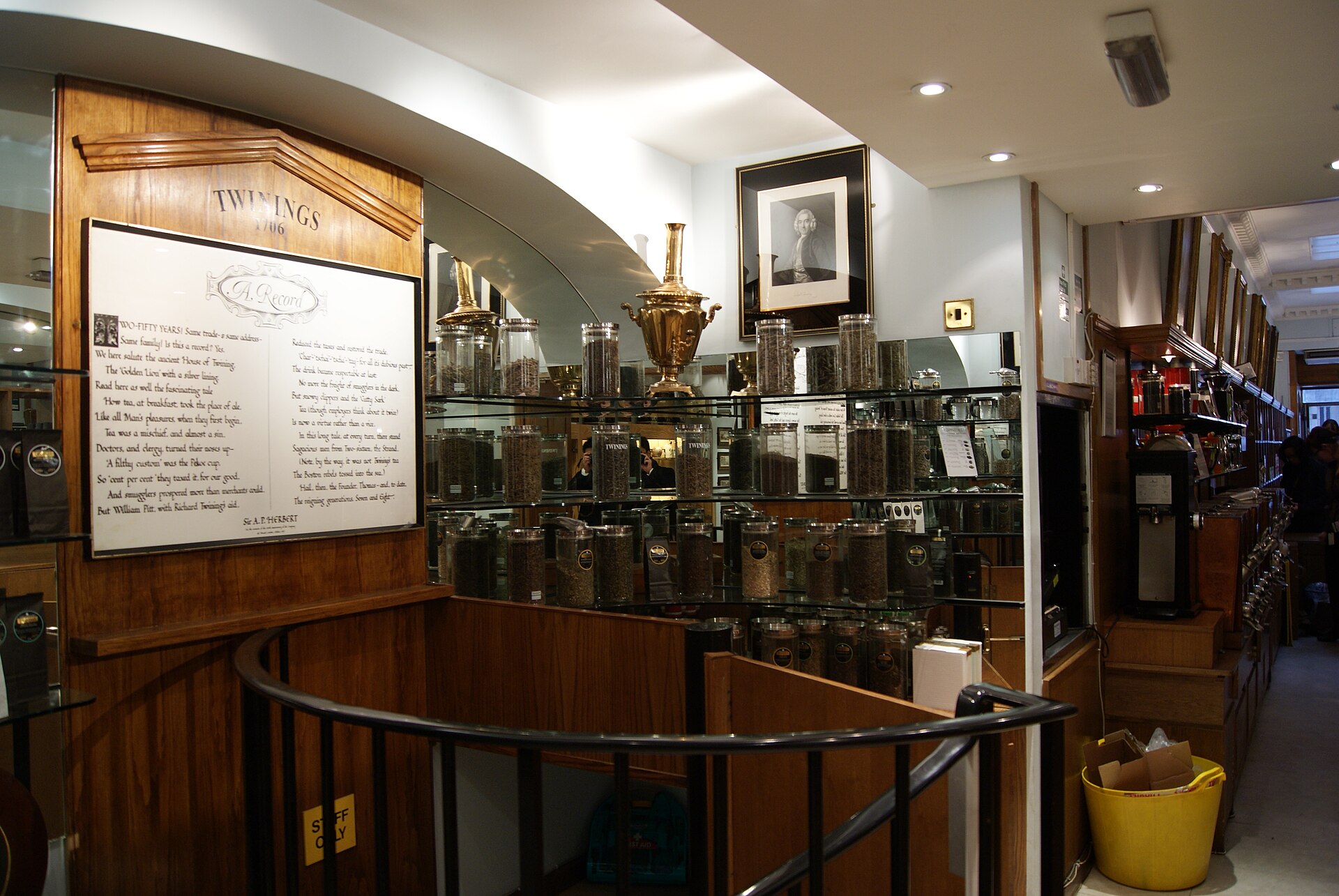
Associated British Foods, owner of Twinings
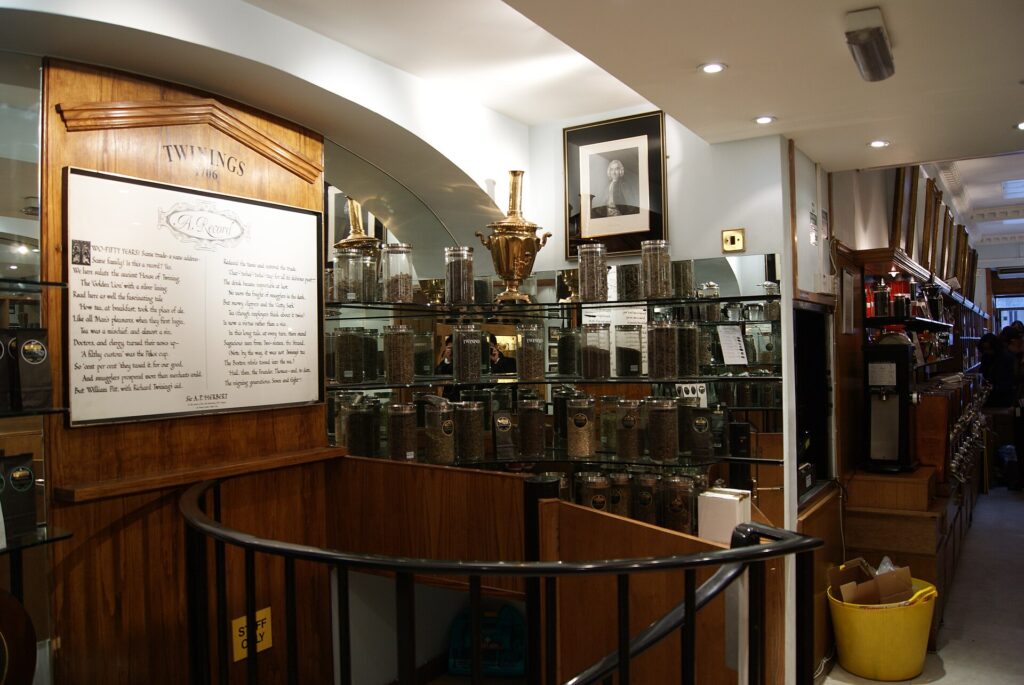
Twinings opened on London’s Strand in 1706 and stayed in family hands until Associated British Foods bought it in 1964. ABF also owns Ovaltine, sugar and ingredients businesses, and the clothing chain Primark. Its controlling shareholder is Wittington Investments, which is mostly owned by the Garfield Weston Foundation charity and partly by the Weston family. Wittington also owns Fortnum & Mason, so two of London’s grandest tea names share an ultimate owner. Our Twinings ownership guide explains how that works, and our history of Twinings covers its first three centuries.
Family-owned tea brands
A few well-known brands are still controlled by the families that built them. That often shows in how they make decisions about sourcing and quality.
- Yorkshire Tea and Taylors of Harrogate. Owned by Bettys & Taylors, a fourth-generation family business that also runs the Bettys tea rooms. Read the Yorkshire Tea and Bettys story.
- Harney & Sons. Started by John Harney in Connecticut in 1983 and now run by his family from Millerton, New York. See the Harney & Sons story.
- Dilmah. Founded by Merrill J. Fernando in Sri Lanka and still controlled by his family. Our profile covers Dilmah’s producer-owned model and the next generation.
- Bigelow. Founded in New York in 1945 and still run by the Bigelow family.
Other brands that changed hands
- Typhoo. The 120-year-old brand went into administration in November 2024 and was bought by Supreme plc for £10.2 million, along with brands such as Heath & Heather and London Fruit & Herb.
- Clipper. The Dorset fair-trade brand was bought by Royal Wessanen in 2012. That company is now Ecotone, controlled by private equity.
- Celestial Seasonings. The Boulder, Colorado, herbal tea maker merged with Hain Food Group in 2000 to form Hain Celestial.
- Mighty Leaf. Bought by Peet’s Coffee in 2014. See the Mighty Leaf and Peet’s deal.
Why tea ownership matters to drinkers
Most people never think about who owns their tea bags, but ownership changes do show up in the cup and on the shelf.
- Products disappear. In 2023, Twinings dropped its lapsang souchong, sold since the 1700s, citing sourcing problems, and replaced it with a smoky blend that many fans dislike. Our lapsang souchong guide covers what happened and where to buy the real thing.
- Formats change. PG Tips replaced its famous pyramid bags with square quick-brew bags in 2023.
- Sourcing standards travel with the owner. Big groups set the ethical programmes, from Twinings’ Sourced with Care scheme to the standards Lipton Teas and Infusions wrote into its Browns deal.
- One logo, several companies. As with Lipton, a brand can belong to different owners in different countries or product types, so what you buy abroad may not be the same tea.
Whoever owns them, most of the big British brands sell blended black tea made for drinking with milk. Our guides to black and green tea, Earl Grey and milk in tea cover the teas themselves.
Quick answers
Is Lipton still owned by Unilever?
Mostly no. Since July 2022, Lipton tea bags and leaf tea outside India, Nepal and Indonesia belong to Lipton Teas and Infusions, owned by CVC Capital Partners. Unilever kept Lipton tea in those three countries and its share of the Lipton Iced Tea joint venture with PepsiCo.
Are PG Tips and Lipton the same company?
Yes. Both belong to Lipton Teas and Infusions. Lipton Yellow Label is not sold in UK supermarkets, where the company sells PG Tips instead.
Is Tetley still British?
Tetley is a British brand, founded in Yorkshire in 1837, but it has been owned by India’s Tata group since 2000.
Who owns Yorkshire Tea?
Bettys & Taylors of Harrogate, a family business in North Yorkshire. It is one of the few major UK tea brands not owned by a multinational or investment firm.
Who owns Twinings?
Associated British Foods, since 1964. ABF is controlled by Wittington Investments, which is owned mainly by the Garfield Weston Foundation and partly by the Weston family.
How to check who owns your tea
Brand names rarely tell you who is behind them, but the box usually does. Look for the small print near the barcode or ingredients, which names the company responsible for the product and its address. In the UK you can then look that company up on the free Companies House register to see its parent company. A brand’s website usually names the owner in its legal notice or terms of use. Remember that the same brand can belong to different companies in different countries.
More ownership questions
Who owns Pukka, TAZO and T2?
All three belong to LIPTON Teas and Infusions, controlled by CVC Capital Partners. They came with the rest of Unilever’s tea business in 2022. Pukka is a British organic herbal brand, TAZO is sold mainly in the United States and T2 is an Australian tea retailer.
Who owns Brooke Bond?
LIPTON Teas and Infusions owns Brooke Bond in most countries. In India, Nepal and Indonesia, Unilever kept it, so Brooke Bond Red Label in India is a Unilever brand.
Who owns Typhoo?
Supreme plc, a UK consumer goods company, which bought Typhoo out of administration in 2024.
Who owns Clipper tea?
Ecotone, a French organic food group formerly called Royal Wessanen, which bought Clipper in 2012. Ecotone is controlled by the private equity firm PAI Partners.
Who owns teapigs and Good Earth?
Both belong to Tata Consumer Products, the Indian company that also owns Tetley.
Who owns Celestial Seasonings?
The Hain Celestial Group, a US natural foods company formed when Celestial Seasonings merged with Hain Food Group in 2000.
Who owns Fortnum & Mason?
Wittington Investments, the holding company that also controls Associated British Foods and, through it, Twinings.
Sources
- Unilever. Completion of the sale of its tea business, ekaterra, 2022.
- LIPTON Teas and Infusions. ekaterra to become LIPTON Teas and Infusions, 2023.
- LIPTON Teas and Infusions. Partnership with Browns Investments, 2024.
- Business Today. Tata Tea’s Tetley buyout, 2011.
- Associated British Foods ownership and Wittington Investments.
- ESM Magazine. Supreme buys Typhoo Tea out of administration.
Last updated: 8 October 2026. Sources are linked in the text.