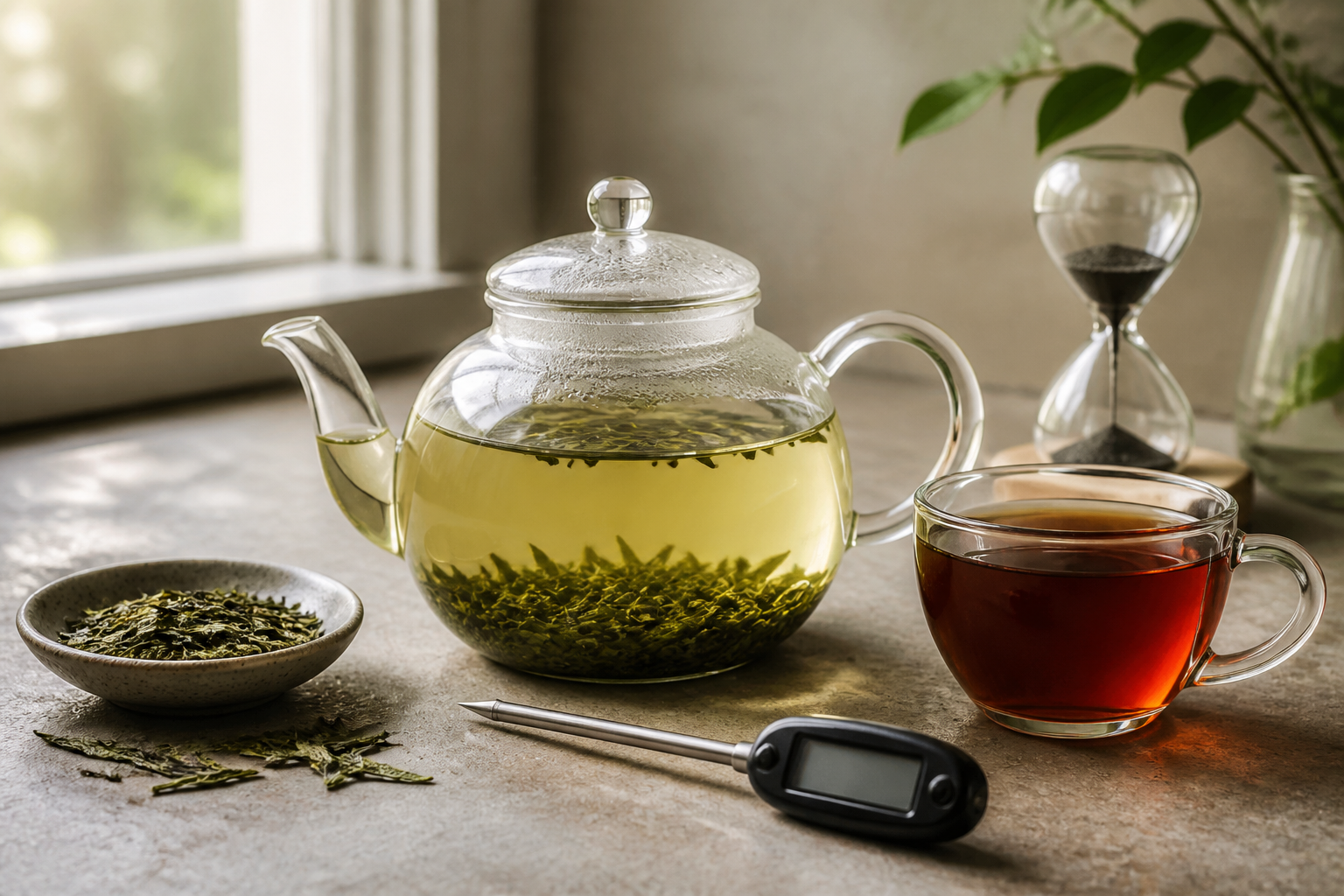
The reason “tea helps me focus” is not folklore. Tea contains caffeine for alertness and L-theanine for a calmer, more sustained attention profile. The catch is that the ratio between the two — and the dose — varies enormously across tea styles. Here is the starting map of what works, what does not, and how to assemble a daily routine without losing sleep.
Tea contains caffeine for alertness and L-theanine for calmer, more sustained attention. The combination is what gives tea a different cognitive profile from coffee. Most regular drinkers describe the experience without having read the research: a smoother lift, less jitter, easier to keep working without crashing. The two compounds together are the basis of a small but consistent body of research on attention, alertness and the subjective quality of focus.
This article maps the popular “focus” teas onto two axes — caffeine and L-theanine — and works through what the research actually supports, how to brew for the effect you want, and how to assemble a daily routine that does not keep you awake at midnight.
Why tea feels different from coffee
The cleanest summary of the cognitive effect is the combination. Caffeine is a well-studied adenosine antagonist: it reduces sleepiness, increases vigilance and improves performance on simple attention tasks. L-theanine, an amino acid that is rare in coffee but abundant in tea, modulates the caffeine response: it crosses the blood-brain barrier, increases alpha-wave activity associated with relaxed attention, and softens the jitter and crash that a high caffeine dose on its own tends to produce.
The combination has been studied more than the sum of its parts. A 2008 review by Einother and Giesbrecht in Nutritional Neuroscience summarised the cognitive and mood effects of L-theanine and caffeine together, including faster reaction time, improved accuracy on attention tasks, and a smoother subjective alertness. A companion study by Nobre and colleagues found that the L-theanine + caffeine combination improved attention switching and reduced susceptibility to distraction in a controlled trial. The doses in those studies sit in the range you get from 1 to 3 cups of tea, depending on style.
The interesting pharmacology is that the two compounds act on different parts of the same alertness system. Caffeine blocks adenosine receptors in the basal forebrain, which keeps the wake-promoting circuitry firing. L-theanine increases GABA, serotonin and dopamine release modestly, and crosses the blood-brain barrier at a rate that produces measurable changes in brain-wave patterns within 30 to 40 minutes of ingestion. The result on an EEG is a shift toward alpha-wave activity , the brain-wave pattern associated with relaxed, focused attention rather than the high-beta alertness of a strong coffee. That is why the lift from a cup of matcha or gyokuro feels different from the lift from a double espresso, even when the caffeine dose is similar.
The European Food Safety Authority’s caffeine ceiling is 200 mg as a single dose and 400 mg across the day for healthy adults , see the EFSA opinion on caffeine. Most tea drinkers land well below that envelope, but the cumulative dose from a “tea stack” through the working day can reach it.
A starting map of caffeine and L-theanine by tea
The chart below puts the popular focus teas on two axes: estimated caffeine per 240 ml cup on the horizontal axis, and estimated L-theanine per gram of dry leaf on the vertical axis. The closer a tea sits to the upper right, the closer it gets to the cognitive profile the research describes. The shaded band on the right is the caffeine-only region where the lift is real but the L-theanine moderation drops away.
Inline SVG stripped by WordPress security policy (svg_uploads:false). Chart data preserved in surrounding prose.
Caffeine vs L-theanine scatter: Matcha 70 mg/5.0 mg/g; Gyokuro 60/5.5; Sencha 35/4.5; Oolong 40/4.0; Black 50/1.5; White 30/2.0; Pu-erh 55/1.2; Coffee 95/0.1.
The teas worth knowing
Not every tea that contains caffeine and L-theanine delivers the same effect. The dose matters, and the ratio matters. The teas below are the ones with the strongest claim on the focus effect, ranked by how close they get to the upper-right corner of the chart.
Matcha
The most efficient single source of caffeine + L-theanine per cup. Because matcha is a powdered, shade-grown green tea that you consume whole, you get the full dose of both compounds rather than what steeps out of the leaf. A 1 g bowl whisked in 60 to 80 ml of hot water typically delivers around 70 mg of caffeine and a meaningful L-theanine dose , the highest combined profile per cup of any common tea. The effect is a clear, smooth lift that lasts around three to four hours.
Gyokuro and other shaded Japanese greens
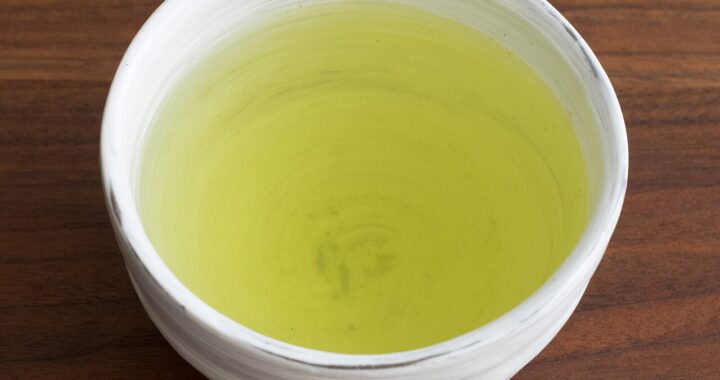
Shaded for three weeks before harvest, gyokuro concentrates both caffeine and L-theanine in the leaf. The result is a sweet, umami-rich green tea that delivers roughly 60 mg of caffeine per cup alongside one of the highest L-theanine-to-caffeine ratios of any common tea. A practical starting guide covers leaf grade, water temperature (around 50 to 60 °C), and short steeps. Tencha and kabusecha are intermediate forms with slightly lower shade coverage and a similar profile.
High-grade sencha and Chinese longjing
First-flush sencha and good Chinese longjing (Dragonwell) sit a step below matcha and gyokuro on the L-theanine axis but still well above black tea. A 240 ml cup of first-flush sencha delivers roughly 35 mg of caffeine with a meaningful L-theanine dose, and the bright, slightly sweet cup suits a morning brew.
Oolong
A mid-range choice. High-grade oolongs (Tieguanyin, Dong Ding, a lightly roasted Wuyi) deliver moderate caffeine with a moderate L-theanine dose, and the cup is more layered than a single-note green. A 240 ml cup is typically 35 to 45 mg of caffeine; L-theanine is around 4 mg/g of dry leaf for the better cultivars.
Black tea and breakfast blends
Reliable but caffeine-dominant. A 240 ml cup of brewed black tea delivers 40 to 60 mg of caffeine with much less L-theanine than green tea (around 1 to 2 mg/g of dry leaf). The lift is real but less modulated than the green or oolong side of the field. For morning focus with milk, an English Breakfast or Assam blend is the conventional choice; for a less jittery lift, swap to a high-grade Darjeeling first flush.
Pu-erh
Similar to black tea on caffeine, low on L-theanine. A 240 ml cup of brewed pu-erh delivers 50 to 60 mg of caffeine with very little L-theanine. The appeal of pu-erh for focus is the cup itself: a bright, clean, almost brothy profile that suits sustained work. Sheng (raw) pu-erh carries more caffeine than shou (ripe).
White tea
The lightest of the field. A 240 ml cup of white tea delivers around 25 to 35 mg of caffeine with low L-theanine (around 2 mg/g). White tea’s role in a focus routine is the afternoon slot: enough lift to keep going, light enough not to disturb sleep if consumed by mid-afternoon.
A side-by-side at-a-glance table
| Tea | Caffeine / 240 ml | L-theanine profile | Cup character | Best slot in the day |
|---|---|---|---|---|
| Matcha | ~70 mg | Highest per cup (full leaf) | Smooth, clear, sustained | Morning |
| Gyokuro | ~60 mg | Very high ratio | Sweet, umami, calm | Morning or early afternoon |
| First-flush sencha | ~35 mg | High | Bright, slightly sweet | Morning |
| High-grade oolong | ~35–45 mg | Moderate | Layered, floral or roasted | Mid-morning or early afternoon |
| Black tea / breakfast | ~40–60 mg | Low | Malty, full-bodied, milk-friendly | Morning |
| Pu-erh | ~50–60 mg | Very low | Bright, brothy, earthy | Afternoon |
| White tea | ~25–35 mg | Low | Light, delicate, floral | Late afternoon, before 4 pm |
How to brew for the effect you want
For a calm morning cup
Matcha is the efficient choice: 1 g whisked in 60 to 80 ml of water at around 80 °C. Single bowl, no second dose, so the caffeine is processed by early afternoon. A gyokuro or first-flush sencha brewed at 70 °C for 90 seconds is the alternative if you prefer a steeped green.
For a strong but smooth lift
High-grade oolong, brewed at 90 °C for 2 to 3 minutes for the first infusion. The combination of moderate caffeine and a meaningful L-theanine dose, layered with the flavour and aroma of a high-grade oolong, is the closest thing to a “focus ritual” cup. Multiple short infusions keep the caffeine dose modest across a working session.
For an afternoon without ruining sleep
A chawan matcha bowl with bright green matcha being whisked with a bamboo chasen on a neutral wood surface in soft natural light. A single bowl of matcha is the highest-density natural combination of caffeine and L-theanine available in a single serving of tea. Pu-erh, white tea or a light oolong , and stop by 3 to 4 pm if your bedtime is around 10 pm. Caffeine half-life in healthy adults is about 5 hours, so a late-afternoon cup leaves a meaningful residual at midnight.
A daily “tea stack” for focused work
The phrase “tea stack” is borrowed from coffee, but the idea is the same: assemble a small routine of three or four cups across a working day, each tuned to a different part of the day. The point is not maximum caffeine. The point is the smoother attention curve that the caffeine + L-theanine combination describes in the research.
- 08:00 — Matcha (1 g, whisked). Highest combined dose of caffeine and L-theanine. Single bowl, no second dose, so the caffeine is processed by early afternoon.
- 10:30 — Gyokuro or first-flush sencha. Brewed at 70 °C for 90 seconds. Light, sweet, sustains focus without adding much caffeine.
- 13:00 — Light oolong or white tea. Multiple short infusions. Keeps the ritual going for the afternoon. Total caffeine for the day is now in the 150–200 mg range.
- 15:30 — Herbal or water. Switch to a non-caffeinated drink. Peppermint, chamomile, rooibos or just water all work.
This is a starting point. People who are sensitive to caffeine should shift every cup later or to lower-caffeine options. People who tolerate caffeine well can keep the morning matcha, swap the 10:30 sencha for a stronger gyokuro, and keep a black tea or light oolong for 13:00. The general shape , high L-theanine, moderate caffeine, finish by mid-afternoon , is the part worth copying.
The caffeine-L-theanine synergy
The reason matcha and gyokuro feel different from coffee is the L-theanine, an amino acid present in tea but absent in coffee. A 2019 placebo-controlled study in Nutritional Neuroscience measured cognitive performance after tea, caffeine alone, and L-theanine alone: the tea condition outperformed both single-compound conditions on attention-switching tasks, suggesting synergy rather than additive effect. The ratio of L-theanine to caffeine in tea sits around 2:1, and matcha concentrates both compounds in the consumed leaf, which is part of why a gram of matcha delivers a noticeably different lift than a gram of sencha.
A practical note on timing and tolerance
Caffeine half-life sits between 4 and 6 hours for most adults, with slower metabolism in some populations and faster in others. A late-afternoon tea (after about 4 pm) will still be circulating at midnight for slow metabolisers, and explains why some readers find a 2 pm cut-off necessary and others tolerate 5 pm with no effect. The 100 mg/day threshold commonly cited for sleep impact is the same number from the American Academy of Sleep Medicine’s 2017 position paper on caffeine; below it, individual variance dominates.
Frequently asked questions
L-theanine standalone effect
L-theanine on its own has measurable but small effects on relaxation and attention in human studies. Its strongest documented role is as a moderator of caffeine’s effect: most positive studies look at the combination. The 2008 review by Einother and Giesbrecht is the standard reference for this distinction.
Green tea vs coffee for focus
For most people, no. A 240 ml cup of green tea typically delivers 25 to 35 mg of caffeine, against 95 to 200 mg in a small drip coffee. The lift is real but smaller, and the L-theanine moderation makes it smoother. If you want a green-tea caffeine dose equivalent to coffee, matcha is the closest match (around 70 mg per bowl).
Downsides of tea for focus
Two real ones. First, the cumulative caffeine dose across a tea-stack day can reach the 400 mg EFSA ceiling, especially if you add a fourth cup after 15:30. Second, the polyphenols in tea reduce non-haem iron absorption when drunk with meals , keep the focus cup between meals rather than with them. The “What to drink with dinner” slot should be herbal or water.
Bottled tea and focus
Most bottled teas are 5 to 30 mg of caffeine per bottle with very little L-theanine, because pasteurisation breaks down the L-theanine and the brewing method is short. They give a small lift without the modulated profile. For the research-supported effect, brew loose leaf or whisk matcha.
Caffeine cut-off time
For a 10 pm bedtime, stop caffeinated tea by 4 to 6 pm. Caffeine half-life is about 5 hours, so a 4 pm cup still leaves roughly half its caffeine in your system at midnight. People with slower caffeine metabolism need more. The earlier end of the range (4 pm) is conservative but safer.
L-theanine cumulative effect
It does not accumulate the way a nootropic stack does. L-theanine acts within an hour of consumption, peaks in plasma around 30 to 60 minutes after ingestion, and clears within a few hours. The cognitive effect comes from the caffeine + L-theanine pairing in each cup, not from a steady-state build. That is why the tea-stack pattern of two to three cups in the first half of the day is more useful than a single large dose at one time.
The bottom line
Tea supports focus because it pairs a useful dose of caffeine with L-theanine, and because the ritual itself is calm and repeatable. Matcha and shaded Japanese greens are the most efficient sources of the pair per cup; light oolong and high-grade sencha are close behind; black tea is reliable but more caffeine-dominant. Match the tea to the time of day, brew for theanine balance, and stop the caffeine by mid-afternoon. The result is a smoother attention curve than coffee, and a routine that does not punish you at night.
The single biggest lever is the time-of-day match. The cognitive research is consistent; the practical difference between a “tea stack” that works and one that ruins the night’s sleep is whether the last caffeinated cup landed by 4 pm. A second lever is the cultivar: shaded Japanese greens give you the caffeine + L-theanine combination in the cleanest per-cup form. A third lever is brew temperature , too-hot water for green tea pulls astringency and bitterness that mask the lift. Get those three right and the rest is personal taste.
For the caffeine half-life chart that explains the afternoon cutoff, see the best tea for sleep. For how green and black tea compare on caffeine in the first place, see green tea vs black tea. And for the brewing ranges that protect L-theanine from over-extraction, see the brewing guide.