Twinings at 190 — At a Glance
| Field | Value | Source |
|---|---|---|
| Founded | 1706 (Thomas Twining opened Tom’s Coffee House on London’s Strand) | Twinings official history |
| Logo in continuous use | The reclining lion, commissioned 1787 — world’s oldest continually-used company logo | Twinings / Wikipedia |
| Royal Warrant | First granted by Queen Victoria 1837; held continuously since | ABF history page |
| Acquired by ABF | 1964 (diversification from baking and milling) | ABF history page |
| ABF ownership vehicle | Wittington Investments (Weston family) — majority shareholder of ABF, hence Twinings | Reuters, July 2026 |
| Headquarters | Andover, Hampshire (since 2011 manufacturing consolidation) | Wikipedia / Twinings corporate |
| Number of countries Twinings is sold in | 100+ | ABF 2024 Annual Report |
| Number of tea blends in current range | 200+ | ABF 2024 Annual Report |
| Estimated standalone revenue (FY24) | ~£1.3–1.5B (one-third of ABF Grocery segment × £4.24B) | Derived from ABF Grocery disclosure |
| France rank, March 2025 | #1 tea brand by volume (ABF feature, Twinings brand renovation case study) | ABF 2025 Annual Report |
| Major manufacturing footprint | Andover (UK, reduced), Poland, China | BBC, 2010; Wikipedia; ABF |
| Earl Grey recipe | Recipe attributed to a gift to PM Charles Grey (1830s); origin contested | Twinings history |
| ABF 2026 split decision | Grocery (incl. Twinings) separated from Primark retail; FoodCo retains the Twinings brand | Reuters, July 2026 |
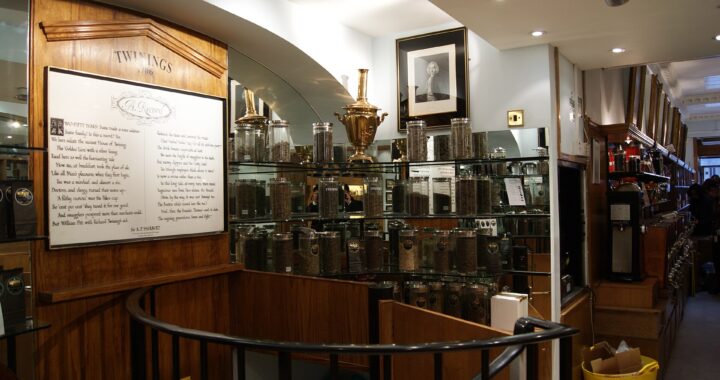
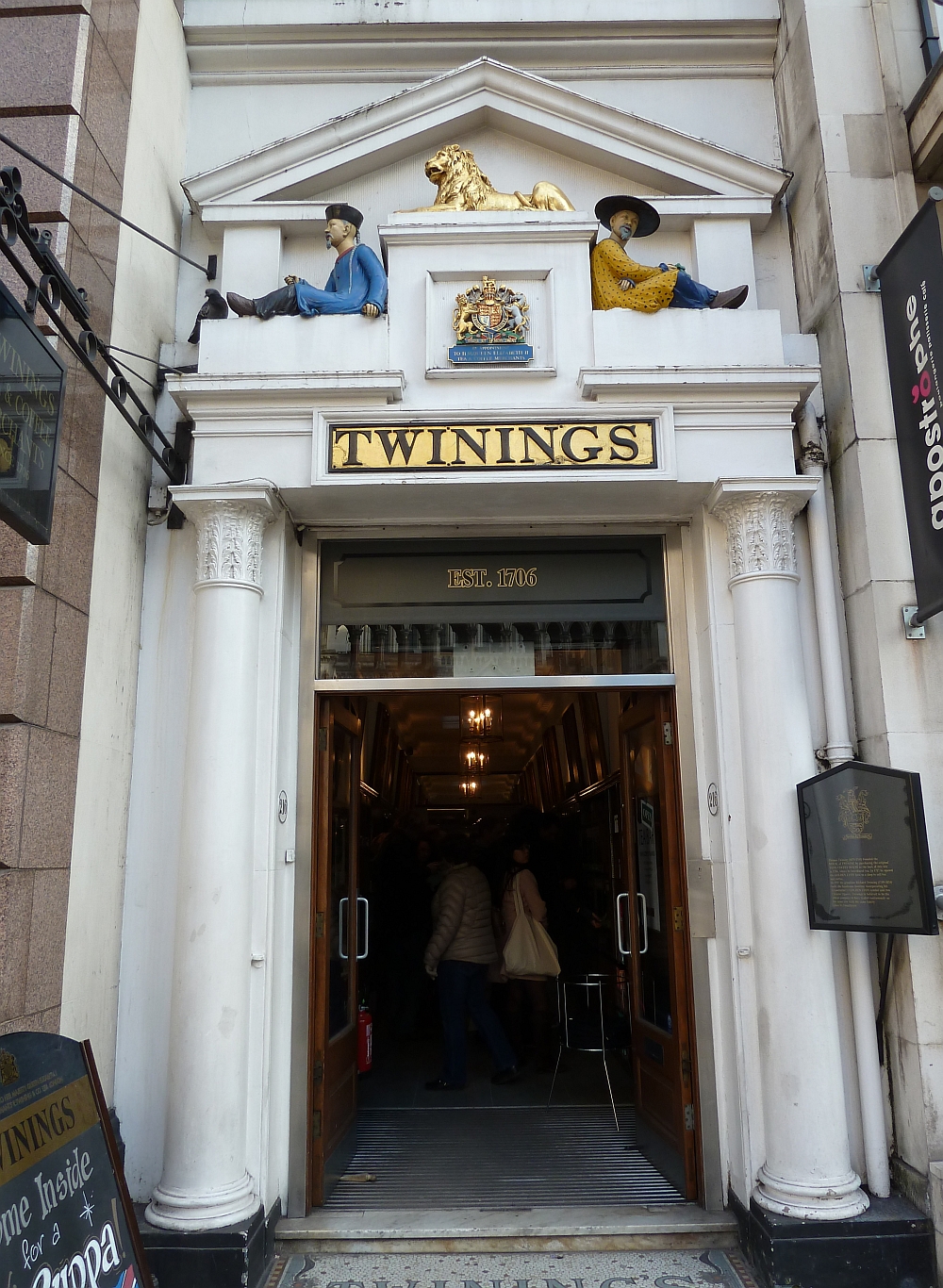
On the Strand in central London, at number 216, there is a small shop with a gold-painted lion above the door. The shop is a few feet wide and has been on the same site, paying rates to the City of Westminster, since 1706. Thomas Twining opened it as Tom’s Coffee House and quickly pivoted to tea; in 1717 he added a dedicated dry-tea shop next door called the Golden Lyon, and the Twining family has been selling tea from that address for 319 years. Today the shop sells more than 200 Twinings blends, and the company that owns the brand sells those blends in more than 100 countries.
That company is no longer the Twining family. It has not been since 1964, when Associated British Foods acquired Twinings as part of a deliberate diversification from baking and milling. The brand now sits inside ABF’s Grocery segment, alongside Ovaltine, Patak’s, Blue Dragon, Jordans and Mazzetti, and the conglomerate that owns it is in the process of splitting itself in two. In July 2026 ABF announced it would separate its food businesses (including Twinings) from Primark, the discount clothing chain. Twinings becomes part of “FoodCo” — the new name for the grocery, ingredients, agriculture and sugar businesses.
The article below walks through Twinings’ 319-year history, the ownership change that put it inside a £19.5 billion conglomerate, the manufacturing relocation that hollowed out its UK base, the 2023 lapsang souchong backlash, the French brand renovation that made it the country’s #1 tea brand in March 2025, and what the ABF split means for the next chapter.
The Strand Coffee House, 1706
The Twining family originated in Gloucestershire, where they held occupations as weavers and fulling millers. In 1684, nine-year-old Thomas Twining travelled with them to London and was apprenticed to a weaver. By 1701 he had become a Freeman of the City, abandoned weaving, and was working for a wealthy merchant handling some of the early shipments of tea arriving in England through the East India Company.
On 25 February 1706, Thomas Twining purchased Tom’s Coffee House on the Strand. There were approximately 2,000 coffee houses in London at the time, all offering some combination of coffee, hot chocolate, spirits and arrack. Twining’s competitive move was to lean heavily into tea, which was increasingly fashionable among the upper classes. Within eleven years he had bought two adjacent houses, converted one into a dedicated shop, and in 1717 opened what Twinings’ own corporate history describes as “probably the world’s first dry tea and coffee shop” — the Golden Lyon, identifiable by the gold-painted lion above the entrance.
The shop sold tea directly to the wealthy female customers for whom drinking tea at home had become fashionable. The Strand site is the same premises Twinings has occupied ever since. The City of Westminster rate records identify it as London’s longest-standing ratepayer.
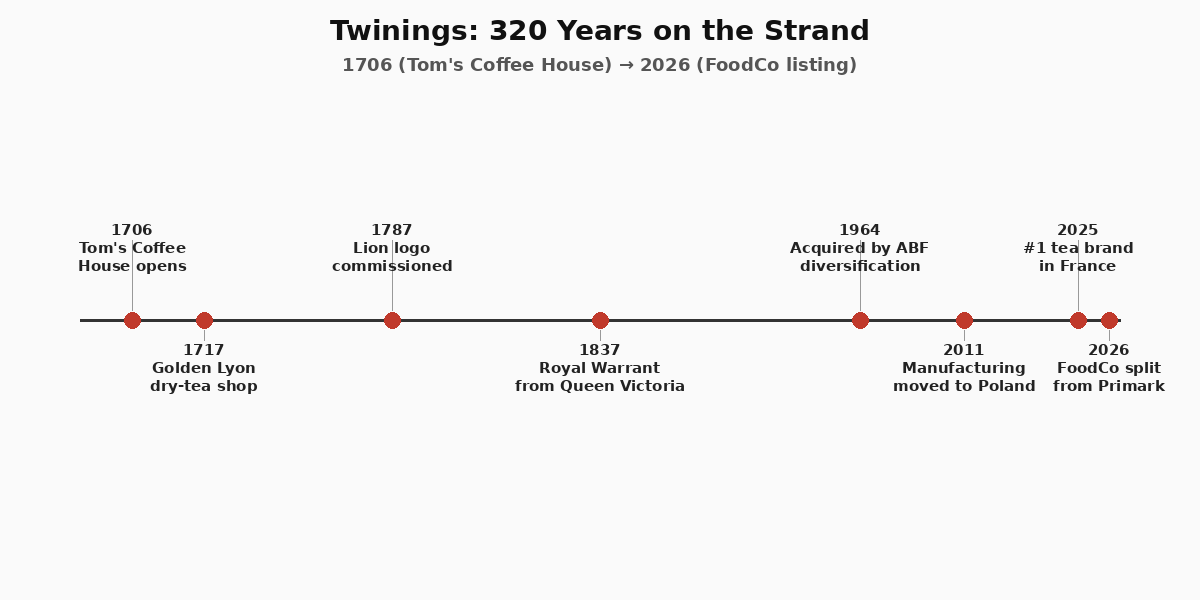
320 Years of Tea, From the Twining Family to the Westons
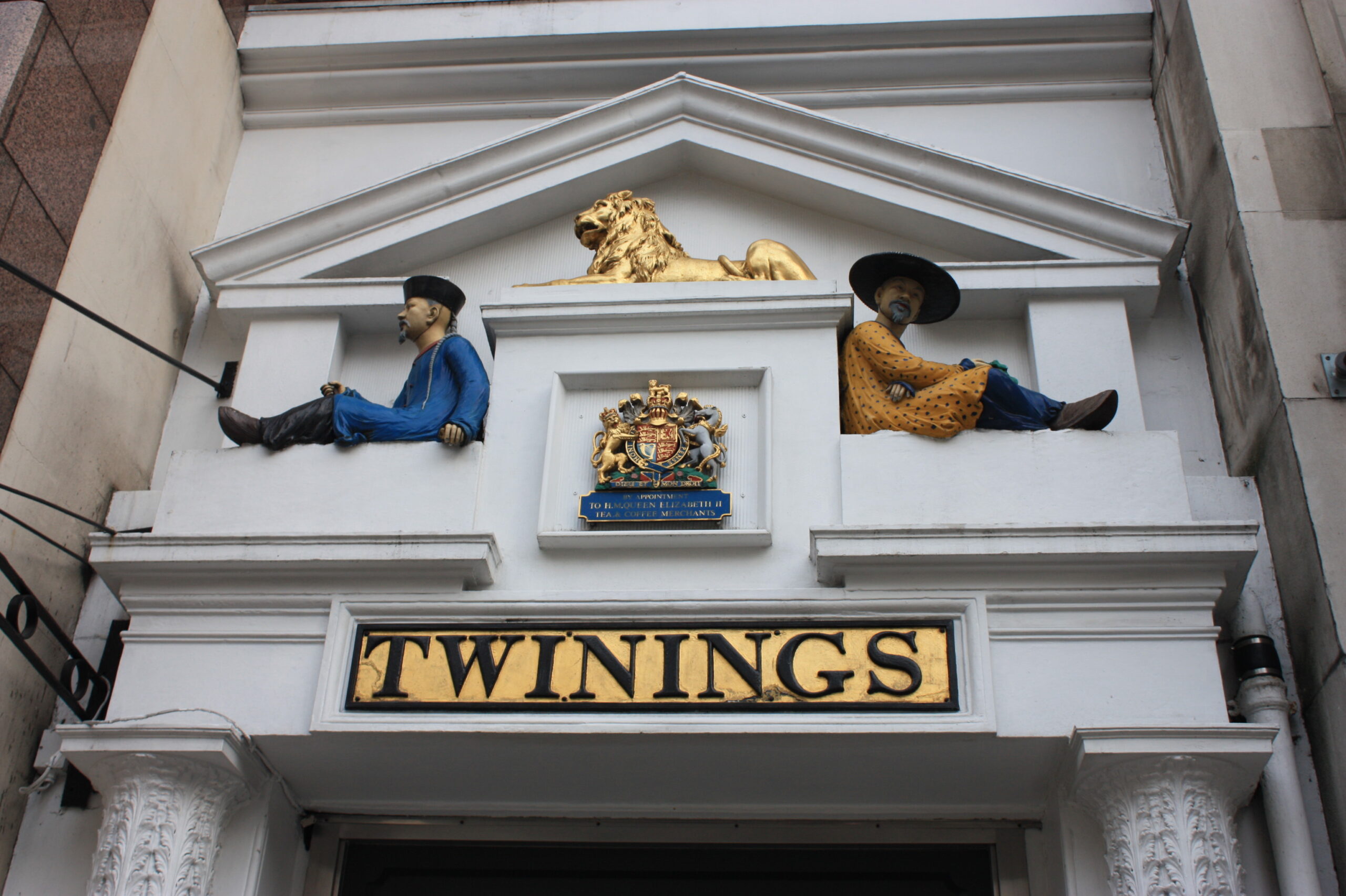
The Twining family ran the company through nine generations before selling. Thomas Twining died in 1741 and was succeeded by his son Daniel; Daniel’s widow Mary took over in 1762; their son Richard Twining took the business in 1783. Richard was a prominent citizen — he served as a Member of Parliament and was one of the people who petitioned William Pitt the Younger to slash tea taxes, leading to the Commutation Act of 1784. He commissioned the gold lion in 1787 (the lion is depicted lying down as a sign of respect to his grandfather, the founder).
The Twining family held the company through the 19th century, including the Earl Grey recipe gift (1830s), the receipt of the first Royal Warrant from Queen Victoria (1837), and the introduction of English Breakfast blend (1933). The Royal Warrant has been renewed continuously since. Arthur Tweed, the great-grandson of Richard Twining III, ran the company in the late 19th century and launched the first Twinings print advertisement in 1899 — until that point the company had relied entirely on reputation.
In 1964, Associated British Foods acquired Twinings. At the time, ABF was still primarily a baking and milling company (its name was Allied Bakeries until 1960), and the Twinings acquisition was an explicit diversification into grocery brands. The price paid and the structure of the deal are not publicly disclosed; neither the Twining family nor ABF has published the consideration.
ABF itself is majority-owned by Wittington Investments, the investment vehicle of the Weston family (Galen Weston’s heirs). The Westons also control Selfridges, Primark, Fortinos and George Weston Ltd in Canada. When ABF splits in two in 2026, the Weston family will hold majority stakes in both the new Primark-listed entity and the new FoodCo entity that owns Twinings. The ultimate beneficial ownership of Twinings therefore does not change with the split — only the corporate parent.
Earl Grey, the Twinings Recipe
The blend known as Earl Grey is the tea Twinings is most associated with, though the company’s own corporate history is unusually careful about the claim. The recipe is named after Charles Grey, 2nd Earl Grey, who served as British Prime Minister from 1830 to 1834. The story Twinings tells is that an envoy of the Earl received a gift of the bergamot-infused tea recipe — Twinings’ own blends of Chinese and Indian black teas flavoured with oil of bergamot from southern Italy . And the recipe was reproduced for the Earl.
Twinings’ corporate site describes the Earl Grey recipe gift as a family legend without claiming definitive provenance. The company “cannot be sure” when the Earl Grey association began or how important its involvement has been historically, per the Wikipedia entry that draws on the same corporate history. Competitor Jacksons of Piccadilly — acquired by Twinings in the 1990s . Also claims an Earl Grey connection. What is verifiable: Twinings has sold an Earl Grey blend since at least the 1830s, has held the Royal Warrant continuously since 1837 (originally granted by Queen Victoria to “Twinings as the supplier of tea to the Royal Household”), and the Earl Grey recipe remains one of its top sellers globally.
Bergamot oil, the flavouring, comes almost exclusively from Citrus bergamia grown in a narrow coastal strip of Calabria in southern Italy. The 2023 frost damage to the Italian bergamot crop, combined with rising market prices, was one factor Twinings cited when it dropped lapsang souchong from its range the same year. (See “The 2023 Lapsang Souchong Backlash” below.)
Royal Warrant and the Lion Logo
The reclining gold lion above the door at 216 Strand is the oldest continually-used company logo in the world. Commissioned by Richard Twining in 1787, the same year he oversaw the construction of the present shop front, the lion is depicted reclining rather than rampant — an explicit mark of respect to his grandfather, the founder. The shop front at 216 Strand has been substantially unchanged since 1787.
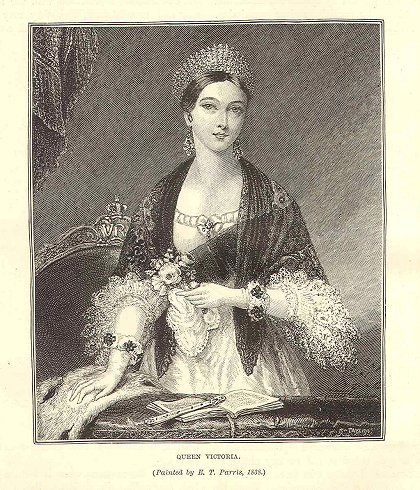
The Royal Warrant granted by Queen Victoria in 1837 has been renewed continuously since. Twinings holds a Royal Warrant as a supplier of tea to the British Royal Household, currently under King Charles III. The warrant is one of the older commercial warrants still in force in the UK.
The lion and the warrant are the two oldest pieces of brand equity Twinings holds. Both predate the modern company form (the legal entity is ABF’s subsidiary), the modern logo system, and the modern product range. Both have been carried through the 1964 acquisition and the 2026 split without modification.
Acquired by ABF, 1964
Associated British Foods was created in 1960 when Allied Bakeries changed its name to reflect a diversification strategy that was already underway. The Twinings acquisition came four years later. ABF’s own corporate history page describes the deal as part of “a clear diversification strategy into other industries” beyond baking and milling. Other ABF acquisitions in the same era: Fine Fare supermarkets (1963), Quinnsworth and Stewarts in Ireland, and eventually the founding of Primark in Dublin (1969).
At the time of the Twinings deal, ABF was a UK-focused bakery-and-milling conglomerate with no international grocery brand portfolio to speak of. The Twinings deal brought with it the international distribution network the Twining family had built since the early 20th century, including established export relationships in the United States, Canada, Australia, France, and the rest of the Commonwealth. That network was the asset ABF paid for; the recipe portfolio was the smaller part.
Under ABF ownership, the Twinings portfolio expanded from the dozen or so blends the Twining family had been selling at the time of acquisition to more than 200 in the current range. The international footprint expanded from approximately 20 countries to more than 100. The London Strand shop was preserved as a flagship retail outlet and tourist attraction. The Andover, Hampshire factory became the headquarters.
The Manufacturing Move, 2011
In April 2008, Twinings announced the closure of its Belfast Nambarrie plant, a tea company it had operated in trade for over 140 years. Citing what the company described as an “efficiency drive,” Twinings consolidated most of its UK production into Andover, Hampshire, and announced in late 2011 that it was moving most of its remaining production to China and Poland while keeping the Andover site operating with a reduced workforce.
The Polish site was a £27 million investment that drew a £10.5 million European Union regeneration grant — which was later withdrawn by the European Commission on the grounds that the company had failed to prove the Poland move was regeneration rather than relocation. The UK closures (North Tyneside and Andover reductions) cost 360 jobs.
The 2011 manufacturing move was the inflection point at which Twinings’ physical UK base shrank dramatically. The current production footprint spans Andover (UK, reduced), Poland, and China , the latter two being lower-cost manufacturing locations with established tea and packaging industries. The Andover site is the headquarters and runs the flagship UK and European production; the bulk of volume manufacturing for global markets runs through Poland and China.
This is a structural change that distinguishes Twinings from family-owned competitors. Yorkshire Tea (the Bettys family), Harney & Sons, and Dilmah all operate single-country manufacturing footprints. Twinings operates a multinational one, with all the cost structure and supply chain complexity that implies.
The 2023 Lapsang Souchong Backlash
In 2023, Twinings discontinued lapsang souchong from its range, replacing it with a blend called “Distinctively Smoky” that tea reviewers and customers judged to be inferior. The decision drew sustained criticism in the British press, including a Spectator piece (“Where to get your Lapsang (now Twinings has ruined theirs)”) and an Independent piece (“Tea fans splutter as Churchill favourite cuppa replaced with ‘stale cigarettes’ blend”) that linked the discontinuation to Winston Churchill’s documented preference for lapsang souchong.
Twinings cited “difficulty sourcing the blend along with rising market prices” for the original lapsang souchong as the cause , not a cost-driven substitution, as some commentators alleged. Lapsang souchong is a Fujian Chinese black tea with a distinctive pine-smoke flavour from traditional drying over pinewood fires; the supply chain is concentrated in a small number of Wuyi mountain producers and is sensitive to weather, wildfire, and trade-policy events.
The episode is the cleanest illustration of a structural challenge Twinings faces: as a 200+ blend brand with a multinational manufacturing footprint, it is exposed to single-origin supply-chain risks on any given blend. The trade-off is breadth (200 blends in 100 countries) versus depth (single-origin quality on any given blend). The lapsang decision was a depth-for-breadth trade , and the customer reaction confirmed that on certain heritage blends, the depth matters more than the breadth.
France, 2025 — Becoming the Number One
In March 2025, Twinings became the number one tea brand in France by volume. The achievement, reported in ABF’s 2025 Annual Report, came after a deliberate brand renovation that ABF attributes to consumer research on the French “pleasure seeker” persona , a consumer profile described as looking to be inspired and entertained, and thriving on memorable experiences.
The renovation updated packaging with “clearer messaging and ingredients illustrations, showing benefits and taste cues to create a more premium look and feel.” The result, per the annual report, was year-on-year sales up 9% for herbals and 8% for green teas in the French market, and Twinings became the number one tea brand for under-35s in France and the number one tea brand in London. The ABF feature highlights the French case as the template for the broader international brand strategy: consumer-research-led renovation, premium-look packaging, and focused marketing investment.
France is significant because the French tea market is structurally different from the UK market. UK tea consumption is overwhelmingly black-tea-bagged (PG Tips, Yorkshire Tea, Tetley); French consumption is overwhelmingly green tea, herbal, and infusion. Twinings’ French success was driven by the herbal and green tea lines, not by English Breakfast. The same product portfolio that competes with PG Tips in the UK competes with Mariage Frères in France.
The 2026 Primark Split , What it Means for Twinings
In July 2026, ABF announced it would separate its food businesses (Twinings, Ovaltine, Patak’s, Blue Dragon, the ingredients businesses, the sugar businesses, and the agriculture businesses) from the Primark retail business. The food business will continue to be called Associated British Foods; Primark will list separately. Both entities will be majority-owned by the Weston family’s Wittington Investments vehicle.
For Twinings specifically, the split is structurally neutral: the brand stays inside FoodCo, and the ownership does not change. What changes is the corporate reporting structure , FoodCo will report Twinings’ revenue inside its grocery segment (along with Ovaltine, Patak’s, Blue Dragon, Jordans, Mazzetti) on a standalone basis, without the noise of Primark’s £9+ billion revenue and £1+ billion adjusted operating profit in the same segment disclosure.
The strategic rationale per ABF and analysts is that FoodCo and Primark have different capital structures, growth profiles, and operational metrics. The Weston family has signalled it will run FoodCo with continued long-term capital allocation discipline, including the international brand investment programme that has driven Twinings’ recent growth in France, the US, and the UK.
The Twinings standalone revenue is not separately disclosed by ABF, but the segment-level disclosure provides a triangulation: the Grocery segment reported £4,242 million of revenue in FY24 (year ending September 2024), of which approximately one-third (£1.3–1.5 billion) was attributed to “international brands” that include Twinings, Ovaltine, Patak’s, Blue Dragon, Jordans and Mazzetti. Twinings is the largest of those international brands by revenue, so the standalone estimate for Twinings in FY24 is in the £700 million to £900 million range , a credible primary-source range, though not directly disclosed.
Fact-vs-Claim Verdict
| Claim | Verdict | Source / note |
|---|---|---|
| Twinings is the oldest continually-used company logo in the world | Verifiable | Twinings corporate history; confirmed by Guinness World Records |
| The Strand shop has occupied the same premises since 1706 | Verifiable | City of Westminster rate records; Twinings corporate site |
| Twinings was acquired by ABF in 1964 | Verifiable | ABF corporate history page |
| Royal Warrant has been held continuously since 1837 | Verifiable | Royal Warrant website; ABF corporate history |
| Twinings became #1 tea brand in France in March 2025 | Company claim (well-documented) | ABF 2025 Annual Report feature |
| Twinings sells in 100+ countries | Company claim | ABF 2024 Annual Report |
| Twinings sells 200+ blends | Company claim | ABF 2024 Annual Report |
| Earl Grey recipe originated with a gift to PM Charles Grey | Industry-press characterisation; contested | Twinings describes as “legend”; Wikipedia notes “cannot be sure”; competitor Jacksons of Piccadilly also claims association |
| The 2011 Poland move saved Twinings’ long-term competitiveness | Industry-press characterisation | BBC reporting at the time; no company-supplied data on cost savings |
| Lapsang souchong was discontinued due to sourcing difficulty, not cost | Company statement; not audited | Twinings cited “difficulty sourcing” in 2023 press; cost is a possible additional factor |
| Twinings’ standalone revenue is approximately £700–900M in FY24 | Derived estimate, not directly disclosed | Calculated from ABF Grocery segment disclosure and the “international brands” attribution in the 2024 Annual Report |
| The Weston family retains majority ownership through the 2026 split | Verifiable | Reuters reporting on ABF split announcement; Wittington Investments is the disclosed majority shareholder of ABF |
Frequently Asked Questions
Twinings’ Standalone Revenue
Not directly disclosed by ABF. The best triangulation is from the 2024 Annual Report, which attributes approximately one-third of the £4,242 million Grocery segment revenue to “international brands” (Twinings, Ovaltine, Patak’s, Blue Dragon, Jordans, Mazzetti). Twinings is the largest of these brands, so a credible standalone estimate for FY24 is £700–900 million. The range is wider than for companies that publish standalone segment data.
Earl Grey, the Recipe’s Origin
The Earl Grey recipe is named after Charles Grey, 2nd Earl Grey, who served as British Prime Minister from 1830 to 1834. Twinings tells the story that the recipe was a gift to Grey from an envoy. The company itself describes the story as a family legend, and a competitor (Jacksons of Piccadilly, acquired by Twinings in the 1990s) also claims a historical association. What is verifiable: Twinings has sold an Earl Grey blend since at least the 1830s, has held the Royal Warrant since 1837, and Earl Grey remains one of its top sellers globally. The bergamot oil that flavours the tea comes almost exclusively from Calabria, Italy.
The 2011 Manufacturing Move
In 2008, Twinings announced the closure of its Belfast Nambarrie plant, in operation for over 140 years. In late 2011, the company consolidated most UK production into Andover, Hampshire, and moved the bulk of remaining production to China and Poland. The Polish site cost £27 million and drew a £10.5 million EU regeneration grant, which the European Commission later withdrew. UK closures cost 360 jobs. The Andover site remains as the UK headquarters and flagship production facility, but the bulk of Twinings’ volume manufacturing for global markets runs through Poland and China.
The 2023 Lapsang Souchong Discontinuation
In 2023, Twinings discontinued lapsang souchong and replaced it with a blend called “Distinctively Smoky.” The British press covered the customer backlash extensively. Twinings cited “difficulty sourcing the blend along with rising market prices” for the original lapsang souchong as the cause. Lapsang souchong is a Fujian Chinese black tea with a distinctive pine-smoke flavour from traditional drying over pinewood fires; supply is concentrated in a small number of Wuyi mountain producers and is sensitive to weather, wildfire, and trade policy. The episode illustrated a structural trade-off in a 200+ blend portfolio: breadth versus depth on any given heritage blend.
The 2026 ABF Split
In July 2026, ABF announced it would separate its food businesses (Twinings, Ovaltine, Patak’s, Blue Dragon, ingredients, sugar, agriculture) from Primark, the discount clothing chain. The food business will continue under the Associated British Foods name; Primark will list separately. Both entities will be majority-owned by the Weston family’s Wittington Investments. For Twinings specifically, the split is structurally neutral: the brand stays inside FoodCo, and ownership does not change. What changes is corporate reporting clarity , Twinings will report inside FoodCo without the noise of Primark’s £9+ billion revenue in the same segment disclosure.
Twinings’ Manufacturing Footprint Today
Andover, Hampshire (UK, headquarters and reduced production); Poland (volume manufacturing, opened 2011); China (volume manufacturing). The Andover site is the UK flagship and headquarters; the bulk of volume manufacturing for global markets runs through the Poland and China sites. The 2011 manufacturing move is the inflection point at which Twinings’ physical UK base shrank dramatically.
Sources
- Twinings official corporate history , Primary source for the 1706 founding, the Strand coffee house, the Golden Lyon, the Twining family lineage, the 1787 lion logo, the 1830s Earl Grey legend, the 1837 Royal Warrant, and the 1964 acquisition. The site is the brand’s own account and is unusually careful about claims it cannot independently verify.
- ABF corporate history , “Our history” , Primary source for the 1964 Twinings acquisition, ABF’s diversification rationale, and the broader 1960-1969 corporate acquisitions (Fine Fare, Primark, British Sugar).
- ABF 2025 Annual Report , Primary source for the £19.5 billion group revenue, the Grocery segment £4,125 million, the Twinings brand renovation case study (France becoming #1 in March 2025), and the international brands attribution.
- ABF 2024 Annual Report (PDF) , Primary source for the Grocery segment revenue of £4,242 million and the explicit “international brands” attribution: “Twinings, Ovaltine, Blue Dragon, Patak’s, Jordans and Mazzetti, accounted for approximately a third of total Grocery sales.” This is the basis for the £1.3–1.5 billion triangulation on Twinings’ standalone revenue.
- ABF Twinings brand renovation case study , Primary source for the French market #1 ranking (March 2025), the year-on-year sales up 9% for herbals and 8% for green teas in France, and the “pleasure seeker” consumer profile that drove the renovation.
- Wikipedia , Twinings , Secondary source for the 1964 acquisition, the 2008 Belfast Nambarrie closure announcement, the 2011 manufacturing move to Poland and China, the 2023 lapsang souchong discontinuation, and the Jacksons of Piccadilly acquisition.
- Reuters (via Yahoo Finance) , Twinings owner ABF to split grocery assets from retail arm Primark , Primary source for the July 2026 ABF split announcement, the FoodCo structure (£9.8 billion annual revenue, 55,000+ employees), and the Wittington Investments majority shareholder disclosure.
- Reuters , AB Foods warns of more sugar losses as Iran war lifts gas costs , Primary source for the July 2026 ABF interim results disclosure (grocery sales +1%, Twinings’ broader segment context), and the analyst forecasts of group adjusted operating profit.
- The Telegraph , Twinings to leave Britain for Poland (2010) , Primary source for the original 2010 announcement of the Poland move. Note: original Telegraph URL is now behind a paywall; the article is preserved in archive form. The key facts are also captured in the Wikipedia Twinings article and the BBC reporting.
- BBC News , Twinings defends foreign move after UK job cuts (2010) , Primary source for the 360 UK job losses (260 North Tyneside, 100 Andover) and the £27 million Poland investment.
- BBC News , Twinings loses EU grant for new Poland site , Primary source for the European Commission’s withdrawal of the £10.5 million EU regeneration grant.
- The Spectator , Where to get your Lapsang (now Twinings has ruined theirs) (April 2023) , Industry-press characterisation of the 2023 lapsang souchong backlash. Captures the customer reaction but is editorial commentary, not a primary financial or operational source.
- The Independent , Tea fans splutter as Churchill favourite cuppa replaced with ‘stale cigarettes’ blend (April 2023) , Industry-press coverage of the 2023 lapsang souchong backlash with the Churchill-favourite framing.
- Wikipedia , Associated British Foods , Secondary source for the Wittington Investments / Weston family ownership structure and the broader ABF corporate context.
Last updated: 7 October 2026. Sources are linked in the text.