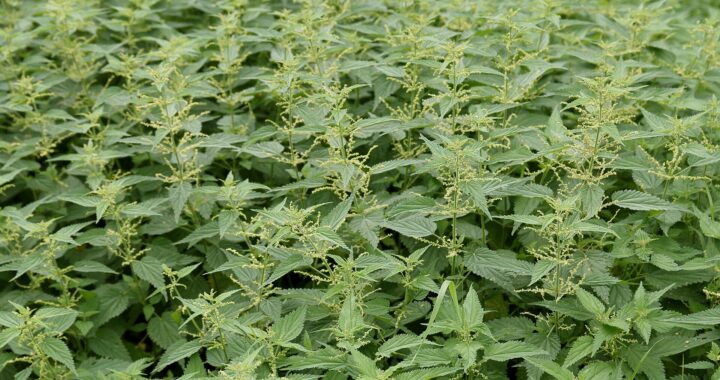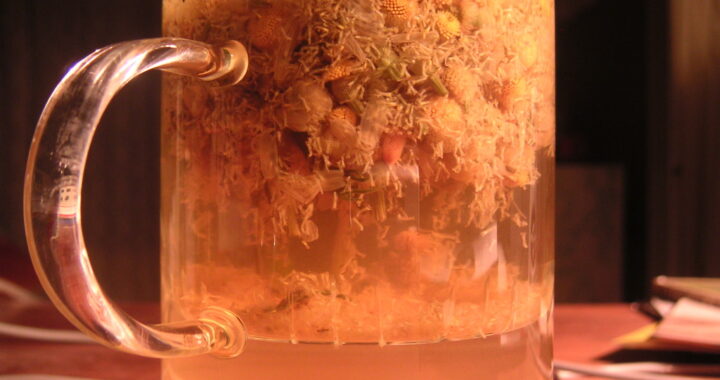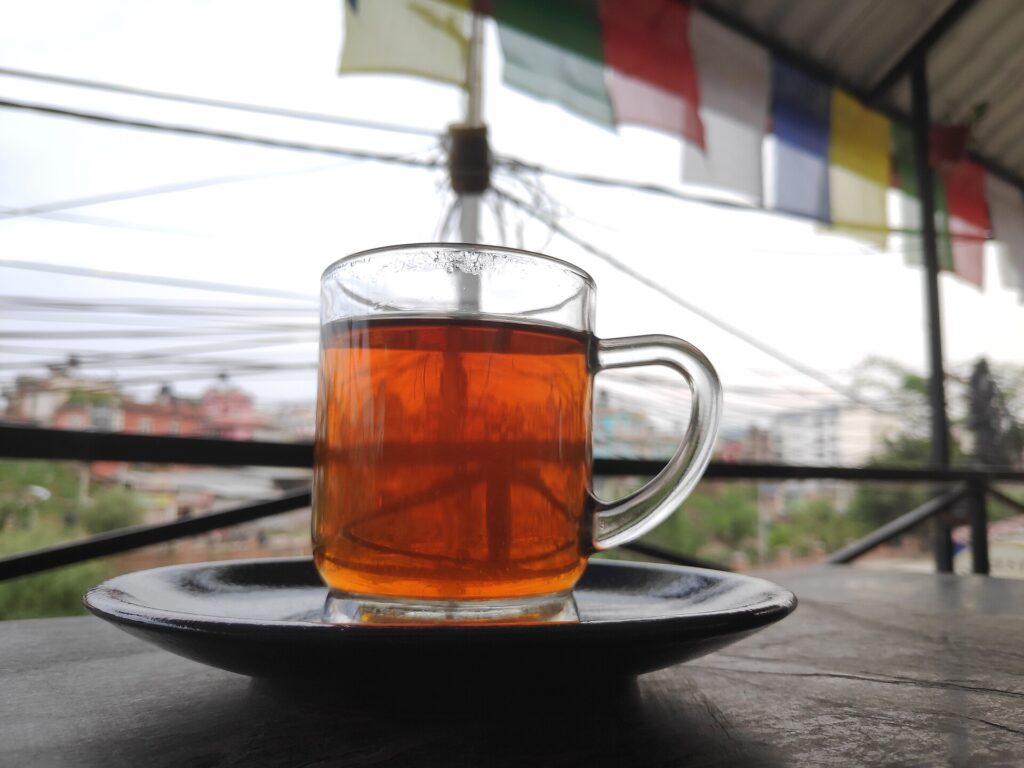
Yes, tea stains teeth, and black tea is one of the strongest everyday staining drinks, in lab tests often worse than coffee. The colour comes from polyphenols that cling to the thin protein film on your enamel, so it sits on the surface and can usually be polished or whitened away. A splash of milk, a rinse of water after your cup, twice-daily brushing with fluoride toothpaste and regular cleanings keep it in check. You do not need to give up tea, even while whitening your teeth.
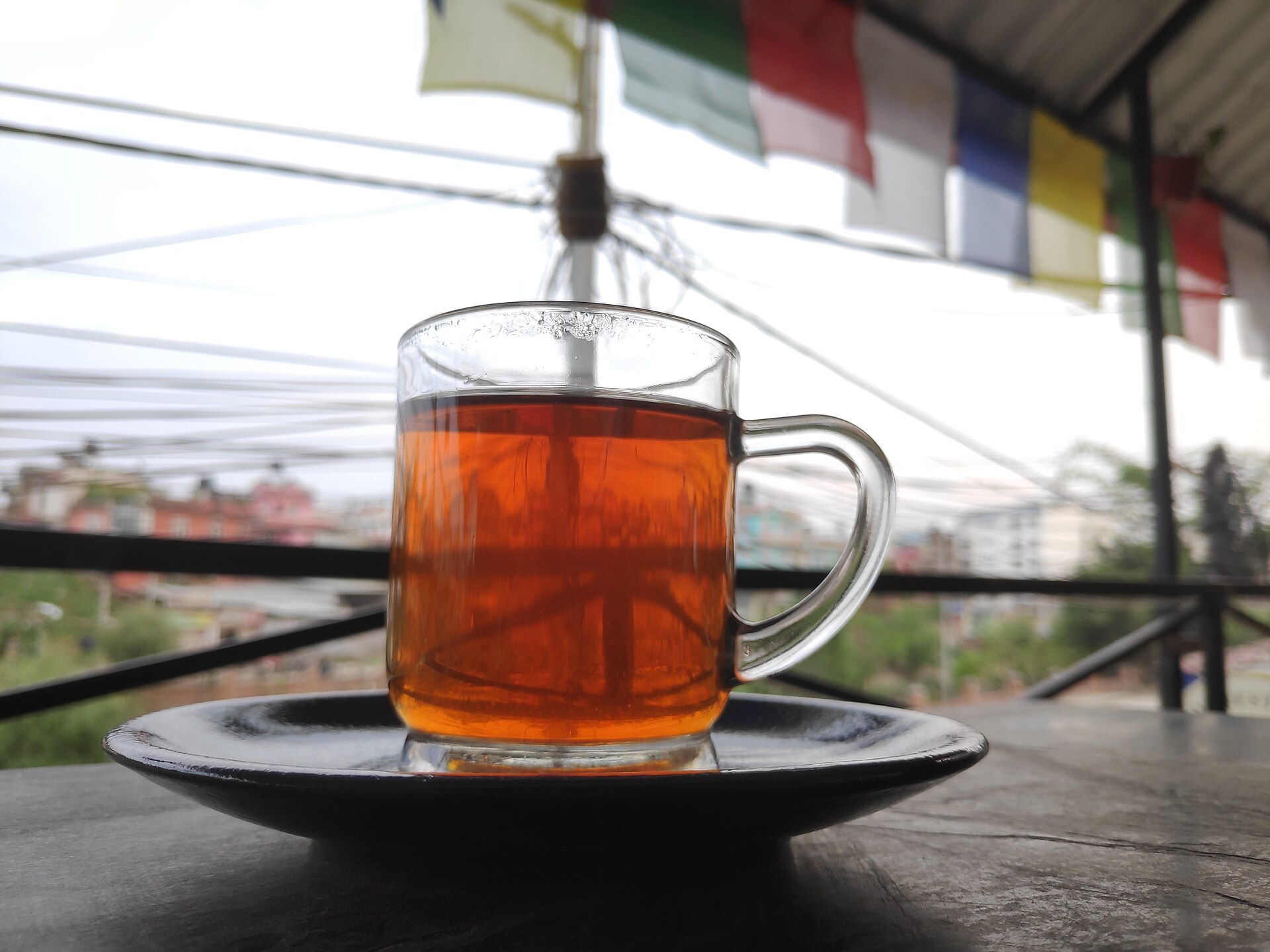
Why tea stains teeth
Within minutes of brushing, saliva coats your teeth in a thin, sticky layer of proteins called the pellicle. It protects the enamel, but it also grabs coloured molecules from food and drink. Tea is full of them. Black tea gets its dark colour from theaflavins and thearubigins, pigments that form when the leaf is oxidised, and from tannins, a family of polyphenols that bind readily to proteins. That protein-binding habit is what makes tea taste dry on the tongue, and it is also why tea sticks to the pellicle.
Dental researchers call this extrinsic staining, meaning it sits on the outside of the tooth rather than inside it. In a widely cited 1997 classification in the Journal of the American Dental Association, tea is the classic example of a direct stain: the coloured compound binds to the pellicle and the tooth takes on its colour. Over months, if it is not cleaned off, the film darkens and can harden into yellow-brown patches, most often near the gums and between the teeth, where brushing misses. A review in the British Dental Journal lists tea, coffee, red wine and smoking as the main dietary and lifestyle causes of this kind of stain.
That is good news in one way. Because the colour sits in the surface film, not deep in the enamel, a scale and polish usually lifts it. Intrinsic stains, from things like fluorosis, certain antibiotics in childhood or a tooth that has died, are inside the tooth and behave quite differently.
Does tea stain more than coffee?
In most lab tests, yes. In a 2022 study in the European Journal of Dentistry, slices of human enamel were cycled through artificial saliva, a chlorhexidine mouthwash (which makes stain build faster, so differences show up within days) and one of eleven drinks. Black tea and red wine produced the most staining. Coffee stained less, and microscope images showed why: black tea laid down a continuous, tough layer, while coffee left a patchier film. After brushing with toothpaste, the black tea stain was the most resistant of all.
An older test of different brands by Leard and Addy reached the same verdict: every coffee brand stained less than every tea brand. It also found big differences within each group, with the least staining brands about three times less potent than the worst. Strength and brand matter, not just the type of drink.
| Staining level | Drinks in the 2022 enamel study |
|---|---|
| High | Black tea, red wine |
| Medium | Tea with milk, coffee, coffee with milk, ginger and lemon infusion, lager, diet cola |
| Low (similar to water) | White wine, diet lemonade |
Two caveats. These are lab models, not people, and the chlorhexidine step exaggerates staining. Real-life results depend on how much you drink, how long you sip, your saliva and how well you brush. Still, the ranking matches what dentists and hygienists see in practice. If you have switched from coffee to tea to cut your caffeine, as in our matcha vs coffee comparison, do not expect whiter teeth as a bonus.
Green, white, herbal: which teas stain least?
Few studies compare tea types head to head, so this part rests partly on chemistry. Black tea is fully oxidised and full of dark pigments, which is why it tops the staining tables. Green tea and white tea are barely oxidised, brew pale yellow or green and contain far fewer of those pigments. They still contain tannin-like catechins that bind to the pellicle, so they can stain, but a light brew is likely to stain more slowly than a strong black one. Matcha is a special case: you drink the whole powdered leaf, so treat a strong matcha like a strong cup of tea.
Herbal teas vary. Pale infusions such as chamomile and peppermint are among the gentler choices. Rooibos brews red and contains polyphenols, though it has not been tested for staining. Deep red hibiscus and berry blends carry both colour and acid, and as the next section shows, acid is the bigger worry. In the 2022 study even a pale ginger and lemon infusion stained enamel noticeably more than water, so colour alone is not the whole story.
Fruit teas and enamel erosion
Staining and erosion are different problems. Stain is a coloured film on top of the enamel. Erosion is acid dissolving the enamel itself, which is permanent. As enamel thins, the yellower dentine underneath shows through, so worn teeth can look darker even with no stain at all.
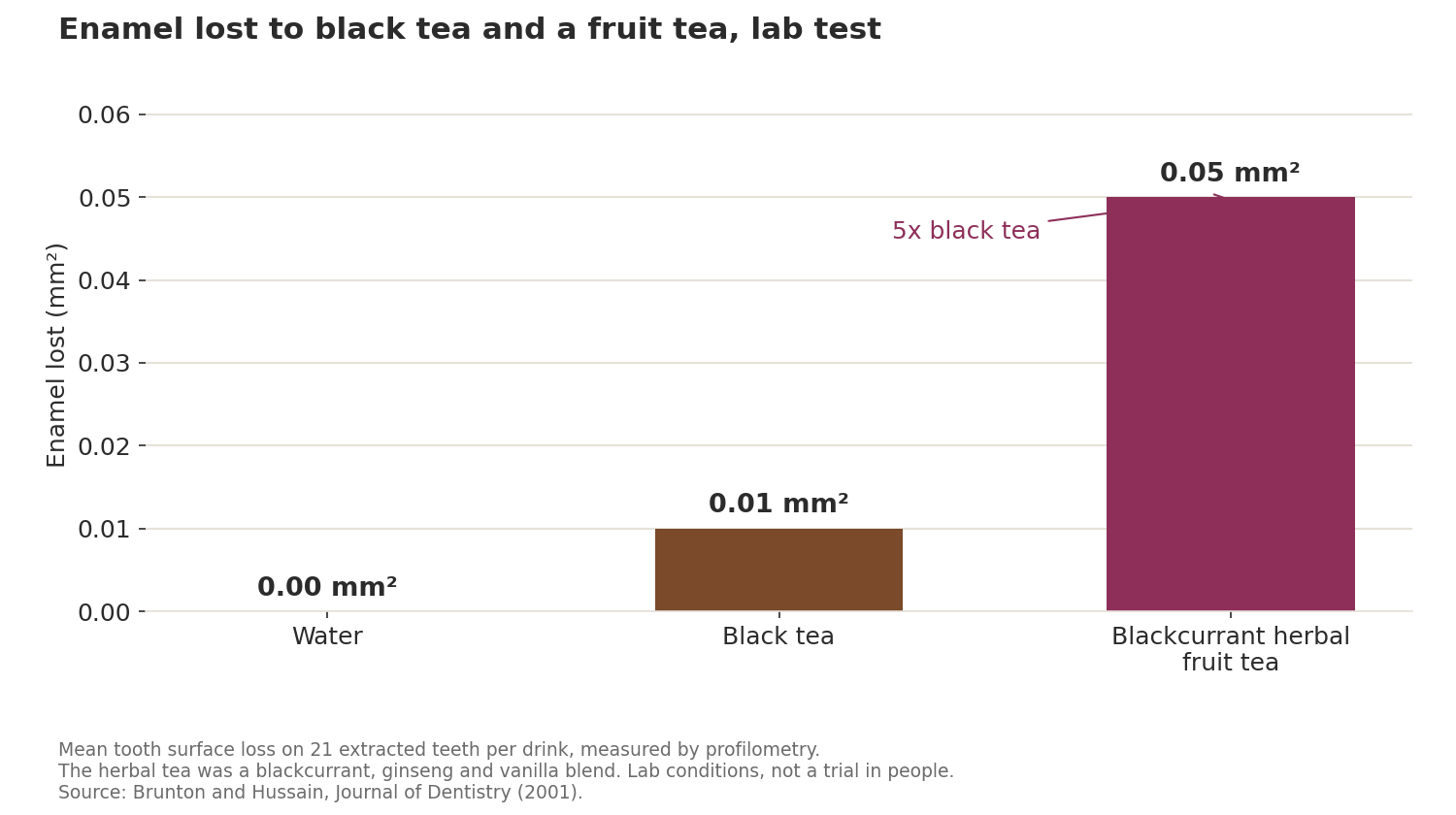
Ordinary tea is barely erosive. In a 20-week lab study in General Dentistry, black and green tea caused about as little erosion as water, far less than soda or orange juice. Fruit teas are another matter. When Brunton and Hussain soaked teeth in a blackcurrant, ginseng and vanilla herbal tea, it removed five times as much enamel as black tea did.
If you drink tart fruit or hibiscus teas through the day, have them with meals rather than sipping for hours, and do not brush straight after, because acid-softened enamel wears more easily. A drink of plain water afterwards helps return your mouth to neutral.
Does milk stop tea staining teeth?
It seems to help. A 2014 study in the International Journal of Dental Hygiene soaked extracted human teeth in tea for 24 hours, with and without milk. Milk significantly reduced staining, and the researchers traced the effect to casein, the main protein in cow’s milk. Casein binds the tea polyphenols in the cup, so fewer of them reach the tooth. The authors reported that casein prevented staining to a degree comparable to what whitening treatments achieve.
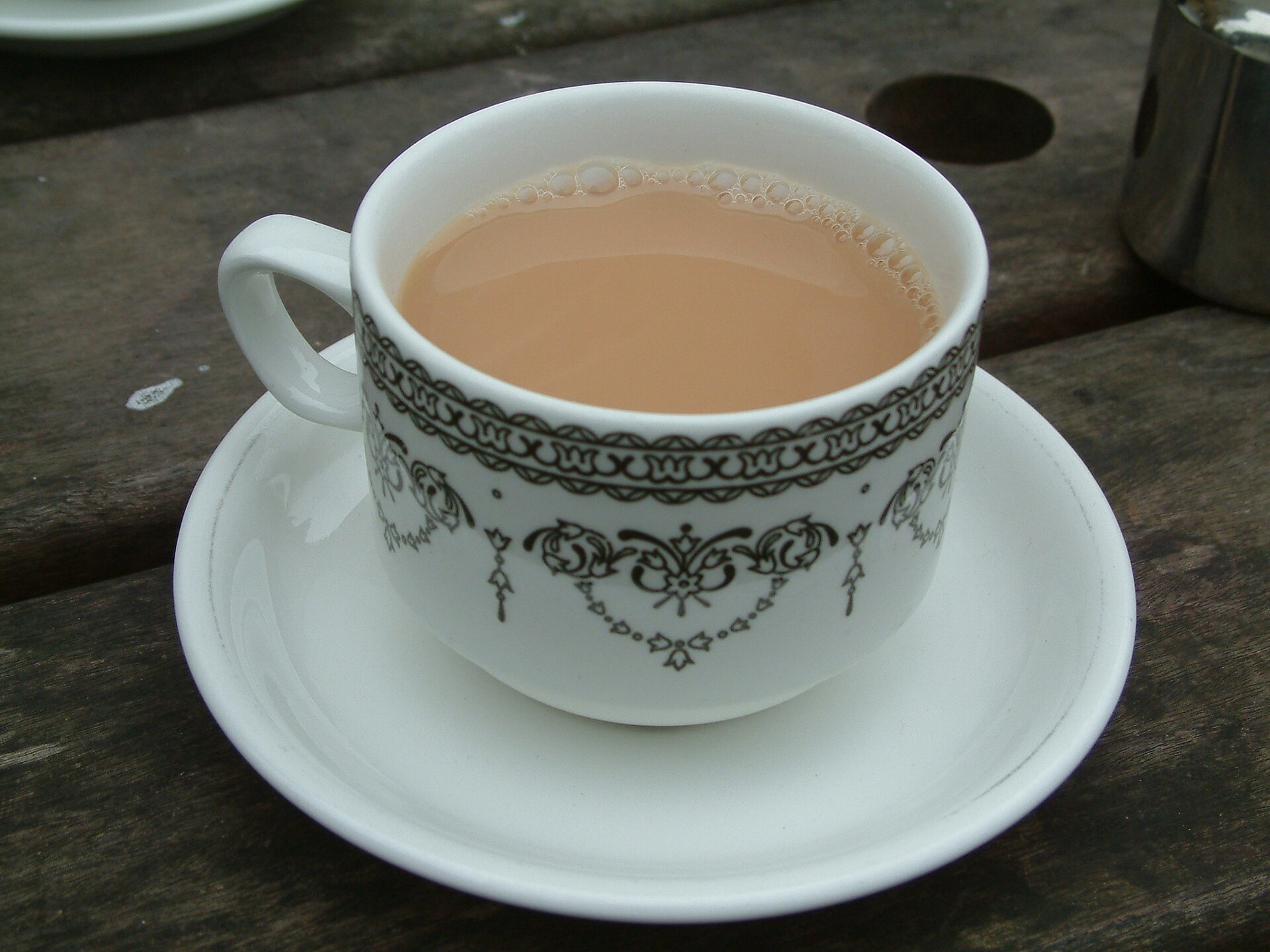
The 2022 enamel study saw the same pattern: tea with milk stained less than black tea and left a looser layer that brushing removed more easily. Plant milks have not been tested, and since most contain little or no casein, there is no reason to assume they work the same way. Whether you pour your milk in first or last makes no known difference to your teeth.
Tea, chlorhexidine and dark stains
If your dentist has prescribed a chlorhexidine mouthwash, such as Corsodyl, after gum treatment or surgery, tea becomes a much bigger staining risk. Chlorhexidine stays on the teeth and attracts tea pigments to the surface, giving brown or almost black stains within days. Addy and Moran showed this in a 1985 clinical study of chlorhexidine, iron and tea staining, and other trials found that cutting out tea and coffee during treatment greatly reduced it. The NHS lists stained teeth as a common side effect, affecting more than 1 in 100 users, and notes that it is not permanent. Regular brushing and a hygienist’s polish clear it, but if you need the mouthwash for a couple of weeks, switch to weak tea with milk or a pale herbal tea for that time.
Can I drink tea while whitening my teeth?
Many dentists hand out a “white diet” during whitening: no tea, coffee, red wine or curry. The evidence says it is not needed. A 2024 meta-analysis of clinical trials found that people who ate and drank normally ended up with the same colour change as those on a white diet, both during treatment and a month later. A 2025 network meta-analysis in the Journal of Dentistry reached the same conclusion for coffee, black tea, red wine, cola and grape juice, with moderate-quality evidence. An earlier pooled analysis of five studies found only a weak link in people who drank large amounts of coffee or tea.
Whitening does not last forever, though. The NHS says results may last around three years, and the Oral Health Foundation notes that tea, coffee and red wine bring the stain back more quickly. A lab study of bleached teeth soaked in tea also found that a remineralising paste (CPP-ACP) did not stop them restaining. Good daily habits matter more than any one product.
How to drink tea without staining your teeth
- Brush twice a day with fluoride toothpaste. The NHS advises two minutes, morning and last thing at night, with at least 1,350 ppm fluoride for adults. Spit, but do not rinse, so the fluoride stays on your teeth.
- Rinse or sip water after your tea. A mouthful of water swilled around clears loose pigment before it settles into the pellicle.
- Drink it, do not nurse it. A cup finished in fifteen minutes gives pigments less contact time than one sipped across a whole morning.
- Add milk if you enjoy it. Cow’s milk is the only addition with evidence behind it.
- Brew lighter. Shorter steeps release fewer tannins. Our brewing temperature and steep time guide has timings for each tea, and cold brew tea tends to taste smoother and less astringent.
- Use a straw for iced tea. It keeps the drink off your front teeth, which are the ones people see.
- Try a whitening toothpaste. A 2025 meta-analysis of 14 trials found whitening toothpastes reduced both the area and the intensity of surface stains compared with regular ones. Pastes with blue covarine give an instant optical brightening in a 2025 trial, though that effect is cosmetic and washes off.
- Book regular cleanings. A scale and polish removes built-up tea stain that brushing cannot, and lets your dentist check it is only stain.
The upside: tea and your teeth
Tea is not all bad news for your mouth. The tea plant takes up fluoride from the soil, and a 2015 analysis of UK tea bags found that a cup delivered roughly 0.7 to 1.7 mg of fluoride, depending on the type. Some brands contained enough to qualify for the EU health claim about maintaining tooth enamel. Typical intakes stayed within safe upper limits for most age groups, though the very heaviest drinkers among toddlers and over-65s could exceed them.
Green tea catechins have also been tested as mouthwashes and gels. A 2021 meta-analysis of 18 trials found encouraging effects on plaque and gum health, but not enough evidence to recommend green tea as a treatment for gum disease or tooth decay. Unsweetened tea is also kind to teeth in a way that sugary drinks are not: the sugar you stir in matters more for decay than the tea. If you drink several cups a day, our guide to how many cups of tea a day is safe covers caffeine and other limits, and our tea and iron absorption guide explains how those same tannins affect iron.
When to see a dentist
Tea stain is cosmetic, but discolouration can have other causes. See a dentist if one tooth darkens on its own, which can mean the nerve is damaged, or if you notice white or brown spots that feel rough, chalky or sensitive, which can be early decay. Grey or banded colouring that does not polish off may be intrinsic and needs a different treatment. And if you are tempted by whitening, the NHS advises using a dentist or another dental professional registered with the General Dental Council.
Quick answers
Does tea stain teeth more than coffee?
Usually, yes. In lab tests black tea stains enamel more than coffee and leaves a tougher layer that is harder to brush off. Brand and strength make a big difference.
Does green tea stain teeth?
It can, but less than black tea. Green tea has fewer dark pigments, though its catechins still bind to the tooth surface, so a light brew is the safer choice.
Does adding milk to tea stop staining?
It reduces it. Casein in cow’s milk binds tea polyphenols before they reach your teeth. Plant milks have not been tested.
Can tea stains be removed?
Yes. Tea stain is on the surface, so a professional scale and polish usually removes it, and whitening toothpastes and dentist whitening can lift what remains.
Should I stop drinking tea while whitening my teeth?
No. Two recent meta-analyses found that drinking tea and coffee during whitening did not reduce the final result. The stain may return sooner if you drink a lot, so keep up good brushing.
Do herbal teas stain teeth?
Pale ones like chamomile and peppermint stain very little. Dark, tart fruit and hibiscus teas can both stain and erode enamel, so drink them with meals and rinse with water afterwards. See our caffeine-free teas guide for gentler options.
Sources
- Nathoo SA. The chemistry and mechanisms of extrinsic and intrinsic discoloration. Journal of the American Dental Association, 1997.
- Watts A, Addy M. Tooth discolouration and staining: a review of the literature. British Dental Journal, 2001.
- Sarembe S et al. The impact on dental staining caused by beverages in combination with chlorhexidine digluconate. European Journal of Dentistry, 2022.
- Leard A, Addy M. The propensity of different brands of tea and coffee to cause staining associated with chlorhexidine. Journal of Clinical Periodontology, 1997.
- Addy M, Moran J. Extrinsic tooth discoloration by metals and chlorhexidine. II. Clinical staining produced by chlorhexidine, iron and tea. British Dental Journal, 1985.
- Lee RJ et al. Prevention of tea-induced extrinsic tooth stain. International Journal of Dental Hygiene, 2014.
- Brunton PA, Hussain A. The erosive effect of herbal tea on dental enamel. Journal of Dentistry, 2001.
- Bassiouny MA et al. Topographic and radiographic profile assessment of dental erosion. Part III: effect of green and black tea on human dentition. General Dentistry, 2008.
- Hardan L et al. Is a white diet necessary for tooth bleaching procedures? A systematic review and meta-analysis. Dentistry Journal, 2024.
- Münchow EA et al. White diet is not necessary during dental bleaching treatment: a systematic review and network meta-analysis of clinical studies. Journal of Dentistry, 2025.
- Matis BA et al. White diet: is it necessary during tooth whitening? Operative Dentistry, 2015.
- Alaghemand H et al. In-vitro effect of casein phosphopeptide amorphous calcium phosphate on enamel susceptibility to staining by tea during bleaching treatment. Journal of Dentistry (Tehran), 2015.
- Hajisadeghi S et al. Effect of whitening dentifrice on discoloration of tooth surface: an updated systematic review and meta-analysis. BMC Oral Health, 2025.
- Zhang L et al. Effect of blue covarine toothpastes on tooth colour: a randomised crossover study. International Dental Journal, 2025.
- Ruxton CHS, Bond TJ. Fluoride content of retail tea bags and estimates of daily fluoride consumption from typical tea drinking in UK adults and children. Nutrition Bulletin, 2015.
- Mazur M et al. Impact of green tea (Camellia sinensis) on periodontitis and caries. Systematic review and meta-analysis. Japanese Dental Science Review, 2021.
- NHS. Teeth whitening.
- NHS. How to keep your teeth clean.
- NHS. Chlorhexidine.
- Oral Health Foundation. Tooth whitening.
Last updated: 17 October 2026. Sources are linked in the text.
This article is general information, not medical advice. Talk to your doctor or pharmacist before using tea or herbs for a health condition, especially if you are pregnant, breastfeeding or take regular medication.