For most people, tea does not cause kidney stones. In large studies that followed more than 200,000 adults for years, tea drinkers were slightly less likely to get a first stone, probably because tea adds to the fluid that keeps urine dilute. Black tea does contain oxalate, the substance in the most common type of stone, but a normal cup has only a few milligrams. If you have had calcium oxalate stones, a few cups a day are usually fine, ideally with milk and not brewed for too long. Very large amounts are another matter.
Why tea comes up with kidney stones
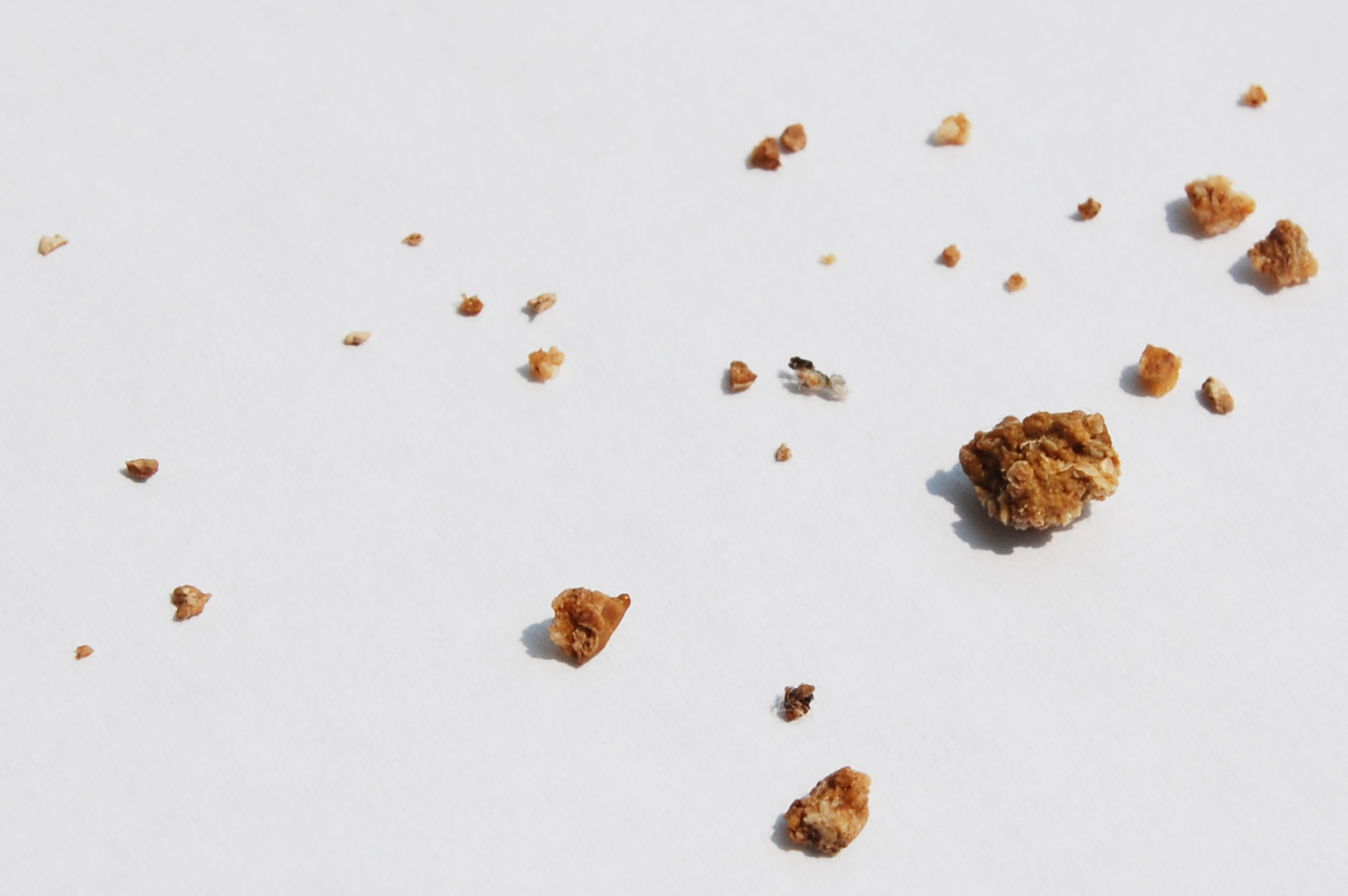
Most kidney stones are made of calcium oxalate. They form when calcium and oxalate meet in concentrated urine and crystallise. Oxalate comes partly from food and partly from the body’s own metabolism, and tea leaves are one of the dietary sources. That is why tea often appears on lists of foods to limit, and why many people who have passed a stone are told, or decide on their own, to give it up.
The National Kidney Foundation in the US, for example, lists tea alongside spinach, nuts, chocolate, beets and rhubarb as high-oxalate foods. But the same page puts drinking plenty of fluid at the top of its advice, and tea is fluid. The question is which effect wins: a little extra oxalate, or a lot of extra water. French researchers who study stones note that many patients stop drinking tea and end up producing less urine as a result, which is the opposite of what they need.
What the big studies show
The best evidence comes from three long-running American cohorts run from Harvard: the Health Professionals Follow-up Study of men and the two Nurses’ Health Studies of women. Participants reported what they drank, and researchers counted who went on to develop a stone.
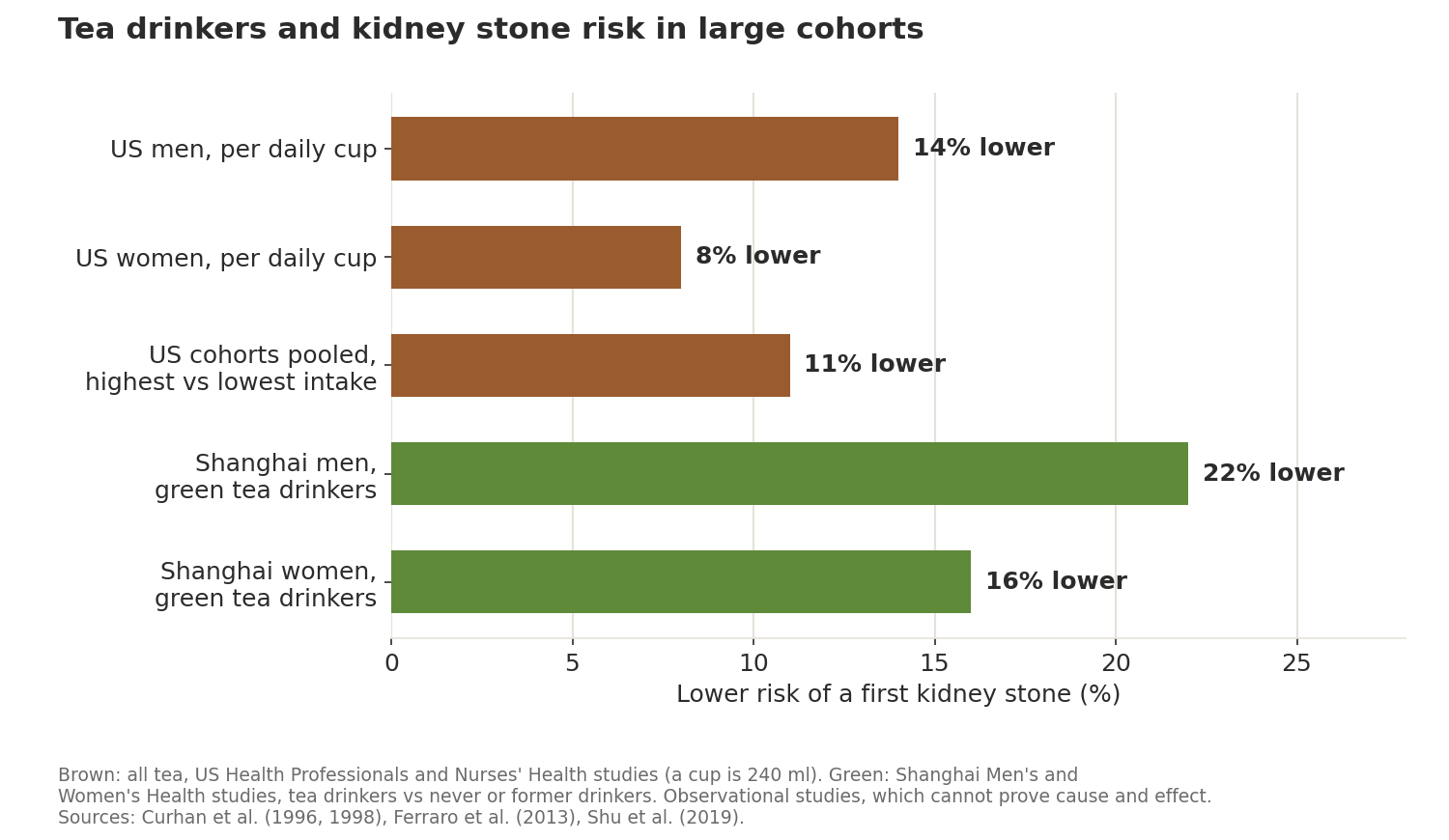
- Men. Among 45,289 men followed for six years, each daily 240 ml (8 oz) cup of tea was linked to a 14% lower risk of a stone, after adjusting for total fluid, diet and other factors.
- Women. Among 81,093 women followed for eight years, each daily cup of tea was linked to an 8% lower risk.
- All three cohorts. A 2013 analysis of 194,095 people found an 11% lower risk in the highest tea category compared with the lowest. Sugary sodas and punch went the other way, with 18% to 33% higher risk.
Caffeine itself looks protective rather than harmful. In a 2014 analysis of 217,883 people, those with the most caffeine had a 26% to 31% lower risk of stones. Among 6,033 participants who collected 24-hour urine, more caffeine went with more urine and slightly lower urine oxalate. Caffeine does make you lose a little more calcium in urine, but the extra volume seems to outweigh it. Our piece on whether tea dehydrates you explains why a cup of tea still counts as fluid.
The pattern holds outside the US. In two Shanghai cohorts of more than 127,000 middle-aged and older adults, almost all of whom drank green tea, tea drinkers had a 22% lower risk of a new stone in men and 16% lower in women, after allowing for oxalate from other foods. In men, the more dried leaf they used each month, the lower the risk. In UK Biobank, which followed 439,072 British adults for about six years, more total fluid meant fewer hospital admissions for stones, and tea followed the same pattern.
A 2021 systematic review in the World Journal of Urology pulled these and other studies together. It concluded that the evidence generally supports a protective role for tea, mainly green tea, while warning that the studies vary a great deal and measure tea in different ways.
The studies that disagree
Not every study is reassuring. An Iranian case-control study of 215 patients with calcium oxalate stones found that people drinking four or more glasses of tea a day had nearly three times the odds of stones compared with those drinking fewer than two. In a Chinese case-control study, green tea drinkers had much lower odds of being admitted to hospital with stones, but black tea showed no clear link either way. Case-control studies ask people about their habits after they get sick, so they are weaker than cohorts, but they are a reminder that heavy intake of strong black tea is the scenario to watch.
How much oxalate is in tea?
Black tea has the most oxalate, green and oolong much less, and herbal teas vary. The table brings together two laboratory studies that measured the soluble oxalate that ends up in the cup.
| Tea | Soluble oxalate per gram of leaf | Per 240 ml cup |
|---|---|---|
| Black tea, bags | 4.68 mg | 2.7 to 4.8 mg (steeped 1 to 5 minutes) |
| Black tea, loose | 5.11 mg | 4.3 to 6.2 mg (steeped 5 to 60 minutes) |
| Green and oolong | 0.23 to 1.15 mg | Not measured, but well below black tea |
| Herbal teas | Not detected to 3.00 mg | Varies by plant |
Put in context, the New Zealand team worked out that six cups of black tea a day would supply roughly 18 to 99 mg of soluble oxalate, depending on the tea. They described that as modest compared with common high-oxalate foods. Low-oxalate diets for stone formers are often set at 40 to 50 mg a day, a figure the doctors in the iced tea case below also cited, so several strong mugs can still make up a real share of the budget. A cup of tea is not like a bowl of spinach, but it is not zero either.
Two habits push the number up: longer steeping and more leaf. Both studies found oxalate climbed steadily with brewing time, and a Chinese study found the same for green tea as the amount of leaf rose. The broader differences between the two main types are covered in our guide to green tea vs black tea.
Milk makes a difference
Oxalate is only a problem if it is absorbed from the gut and passes into the urine. Calcium in the gut binds oxalate into a form the body cannot absorb, which is why kidney specialists advise eating calcium foods together with oxalate foods rather than cutting calcium out.
A small New Zealand trial tested this directly with tea. Ten volunteers drank six cups of black tea over a day, with and without milk, and collected their urine. Without milk, about 2% to 5% of the oxalate in the tea showed up in urine over the first six hours. With milk, very little oxalate from the tea was absorbed at all. The authors concluded that people who take milk in their tea absorb very little of its oxalate.
So if you have had calcium oxalate stones and like black tea, milk is a simple fix. It does not matter much whether it goes in first or last. Tea binds other minerals too: its polyphenols cut the iron absorbed from plant foods, as our guide to tea and iron absorption explains.
Green tea and stone formers
Green tea is the best studied type and the most reassuring. A French study of 273 stone formers with high urine calcium compared the 41 who drank green tea daily with those who did not. The green tea drinkers had no more oxalate, calcium or other risk factors in their urine. Among women, none of the green tea drinkers had stones made of calcium oxalate monohydrate, the hardest type, against 42% of the non-drinkers.
That fits animal studies in which green tea reduced stone formation in rats, though that has not been proven in people. The one note of caution comes from the Chinese trial in 12 healthy young men: a week of daily green tea raised 24-hour urine oxalate from about 0.24 to 0.32 mmol. The rise was small, from a low starting point, and urine volume matters at least as much.
The iced tea case
The story behind most scary headlines is a 2015 letter in the New England Journal of Medicine from doctors in Arkansas. They described a 56-year-old man with kidney failure whose biopsy showed the kidney packed with oxalate crystals. He had no other explanation for it, but he said he drank about 16 cups (8 oz each, close to 4 litres) of iced tea every day. The doctors estimated his oxalate intake at more than 1,500 mg a day and called the condition iced-tea nephropathy. He needed dialysis.
Their estimate assumed tea at the high end of published oxalate values, and lab measurements of brewed tea bags suggest far less per cup. Still, drinking four litres of strong black tea a day, without milk or food, is a long way from normal. One case does not overturn studies of hundreds of thousands of people, but it shows that very large amounts of anything high in oxalate can hurt the kidneys. Sweet iced tea adds another problem: the National Kidney Foundation advises avoiding sweetened iced tea along with sodas, in line with the cohort finding on sugary drinks. If you love cold brew or iced tea, keep it unsweetened and in sensible amounts.
How to drink tea if you get kidney stones
First, find out what your stone was made of. The advice below is aimed at calcium oxalate stones, the most common type. Uric acid, cystine and other stones need different diets, and people with very high urine oxalate or kidney disease may need stricter limits from their doctor.
- Drink enough in total. The NHS advises adults who are prone to stones to drink 2.5 to 3 litres a day. NIDDK calls fluid, mainly water, the most important thing you can do. Tea can be part of that, but water should do most of the work.
- Keep to a few cups. Two to four cups of ordinary black tea a day fits within what the cohort studies saw as safe or protective. Our guide on how many cups of tea a day covers caffeine limits too.
- Add milk or have tea with a meal. Calcium binds oxalate in the gut.
- Steep shorter and lighter. Oxalate rises with brewing time and the amount of leaf. A 2025 French study found that a quick rinse of the tea bag in hot water for 30 seconds, poured away before the main brew, cut oxalate by 38% to 51% without changing the taste. Our steeping guide gives normal brewing times.
- Lean on green, oolong or low-oxalate herbal teas. They contain much less oxalate than black tea. Rooibos was tested for a month in stone formers without any change in urine risk factors. See our list of caffeine-free teas for more options.
- Skip the sugar. Sweetened iced tea and soft drinks are linked to more stones, not fewer.
- Watch salt and the big oxalate foods. NIDDK advises keeping sodium under 2,300 mg a day. Spinach, rhubarb, nuts and wheat bran carry far more oxalate than tea.
If you are curious how much caffeine you are getting along the way, see our tea caffeine chart.
Quick answers
Does tea cause kidney stones?
Not in normal amounts. Large cohort studies link a few cups a day to a slightly lower risk of stones. Problems have been reported only with extreme intake, such as the man who drank about 4 litres of iced tea daily.
Which tea is best for kidney stones?
Green tea has the most reassuring evidence and less oxalate than black tea. Oolong and many herbal teas are also low in oxalate. Black tea is fine in moderation, ideally with milk.
Should I stop drinking black tea after a kidney stone?
Usually not. Most people with calcium oxalate stones can keep drinking a few cups of black tea a day, with milk and a shorter steep, as long as total fluid stays high. Ask your doctor if your urine oxalate is very high.
Is iced tea bad for your kidneys?
A glass or two is not. Very large daily amounts of strong black iced tea have caused oxalate kidney damage in rare cases, and sweetened iced tea is linked to more stones because of the sugar.
Does milk in tea reduce oxalate?
It reduces how much oxalate you absorb. In a small trial, very little of the oxalate in black tea was absorbed when it was drunk with milk.
Sources
- Curhan et al. Prospective study of beverage use and the risk of kidney stones. American Journal of Epidemiology, 1996.
- Curhan et al. Beverage use and risk for kidney stones in women. Annals of Internal Medicine, 1998.
- Ferraro et al. Soda and other beverages and the risk of kidney stones. Clinical Journal of the American Society of Nephrology, 2013.
- Ferraro et al. Caffeine intake and the risk of kidney stones. American Journal of Clinical Nutrition, 2014.
- Shu et al. Green tea intake and risk of incident kidney stones: prospective cohort studies in middle-aged and elderly Chinese individuals. International Journal of Urology, 2019.
- Littlejohns et al. Fluid intake and dietary factors and the risk of incident kidney stones in UK Biobank. European Urology Focus, 2020.
- Barghouthy et al. Tea and coffee consumption and the risk of urinary stones: a systematic review of the epidemiological data. World Journal of Urology, 2021.
- Haghighatdoost et al. The associations between tea and coffee drinking and risk of calcium-oxalate renal stones. Plant Foods for Human Nutrition, 2021.
- Liu et al. Association between tea intake and hospitalized nephrolithiasis in Chinese adults: a case-control study. Frontiers in Nutrition, 2022.
- Charrier, Savage and Vanhanen. Oxalate content and calcium binding capacity of tea and herbal teas. Asia Pacific Journal of Clinical Nutrition, 2002.
- Mahdavi et al. Effect of different brewing times on soluble oxalate content of loose-packed black teas and tea bags. Urolithiasis, 2013.
- Savage, Charrier and Vanhanen. Bioavailability of soluble oxalate from tea and the effect of consuming milk with the tea. European Journal of Clinical Nutrition, 2003.
- Chen et al. Does green tea consumption increase urinary oxalate excretion? Results of a prospective trial in healthy men. International Urology and Nephrology, 2018.
- Rode et al. Daily green tea infusions in hypercalciuric renal stone patients: no evidence for increased stone risk factors or oxalate-dependent stones. Nutrients, 2019.
- Clément et al. Efficient removal of oxalate from tea by pre-infusion. Néphrologie et Thérapeutique, 2025.
- Rodgers et al. Do teas rich in antioxidants reduce the physicochemical and peroxidative risk factors for calcium oxalate nephrolithiasis in humans? Urolithiasis, 2016.
- Itoh et al. Preventive effects of green tea on renal stone formation and the role of oxidative stress in nephrolithiasis. Journal of Urology, 2005.
- Syed, Mena-Gutierrez and Ghaffar. A case of iced-tea nephropathy. New England Journal of Medicine, 2015.
- National Kidney Foundation. Kidney stone diet plan and prevention.
- National Institute of Diabetes and Digestive and Kidney Diseases. Eating, diet and nutrition for kidney stones.
- NHS. Kidney stones: prevention.
Last updated: 17 October 2026. Sources are linked in the text.
This article is general information, not medical advice. Talk to your doctor or pharmacist before using tea or herbs for a health condition, especially if you are pregnant, breastfeeding or take regular medication.