Twinings Sourced with Care — At a Glance
| Field | Value | Source |
|---|---|---|
| Program launch year | 2016 (announced publicly; evolved through subsequent refreshes) | Twinings official Sourced with Care page |
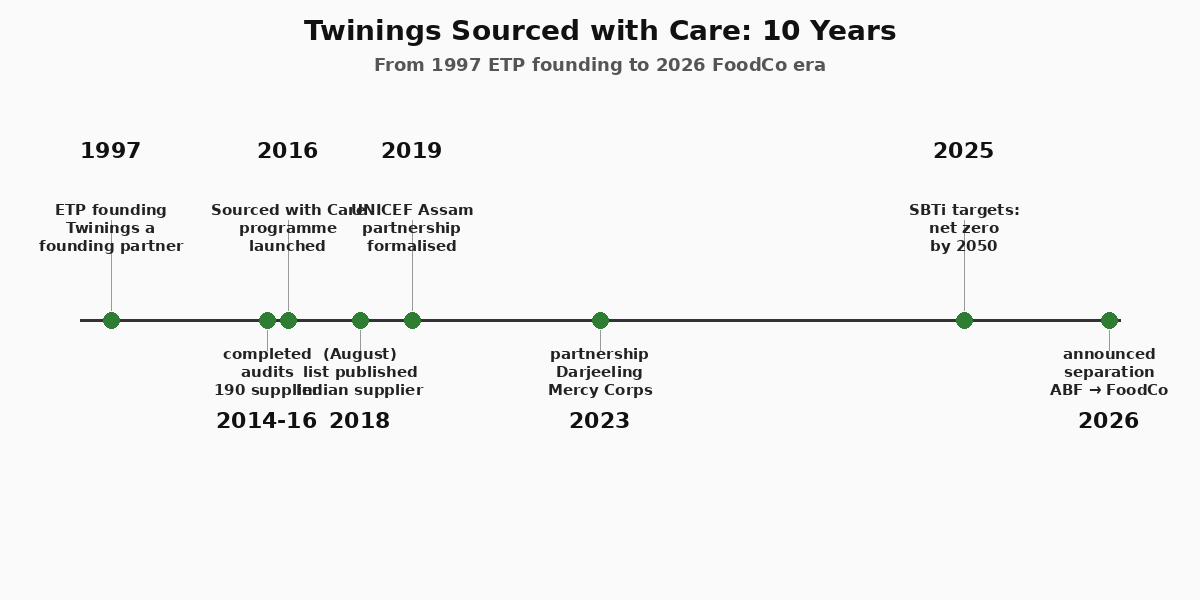
| Founding partner of ETP | 1997 (the Ethical Tea Partnership, founded together with other major UK tea brands) | ETP history page |
| Supplier audit cadence | Unannounced or semi-announced; third-party auditors | World Tea News feature on Twinings |
| Audits completed Oct 2014 – Sep 2016 | 190 third-party supplier audits | World Tea News feature |
| Supplier list disclosed | Full list of Indian tea estates (Assam, Darjeeling, southern India), published August 2018 | Reuters / The Grocer / Twinings Sourced with Care |
| Code of Conduct | All Twinings suppliers must sign a code of conduct that forbids forced labour | World Tea News feature |
| On-the-ground partnerships | UNICEF in Assam; Mercy Corps in Darjeeling | World Tea News feature |
| Number of sourcing countries | 7+ (China, Kenya, India, Malawi, Indonesia, Argentina, Sri Lanka) | World Tea News feature |
| Carbon target | Science-based targets to reduce full value chain emissions by 2030; net zero by 2050 | Twinings official Sourced with Care page |
| Reporting cadence | Annual Impact Report published on sourcedwithcare.com | Twinings corporate |
| Owner of Twinings | Associated British Foods (ABF); going into FoodCo post the 2026 Primark split | ABF 2025 Annual Report |
Twinings publishes more supply-chain disclosure than any other major UK tea brand. The Sourced with Care program, launched in 2016 and refreshed multiple times since, includes a published list of every Indian tea estate that supplies the brand, third-party supplier audit results, an annual impact report, partnerships with UNICEF in Assam and Mercy Corps in Darjeeling, and explicit science-based emissions targets for the full value chain. By the standards of large UK tea companies, Twinings is the most transparent operator in the segment.
The Sourced with Care program is also the most consequential ethical-sourcing commitment in UK tea retail — and it sits inside a corporate structure (ABF → Twinings → Sourced with Care) that has changed substantially since the program was launched. The 2026 ABF split, which separates Twinings into a new FoodCo entity, creates both continuity (the program continues under the same operating team) and uncertainty (the program’s future funding depends on FoodCo’s capital allocation priorities rather than ABF’s).
The article below walks through the program’s founding context, the 1997 founding of the Ethical Tea Partnership, the 2016 launch of Sourced with Care, the 2018 supplier-list disclosure, the audit infrastructure, the on-the-ground partnerships, the climate commitments, and how the program compares to the limited disclosure available from PG Tips, Tetley, and Yorkshire Tea.
The 1997 Ethical Tea Partnership Founding
Twinings was a founding partner of the Ethical Tea Partnership (ETP) in 1997. The ETP was created by major UK tea-packing companies — Twinings, Tetley, Yorkshire Tea, PG Tips (then Unilever), and others . To coordinate supplier auditing and to address working conditions on tea estates. The original name was the Tea Sourcing Partnership; it became the Ethical Tea Partnership as membership expanded.
The ETP’s original focus was on supplier audits: introducing independent social and environmental audits on tea estates, with the goal of raising the floor of labour and environmental standards across the major tea-producing regions. The audits covered issues such as worker pay, working hours, child labour, sanitation, and chemical use. The ETP did not initially issue certifications or run on-the-ground programmes; it was a coalition that conducted and coordinated supplier audits on behalf of its members.
The ETP’s audit-based approach evolved through the 2000s and 2010s. As Fairtrade, Rainforest Alliance, and other certification programmes grew in prominence — both with consumers and within the tea industry itself . The ETP recognised that audits alone were insufficient to address the underlying issues. In 2019, the ETP stopped conducting supplier audits and shifted to running projects in producing countries: community-level programmes on sanitation, education, gender, and economic diversification. The audits continued to be performed by third-party certification bodies rather than by the ETP itself.
Twinings has remained an ETP member through the transition. The current ETP membership includes Twinings and most of the major UK tea packers, with membership open to any company that packs, sources, or retails tea globally (excluding companies in UK-sanctioned jurisdictions).
Sourced with Care, Launch 2016
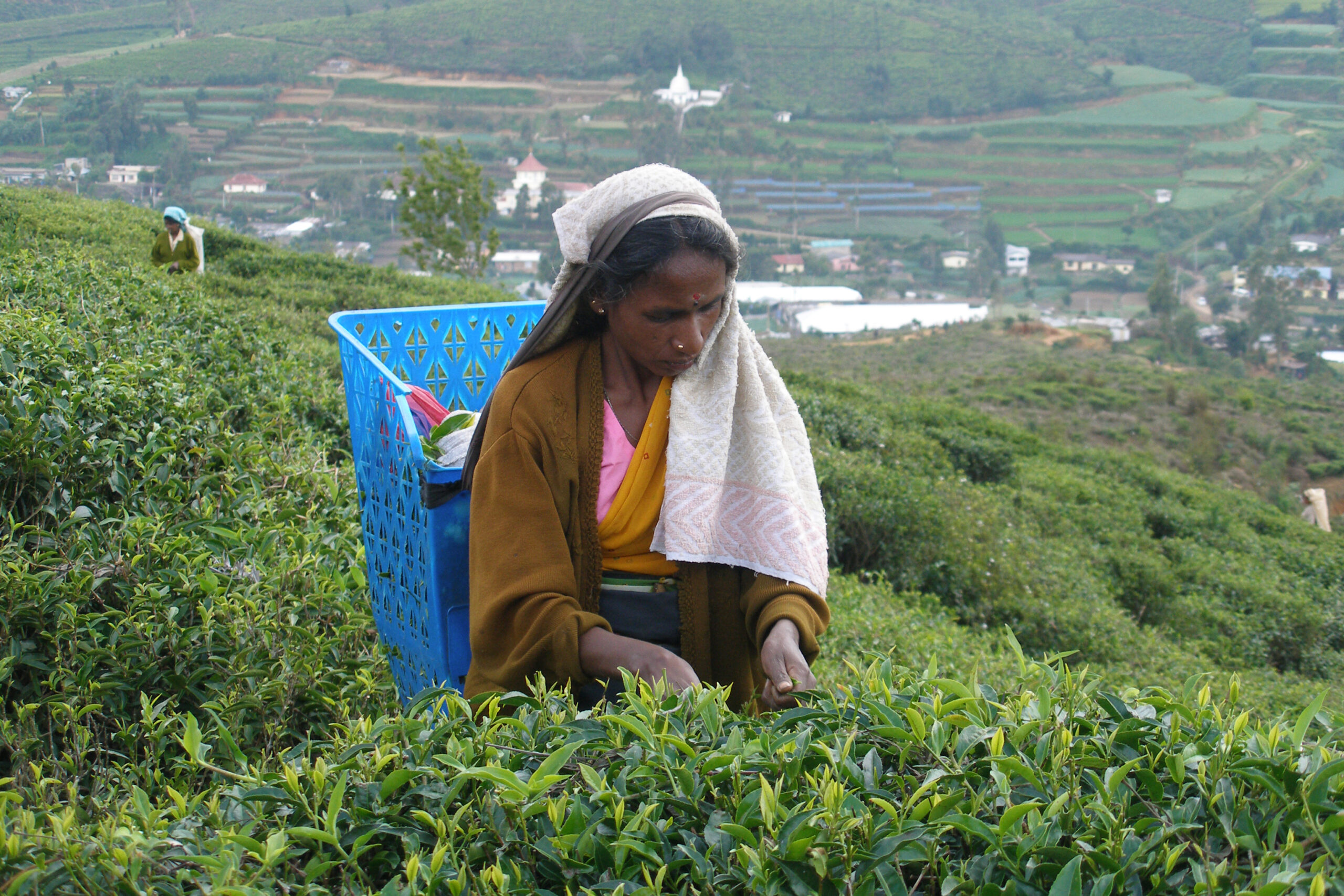
Twinings launched the Sourced with Care programme publicly in 2016. The launch was the company’s most visible ethical-sourcing commitment to date — a public-facing programme with a dedicated website (sourcedwithcare.com), annual impact reports, and explicit commitments to suppliers and workers.
The programme’s stated aim, per the official Sourced with Care page, is “to play a leading role in helping to develop a progressive and thriving tea and herbs industry.” The programme sits inside Twinings’ broader responsible sourcing framework, which includes a Code of Conduct that all suppliers must sign (the Code explicitly forbids forced labour), a Human Rights Policy, and a layered approach to monitoring supplier compliance.
The 2016 launch positioned Twinings explicitly in the “responsible sourcing” lane of UK tea retail, in contrast to the discount-driven pricing strategy of supermarket own-label brands and the more limited disclosure of competitor brands like PG Tips and Tetley. Twinings’ decision to publish the Sourced with Care programme coincided with growing consumer interest in supply-chain transparency and the increased salience of labour-rights issues in the UK tea industry (the Traidcraft Exchange campaign on slave labour in Indian tea estates had been running since the early 2010s).
The programme has been refreshed multiple times since 2016. The current version, per the official site, focuses on three pillars: communities (programmes on sanitation, education, gender, and livelihoods), environment (science-based emissions targets and packaging reduction), and people (supplier compliance and human rights). The refresh was undertaken with sustainability consultancy Blurred, per the consultancy’s published case study.

The 2018 Indian Supplier List Disclosure
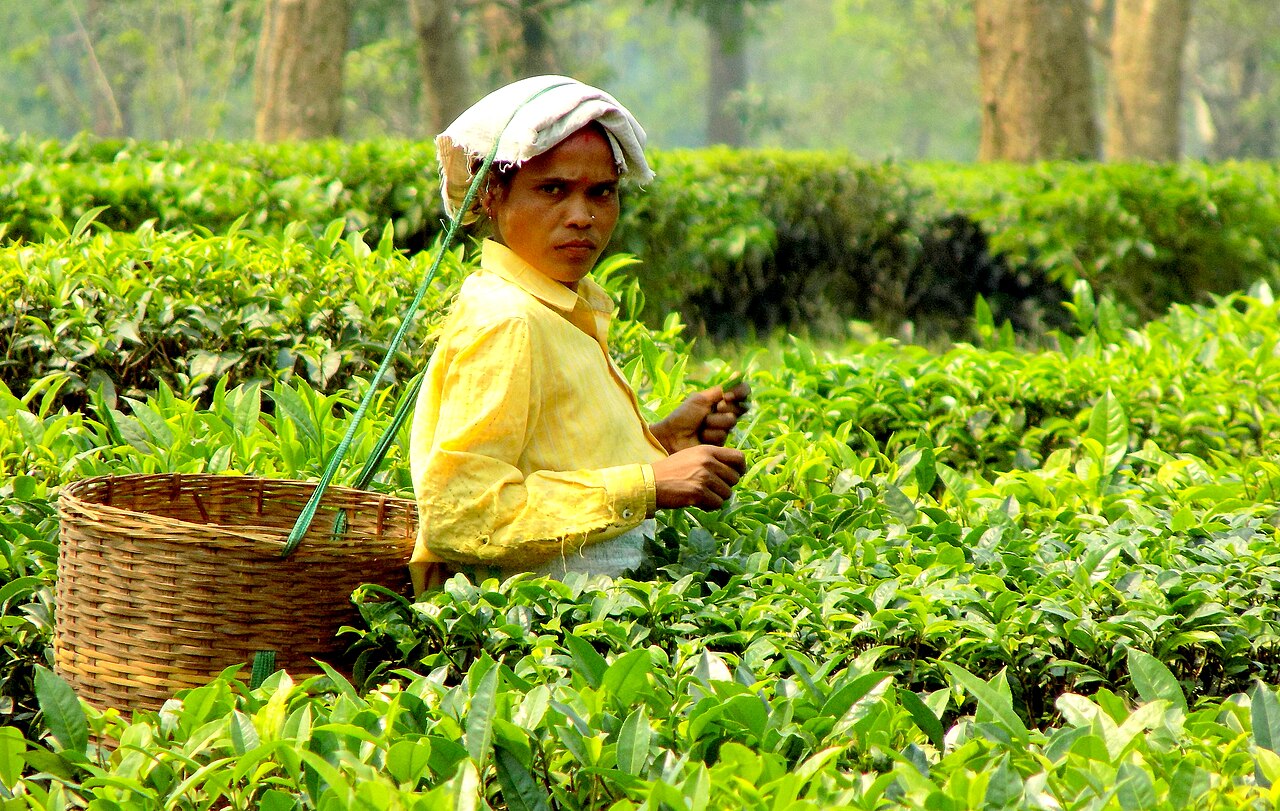
In August 2018, Twinings published the full list of its Indian tea estates — every plantation in Assam, Darjeeling, and southern India that supplied Twinings with tea. The disclosure was the second major UK tea company to do so, after Bettys and Taylors (the owner of Yorkshire Tea) in June 2018. The disclosures were hailed as a “major victory for campaigners” by Traidcraft Exchange, which had been running a campaign calling on all UK tea brands to disclose their suppliers.
The disclosure matters because Indian tea estates have been the centre of recurring labour-rights controversies: low pay (often below the official minimum wage), poor housing conditions, child labour, restrictions on trade union activity, and exposure to pesticides. Traidcraft Exchange and other labour-rights organisations argued that supplier disclosure is a precondition for accountability — without knowing which estates supply which brands, monitoring organisations cannot verify working conditions and consumer pressure cannot reach the right supply-chain nodes.
The Twinings disclosure included a “sourcing map” added to sourcedwithcare.com, naming every Indian tea estate that supplied the brand at the time. The map included estates in the major Indian tea regions — Assam (the largest by volume), Darjeeling (the premium mountain-grown tea), and southern India (Nilgiri and other regions). Subsequent updates to the disclosure have included supplier updates as the supply chain has changed year-over-year.
The disclosure model has not been universally adopted. PG Tips (Unilever at the time, then Lipton Teas and Infusions from 2022) has not published a full estate-level supplier list. Tetley (Tata Consumer Products) has not either. Yorkshire Tea’s 2018 disclosure was a watershed moment, and Twinings’ follow-up disclosure in the same year created a public expectation that other major UK brands would do the same. As of 2026, the two-company disclosure pattern (Yorkshire Tea and Twinings) has held, with no third major UK tea brand having published a comparable list.
Audit Infrastructure and Results
Twinings operates a layered supplier audit programme. The audits are conducted by third-party auditors (rather than by Twinings employees), on an unannounced or semi-announced basis, and include worker interviews as a standard component. The audits are designed to verify compliance with Twinings’ Code of Conduct, which explicitly forbids forced labour, and to identify any working-condition issues that require remediation.
Between October 2014 and September 2016, Twinings completed 190 third-party supplier audits. The audit volume reflects the breadth of Twinings’ supplier base — over 7 sourcing countries (China, Kenya, India, Malawi, Indonesia, Argentina, Sri Lanka) and a multi-tier supplier structure that includes both direct estate suppliers and aggregators.
The audit cadence (unannounced or semi-announced) is consistent with the Ethical Trading Initiative (ETI) base code, which is the labour standards framework Twinings and other UK ethical-sourcing programmes draw on. The ETI base code is based on International Labour Organization conventions and covers forced labour, child labour, discrimination, freedom of association, wages, working hours, and health and safety.
The audit results are reported in aggregate in the annual Sourced with Care Impact Report. Twinings has not historically published the per-supplier audit results (i.e., which suppliers passed, which had remediation requirements, which were suspended). The aggregate reporting is consistent with industry norms but stops short of the per-supplier transparency that labour-rights campaigners have called for.

The On-the-Ground Partnerships
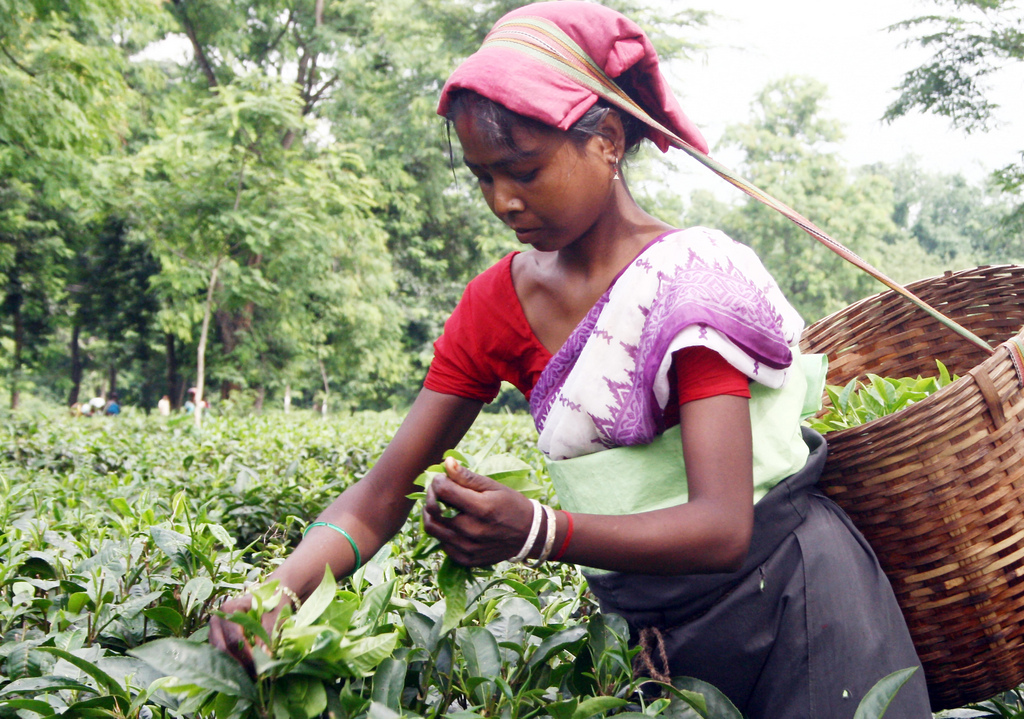
Sourced with Care runs direct community-level programmes in two Indian sourcing regions: Assam (with UNICEF) and Darjeeling (with Mercy Corps). The programmes are the most concrete operational expression of the Sourced with Care commitment, and they are the elements most visible to the workers and communities the programme is intended to support.
The Assam partnership with UNICEF focuses on adolescent girls living on tea estates. The programme forms Adolescent Girls Groups on tea estates that address issues of safety, nutrition, and education. The groups are a response to the specific vulnerability of adolescent girls on tea estates , a population that has historically been at risk of school dropout, early marriage, and limited economic opportunity. The Assam partnership is run in collaboration with the Assam Branch of the Indian Tea Association (the industry body that represents tea estates in the state).
The Darjeeling partnership with Mercy Corps focuses on economic diversification and water-sanitation. Tea estate workers in Darjeeling face extreme seasonal income volatility , the plucking season provides 7-9 months of employment, with the remainder of the year characterised by underemployment or out-migration. The Mercy Corps partnership provides alternative forms of employment for tea estate workers during the low season, which reduces out-migration and stabilises household income. The partnership also addresses water sanitation and hygiene awareness, which are chronic issues on remote mountain estates.
The on-the-ground partnerships are funded out of Twinings’ Sourced with Care budget, which is not separately disclosed. The partnerships are a small fraction of Twinings’ overall tea procurement budget but are the most labour-intensive elements of the ethical-sourcing commitment.
Climate and Environment
Sourced with Care includes explicit climate commitments. Twinings has set science-based targets to reduce emissions across the full value chain by 2030 and to reach net zero by 2050. The targets are consistent with the Paris Agreement’s 1.5°C pathway and are verified by the Science Based Targets initiative (SBTi).
The bulk of Twinings’ emissions footprint is in the supply chain rather than in its own manufacturing and packaging. Tea cultivation, processing, and transport together account for the majority of the company’s full-value-chain emissions. The Sourced with Care climate programme therefore focuses on supporting suppliers, farmers, and partners with initiatives to reduce on-farm emissions, enhance transport efficiency, minimise packaging, and reduce material weight.
The packaging commitments include reductions in plastic and reductions in overall material weight. Twinings has committed to recyclable packaging across its core product range, with progress reports in each annual Sourced with Care Impact Report.
The climate commitments are credible at the level of intent and target-setting but are difficult to verify independently. SBTi validation confirms the targets are science-based; the company’s actual progress against the targets requires annual emissions reporting and third-party verification. Twinings has published annual emissions data in the Sourced with Care Impact Report since 2018, but the data has not been independently audited at the level of granularity that financial-statement audits provide.
How Twinings Compares
Twinings’ Sourced with Care programme is the most thorough ethical-sourcing commitment among the top UK tea brands. The comparison to PG Tips, Tetley, and Yorkshire Tea:
PG Tips (now Lipton Teas and Infusions, the 2022 CVC acquisition of Unilever’s tea business) has historically published limited supply-chain disclosure. The Lipton Teas and Infusions corporate sustainability reports cover the broader portfolio but do not include estate-level supplier lists for PG Tips specifically. The CVC ownership creates private-equity reporting norms that may reduce the public disclosure available.
Tetley (Tata Consumer Products) operates the Tata Tea Sustainable Sourcing Programme. The programme covers Indian and Kenyan sourcing and includes supplier audits and worker welfare programmes, but has not published estate-level supplier lists comparable to Twinings’ 2018 disclosure. Tata Consumer Products publishes consolidated sustainability data at the parent-company level but does not break out Tetley-specific data.
Yorkshire Tea (Bettys and Taylors of Harrogate, family-owned) was the first UK tea company to publish a full estate-level supplier list, in June 2018. The disclosure was a watershed moment for UK tea transparency. Yorkshire Tea does not publish a Twinings-comparable annual impact report with audit results, climate targets, and partnership details; the disclosure is concentrated in the supplier-list publication rather than a multi-pillar sustainability programme.
Within UK tea retail, the Twinings programme is the standard against which other programmes are measured. The 2018 supplier-list disclosure, the 190 audits in the 2014-2016 period, the UNICEF and Mercy Corps partnerships, and the science-based climate targets are the most concrete commitments any major UK tea brand has made.
The 2026 ABF Split
In July 2026, ABF announced it would separate its food businesses (Twinings, Ovaltine, Patak’s, Blue Dragon, ingredients, sugar, agriculture) from Primark, the discount clothing chain. The food business will continue to operate as Associated British Foods; Primark will list separately. Twinings becomes part of “FoodCo” , the new entity housing the food businesses.
For the Sourced with Care programme specifically, the split is structurally neutral: the programme continues under the same operating team with the same supplier base and the same partnership commitments. What changes is the corporate parent, and with it the corporate governance context for the programme’s funding and reporting.
ABF has historically supported Twinings’ ethical-sourcing programme as part of its broader ESG commitments. The group’s annual ESG disclosure includes Twinings-specific data on supplier audits, climate targets, and partnership outcomes. FoodCo’s ESG framework, which is being developed for the 2026 listing, will need to continue the Twinings-specific reporting.
The Weston family, which controls both the new FoodCo and the new Primark entity through Wittington Investments, has historically supported long-term capital allocation over short-term financial optimisation. The Sourced with Care programme’s continued funding depends on FoodCo’s board and management continuing to support ethical-sourcing investment as part of the brand’s value proposition.
Fact-vs-Claim Verdict
| Claim | Verdict | Source / note |
|---|---|---|
| Sourced with Care launched in 2016 | Verifiable | Twinings official site |
| Twinings was a founding partner of the ETP in 1997 | Verifiable | ETP history page; Twinings corporate |
| Twinings completed 190 supplier audits in 2014-2016 | Verifiable | World Tea News feature on Twinings |
| Twinings published full Indian supplier list in August 2018 | Verifiable | Reuters / The Grocer coverage |
| Twinings partners with UNICEF in Assam and Mercy Corps in Darjeeling | Verifiable | World Tea News feature |
| Twinings has set science-based targets to reach net zero by 2050 | Verifiable | Twinings official Sourced with Care page |
| Twinings sources from 7+ countries | Verifiable | World Tea News feature (China, Kenya, India, Malawi, Indonesia, Argentina, Sri Lanka) |
| Twinings’ Code of Conduct explicitly forbids forced labour | Verifiable | World Tea News feature / Twinings Responsible Sourcing Policies |
| Sourced with Care is the most thorough UK tea ethical-sourcing programme | Industry-press characterisation | Based on the 2018 disclosure, audit volume, partnership depth, and climate target-setting relative to PG Tips, Tetley, Yorkshire Tea |
| ETP stopped conducting supplier audits in 2019 | Verifiable | ETP history page |
| Yorkshire Tea was first UK tea brand to publish supplier list (June 2018) | Verifiable | Reuters / The Grocer |
| SBTi-verified emissions targets | Verifiable | Twinings official site, consistent with SBTi public database |
| FoodCo will continue Twinings’ Sourced with Care post-2026 split | Forward-looking statement | Not yet confirmed in FoodCo’s IPO documentation; expected based on ABF’s prior commitments |
Frequently Asked Questions
The Sourced with Care Programme, in Brief
Twinings’ Sourced with Care programme is the company’s ethical-sourcing commitment, launched publicly in 2016. The programme covers three pillars: communities (programmes on sanitation, education, gender, and livelihoods in sourcing regions), environment (science-based emissions targets and packaging reduction), and people (supplier compliance and human rights). The programme includes a published list of Twinings’ Indian tea estates, third-party supplier audits, partnerships with UNICEF in Assam and Mercy Corps in Darjeeling, and annual Impact Reports published on sourcedwithcare.com.
The Supplier List Disclosure
Twinings published the full list of its Indian tea estates (every plantation in Assam, Darjeeling, and southern India) in August 2018. The disclosure was the second major UK tea company to do so, after Bettys and Taylors (Yorkshire Tea’s owner) in June 2018. The disclosure was added to sourcedwithcare.com as a “sourcing map” and has been updated as the supply chain has changed. PG Tips and Tetley have not published comparable full estate-level supplier lists as of 2026.
The Audit Cadence
Twinings operates a layered third-party audit programme, with audits conducted on an unannounced or semi-announced basis. The audits verify compliance with the company’s Code of Conduct (which explicitly forbids forced labour) and identify remediation requirements. Between October 2014 and September 2016, the company completed 190 audits. Audit results are reported in aggregate in the annual Impact Report; per-supplier results are not published.
The Assam and Darjeeling Partnerships
In Assam, Twinings partners with UNICEF and the Assam Branch of the Indian Tea Association on programmes for adolescent girls living on tea estates. The Adolescent Girls Groups address safety, nutrition, and education. In Darjeeling, Twinings partners with Mercy Corps on economic diversification (alternative employment during the tea-estate low season), water sanitation, and hygiene awareness. The programmes are funded out of Twinings’ Sourced with Care budget.
Climate Targets
Twinings has set science-based targets to reduce emissions across the full value chain by 2030 and reach net zero by 2050. The targets are verified by the Science Based Targets initiative (SBTi). The bulk of Twinings’ emissions footprint is in the supply chain (tea cultivation, processing, transport), so the climate programme focuses on supplier support, transport efficiency, packaging reduction, and material weight reduction. Annual emissions data is published in the Impact Report.
Twinings vs the Competition
Twinings’ Sourced with Care is the most thorough ethical-sourcing programme among the top UK tea brands. PG Tips (Lipton Teas and Infusions, CVC Capital) publishes limited supply-chain disclosure. Tetley (Tata Consumer Products) operates a sustainability programme through its parent company but has not published estate-level supplier lists. Yorkshire Tea (Bettys and Taylors) was the first UK tea brand to publish a full estate-level supplier list in June 2018, ahead of Twinings’ August 2018 disclosure. The Twinings programme is the standard against which other UK tea ethical-sourcing programmes are measured.
Sources
- Twinings , Sourced with Care official page , Primary source for the 2016 launch, the three-pillar programme structure (communities, environment, people), the science-based targets, the sourcing map, and the supplier commitment framework.
- Sourced with Care microsite , Primary source for the annual Impact Report, the sourcing map (with Indian estate list), and the on-the-ground programme details.
- Twinings , Sourced with Care About page , Primary source for the Code of Conduct, Human Rights Policy, Responsible Sourcing Policies, and the layered monitoring approach.
- Ethical Tea Partnership , History , Primary source for the ETP’s 1997 founding, the membership evolution, and the 2019 shift from audits to projects in producing countries.
- World Tea News — 7 Ways Twinings Tea Drives Positive Change , Secondary source for the 190 supplier audits Oct 2014-Sep 2016 figure, the UNICEF Assam partnership, the Mercy Corps Darjeeling partnership, the seven sourcing countries, and the Code of Conduct forced-labour provision.
- Reuters , Twinings reveals suppliers amid drive for slave-free Indian tea , Primary source for the August 2018 supplier-list disclosure, the Traidcraft Exchange campaign context, and the response from campaigners including Fiona Gooch.
- The Grocer , Twinings publishes full list of its tea suppliers in India , Primary source for the August 2018 disclosure, the sourcing-map feature on sourcedwithcare.com, and the comparison to Yorkshire Tea’s June 2018 disclosure.
- Blurred , Refreshing Twinings’ sustainability strategy and narrative , Secondary source for the consultancy that worked on the Sourced with Care refresh.
Last updated: 7 October 2026. Sources are linked in the text.