An 8 oz (237 ml) cup of brewed green tea has about 28 mg of caffeine on average, roughly a third of a cup of filter coffee and a little over half a cup of black tea. The real figure depends on the type and how you brew it. Hojicha, bancha and genmaicha are at the low end, sencha sits in the middle, and matcha and gyokuro are the strongest, with a small cup of gyokuro holding as much caffeine as an espresso.
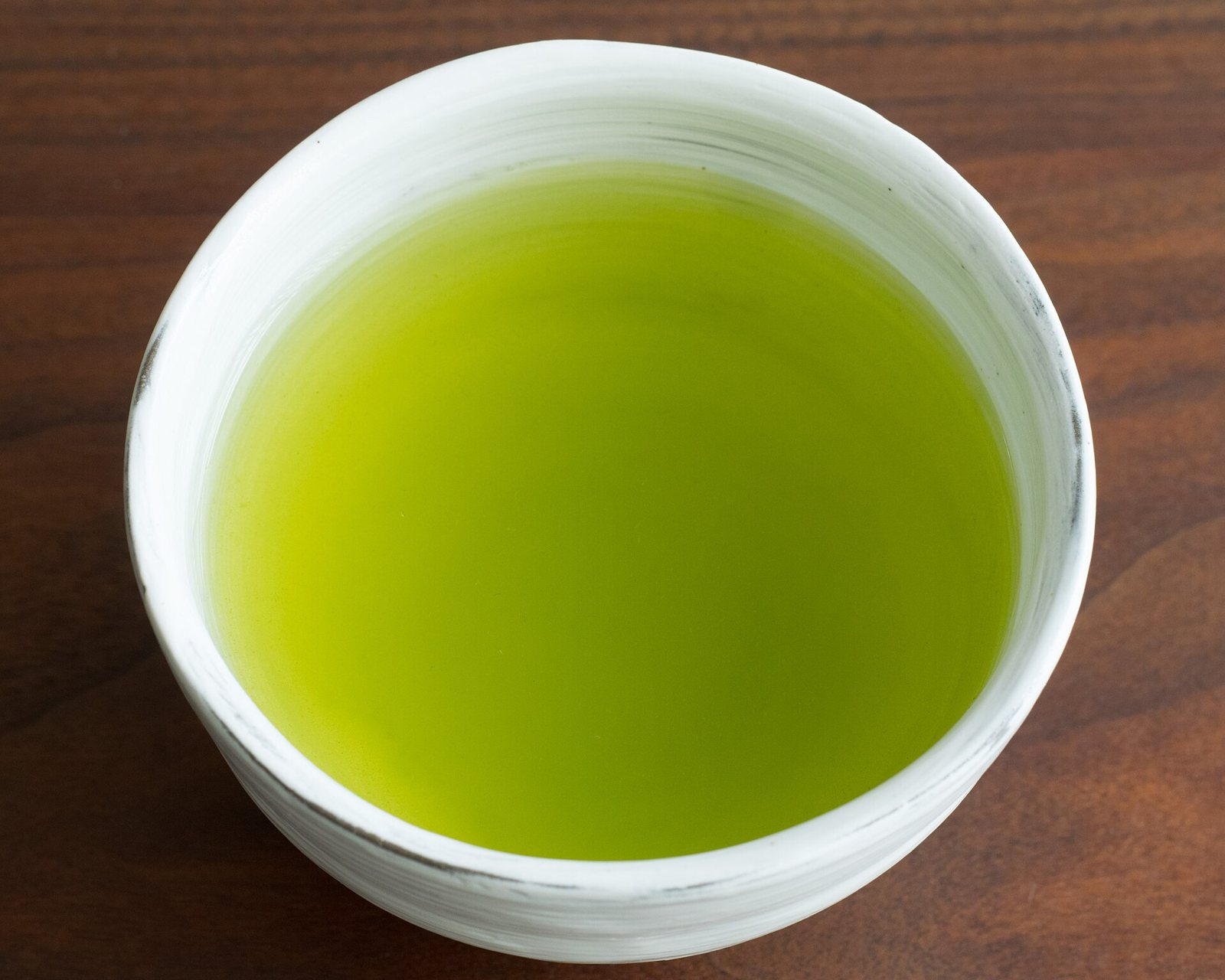
How much caffeine is in a cup of green tea?
The US Department of Agriculture’s food database lists brewed green tea at 12 mg of caffeine per 100 g, which works out at 28 mg for an 8 oz cup. That is the figure most nutrition labels and caffeine calculators use. It describes an ordinary cup made with a tea bag, not a Japanese pot brewed with a lot of leaf.
Real cups vary well beyond that average. A US lab analysis of 20 commercial teas found 14 to 61 mg per 6 or 8 oz serving across white, green and black teas, with no clear difference by tea type. Steep time made the biggest difference. In a 2025 study of 12 green teas brewed with 2 g of tea in 200 ml of water, caffeine ranged from 11 mg after a 2-minute steep at 80°C to 28 mg after 10 minutes. Most everyday cups of green tea fall somewhere between 20 and 45 mg.
Green tea caffeine compared with other drinks
| Drink (8 oz / 237 ml unless stated) | Caffeine, typical | Source |
|---|---|---|
| Brewed green tea | 28 mg | USDA |
| Brewed black tea | 47 mg | USDA |
| Filter coffee | 95 mg | USDA |
| Matcha, 2 g of powder | about 32 to 64 mg | Koláčková, MEXT |
| Decaf green tea | close to 0, a few mg at most | USDA |
So green tea is usually the gentler choice, but not always. Brewed the same way, green and black tea come out close. In the 2025 tests, after 5 minutes at 100°C, green tea averaged 25 mg per 200 ml and black tea 23 mg, a difference the authors did not find significant. Green tea ends up lower in most kitchens because it is brewed cooler and shorter. Our black tea caffeine guide and our tea caffeine chart give the full comparison.
Caffeine by type of green tea
The best data on individual green teas comes from Japan. The government’s Standard Tables of Food Composition list caffeine for each tea, brewed in the traditional way. Those brews use far more leaf than a Western tea bag, so the figures per 100 ml are higher than the USDA cup.
| Green tea | Caffeine per 100 ml | How it was brewed | Source |
|---|---|---|---|
| Gyokuro | 160 mg | 10 g leaf, 60 ml water at 60°C, 2.5 min | MEXT |
| Sencha | 20 mg | 10 g leaf, 430 ml at 90°C, 1 min | MEXT |
| Hojicha | 20 mg | 15 g leaf, 650 ml at 90°C, 30 s | MEXT |
| Bancha | 10 mg | 15 g leaf, 650 ml at 90°C, 30 s | MEXT |
| Genmaicha | 10 mg | 15 g leaf, 650 ml at 90°C, 30 s | MEXT |
| Matcha powder | 3.2 g per 100 g of powder | Whole leaf, eaten | MEXT |
Gyokuro, the strongest cup
Gyokuro is shaded for about three weeks before picking, which keeps the leaves tender and rich in amino acids and caffeine. A 2025 Japanese analysis measured 35 mg of caffeine per gram of gyokuro leaf, against 25 to 31 mg for sencha. It is also brewed with a lot of leaf in very little water. Brewed that way, the same study found 2,261 mg per litre, so a small 40 ml cup holds about 65 to 90 mg. That is close to a cup of coffee, in a few sips.
Matcha
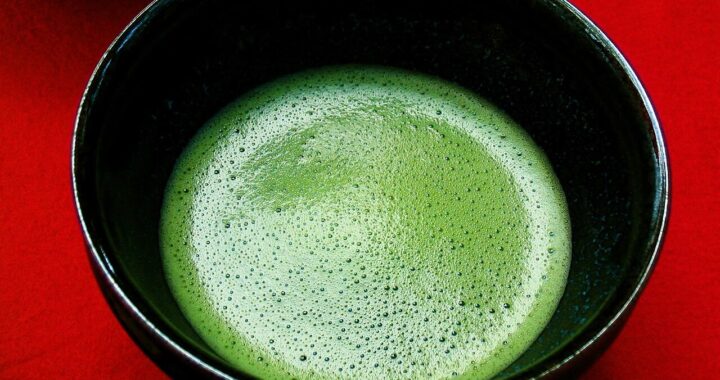
With matcha you drink the whole leaf, so none of the caffeine is left behind in the pot. How much you get depends on the powder and the scoop. One Czech lab analysis measured 16.1 mg of caffeine per gram, which gives about 32 mg for a usual 2 g serving, the figure in our matcha vs coffee guide. Japan’s food tables list 3.2 g per 100 g of powder, or about 64 mg for 2 g, and a 2026 review of 142 matcha products found averages of 32 to 40 mg per gram for matcha sold in and outside Japan. A latte made with two or three scoops can therefore match a mug of coffee.
Sencha
Sencha is the everyday green tea of Japan and the base of many bagged green teas sold abroad. At 20 mg per 100 ml in the official tables, a 200 ml cup has about 40 mg. Leaf picked early in the season is stronger. In the 2026 review, first-flush sencha leaf had 31 mg of caffeine per gram, second flush 25 mg and autumn tea 21 mg.
Hojicha: roasted, but not caffeine-free
Hojicha is green tea roasted until it turns brown, and it is often sold as a low-caffeine tea. That is only partly true. Japan’s tables give it the same 20 mg per 100 ml as sencha. The 2025 analysis found 21 mg of caffeine per gram of hojicha leaf, a little below sencha, and noted that roasting drives off only a small amount of caffeine. Hojicha tastes milder mainly because it is usually made from later, coarser leaf and brewed quickly.
Bancha and genmaicha
Bancha is made from larger, older leaves, which hold less caffeine than young shoots. Genmaicha is green tea mixed with toasted brown rice, and the rice has no caffeine, so each spoonful holds less tea. Both come out at about 10 mg per 100 ml, or around 20 mg in a 200 ml cup. They are the best Japanese choices for the afternoon.
Chinese and flavoured green teas
Chinese green teas such as Longjing and Bi Luo Chun are pan-fired rather than steamed, and they are usually brewed with less leaf than Japanese teas, so their caffeine depends mostly on how much leaf you use and how long you steep it. Jasmine tea is usually green tea scented with flowers, so its caffeine is that of its base tea. White tea is often called the lowest-caffeine true tea, but its buds can be just as rich, as our white tea guide explains.
What changes the caffeine in your cup
Tea bag or loose leaf
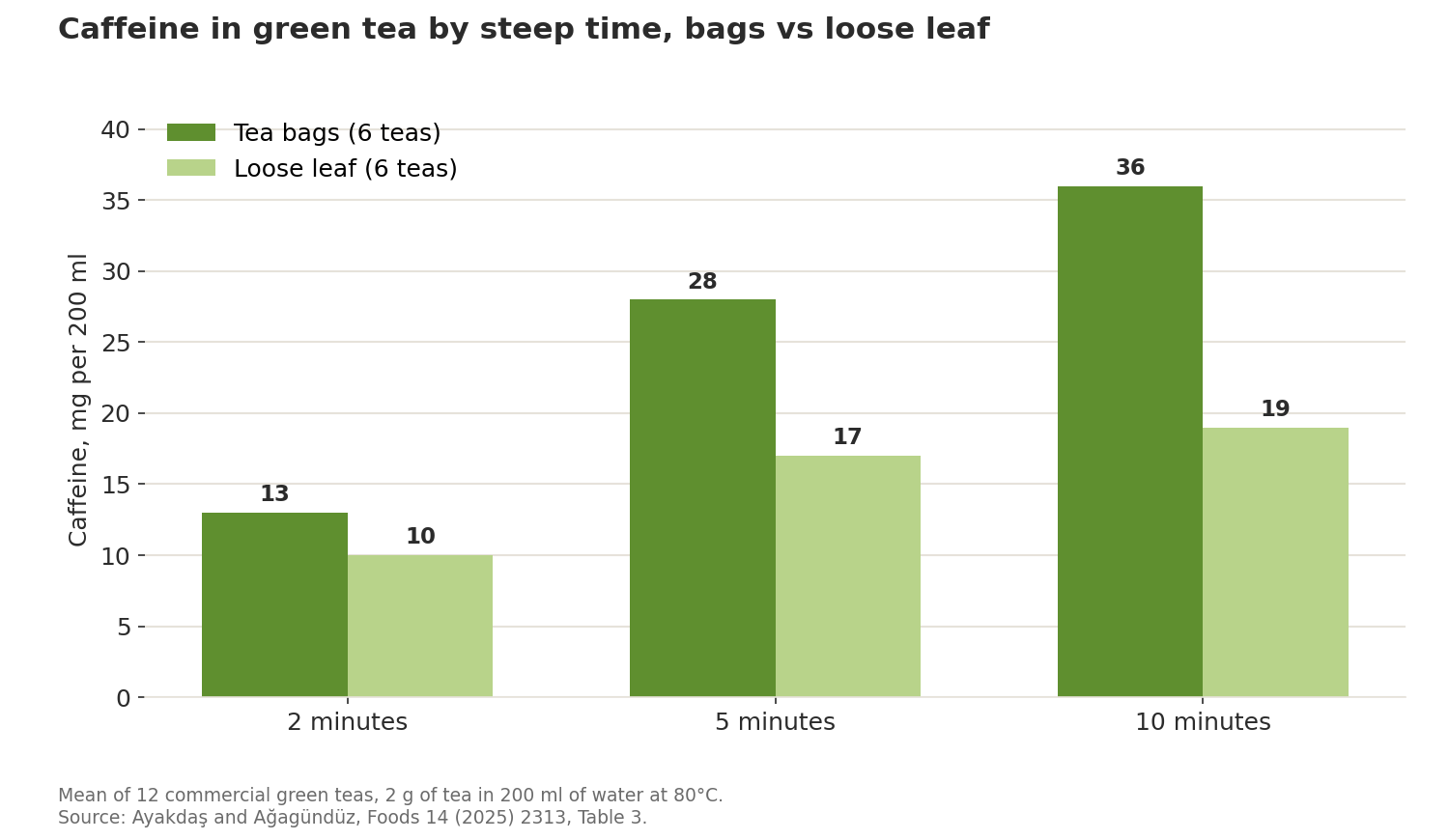
Bagged green tea released far more caffeine in the 2025 tests. At 80°C, cup tea bags gave 13 mg after 2 minutes, 28 mg after 5 and 36 mg after 10. Loose leaf gave 10, 17 and 19 mg. The likely reason is particle size. Bags hold small broken leaf with more surface area, so caffeine dissolves faster. A 2001 study also found that the grade of the leaf and the size and material of the bag all changed how much caffeine reached the cup.
Steep time
Caffeine comes out quickly in the first few minutes and then slows down. Across all 12 green teas at 80°C, the average went from 11 mg at 2 minutes to 23 mg at 5 minutes and 28 mg at 10. A short steep of 1 to 2 minutes, which is what most green teas need for good flavour anyway, keeps the caffeine down and the bitterness too.
Water temperature
Hotter water speeds things up, but after a few minutes the difference shrinks. At 100°C the same teas gave 15 mg at 2 minutes, 25 mg at 5 and 27 mg at 10, close to the 80°C results. Cold water is different. Japan’s tea research institute found that green tea cold-brewed at 10°C released about half the caffeine of a hot brew. Our cold brew tea guide shows how to make it.
How much leaf you use
This is the factor people forget. Japanese brewing often uses 5 to 10 g of leaf for a small pot, two to four times what is in a tea bag, and caffeine rises roughly in step with the leaf. The 2025 Japanese study found that caffeine in the cup increased in proportion to the amount of leaf used. A heaped spoonful in a big mug can easily double the caffeine of a single bag.
Second and third infusions
Green tea leaves are often brewed several times. Each round gives less caffeine, because much of it comes out in the first cup. Rinsing the leaves for 30 seconds does not make green tea caffeine-free, as our article on how to decaffeinate tea at home explains.
Why green tea feels calmer than coffee
Green tea contains L-theanine, an amino acid that may soften caffeine’s edge. In the 2025 tests, green tea released about 12 to 17 mg of L-theanine per 200 ml, and shaded teas such as gyokuro and good matcha hold far more. Combined with a smaller dose of caffeine, this is one reason many people feel focused rather than jittery after green tea. Our guide to L-theanine in tea covers the research, and our green tea vs black tea comparison looks at the other differences.
How much green tea is too much?
The European Food Safety Authority says up to 400 mg of caffeine a day from all sources is safe for healthy adults, with single doses up to 200 mg. The US Food and Drug Administration uses the same 400 mg figure. At 28 mg a cup, that is more than a dozen cups of ordinary green tea, but only a handful of strong matcha lattes or a few rounds of gyokuro. In pregnancy the NHS advises staying under 200 mg a day. Our pregnancy tea guide has the details, and how many cups of tea a day looks at the wider evidence.
Timing matters too. In a sleep study, 400 mg of caffeine taken 6 hours before bed still cut sleep time. Green tea doses are much smaller, but sensitive people notice even a cup or two in the evening. In a small Japanese trial of 20 middle-aged adults, a week of low-caffeine green tea brewed in room-temperature water was linked to lower stress markers and better sleep than standard green tea. If you sleep badly, switch to a caffeine-free tea after lunch, or see our best tea for sleep guide. Green tea supplements and extracts are a separate matter, since some add concentrated caffeine, as our green tea and weight loss article explains.
How to control the caffeine in green tea
| You want | What to do |
|---|---|
| More caffeine | Matcha or gyokuro, or two bags of sencha steeped 3 to 5 minutes |
| A moderate cup | One bag or 2 g of loose sencha at 70 to 80°C for 1 to 2 minutes |
| Less caffeine | Hojicha, bancha or genmaicha, a short steep, or cold brew overnight |
| Almost none | Decaf green tea, or a herbal tea such as rooibos or peppermint |
If you want green tea for a lift, our best tea to stay awake guide ranks the strongest options.
Quick answers
How many mg of caffeine is in green tea?
About 28 mg in an 8 oz cup on average, with most cups between 20 and 45 mg. Matcha and gyokuro can reach 60 mg or more per serving.
Does green tea have more caffeine than coffee?
No. Filter coffee averages about 95 mg per 8 oz, more than three times a typical cup of green tea. Only strong matcha or gyokuro comes close.
Does green tea have less caffeine than black tea?
Usually, because it is brewed cooler and shorter. Brewed the same way, the two are close, at about 25 and 23 mg per 200 ml in lab tests.
Which green tea has the least caffeine?
Genmaicha and bancha, at about 10 mg per 100 ml in Japan’s food tables. Hojicha is a little higher than its reputation suggests. Decaf green tea has almost none.
Can I drink green tea at night?
A single weak cup is fine for many people, but a matcha latte or strong sencha in the evening can affect sleep. Choose genmaicha, cold brew or a herbal tea if you are sensitive.
Sources
- USDA FoodData Central. Beverages, tea, green, brewed, regular (FDC 171917).
- USDA FoodData Central. Beverages, tea, green, brewed, decaffeinated (FDC 171910).
- USDA FoodData Central. Beverages, tea, black, brewed, prepared with tap water (FDC 173227).
- USDA FoodData Central. Beverages, coffee, brewed, prepared with tap water (FDC 171890).
- MEXT. Standard Tables of Food Composition in Japan, 8th edition, 2023 supplement. Gyokuro, infusion (16034).
- MEXT. Standard Tables of Food Composition in Japan. Matcha (16035).
- MEXT. Standard Tables of Food Composition in Japan. Sencha, infusion (16037).
- MEXT. Standard Tables of Food Composition in Japan. Bancha, infusion (16039).
- MEXT. Standard Tables of Food Composition in Japan. Hojicha, infusion (16040).
- MEXT. Standard Tables of Food Composition in Japan. Genmaicha, infusion (16041).
- Ayakdaş and Ağagündüz. Determination of L-theanine and caffeine contents in tea infusions with different fermentation degrees and brewing conditions. Foods, 2025.
- Unno et al. Stress-relieving effects of Japanese green tea: evaluation using the molar ratio of caffeine and epigallocatechin gallate to theanine and arginine as an indicator. Foods, 2025.
- Unno, Kameoka and Nakamura. Compositional diversity and functional interactions of bioactive compounds in Japanese green tea: focus on matcha, sencha, and gyokuro. Molecules, 2026.
- Koláčková et al. The effect of in vitro digestion on matcha tea active components and antioxidant activity. Antioxidants, 2022.
- Chin et al. Caffeine content of brewed teas. Journal of Analytical Toxicology, 2008.
- Astill et al. Factors affecting the caffeine and polyphenol contents of black and green tea infusions. Journal of Agricultural and Food Chemistry, 2001.
- Monobe. Health functions of compounds extracted in cold-water brewed green tea. Japan Agricultural Research Quarterly, 2018.
- Unno et al. Reduced stress and improved sleep quality caused by green tea are associated with a reduced caffeine content. Nutrients, 2017.
- Drake et al. Caffeine effects on sleep taken 0, 3, or 6 hours before going to bed. Journal of Clinical Sleep Medicine, 2013.
- European Food Safety Authority. Caffeine.
- US Food and Drug Administration. Spilling the beans: how much caffeine is too much?
- NHS. Foods to avoid in pregnancy (caffeine).
Last updated: 17 October 2026. Sources are linked in the text.