Harney & Sons, the Mohawk Valley Tea Maker — At a Glance
| Field | Value | Source |
|---|---|---|
| Founded | 1983, Salisbury, Connecticut | Wikipedia |
| Founder | John Harney (proprietor of an inn in Salisbury) | Harney & Sons official history |
| Current HQ | Millerton, New York (Dutchess County) | Wikipedia / Harney & Sons |
| Family ownership | Third-generation Harney family (Mike, Paul, Emeric, Alex — John’s sons; Brigitte wife of Mike) | Harney & Sons official history |
| Product line | 300+ varieties of loose tea and sachet tea | Harney & Sons official site |
| Estimated revenue | $29.5 million (per RocketReach estimate) | RocketReach |
| Distribution | Wholesale (specialty foodservice, hotel, restaurant), retail (own stores + e-commerce), international | Harney & Sons official site |
| Flagship stores | Millerton NY (factory + tea room), SoHo NYC | Harney & Sons official history |
| Notable innovation | Silk sachet tea bags (premium format), CBD teas (recent), organic ready-to-drink teas | Harney & Sons official site |
| Founding context | John Harney, then inn proprietor, served his custom blends to inn guests; demand grew into a wholesale business | Harney & Sons official history |
Harney & Sons is a family-owned specialty tea company in Millerton, New York, in the Mohawk Valley region of Dutchess County, about 90 miles north of New York City. Founded in 1983 by John Harney as a side business while he was running an inn in Salisbury, Connecticut, the company has grown into one of the largest US specialty tea blenders, with a catalogue of more than 300 varieties and a global e-commerce operation that ships to tea drinkers in dozens of countries.
The brand’s reputation is anchored in the founder’s blending skill. John Harney (1930-2014) was a self-taught tea blender who developed his craft by serving custom blends to guests at his inn and refining the recipes through trial and customer feedback. The blends that emerged — Hot Cinnamon Spice, SoHo, White Christmas, and many others . Became the foundation of a wholesale specialty tea business that supplied restaurants, hotels, and tea shops across the United States.
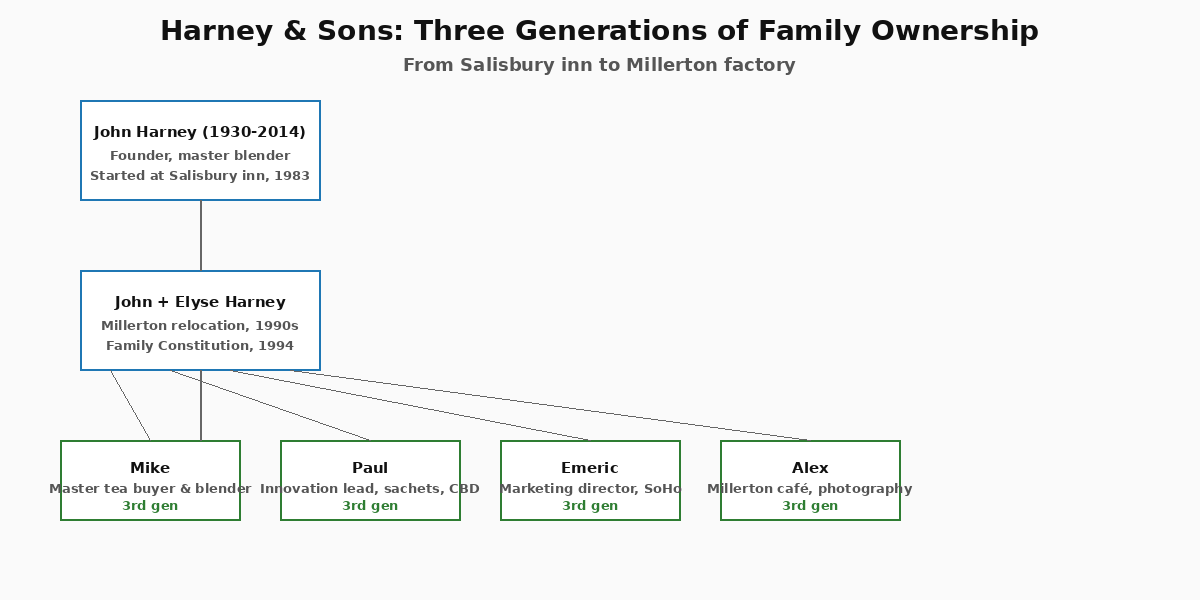
The company is now run by the third generation of the Harney family. John Harney’s sons Mike (master tea buyer and blender), Paul (innovation lead for sachets and ready-to-drink teas), Emeric (marketing director), and Alex (Millerton café manager) all hold named roles in the family business. John’s widow Elyse runs a separate real estate business in the same tri-state region.
The 1983 Founding at the Inn
John Harney founded the company in 1983 while he was the proprietor of an inn in Salisbury, Connecticut — the small Litchfield County town on the New York border. The inn’s hospitality business included serving tea to guests, and Harney began blending his own custom tea recipes rather than buying from established tea merchants. The blends that emerged from this trial-and-error process were unusual for the time: bolder, more aromatic, and less bound by the British black-tea conventions that dominated American tea retail in the early 1980s.
The blends became the centre of the inn’s hospitality experience. Word spread among inn guests, who began asking to buy the tea to take home. Harney started packaging the blends for retail sale, initially through the inn’s gift shop and then through wholesale relationships with specialty food retailers and restaurants. The wholesale business grew faster than the inn’s hospitality business, and by the late 1980s Harney had transitioned out of innkeeping to focus on the tea company full-time.
The company relocated from Salisbury to Millerton, New York, in the early 1990s. Millerton is a small town in Dutchess County, in the Hudson Valley region of New York, about 90 miles north of New York City. The Millerton location provided warehouse and production space that Salisbury could not, and positioned the company closer to the New York wholesale and specialty food market.
John Harney’s Blending Philosophy
John Harney’s blending approach was self-taught and unconventional. He did not come from a tea-trade background, had no family connection to the tea industry, and developed his craft through informal experimentation rather than apprenticeship at an established blending house. The approach gave him freedom from the conventions of British-style tea blending that dominated the US specialty tea market in the 1980s.
Three blending principles defined Harney’s work: first, the leaves should be visible and identifiable (the brand’s loose-leaf catalogue explicitly lists the leaf grade and origin for every blend); second, the aromatics should be expressive (Hot Cinnamon Spice, one of the brand’s most popular blends, uses a heavier hand with cinnamon bark and clove than the British-style “spiced tea” convention); third, the blends should be approachable for new tea drinkers rather than aimed at the existing specialty tea audience.
The Hot Cinnamon Spice blend, introduced in the 1980s, is the brand’s defining product and the case study for Harney’s approach. The blend is a black tea base (typically a Ceylon and Keemun mix) with a heavy-handed combination of cinnamon, clove, and sweet orange peel. The blend was designed to be welcoming to American consumers who associated tea with sweet, spiced flavours (a category that the British “builder’s tea” or Chinese green tea traditions did not serve). It became the brand’s best-seller and remains so today.

The Millerton Factory and Café
The Millerton, New York location houses the company’s bottling plant, warehouse, flagship retail store, and the Harney & Sons Café. The factory and warehouse operations blend, package, and ship the company’s loose-leaf and sachet teas for wholesale and e-commerce distribution. The café serves a tea-focused menu and is run by Alex Harney, John’s son and the family member responsible for the Millerton retail experience.
The café is a destination for tea enthusiasts visiting the Hudson Valley. It serves a tea-pairing menu (similar to a wine-pairing menu in concept) where each dish is matched to a specific Harney tea blend. The format is unusual for the US tea industry, where tea is typically sold as a beverage rather than as a curated pairing with food.
The factory and café together represent the company’s commitment to direct customer relationships. The Millerton location is both a production facility and a tourism destination, with visitors able to watch blending operations, tour the warehouse, and drink tea in the café. The model is closer to a winery or craft brewery than to a typical packaged-tea company.
The Third Generation
John Harney died in June 2014 at age 83. The company was already in transition to the third generation before his death; his sons had been running individual aspects of the business for several years. The post-John-Harney era has been characterised by continued family ownership, expansion of the product line, and growth in the e-commerce channel.
Mike Harney is the master tea buyer and blender for the company. Like his father, Mike is a published author (he wrote The Harney & Sons Guide to Tea) and travels to tea-producing regions to source leaves directly from growers. His wine-tasting background (per the company’s own profile) is reportedly relevant to tea tasting — both disciplines involve identifying flavour components and assessing balance.
Paul Harney leads innovation at the company. His recent work has focused on ready-to-drink teas (a bottled iced-tea line), organic certifications, and the Hemp Division, a CBD-infused tea line launched with Mike Harney. The Hemp Division was a notable category expansion for a company whose brand identity had historically been built on traditional tea blending rather than on functional-ingredient or wellness positioning.
Emeric Harney leads marketing and runs the SoHo store in Manhattan, opened in 2010. The SoHo store is the company’s flagship retail location in New York City and serves both as a retail outlet and as a brand presence. Emeric is also credited with developing two of the brand’s best-selling blends, SoHo and White Christmas.
Alex Harney runs the Millerton café and the company’s photography and film direction. The café’s food and tea pairing menu, and the brand’s distinctive photography style, are attributed to Alex’s work.
Brigitte Harney, Mike’s wife and a French native, manages the Millerton store’s accessories and gift selection and travels with Mike to tea-producing regions. Elyse Harney, John’s widow, runs a separate real estate business in the same tri-state region (Elyse Harney Real Estate).
The 300-Variety Catalogue
Harney & Sons offers more than 300 varieties of loose-leaf and sachet teas. The catalogue is organised by tea type (black, green, oolong, white, herbal, flavoured, decaffeinated, iced) and by region of origin (China, India, Sri Lanka, Kenya, Japan, Taiwan, South Africa). Within each category, the brand offers both single-origin teas and signature blends.
The signature blends are the brand’s most distinctive products. Hot Cinnamon Spice is the best-seller. SoHo (a Chinese black tea blend with a chocolate and bergamot twist) and White Christmas (a seasonal blend with vanilla, coconut, and almond notes) are the most popular of the John Harney-era blends. The Mike Harney-era additions include Japanese sencha and gyokuro single-origin offerings, oolong single-origin offerings from Taiwan, and a small but growing list of CBD-infused teas from the Hemp Division.
The 300-variety catalogue is comparable to the larger US specialty tea retailers (Adagio, Republic of Tea) but smaller than the catalogue of a Twinings (200+ in the consumer range) or a Dilmah (100+ single-estate teas). The size reflects Harney & Sons’ positioning as a specialty blender rather than as a mass-market retailer.
The Sachet Innovation
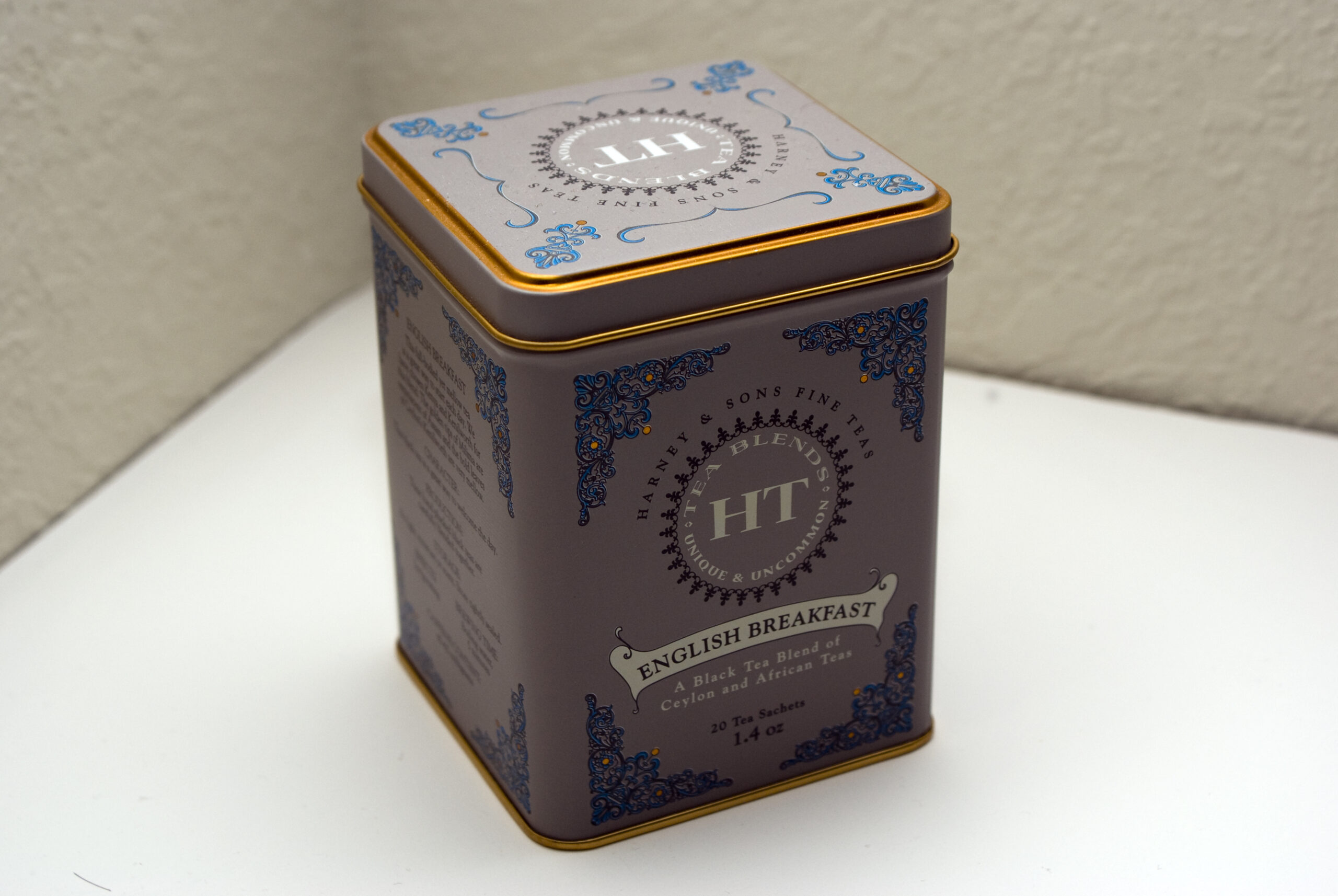
Paul Harney is the mastermind behind the brand’s sachet tea line, per the company’s own profile. The sachet format for Harney & Sons is a premium mesh pyramid similar to the Mighty Leaf innovation (which predated Harney’s entry into the format). The sachet line allowed the company to compete in the foodservice channel and the supermarket specialty aisle without sacrificing the brand’s reputation for loose-leaf quality.
The sachet line includes many of the company’s signature blends (Hot Cinnamon Spice, SoHo, White Christmas) as well as a wider range of single-origin teas. The sachets are sold both directly through the Harney & Sons e-commerce site and through wholesale distribution to specialty foodservice accounts and high-end hotels.
The sachet innovation was strategically important for the company’s growth. The foodservice channel is dominated by sachet teas (because they are faster to brew than loose-leaf and easier to standardise across multiple service locations), and Harney’s entry into the sachet format allowed the brand to expand into this channel while preserving its loose-leaf reputation.
International and E-Commerce
Harney & Sons operates a substantial e-commerce business, shipping to tea drinkers in dozens of countries. The e-commerce channel has grown since the early 2010s and now represents a significant share of the company’s revenue, particularly since the COVID-19 pandemic accelerated the shift to online tea purchasing.
The international reach is supported by the company’s reputation in the US specialty tea market and by word-of-mouth among international tea enthusiasts. The brand has not opened international retail locations or pursued aggressive international expansion; the growth has been organic, driven by the e-commerce channel and by international foodservice accounts.
The estimated revenue is $29.5 million per RocketReach, an industry estimate based on available data. The company does not publish standalone revenue figures, and the RocketReach estimate is consistent with the company’s observed scale (specialty tea brand with 300+ SKUs, US foodservice and e-commerce distribution, family ownership) but is not directly disclosed.
The Family Business Architecture
The Harney family business is structured around individual member roles rather than around a corporate hierarchy. John Harney was the founder and primary public face; after his death, the company has continued under a multi-sibling management structure where each brother runs a specific aspect of the business (Mike — blending and sourcing, Paul . Innovation, Emeric . Marketing and SoHo store, Alex . Millerton café and photography). The brothers’ wives (Brigitte and the spouses of the other brothers) participate in specific aspects of the business, and John’s widow Elyse runs a separate real estate business in the same tri-state region.
The family business architecture has been stable for three decades. The company has not pursued outside investment, has not been acquired by a strategic or financial buyer, and has not pursued aggressive expansion that would require external capital. The growth has been organic, financed out of operating cash flow, and constrained by the family’s capacity to manage the business at its current scale.
The architecture is similar to the Bettys and Taylors model (four-generation family ownership with a family constitution) and to the Dilmah model (single-family ownership across three generations). Both models are unusual in the modern US and UK consumer goods industry, where family-owned brands are increasingly rare.
Fact-vs-Claim Verdict
| Claim | Verdict | Source / note |
|---|---|---|
| Harney & Sons was founded in 1983 in Salisbury, Connecticut | Verifiable | Wikipedia / company history |
| John Harney was the founder | Verifiable | Harney & Sons official site |
| Current HQ in Millerton, New York | Verifiable | Wikipedia / Harney & Sons |
| John Harney died June 2014 at age 83 | Verifiable | NYT obituary (June 2014) |
| Third-generation family ownership | Verifiable | Harney & Sons official site |
| 300+ varieties of loose tea and sachet tea | Verifiable | Harney & Sons official site |
| Estimated revenue $29.5 million | Industry estimate, not directly disclosed | RocketReach |
| Hot Cinnamon Spice is the best-selling blend | Company claim | Harney & Sons product positioning |
| Mike Harney authored The Harney & Sons Guide to Tea | Verifiable | Published book, ISBN record |
| Paul Harney leads the sachet and ready-to-drink innovation | Verifiable | Harney & Sons official profile |
| The Hemp Division was a CBD tea line launched with Mike Harney | Verifiable | Harney & Sons official site |
| The SoHo store opened in 2010 | Verifiable | NY Magazine coverage (2010 opening) |
| John Harney developed his blending craft as an inn proprietor | Verifiable | Harney & Sons official history |
Frequently Asked Questions
The Harney & Sons Founding
John Harney founded the company in 1983 while he was the proprietor of an inn in Salisbury, Connecticut. The inn’s hospitality business included serving tea to guests, and Harney developed custom blends for the inn that became the basis of the wholesale business. The company relocated to Millerton, New York, in the early 1990s. John Harney died in June 2014 at age 83.
The Blending Approach
John Harney’s blending approach was self-taught and unconventional. Three principles defined his work: visible and identifiable leaves, expressive aromatics, and approachability for new tea drinkers. The Hot Cinnamon Spice blend, introduced in the 1980s, is the brand’s defining product and remains its best-seller. The blend uses a black tea base with a heavy-handed combination of cinnamon, clove, and sweet orange peel.
The Third-Generation Family
John Harney’s sons all hold named roles in the family business: Mike (master tea buyer and blender, published author), Paul (innovation lead for sachets and ready-to-drink teas, CBD tea line), Emeric (marketing director, SoHo store), and Alex (Millerton café manager). Mike’s wife Brigitte manages the Millerton store’s accessories and gift selection. Elyse, John’s widow, runs a separate real estate business.
The 300-Variety Catalogue
Harney & Sons offers more than 300 varieties of loose-leaf and sachet teas, organised by tea type (black, green, oolong, white, herbal, flavoured, decaffeinated, iced) and by region of origin. The catalogue includes signature blends like Hot Cinnamon Spice, SoHo, and White Christmas, plus single-origin offerings from the major tea-producing regions.
The Sachet Innovation
Paul Harney leads the brand’s sachet tea line, which uses a premium mesh pyramid format similar to the Mighty Leaf innovation. The sachet line includes signature blends as well as single-origin teas and is sold through wholesale foodservice, high-end hotels, and direct e-commerce. The sachet format was strategically important for growth into the foodservice channel.
Revenue and Scale
Harney & Sons does not publish standalone revenue figures. The RocketReach estimate of $29.5 million is consistent with the company’s observed scale (specialty tea brand with 300+ SKUs, US foodservice and e-commerce distribution, family ownership). The growth has been organic, financed out of operating cash flow, and constrained by the family’s capacity to manage the business at its current scale.
Sources
- Wikipedia , Harney & Sons , Secondary source for the 1983 Salisbury, Connecticut founding, the relocation to Millerton, New York, the John Harney founding context, and the John Harney obituary reference.
- Harney & Sons , About Us official history , Primary source for the family member roles (John, Mike, Paul, Emeric, Alex, Brigitte, Elyse), the founding story, the 300+ varieties claim, the SoHo store opening, the Millerton café, and the Hemp Division.
- The New York Times , John Harney obituary (June 2014) , Primary source for John Harney’s death at age 83, his reputation as a “missionary” for tea, and the family business continuation.
- RocketReach , Harney & Sons profile , Industry estimate of $29.5 million in revenue and 2 employees (likely a miscount of the operational headcount; RocketReach estimates are typically derived from web traffic and public filings).
Last updated: 7 October 2026. Sources are linked in the text.