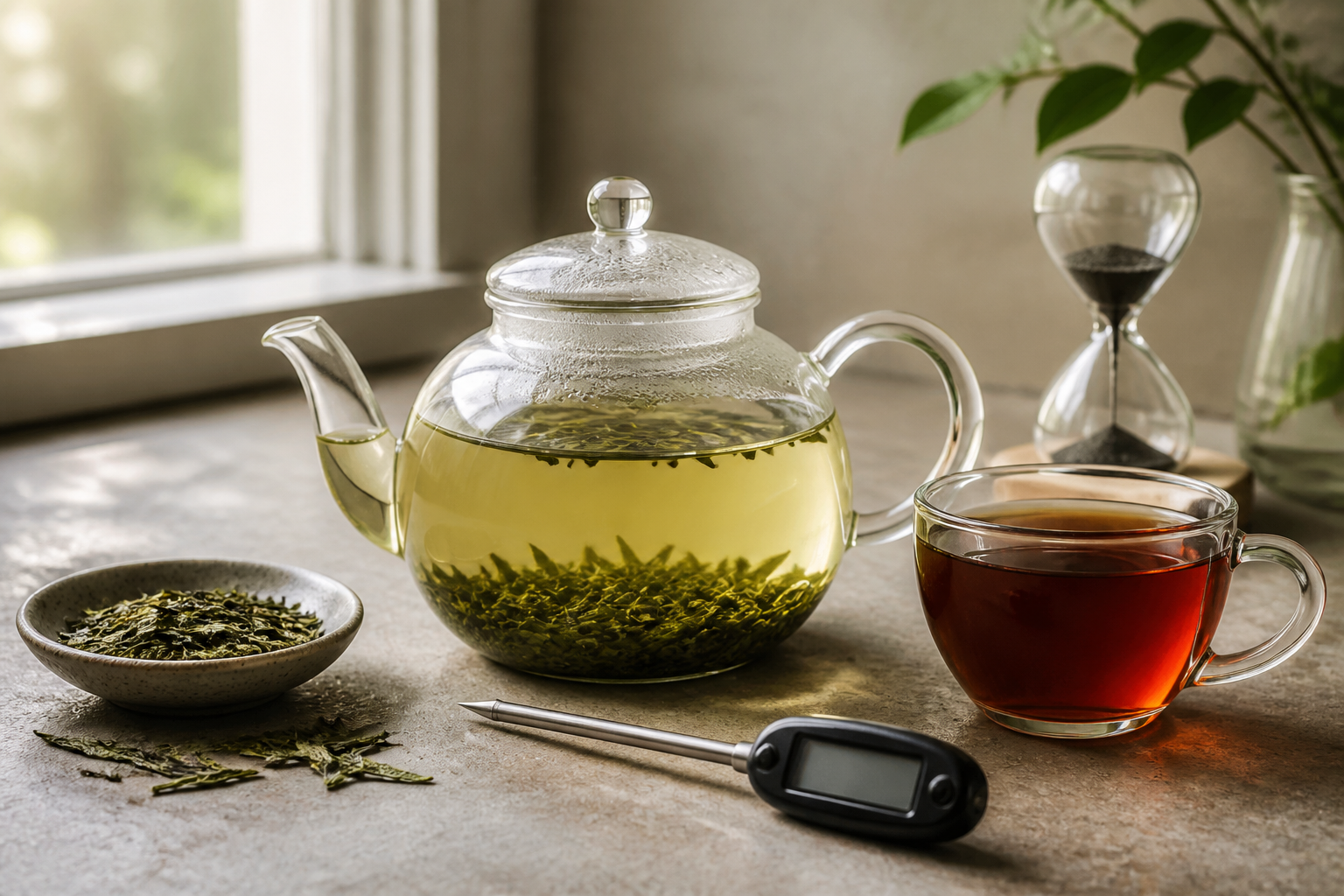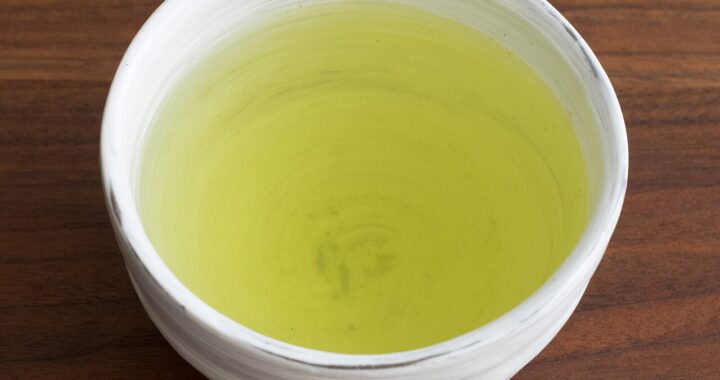
To make cold brew tea, put about 10 g of loose tea (four or five tea bags) in a clean jar with 1 litre of cold water, cover it, and steep it in the fridge. Give green and white tea 6 to 8 hours and black, oolong and herbal tea 8 to 12 hours. Strain it and drink it within three days. Cold water pulls out less caffeine and far less of the bitter catechin EGCG, so the tea tastes smoother and sweeter than hot-brewed tea poured over ice.

Cold brewing needs no kettle, no timer and no skill, and the result holds up in the fridge for days. It works because different parts of the tea leaf dissolve at different temperatures. Cold water extracts the sweet, savoury compounds readily and the bitter, astringent ones slowly. Hot water extracts everything fast. That difference explains the method below, the ratios, and why the usual iced-tea problems of bitterness and cloudiness mostly disappear.
The basic method
- Measure. Use 10 g of loose-leaf tea per litre of water, about 2 g per 200 ml glass. That is roughly four heaped teaspoons of a rolled or broken-leaf tea, or four to five standard tea bags. Large open leaves such as white tea are bulky, so weigh them if you can.
- Combine. Put the tea in a clean glass jar or jug and pour in cold, fresh water. Filtered water gives a clearer, cleaner-tasting result in hard-water areas.
- Cover and chill. Put a lid on and put the jar straight in the fridge. Do not leave it on the counter or in the sun.
- Steep. Use the times in the table below. Taste at the lower end and carry on if it is thin.
- Strain. Take out the bags, or pour the tea through a fine sieve, and discard the leaves. Leaving leaf in the jar keeps extracting and slowly turns the tea flat and tannic.
- Store. Keep it covered in the fridge and drink it within three days.
Cold brew ratios and steeping times by tea type
| Tea type | Leaf per litre | Fridge steep time | What to expect |
|---|---|---|---|
| Japanese green (sencha, gyokuro) | 10 g | 3 to 6 hours | Sweet, brothy, bright green; the classic cold brew |
| Chinese green (Dragon Well, jasmine) | 10 g | 6 to 8 hours | Nutty or floral, very little bitterness |
| White (Silver Needle, Bai Mu Dan) | 10 to 12 g | 8 to 10 hours | Honeyed and delicate; bulky leaf, weigh it |
| Oolong (rolled or twisted) | 10 g | 8 to 12 hours | Rolled leaves unfurl slowly; floral to roasted |
| Black (Assam, Ceylon, Darjeeling) | 10 to 12 g | 8 to 12 hours | Smooth and malty, far less astringent than hot |
| Herbal (hibiscus, mint, rooibos) | 12 to 15 g | 10 to 12 hours or overnight | Hibiscus turns deep red and tart |
Cold brew needs more leaf than a hot pot because cold water extracts less of everything, not only the bitter parts. Most hot-brewing guides use 2 to 3 g per 250 ml cup. Cold brew gets a similar strength from a similar dose by steeping much longer. For the hot-water equivalents, see tea brewing temperature and steep time.
Why cold brew tastes smoother
The clearest numbers come from Japan’s national agriculture research agency. Manami Monobe of the NARO Institute of Fruit Tree and Tea Science summarised the work in a 2018 review in JARQ. Sencha steeped for one hour in 10°C water was compared with the same leaf brewed for two minutes at 80°C. The cold infusion held about 70% as much EGC, a mild catechin, but only about 50% as much caffeine and about 20% as much EGCG. EGCG is the catechin most responsible for green tea’s bitterness and astringency. Longer steeping did not change those levels.
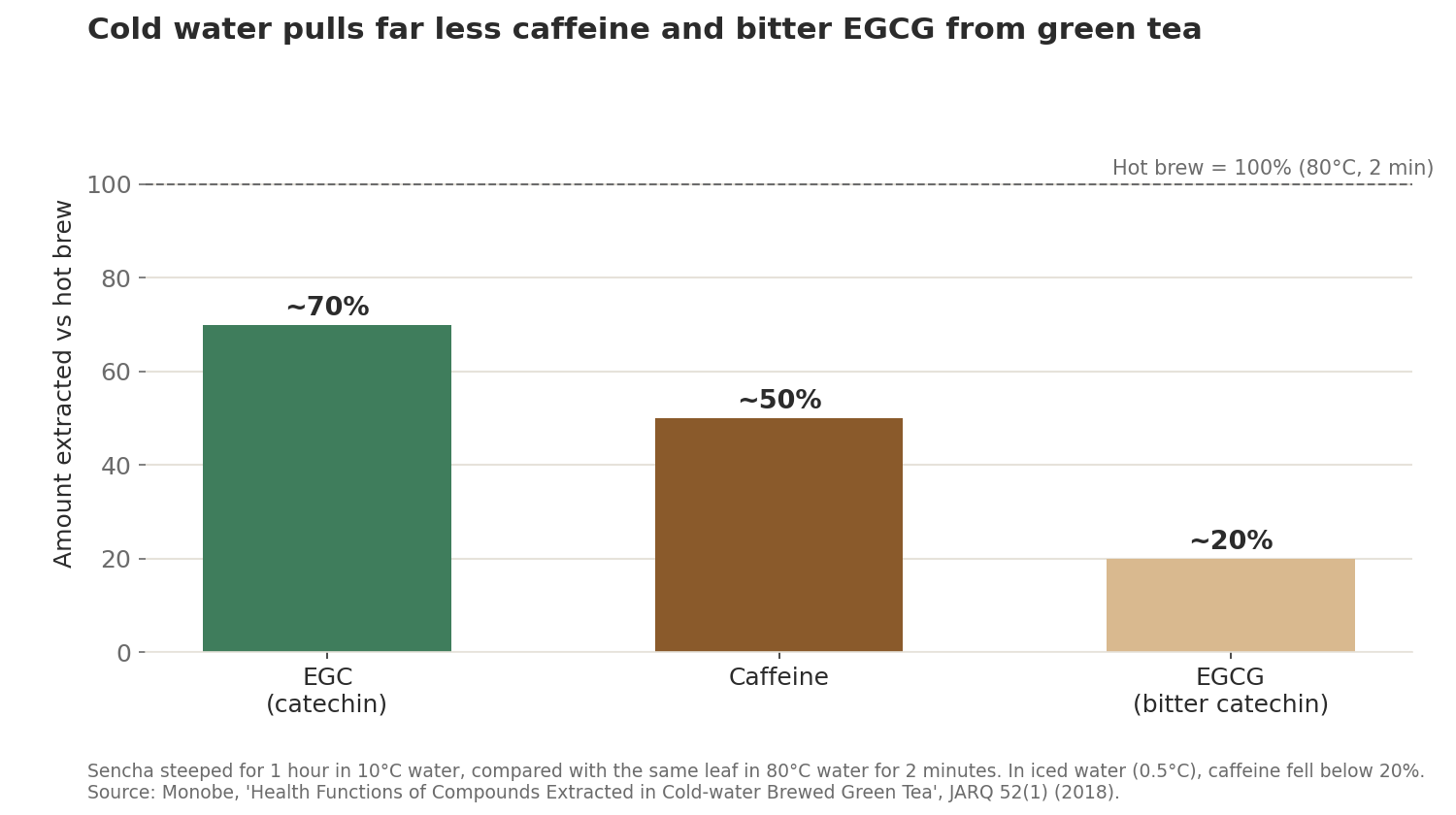
In iced water at 0.5°C the effect was stronger. Caffeine fell below 20% of the hot-brew level, while theanine and the other main amino acids still came out at about 80%. Theanine is the amino acid behind green tea’s savoury, rounded taste. The result is a cup where sweetness and umami lead and bitterness drops into the background. That is why cold brew can make a cheap green tea taste better than it does hot.
Other work agrees. A 2014 study in the Journal of Food Processing and Preservation by Lin and colleagues compared cold and hot brewing of two green teas at three leaf ratios. The cold infusions contained less caffeine, EGCG and EGC and were less bitter and astringent. Tasters rated them higher overall.
Cold brew tea and caffeine
Cold brew tea usually has less caffeine than the same leaf brewed hot, but it is not decaf. The halving in the Monobe data applies to green tea at 10°C. Black tea steeped overnight in the fridge still carries a real dose, and using more leaf adds some back. If you are cutting caffeine for sleep, cold brew helps but does not replace a herbal tea. The tea caffeine comparison gives hot-brew figures to start from. Our guide to decaffeinating tea at home explains why cold brewing is one of the few home methods that actually lowers caffeine.
Food safety: fridge, not sun
Cold brewing never heats the water, so it does not kill anything already in the jar, the water or on the leaf. The safety step is to keep the tea cold from start to finish. Iowa State University Extension says tea “can also be brewed safely in the refrigerator by putting tea in cold water for six hours to overnight”. Its other rules:
- Sanitise jars and pitchers before each use.
- Do not hold brewed tea at room temperature for more than 8 hours.
- Drink refrigerated tea within three days.
- Avoid sun tea. Iowa State notes the CDC has discouraged it since 2011, because a jar warming in the sun is a good place for bacteria to grow.
If a jar of tea turns thick, syrupy or “ropy”, throw it away. Bacterial growth causes that texture. It is different from the harmless haze described below.
Troubleshooting
Why is my cold brew tea cloudy?
Hot tea that is chilled quickly often turns cloudy. Tea scientists call this “creaming”: tannins and caffeine that dissolved in hot water bind together and settle out as they cool. Cold brew is usually much clearer because less of those compounds dissolves in the first place. If yours is hazy, the likely causes are very hard tap water, a long steep with broken-leaf bags, or leaves left in too long. Filtered water and straining on time usually fix it.
It tastes weak or watery
Add leaf rather than time. After the recommended window, a longer steep tends to add flatness rather than flavour. Go up by 2 g per litre next time, or switch from large whole leaves to a rolled or broken grade, which extracts faster.
It tastes bitter or drying
Strain it sooner, especially with black tea bags. Tannins keep dissolving slowly even in the cold. Oversteeped black tea is the usual culprit, so take the next batch out at the 8-hour mark.
Variations
- Cold brew concentrate. Double the leaf (20 g per litre), steep for the same time, then dilute one-to-one with cold water, sparkling water or milk to serve. It saves fridge space, but the three-day limit still applies.
- Fruit and herbs. Add sliced citrus, crushed berries or fresh mint for the last few hours rather than the whole steep. Fruit left overnight can turn the tea sour and spoils faster.
- Sweetening. Sugar dissolves poorly in cold liquid. Stir in simple syrup (equal parts sugar and hot water, cooled), or honey loosened with a spoonful of warm water.
- Tea bottles. Cold-brew bottles with a built-in filter follow the same ratios. Fill with 5 g of leaf per 500 ml and refrigerate.
Frequently asked questions
Can you cold brew regular tea bags?
Yes. Ordinary black, green and herbal tea bags all cold brew well. Use four or five bags per litre and check an hour earlier than you would for loose leaf, because the fine broken leaf in bags extracts faster.
Can you cold brew tea at room temperature?
It is not recommended. Tea brewed without heat should stay in the fridge throughout. Iowa State Extension advises not holding brewed tea at room temperature for more than 8 hours, and a counter-top steep often runs longer than that.
How long does cold brew tea last in the fridge?
Up to three days in a covered, clean container, once the leaves are strained out. The flavour is best in the first day or two.
Is cold brew tea healthier than hot tea?
It is different rather than better. Cold brew has less caffeine and EGCG and a higher share of EGC and theanine. Monobe’s review describes laboratory and animal work suggesting EGC and theanine have their own effects, but human evidence that cold brew improves health outcomes is limited. Choose it for the taste and the lower caffeine.
What is the difference between cold brew tea and iced tea?
Iced tea is usually brewed hot, often double strength, then poured over ice. It is quick but can be bitter and cloudy. Cold brew is steeped in cold water from the start. It takes hours, but it is smoother, clearer and lower in caffeine.
The bottom line
Cold brew tea is 10 g of leaf, a litre of cold water, a lid and a night in the fridge. Green and white teas need 6 to 8 hours, black, oolong and herbal teas 8 to 12. Strain on time and drink within three days. Cold water extracts the sweet, savoury compounds and leaves much of the caffeine and bitter EGCG behind, which is why the method forgives cheap leaf and careless timing.
Loose leaf keeps its flavour longer if it is stored properly; see how to store tea. If you are drinking cold tea in summer heat, does tea dehydrate you covers what the hydration trials found.
Sources
- Monobe M. Health functions of compounds extracted in cold-water brewed green tea from Camellia sinensis L. JARQ 2018;52(1):1-6.
- Lin SD, Yang JH, Hsieh YJ, Liu EH, Mau JL. Effect of different brewing methods on quality of green tea. J Food Process Preserv 2014;38(3):1234-43.
- Iowa State University Extension and Outreach, AnswerLine. Iced tea safety (2018).