The useful difference in English Breakfast vs Irish Breakfast tea is the particular blend, rather than the country in its name. Several producers use Assam in their Irish Breakfast, but the recipe matters more. Seven current product descriptions show why: one English Breakfast is entirely Chinese tea, one Irish Breakfast combines Assam with Darjeeling, and two products bearing the same English name list different origins in Britain and North America. [1][2][3][4][5]
A useful comparison should help you buy a tea you will enjoy. Saying that Irish is always stronger, English is always lighter, or either contains a fixed dose of caffeine cannot do that reliably. Below, the evidence is the tea companies’ own published recipes and brewing instructions, checked on 5 November 2026. This is a comparison of those records, rather than a tasting test or a laboratory analysis.
The blends behind the names
The products below all use black tea. The distinction is which teas the blender chooses, what the producer says about the finished cup, and how you prepare it. The number of listed origins does not rank quality, and a list of countries does not disclose blend percentages. Barry’s Gold is included as a specific example from an Irish tea company; its product name is Gold Blend, not Irish Breakfast.
| Product and market | Published composition | What the label comparison establishes |
|---|---|---|
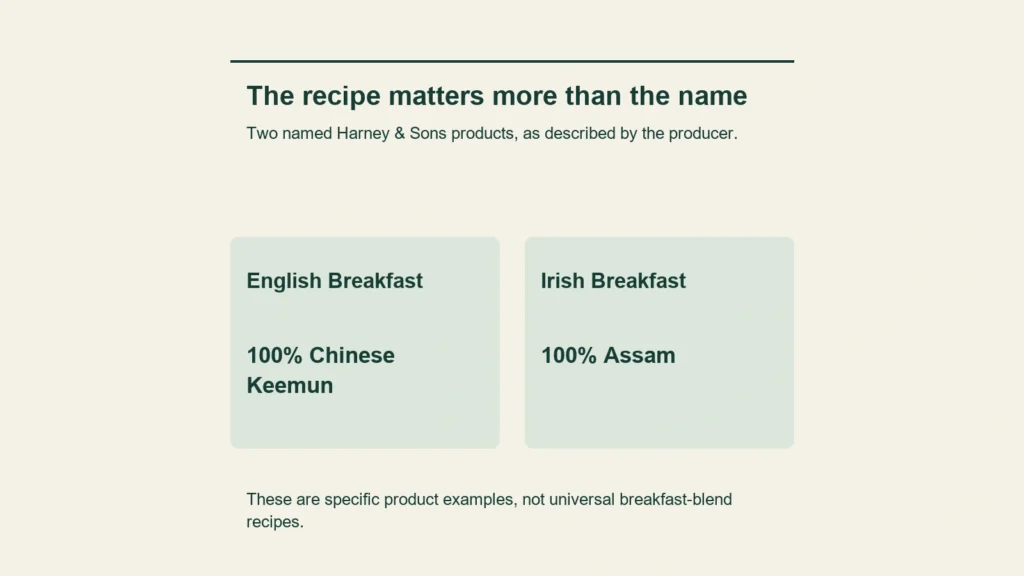
| Harney & Sons English Breakfast, US | 100% Chinese Keemun black tea. [1] | An English Breakfast need not contain Assam, Ceylon or Kenyan tea. |
| Harney & Sons Irish Breakfast, US | 100% Assam black tea. [2] | This pair offers a clear contrast in tea origin within one brand. |
| Twinings English Breakfast tea bags, North America | Kenya, Indonesia, Assam, Malawi and China. [3] | Five named origins; their proportions are not provided. |
| Twinings Irish Breakfast Loose Tea, North America | Kenya, Indonesia, Assam and China. [6] | Four origins shared with the English product; neither list establishes the Assam percentage. |
| Twinings English Breakfast, 120 tea bags, UK | The description identifies Assam, African teas and high-grown Ceylon; the ingredient declaration is 100% black tea. [4] | The UK description should not be substituted for the North American recipe. |
| Bewley’s Irish Breakfast Tea, Ireland | Assam and Darjeeling teas, harvested in India. [5] | Irish Breakfast can include Darjeeling; it is not necessarily Assam alone. |
| Barry’s Gold Blend, 40 tea bags, Ireland | Rwanda, Kenya and the Assam Valley of India. [7] | An Irish company’s everyday blend can draw on African and Indian origins. |
The table shows several different recipes. The two North American Twinings rows also use different formats: tea bags and loose tea. They establish published origins, without providing a controlled taste comparison. If you already know that you enjoy Assam tea, a product explicitly described as Assam is a useful starting point. To try another origin, look for a producer that identifies it.
Strength, malt and milk
Harney describes its Irish Breakfast as full-bodied and malty, and its English Breakfast as mellow with toast and honey notes. These are the company’s tasting descriptions. They give a shopper a useful expectation for this particular pair; they do not prove that all Irish blends taste stronger than all English ones. Both product pages also describe serving the tea with milk. [1][2]
Bewley’s recommends milk with its Assam-and-Darjeeling Irish Breakfast. That supports milk as a serving suggestion for the product, rather than a requirement for the entire style. You can still try it plain before deciding how much milk you prefer. A useful shopping question is whether the producer’s description fits your preference for malt, aroma or body, rather than whether its national label sounds stronger. [5]
Keep three questions separate: how strong the tea tastes, how much milk you add, and how much caffeine the drink contains. A larger mug, a different dose of leaf or a different steep changes the comparison you are making. If a cup tastes weak to you, first record the amount of tea and water. Buying an Irish-labelled replacement without checking either may leave the real problem unresolved.
Caffeine cannot be ranked by the breakfast name
Twinings North America gives a guidance range of 40–76 mg for unflavoured black tea prepared with one bag in 200 ml water. Its FAQ says the result varies with factors including the blend, bag contents, origin and steep time. That is a general range, not a measurement of either breakfast product in the table. It cannot establish that an Irish Breakfast has more caffeine than an English Breakfast. [8]
For a meaningful caffeine comparison, look for data that identify the exact products and preparation method. If those details are missing, leave the ranking open. Colour and the word strong on a pack are not a caffeine assay. The black tea caffeine guide explains the difference between a general reference range and the contents of a particular mug.
Brewing instructions differ too
The listed instructions are not uniform. Harney specifies five minutes at 212°F for its English Breakfast, and four to five minutes at 212°F for its Irish Breakfast; 212°F is 100°C. Twinings UK suggests two to three minutes for its 120-bag English Breakfast. Barry’s recommends one Gold Blend bag per cup with freshly boiled water and a three-to-five-minute brew. Start with the directions for the pack you own. [1][2][4][7]
Those differences also explain why a comparison needs a stated method. Preparing every tea for three minutes answers one question: what happens under that shared condition? Preparing each according to its own directions answers another: how do the products compare as their makers suggest serving them? Neither approach should be presented as the other. Our brewing temperature and steep-time guide includes a blank record for keeping the method consistent.
A fair comparison at home
You do not need to buy several large boxes to identify a preference. Two small packs or samples are enough for an initial comparison. Keep the tea fresh and use the same water for both. This procedure is a proposed home comparison, with no tasting results claimed:
- Write down the exact producer, product, country of sale and format. Photograph the ingredient and preparation panels so you can check what you actually used later.
- Measure the water into two similar cups. Use the same volume, rather than filling one mug to its rim and another to a different height. Record that volume in millilitres.
- For the first round, follow each pack’s directions. Record the number of bags or mass of loose tea, water temperature and time. Do not quietly extend one brew because its colour looks lighter.
- Remove the tea at the recorded time. Try each plain, then add an equal measured amount of the same milk if that is how you normally drink it. Record impressions such as aroma, body, bitterness and how clearly the tea comes through the milk.
- If you want to compare equal leaf doses, use loose tea and a scale for a second round. For example, 2 g in 200 ml is 10 g per litre. This is an illustrative shared ratio, rather than an optimum established for these products. Keep the water, temperature and time identical and note any departure from pack instructions.
- Repeat on another day before buying a large pack. Reverse the order of the cups, or ask someone to conceal the labels, if you want to reduce the influence of the product names.
For the milk step, 20 ml added to each 200 ml brew is a simple example you can reproduce; use your usual amount instead if you measure it. The purpose is to keep the comparison interpretable. A preference recorded with more milk in one cup says something about those finished drinks, but does not isolate the tea blend.
The quickest route to the right pack
Start with the label detail that matters to you. To compare a Chinese tea with an Assam tea, the two Harney products provide clearly identified examples. To compare styles within Twinings North America, check the two exact packs and their brewing instructions; the published origin lists alone cannot tell you their proportions. To try a different Irish recipe, Bewley’s identifies Darjeeling alongside Assam. None of these choices needs to be described as a universal winner.
If you are replacing a tea you already like, keep a photograph of its pack and buy the same market version where possible. If it was the bergamot fragrance you enjoyed, your comparison may be with Earl Grey rather than between the breakfast names. The most useful next purchase is one that answers a specific preference, with a small enough pack that you can change your mind.
Sources
- Harney & Sons: English Breakfast, US product description and brewing directions.
- Harney & Sons: Irish Breakfast, US product description and brewing directions.
- Twinings North America: English Breakfast tea bags.
- Twinings UK: English Breakfast, 120 tea bags.
- Bewley’s: Irish Breakfast Tea, Ireland product page.
- Twinings North America: Irish Breakfast Loose Tea.
- Barry’s Tea: Gold Blend, 40 tea bags.
- Twinings North America: FAQ, caffeine guidance and preparation qualifications.
Last updated: 5 November 2026. Sources are linked in the text.