Earl Grey is black tea scented with oil from the bergamot orange, and almost everything people say about it is true of black tea in general. The caffeine is real, the heart benefits are real, the focus lift is real, and the “lowers cholesterol” claim is a myth from a study that used a different product. Here is what the evidence actually supports — and what it does not.
Earl Grey is one of the most recognisable names in tea, but it is not a separate plant. It is a scented black tea — usually a Ceylon or a China Keemun base — flavoured with oil from the bergamot orange, a small sour citrus that grows almost entirely in southern Italy. The blend was popularised in Britain in the 19th century, and the recipe is now made by virtually every tea brand, from supermarket own-label to single-estate bergamot releases from Italian and Sri Lankan gardens.
Most of the health claims attached to Earl Grey travel with it from generic black tea research. A few are specifically about the bergamot. Sorting those two is the first job, because a cup of Earl Grey delivers tea-sized doses of black-tea compounds, but only a trace of bergamot — usually a fraction of a milligram of bergamot oil per cup. The cholesterol-lowering effect that some sites attribute to “Earl Grey” is actually from concentrated bergamot extract, sold as a supplement, at doses around 150 mg of flavonoids a day. The cup does not come close.
What Earl Grey actually is
The base tea is a black tea, made from the same Camellia sinensis plant as every other true tea. See the green tea vs black tea comparison for how processing changes the cup. The bergamot is added in one of three ways: by spraying the leaf with cold-pressed bergamot oil after drying, by adding a smaller dose of oil during blending, or by mixing in a small amount of dried bergamot peel. The first is most common in mass-market blends. The third is most common in artisanal and Italian single-garden Earl Greys.
The bergamot itself is a real citrus fruit. Its peel oil is roughly 30 to 45% linalool and linalyl acetate, with smaller amounts of other volatiles. Those compounds carry the floral, slightly soapy aroma that defines Earl Grey. They are also the source of the most over-stated health claim in the tea section, which is unpacked in the table below.
Caffeine in Earl Grey
Earl Grey is a black tea, so its caffeine content tracks black tea. A 240 ml cup of brewed Earl Grey typically contains around 40 to 70 mg of caffeine. That is more than a green tea (around 25 to 35 mg per cup), similar to an English Breakfast or Lady Grey, and roughly half of a small drip coffee. The chart below puts it next to the other drinks most readers compare it to.
Inline SVG stripped by WordPress security policy (svg_uploads:false). Chart data preserved in surrounding prose.
Caffeine bar chart across 7 drinks: Decaf EG 3 mg, Green 28 mg, Lady Grey 47 mg, Earl Grey 50 mg, English Breakfast 50 mg, Black tea 47 mg, Drip coffee 95 mg.
The 40 to 70 mg range is wide because real cup levels depend on the leaf grade, the particle size, the water temperature, the brew time, and the leaf-to-water ratio. A teaspoon of fine-cut tea in a small pot at a rolling boil for 5 minutes will deliver more caffeine than a teaspoon of whole-leaf tea steeped for 3 minutes in the same water. The standard Western starting point of about 2 grams per 240 ml of water at 95–100 °C for 3 to 5 minutes gives a cup near the middle of the range.
For context, the European Food Safety Authority’s caffeine guidance is 200 mg as a single dose and 400 mg across the day for healthy adults — see the EFSA opinion on caffeine. Three to four cups of Earl Grey across the day is comfortably inside that envelope; six to eight cups is not.
The bergamot question
Bergamot has a real research record, just not for the reason most Earl Grey marketing suggests. The strongest evidence is for concentrated bergamot extract — the kind sold in capsules as a supplement — for supporting healthy cholesterol levels in people with mild to moderate dyslipidaemia. A representative 2019 study by Rizzo and colleagues reported that a bergamot polyphenolic formulation added to statin therapy improved LDL cholesterol and several other markers in a randomised trial.
That result does not transfer to a cup of Earl Grey for two reasons. The dose in the study was around 150 mg of bergamot flavonoids a day, taken as a supplement. The amount of bergamot in a cup of Earl Grey is at most a fraction of a milligram, and in many supermarket blends it is a synthetic, nature-identical flavouring rather than cold-pressed peel oil. The cup is essentially a black tea with a citrus note. The bergamot story is real, but it lives next to the tea section in the supplement aisle, not in the teapot.
Very high consumption of Earl Grey consumption of Earl Grey has been associated with muscle cramps in case reports. A 1981 Lancet letter described a man drinking around four litres of Earl Grey a day who developed severe muscle cramps that resolved when he stopped. The mechanism is thought to involve the bergapten in bergamot oil blocking potassium channels. The threshold is well above what any normal drinker would consume, but worth knowing if you are drinking more than a pot a day.
The health claims, ranked by what the evidence supports
The table below sorts the common health claims about Earl Grey by how strongly the evidence supports them. The first three are well-supported. The last three are not supported for a cup of tea, even though the underlying compounds do have research in supplement or extract form.
| Claim | Verdict for a cup of Earl Grey | Where the evidence actually sits |
|---|---|---|
| Heart-health support (modest blood-pressure benefit, improved vascular function) | Real, but small | Meta-analyses of black-tea trials show about 1.8 mmHg systolic and 1.3 mmHg diastolic reduction with regular consumption. Modest, but consistent at population scale. |
| Calm, focused alertness from caffeine + L-theanine | Real | The L-theanine content of black tea is lower than green tea, but still meaningful. Earl Grey is a reasonable mid-range choice for the calm-focus effect. |
| Hydration and a low-calorie daily drink | Real | An unsweetened cup is essentially calorie-free and contributes to fluid intake. Tea counts towards hydration just like water for most people. |
| Lowers cholesterol | Not supported at cup doses | Bergamot extract supplements (about 150 mg flavonoids/day) do show cholesterol benefit (see Rizzo 2019). The bergamot in Earl Grey is orders of magnitude below that dose. |
| “Detox” or general cleansing | Not a real medical category | The body detoxifies through the liver and kidneys. Tea contributes to fluid intake and contains antioxidants, but does not “cleanse” anything specific. |
| Cures or prevents cancer | Not supported | Observational studies link regular black-tea drinking to small reductions in some cancer risks, but causation is not established and no tea is a treatment. |
How to brew Earl Grey well
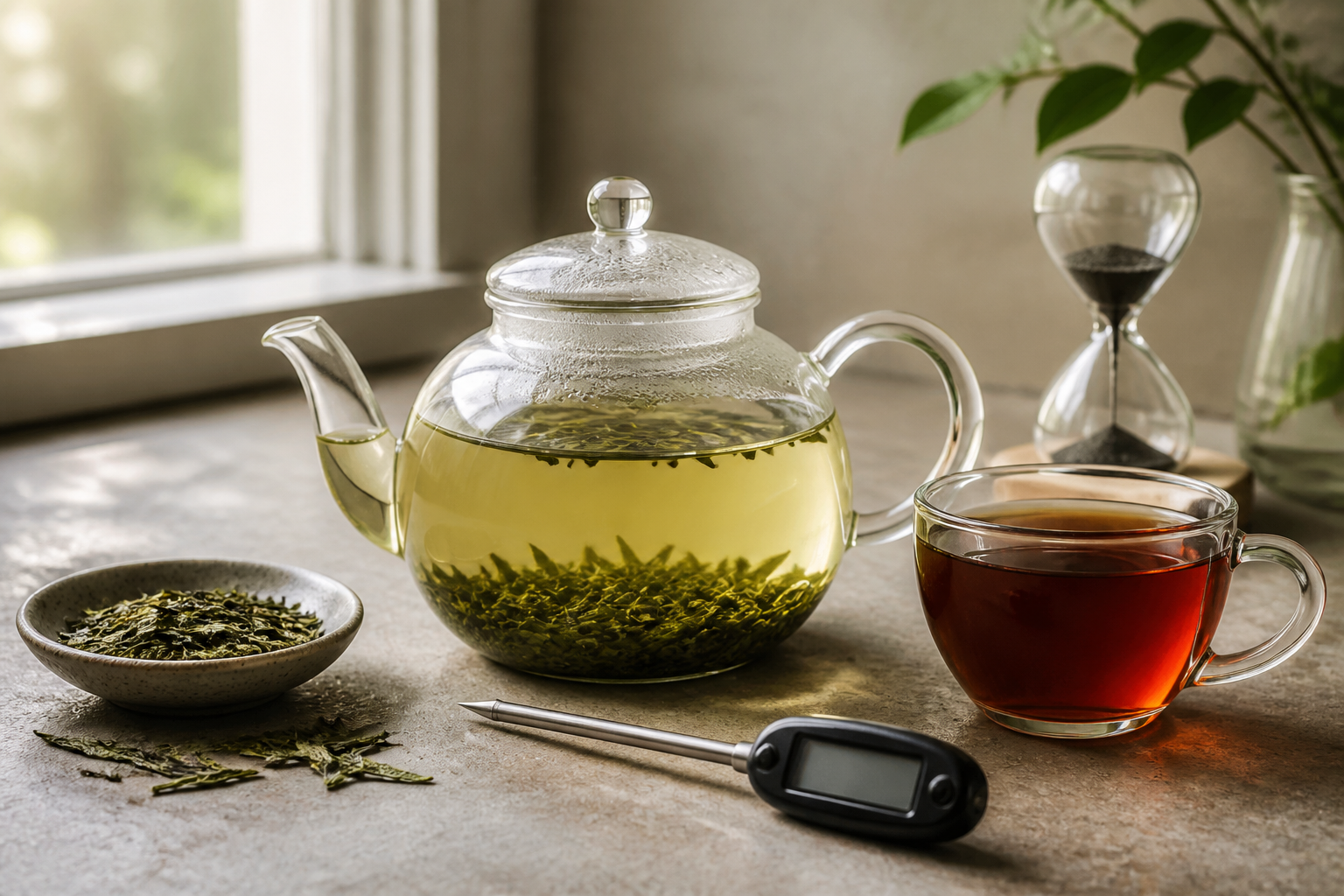
Earl Grey is forgiving. A standard Western brew uses about 2 grams of loose leaf (or one tea bag) per 240 ml of water at 95 to 100 °C, steeped for 3 to 5 minutes. The bergamot oils are volatile, so a long, gentle steep at near-boiling water draws the citrus character out without burning the leaf. Over-steeping pulls more caffeine and tannins and tips the cup from fragrant to harsh.
For a one-and-done Western cup, a 4-minute steep is a reasonable starting point. For a more layered cup that supports several infusions, use a slightly larger leaf dose in a small pot and pour short infusions of 30 to 60 seconds. Italian-style brewing often uses a larger leaf dose and a longer steep, around 5 minutes, to push the bergamot forward. The brewing guide covers the general rules in more depth.
Milk, lemon, sugar — what works
Milk and Earl Grey is a respectable choice, especially with a Ceylon base. The milk softens the briskness and lets the bergamot come through more clearly. Lemon is the more traditional service in British hotels and Italian cafés, partly because the citric acid brightens the bergamot note. Sugar is optional; the leaf is naturally slightly sweet once the bergamot is in the cup. Honey works well if you want to add something, and a small slice of candied bergamot peel is a low-key upgrade for a tea party.
Latte Earl Grey (a properly made one)
An Earl Grey latte is a strong double-shot of Earl Grey with steamed milk, served as a coffee-style drink. To make one that does justice to the leaf, brew a concentrated 60 to 90 ml shot using 4 to 5 grams of leaf at 95 °C for 4 minutes, strain, and top with about 150 ml of steamed milk. The result is closer to the Italian tea latte tradition than to a tea bag dropped in a cup of warm milk. A small amount of vanilla syrup is optional; the bergamot is the main event.
Earl Grey vs English Breakfast
English Breakfast and Earl Grey are both black teas, but they are blended for different drinks. English Breakfast is built for milk and a substantial morning cup: a blend of Assam, Ceylon and sometimes Kenya, with enough body and tannin to hold up to milk and sugar. Earl Grey is built for aroma: a Ceylon or Keemun base scented with bergamot, designed to be fragrant with or without milk.
Caffeine-wise, they are in the same ballpark — both deliver roughly 45 to 55 mg per 240 ml cup. The difference is what the cup tastes and smells like. If you want a strong, malty morning cup with milk, English Breakfast is the better fit. If you want a fragrant afternoon cup that pairs with a slice of cake or a biscuit, Earl Grey is the better fit. Many regular drinkers keep both.
Side effects and how much is too much
For most healthy adults, three to four cups of Earl Grey across the day is a reasonable ceiling. Above that, the cumulative caffeine starts to crowd the 400 mg daily ceiling from EFSA. The other consideration is the bergamot. At normal dietary doses, the bergamot in Earl Grey is well below the level linked to muscle cramps in the case-report literature. But very heavy daily consumption is not advisable, and anyone taking statins or other lipid-lowering medication should not assume that Earl Grey is a substitute for the supplement form of bergamot extract that has been studied for cholesterol support.
Tea also affects iron absorption when drunk with meals. The polyphenols in black tea can reduce non-haem iron uptake by 50% or more if the cup is consumed at the same time as the meal, which is a meaningful consideration for people with low iron stores. Drinking Earl Grey between meals, rather than with them, sidesteps most of this. See the iron and tea discussion in the green vs black tea article for the underlying study.
Frequently asked questions
Earl Grey daily safety
For most healthy adults, yes. Three to four cups a day keeps caffeine well within the 400 mg daily ceiling from EFSA, and the bergamot dose is well below anything linked to the side effects in the case-report literature. People who are pregnant, caffeine-sensitive, or taking medication that interacts with grapefruit (bergamot is in the same citrus family and can affect the same liver enzymes) should be more conservative. When in doubt, ask your doctor.
Earl Grey calories
An unsweetened cup of plain Earl Grey contains essentially zero calories — typically less than 5 kcal per 240 ml cup, and often 0 kcal according to USDA food composition tables. Adding milk, sugar, honey or a flavoured syrup will change that, and an Earl Grey latte from a coffee shop typically runs 120 to 250 kcal depending on milk and syrup.
Earl Grey at night
For most people, no. A 240 ml cup of Earl Grey contains around 40 to 70 mg of caffeine, and caffeine half-life in healthy adults is about 4 to 6 hours. A late-evening cup will still leave a meaningful amount of caffeine in your system at midnight. If you want a fragrant evening drink, a decaf Earl Grey or a bergamot-flavoured herbal infusion is the better choice.
Decaf Earl Grey caffeine
No. The standard CO2 or methylene chloride decaffeination process removes about 97% of the caffeine, which still leaves a small residual. A cup of decaf Earl Grey typically contains 2 to 5 mg of caffeine. That is far below regular Earl Grey, and small enough to be fine for most people in the evening. People who are extremely caffeine-sensitive or who have been told to avoid caffeine entirely should know that decaf is not zero.
Earl Grey and tooth staining
Yes, but less than coffee. The tannins in black tea are the main staining compound; the bergamot does not add stain on top. Rinsing with water after a cup, drinking through a straw when possible, and keeping up regular dental hygiene all help. Adding a splash of milk also reduces the staining because casein binds some of the tannins before they reach the enamel.
Earl Grey vs Lady Grey
Lady Grey is a Twinings-developed variation that adds lemon peel and cornflower petals to the classic Earl Grey blend. The caffeine content is essentially the same as Earl Grey. The flavour is brighter and more lemony, with less of the floral, slightly soapy bergamot note. Both are worth trying; they suit different times of day.
The bottom line
Earl Grey is a black tea, and most of what is good about it is what is good about black tea: a useful caffeine dose paired with a small amount of L-theanine, a modest contribution to heart and vascular health, hydration, and a low-calorie daily ritual. The bergamot adds a distinctive flavour and a trace amount of citrus volatiles, but the cholesterol-lowering effect that often gets attached to Earl Grey comes from concentrated bergamot extract at supplement doses, not from a cup of tea. Treat Earl Grey as a black tea with a beautiful aroma, drink it at sensible hours, and skip the marketing.
For a side-by-side of how Earl Grey compares to other black teas on caffeine and processing, see green tea vs black tea. For the brewing ranges that protect the bergamot from going bitter, see the brewing guide. For the caffeine timing that lets you keep the morning cup without losing sleep, see best tea for focus. And for the storage rules that keep a tin of loose-leaf Earl Grey fresh for months, see how to store tea.