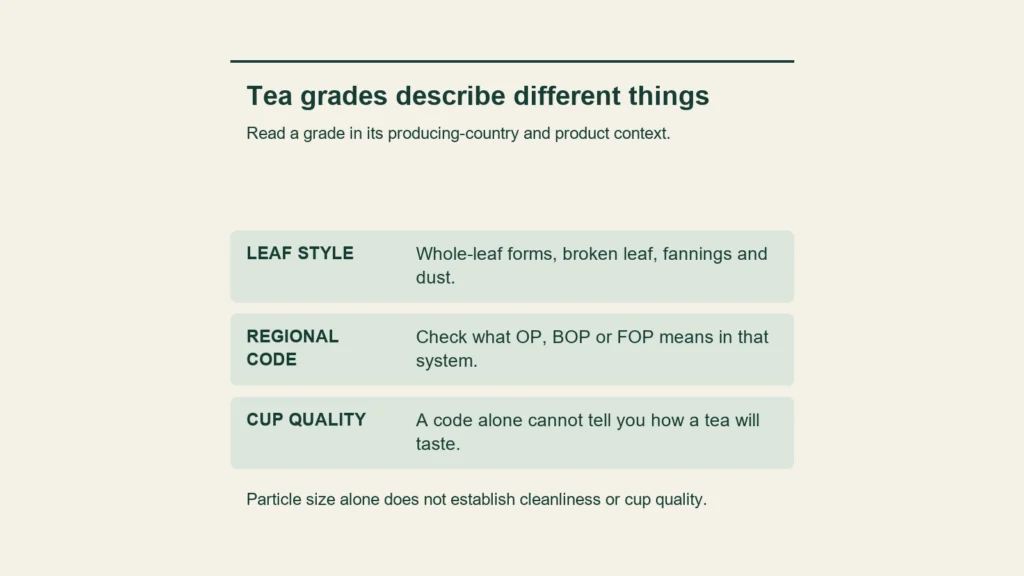
Tea grades such as OP, BOP and FOP help describe the size and style of processed tea leaves. They are useful clues when buying black tea, but they are not a universal score for flavour or quality. Read the letters alongside the origin, manufacturing method and seller’s description. A shorter grade name does not automatically mean a worse tea.
The practical question is what the label helps you choose. Do you want a leafy tea to brew in a basket, a quick infusion for a morning mug, or small particles for a filtered milk tea? This guide decodes the common names and gives you a way to compare packs without turning the alphabet into a league table.
Read the label in three parts
Separate origin, manufacture and grade. “Ceylon” identifies Sri Lankan origin; “orthodox” describes a manufacturing approach; “BOP” identifies a broken-leaf grade. These are different pieces of information. Our Ceylon tea guide covers the regions, rather than treating a grade as an origin.
A hypothetical label reading “Assam orthodox TGFOP” is therefore doing several jobs. Assam is the place; orthodox is the processing method; the final letters describe the leaf style. Do not expect the same information from a pack labelled only “black tea”. Missing grade letters are a reason to read the product details, rather than proof that the contents are poor.
Upton describes sifting manufactured tea into more uniform sizes. OP covers larger particles or whole leaves; BOP is finer. Smaller particles generally infuse faster. [1]
Common tea grades explained
| Label | Common expansion | What it tells you |
|---|---|---|
| OP | Orange Pekoe | A larger, leafy black-tea style; consult the origin’s specification. |
| FOP | Flowery Orange Pekoe | A leafy designation associated with bud or tip content. |
| GFOP / TGFOP | Golden / Tippy Golden Flowery Orange Pekoe | Additional descriptions of the tipped leaf style. |
| BOP | Broken Orange Pekoe | Broken pieces rather than a long-leaf style. |
| FBOP | Flowery Broken Orange Pekoe | A broken-leaf designation associated with tips. |
| BOPF | Broken Orange Pekoe Fannings | Finer particles than BOP in the Sri Lankan nomenclature. |
| F / PF | Fannings / Pekoe Fannings | Small-particle designations; check the trading system. |
| D / D1 | Dust / Dust 1 | Fine-particle grades; the exact specification matters. |
The expansions above follow Upton and the Tea Exporters Association of Sri Lanka. The latter distinguishes orthodox grades from CTC grades, and describes OP1 as more wiry than OP. It lists BOPF below BOP in particle size. Those are physical distinctions; they do not tell you which individual lot you will prefer. [1] [2]
What do “orange”, “flowery” and “golden” mean?
Orange Pekoe does not promise orange flavour. Upton distinguishes it from a flavour or quality guarantee. Check the ingredients for added citrus. [1]
In these letter strings, flowery and tippy refer to descriptions associated with young leaf buds or tips. Golden refers to the appearance of tips after processing, rather than added gold. Palais des Thés explains the Indian GFOP and TGFOP names in terms of bud content. It also treats numbers appended to some grades as selection or tasting distinctions. [4]
Read F according to its position. In FOP it means flowery; in BOPF it means fannings. “Flowery” in this context does not mean the tea has been blended with flowers. Nor does a golden tip on a leaf photograph tell you the finished cup’s colour.
Even FTGFOP varies: Upton uses “Fine” and Palais des Thés “Finest”. Their S prefixes differ too. Ask which merchant convention applies. [1] [4]
Why a single best-to-worst ladder fails
The Sri Lanka Tea Board’s published Ceylon tea specification considers details such as twist, evenness and the presence of tips as well as particle size. BOP1, for example, is a wiry style shorter than OP1. The “1” is part of the named specification, not a promise that it beats every tea without a number. [3]
There can still be meaningful differences in workmanship within a grade. A tidy, consistent lot and a badly sorted mixture should not be treated as interchangeable just because a seller gives them similar letters. The sensible distinction is between meeting a stated specification and winning a universal contest for the most enjoyable cup.
ISO 11286 is specifically a method for classifying tea by particle-size analysis. Its public abstract excludes large leafy grades and says the method may be unsuitable for blends. It is not a global tasting scale for every tea on a shop shelf. [5]
That also explains why this alphabet cannot describe all tea equally well. A familiar grade string may be useful on an Assam or Ceylon black tea, but it should not replace the style-specific information needed to buy an oolong or a Japanese green tea. For the harvest vocabulary used alongside Indian grades, see our guide to Darjeeling flushes.
Are fannings and dust bad tea?
They are names for small particles. The Tea Exporters Association describes dust as the fine material left after sifting and notes its rapid infusion. The Tea Board specification distinguishes clean, grainy D1 from other dust descriptions. A pack’s exact grade and condition matter more than an unpleasant association with the everyday word “dust”. [2] [3]
Calling every fine grade floor sweepings is therefore misleading. Calling every fine grade excellent would be equally unhelpful. The name does not tell you how the leaf was stored, whether the seller’s description is accurate, or whether you enjoy the result. It also cannot establish food safety or cleanliness by itself.
For a buyer, the useful consequence is filtration and timing. Fine particles call for a filter that retains them; a very open strainer may leave sediment. If a new tea becomes too forceful under your normal routine, shorten the next infusion before deciding that its grade is the problem.
A five-step buying check
- Write down the cup you want. Include whether you add milk, how much time you have and what you brew in. “Tea for a large breakfast mug with milk” is a more useful brief than “the highest grade”.
- Identify the system. Look for the origin and whether the tea is orthodox or CTC. Use the relevant seller or trade glossary. Do not copy a Sri Lankan definition onto an unfamiliar product without checking.
- Inspect the actual product. Prefer a clear photograph of that tea, a stated pack size and a useful description over a generic estate photograph. Ask whether the photograph represents the current product when that affects your decision.
- Ask what the letters leave unanswered. Is it a named garden or a blend? Does the seller provide harvest or packing information? What brewing instructions does it recommend? An elaborate acronym cannot supply missing provenance.
- Buy a small amount first. Keep the label and record your own successful dose and time. A sample that suits your daily routine is more informative than paying for a longer name without knowing whether you like it.
Our Assam tea guide supplies the origin context, and our tea storage guide helps you preserve the tea once bought. Neither task is settled by the grade.
Let the grade guide your first adjustment
Start with the producer’s instructions, using a weighed amount if possible. If you are moving between a long-leaf tea and a fine broken grade, do not assume that the same heaped spoon contains the same mass. Keep the water volume fixed, strain the tea fully and change one variable on the next brew.
A short record needs only the product and grade, grams of tea, millilitres of water, brewing time and your own description of the cup. Write “too drying for me after milk” rather than giving an unmeasured numerical strength score. Our brewing temperature and steep-time guide provides a broader starting chart and comparison record.
For the processing distinction behind some of these labels, see CTC versus orthodox tea. That guide explains the factory methods and a controlled way to compare two products.
Sources
- Upton Tea Imports: Tea Nomenclature.
- Tea Exporters Association of Sri Lanka: Tea Grade Nomenclature.
- Sri Lanka Tea Board: Ceylon tea product specification, sections 3.1.2 and 4.5.
- Palais des Thés: Tea grades.
- ISO: public abstract for ISO 11286:2004.
Last updated: 5 November 2026. Sources are linked in the text.