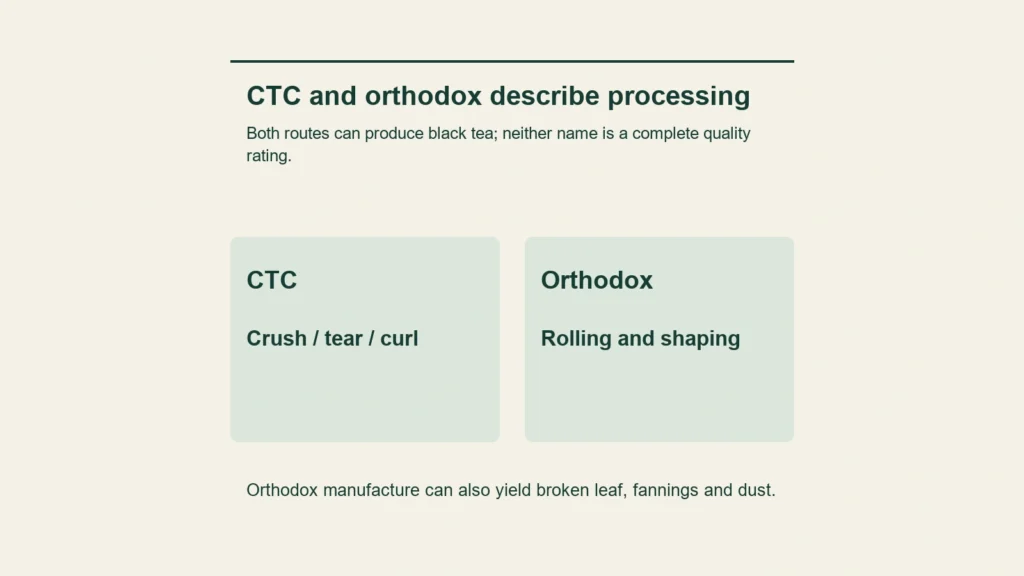
CTC and orthodox describe how tea leaves are processed. CTC uses toothed rollers to crush, tear and curl the leaf into small particles. Orthodox manufacture rolls the leaf with less extensive maceration. For black tea, both routes include oxidation and drying. The useful choice depends on the actual tea and your brewing routine, rather than one method always being better.
A packet of small, loose granules can be CTC; a tea bag can contain broken orthodox leaf. Packaging, leaf size and manufacturing method are related, but they are different things. Understanding that distinction helps you choose a tea for a quick mug, a milk tea or a more deliberate comparison between batches.
CTC vs orthodox tea in the factory
UPASI Tea Research Foundation describes the crucial difference at maceration, the stage that disrupts leaf tissue. In orthodox manufacture, specialised rollers twist and crush withered leaves. In CTC, the leaf passes between toothed rollers turning in opposite directions at different speeds, producing more extensive disruption. CTC is commonly expanded as “Crush, Tear and Curl”; some trade sources use “Cut” for the first word. [1]
Withering comes first. Air removes moisture while chemical changes also condition the freshly harvested leaf. Tea Research Association explains that withering makes the leaf flexible for the next processing stage. It is not simply a wait for the leaf to dry out completely. [2]
Once cells are disrupted, constituents previously held apart can interact. Tea Research Association describes the enzyme-driven oxidation that develops black tea’s characteristic compounds. It distinguishes the more intense oxidation of CTC manufacture from the more prolonged orthodox process. That is why changing the degree of leaf disruption affects more than the final shape. [2]
The factory then manages oxidation and dries the tea. UPASI identifies drying’s purposes as stopping the oxidative stage and removing moisture for storage. Sorting follows. These are controlled manufacturing decisions, so “machine-made” versus “handmade” is an unreliable shortcut: orthodox rolling can use machinery too. [1]
| Question | CTC black tea | Orthodox black tea |
|---|---|---|
| How is the leaf disrupted? | Toothed rollers crush, tear and curl it. | Orthodox rollers twist and rupture it less extensively. |
| What does it often look like? | Small, grainy particles. | Leafy, wiry, rolled or broken pieces, depending on grade. |
| Is it oxidised? | Yes, for black tea. | Yes, for black tea. |
| Must it be in a bag? | No. It can be sold loose. | No. Small orthodox grades can also be bagged. |
| Does the method settle cup quality? | No: inspect the product and preparation. | No: inspect the product and preparation. |
Orthodox does not mean every leaf stays whole
The Sri Lanka Tea Board’s product specification explicitly distinguishes orthodox manufacture, which produces leafy and broken grades, from orthodox-rotorvane manufacture, which produces broken grades. It describes CTC output as predominantly small and even. A comparison that calls all orthodox tea whole leaf leaves out a substantial part of the trade. [3]
This matters when shopping. Comparing a large leafy orthodox tea with a fine CTC tea changes manufacturing method and particle size together. Comparing broken orthodox with CTC of a similar size asks a narrower question. Neither is a useless comparison, but they cannot tell you exactly the same thing.
Origin is another separate variable. Our Assam tea guide covers a region that produces both styles. Our Ceylon tea guide explains the Sri Lankan origin and regional differences. The tea-grade decoder covers the leaf-size vocabulary. Do not assume that the name of a country alone tells you how the leaf was macerated.
What “stronger” can mean
People use strong to mean at least three things: dark colour, pronounced flavour or a large caffeine dose. Those are not interchangeable measurements. A dark infusion can tell you what you see, and tasting can tell you what you prefer. Neither gives a reliable caffeine result in milligrams.
A 2026 study of 32 black teas from Upper Assam and North Bank reported similar average water-extract values for orthodox and CTC samples: about 404 and 408 mg per gram of dry tea respectively. The teas were collected in April–May 2023 and ground for analysis; the water-extract assay refluxed 2 g with hot water for an hour. These dry-matter results describe a laboratory assay, not equivalence between ordinary mugs. [6]
A different Tocklai-led study, published in 2020, processed green tea by both routes. Under its defined conditions, CTC green tea infusions had 17.1% more water extract than the orthodox infusions. Its tasting panel nevertheless preferred the orthodox teas. Greater extraction and preferred flavour were different outcomes. These were green teas, so the number should not be presented as a guaranteed advantage for black CTC tea. [5]
For the drinker, the useful lesson is to ask what was measured. Faster colour in your cup, a laboratory’s extract measurement and the amount of caffeine you drink answer different questions. The word CTC on a packet supplies no fixed serving value for any of them. See our black tea caffeine guide for the factors involved in that separate question.
Which should you buy for your routine?
Treat the following as ways to choose samples, not promises about every product made by a method. A seller’s preparation instructions and a small trial pack are more useful than an unsupported claim that one manufacturing route wins every category.
- For a quick mug with milk: consider a fine CTC or broken orthodox tea described for that use. Check that your filter retains the particles and that the recommended preparation fits the time you have.
- For a leafy tea to drink plain: start with a clearly described orthodox lot. Look for its origin and grade, then decide whether the seller’s flavour description interests you. Orthodox is too broad a word to supply that description by itself.
- For simmered spiced tea: choose a tea sold for a milk-and-spice method and judge it using that method. A plain-water infusion and a simmered chai are different products in the cup, even when they begin with the same dry tea.
- For comparing estates or harvests: ask for named lots and their production details. The method gives context, while the actual garden, batch and seller’s information determine what you can meaningfully compare.
Our masala chai guide covers a milk-and-spice preparation. If you are buying a tea for that routine, assess whether it works there rather than rejecting it because you disliked an unrelated tasting setup.
How to compare two teas without confusing the result
There are two useful home comparisons. The first asks how two particular products behave under the same conditions. The second asks which makes the cup you prefer after you adjust the preparation. Keep the questions separate. The procedure below is a proposed comparison for readers; it is not a report of a Tea Savor tasting.
Round one: keep the conditions fixed
- Choose and identify the samples. Record the product name, origin, grade and manufacturing method. If either method is unknown, record it as unknown rather than guessing from a photograph.
- Use matching vessels and filters. Choose filters fine enough to retain both samples. Use the same water source and preheat both cups in the same way.
- Weigh the tea and measure the water. For example, you could select 2.0 g per 200 ml for both. These are illustrative trial settings, not a claim that this ratio is ideal for every tea. If your equipment supports different amounts, record those instead.
- Fix temperature and time in advance. Choose a common starting point from the packs’ instructions. If the instructions differ substantially, write down that compromise. Start each timer when water reaches the leaf and strain each infusion fully at the chosen time.
- Record observations separately. Note colour, aroma, bitterness, drying sensation and whether you like the cup. If you use milk, measure the same amount into each. Avoid turning colour into an invented caffeine or antioxidant score.
If possible, repeat on another day and swap the sample positions. A clear preference for sample A is useful for your next purchase. It does not prove that every orthodox or CTC tea will behave like those two packets: origins, harvests and grades may still differ.
Round two: find the preparation you actually enjoy
Return to the product’s recommended method. If a tea is too forceful, shorten the infusion on the next brew while keeping dose and water fixed. If it is too light, adjust one variable and record the result. Do not change leaf mass, time and milk together, because you will lose track of what helped.
Then compare the successful recipes, including how much dry tea each used and whether the routine is convenient. This is a fairer buying decision than insisting both products must be enjoyable after identical treatment. Our brewing temperature and steep-time guide provides a fuller starting chart and a blank comparison record.
What to check on an “Assam orthodox” label
An origin claim may have requirements beyond the generic manufacturing word. Tea Board of India’s Assam (Orthodox) regulations describe a certification scheme tied to defined gardens, processing location and sensory characteristics. For a product sold under that protected identity, provenance matters alongside the processing description. A generic claim of “orthodox” does not by itself establish certification or a named estate. [4]
Before paying more, ask what the extra information buys you: a traceable lot, a flavour description that fits your taste, suitable packaging and a preparation you can repeat. Those are concrete reasons to choose a packet. The manufacturing method helps explain it; your own cup determines whether you want to buy it again.
Sources
- UPASI Tea Research Foundation: CTC manufacturing.
- Tea Research Association: Tea Manufacture.
- Sri Lanka Tea Board: Ceylon tea specification, section 4.4.1.
- Tea Board of India: Assam (Orthodox) regulations.
- Deka et al., 2020: comparison of orthodox and CTC green teas.
- Sarmah et al., 2026: biochemical profile of 32 Assam black teas, methods 2.3 and 2.8.
Last updated: 5 November 2026. Sources are linked in the text.