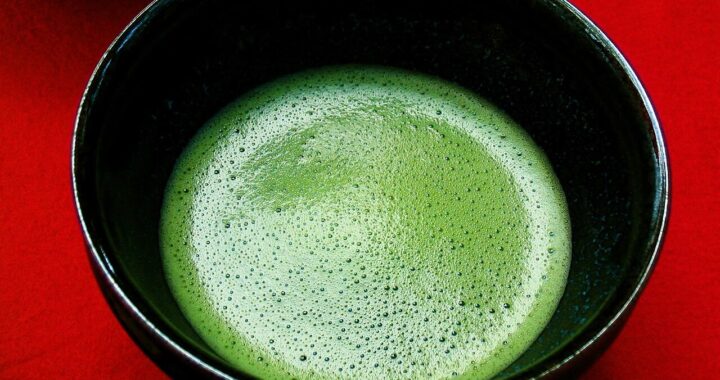
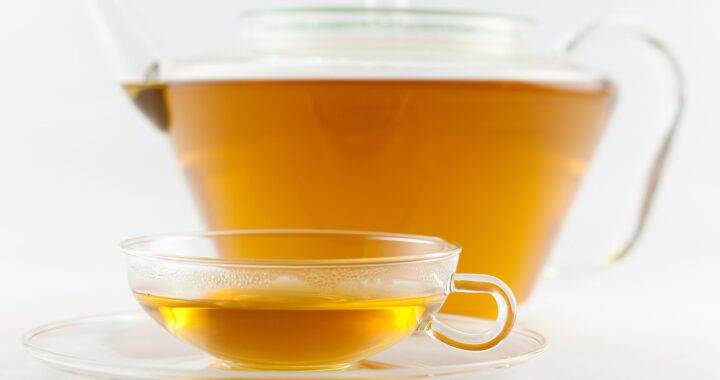
An 8 oz (237 ml) cup of brewed black tea has about 47 mg of caffeine on average, roughly half as much as the same cup of filter coffee. Real cups vary a lot, from about 14 to 61 mg in lab tests, because the amount depends on how much leaf you use and how long you steep it. A big British mug can reach 75 mg. Decaf black tea has only a few milligrams.
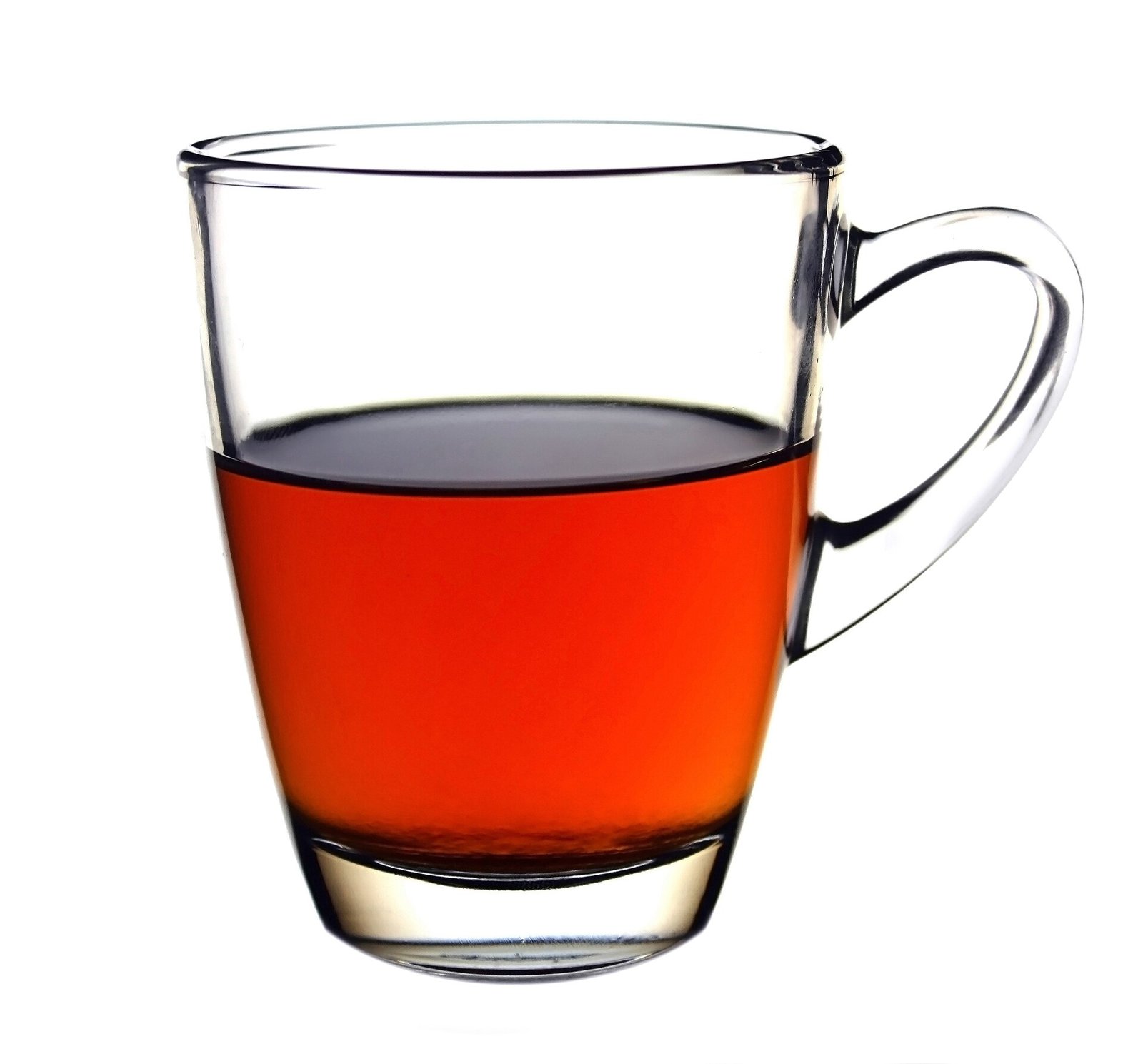
Caffeine in black tea compared with other drinks
The most widely quoted figure comes from the US Department of Agriculture’s food database, which lists brewed black tea at 20 mg of caffeine per 100 g. That works out at 47 mg for an 8 oz cup. The table puts that next to other common drinks, using the same database so the numbers are comparable.
| Drink (8 oz / 237 ml unless stated) | Caffeine, typical | Source |
|---|---|---|
| Brewed black tea | 47 mg | USDA |
| Brewed black tea, UK mug | 75 mg | NHS |
| Brewed oolong tea | 38 mg | USDA |
| Brewed green tea | 28 mg | USDA |
| Bottled black iced tea | 26 mg | USDA |
| Decaf black tea | 2 mg | USDA |
| Filter coffee | 95 mg | USDA |
| Cola, 12 oz can | about 33 mg | USDA |
So black tea sits between green tea and coffee. In the United States, coffee is still the main source of caffeine for every age group, while tea and soft drinks make up a bigger share for people under 18, according to a national survey of 37,602 people. Our tea caffeine chart compares every tea type side by side.
Why the caffeine in black tea varies so much
A lab analysis of 20 commercial teas found 14 to 61 mg per 6 or 8 oz serving across white, green and black teas, with no consistent difference by tea type. What changed the result most was the steep time. Five things set the caffeine in your cup.
1. The leaf itself
Caffeine content differs from garden to garden. In 32 black teas from Assam, a 2026 study measured caffeine from 15.5 to 39.2 mg per gram of dry leaf, with an average of 30 mg, or about 3% of the leaf’s weight. Growing conditions, leaf maturity and processing all played a part.
2. How much leaf you use
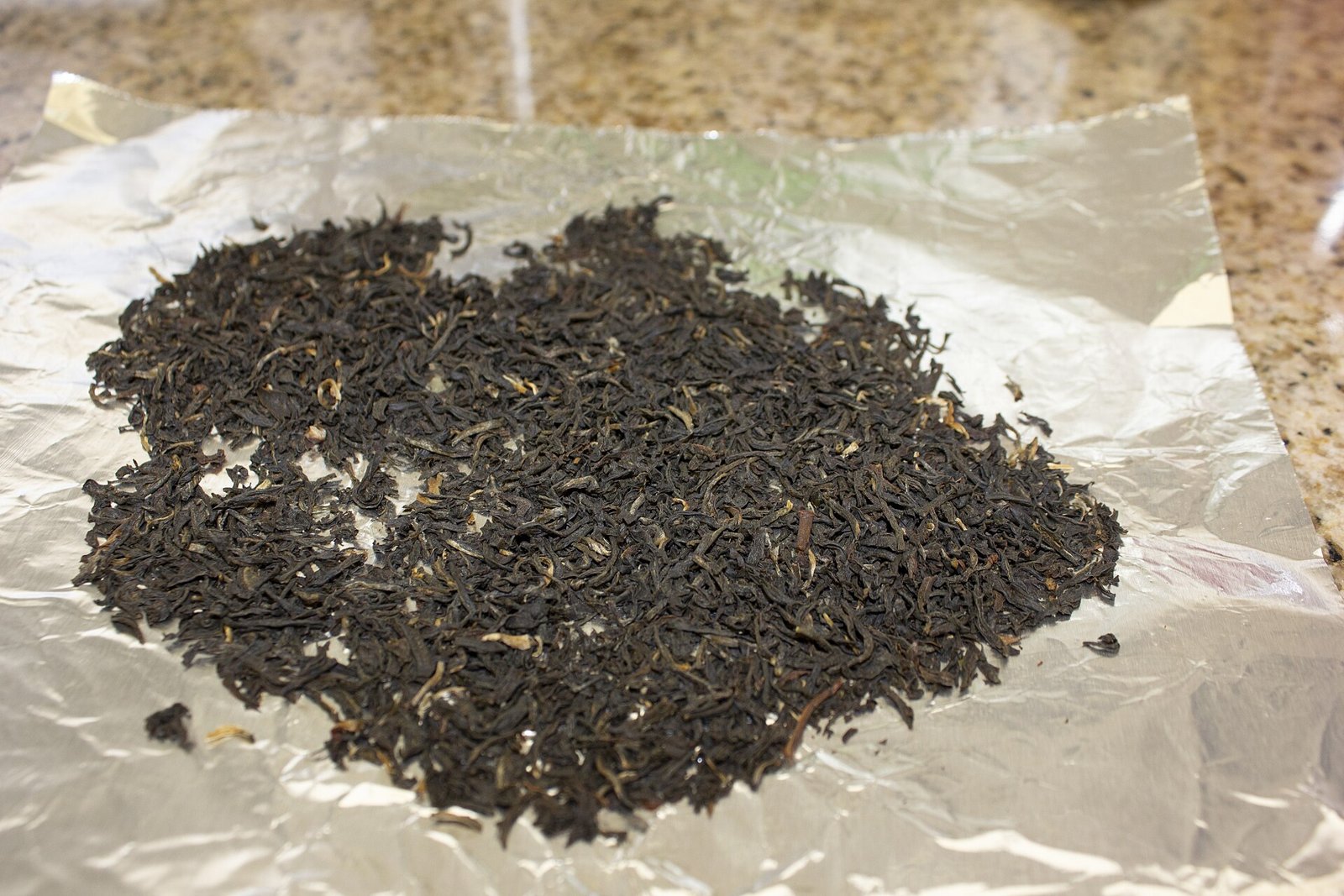
At 30 mg per gram, a 2.5 g tea bag holds about 75 mg of caffeine before you add any water. You will not get all of it into the cup, but doubling the leaf roughly doubles the caffeine. Two bags in a mug, or a heaped spoon of loose tea, is the simplest way to make a strong cup.
3. Steep time
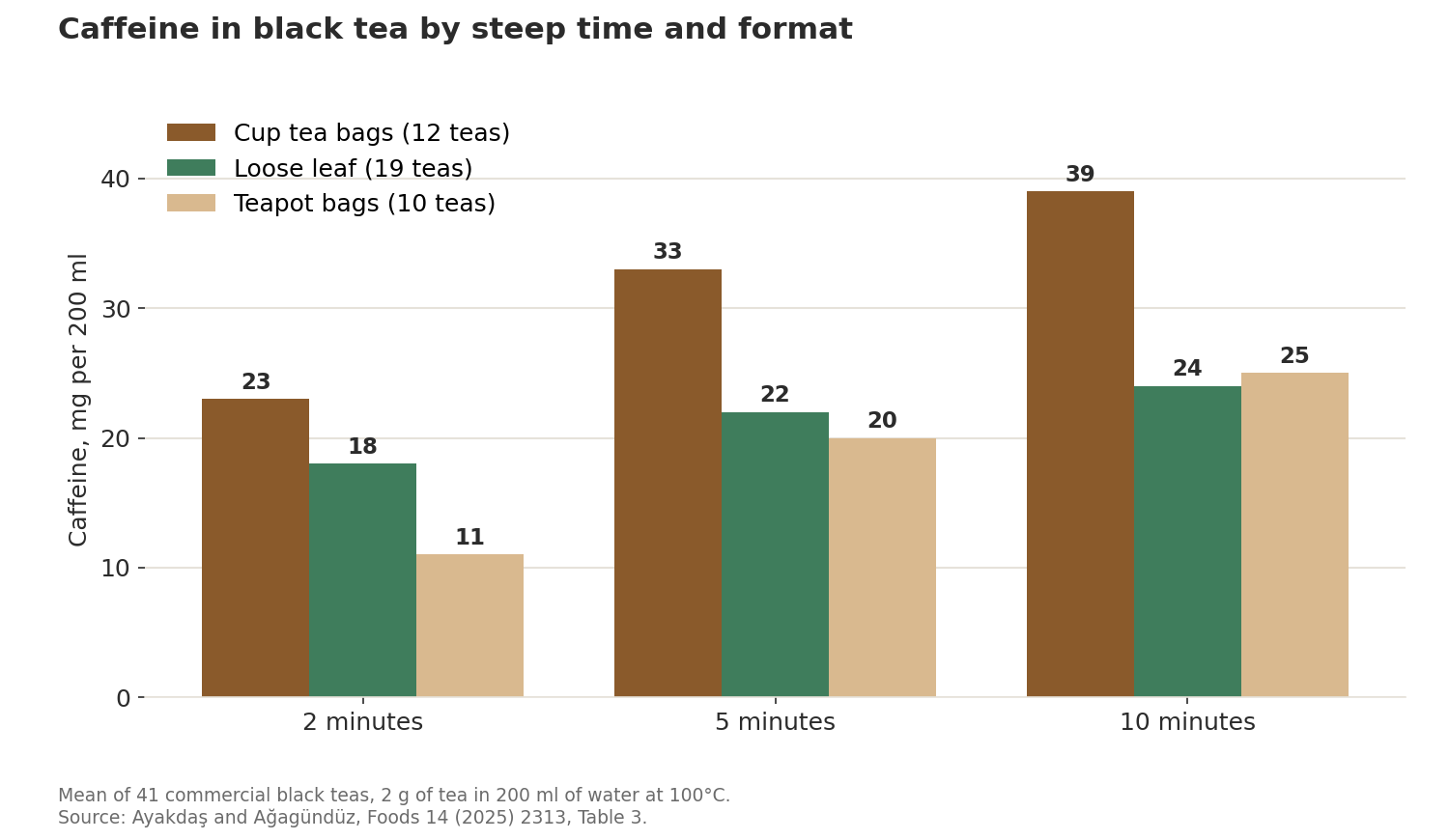
Caffeine comes out fast at first and then more slowly. A 2025 study brewed 41 black teas, using 2 g of tea in 200 ml of water. At 100°C, the average was 17 mg after 2 minutes, 23 mg after 5 minutes and 27 mg after 10 minutes. Even a full brew leaves caffeine behind. In a classic 1996 experiment, a 5-minute steep in boiling water released about 69% of the leaf’s caffeine on average, and a second steep released another 23%.
4. Tea bag or loose leaf
Cup-size tea bags gave the most caffeine in that study: 23 mg at 2 minutes and 39 mg at 10 minutes. Loose leaf gave 18 and 24 mg. The likely reason is particle size. Bagged tea is mostly small broken leaf or CTC granules, which have more surface area, so caffeine dissolves faster. A 2001 study found the same: grade, bag material and bag size all changed how much caffeine and polyphenol ended up in the cup. Large teapot bags were lowest of all per 200 ml in the 2025 tests, probably because they hold whole-leaf tea in a bigger, slower bag.
5. Water temperature
Hotter water extracts caffeine faster, but for black tea the difference is small once the steep passes a few minutes. In the 2025 tests, black tea at 80°C and 100°C both reached about 23 mg after 5 minutes. Cold water is a different story. Japan’s tea research institute found that green tea cold-brewed at 10°C released about half the caffeine of a hot brew. The same principle applies to black tea, which is why our cold brew tea guide is a good option if you want a gentler glass.
Does the type of black tea matter?
Less than you might think. Assam is often called the strongest black tea, and its leaf is naturally rich in caffeine, but a light Darjeeling brewed for 5 minutes can match a quick dip of an Assam bag. Breakfast blends are usually built from Assam, Ceylon and African teas and are sold in fine-cut bags, which helps explain their reputation for strength.
- Assam tea: malty and strong, often 40 to 60 mg in a mug.
- Darjeeling tea: lighter and floral, with caffeine that varies by flush.
- Ceylon tea: bright and brisk, in the middle of the range.
- Earl Grey: a black tea scented with bergamot, so it has the caffeine of its base tea.
Black and green tea come from the same plant. In the 2025 study, after 5 minutes at 100°C, black tea averaged 23 mg per 200 ml and green tea 25 mg, a difference the authors did not find significant. Green tea usually ends up lower in practice because it is brewed cooler and shorter. Our green tea vs black tea guide has the details.
Does milk or a second steep change it?
Milk does not remove caffeine. It only dilutes the tea, so a mug topped up with milk has the same caffeine as before, spread over more liquid. Whether you add it first or last makes no difference to the caffeine.
A second steep of the same leaves is lower, because most of the caffeine came out the first time. Rinsing tea for 30 seconds and throwing the water away does not decaffeinate it, despite the popular claim. Our article on how to decaffeinate tea at home explains what does and does not work.
Iced, bottled and chai black tea
Bottled iced tea is usually weaker than a hot cup. USDA lists ready-to-drink black tea at 11 mg per 100 g, or about 26 mg per 8 oz, though brands vary and some add extra caffeine or guarana. A 500 ml bottle at that strength holds about 55 mg, more than a standard cup of hot tea, so check the label rather than the serving size.
Homemade iced tea depends on how you make it. Tea brewed hot at double strength and poured over ice keeps all its caffeine, while tea steeped overnight in the fridge has less. Chai is usually made with strong black tea simmered with milk and spices. Simmering extracts caffeine well, but the milk takes up much of the cup, so a mug of masala chai often ends up close to an ordinary cup of black tea. Café chai lattes made from concentrate vary widely between brands.
It also helps to count across the day. Three large mugs of strong black tea at about 75 mg each come to 225 mg, which is well within adult limits but above the 200 mg pregnancy limit. Add a cola or a square of dark chocolate and the total climbs further.
How much black tea is too much?
The European Food Safety Authority says up to 400 mg of caffeine a day from all sources is safe for healthy adults, with single doses up to 200 mg. The US Food and Drug Administration uses the same 400 mg figure. At 47 mg a cup, that is about eight cups of black tea, or five large British mugs at the NHS figure of 75 mg. In pregnancy the limit is 200 mg a day, which is under three mugs. Our pregnancy tea guide lists caffeine-free alternatives, and how many cups of tea a day is healthy looks at the wider evidence.
Timing matters as well as total. EFSA notes that 100 mg close to bedtime may affect sleep in some adults. In a sleep study, 400 mg of caffeine taken even 6 hours before bed cut sleep time, so a pot of strong black tea in the evening can cost you rest. Switch to a caffeine-free tea in the afternoon if you sleep badly. If you drink a lot of tea and then stop suddenly, you may get a withdrawal headache, as our article on whether tea can cause headaches explains.
Why black tea feels gentler than coffee
Black tea also contains L-theanine, an amino acid that may smooth out caffeine’s edge. In the 2025 tests, black tea released about 21 to 23 mg of L-theanine per 200 ml after 5 to 10 minutes, about the same as its caffeine. Combined with the lower caffeine dose, this is one reason many people find tea gives steadier alertness. See our best tea for focus and matcha vs coffee guides for the research. If you want the biggest lift, our best tea to stay awake guide ranks the options.
How to control the caffeine in your cup
| You want | What to do |
|---|---|
| More caffeine | Use two bags or 3 g of leaf, boiling water, steep 5 minutes, choose a fine-cut Assam or breakfast blend |
| Less caffeine | One bag, steep 2 minutes, or cold brew in the fridge |
| Almost none | Buy decaf black tea or switch to rooibos |
| A steady amount every day | Use the same tea, cup and timer each time |
Quick answers
How many mg of caffeine is in a cup of black tea?
About 47 mg in an 8 oz cup on average, with a typical range of roughly 14 to 61 mg. A large mug brewed strong can reach about 75 mg.
Does black tea have more caffeine than coffee?
No. Filter coffee averages about 95 mg per 8 oz, twice as much as black tea, partly because a cup of coffee uses far more ground beans than a cup of tea uses leaf.
Does black tea have more caffeine than green tea?
Usually a little more per cup, mainly because black tea is brewed hotter and longer. Brewed the same way, the two are close.
Does steeping longer add caffeine?
Yes. In lab tests black tea went from about 17 mg after 2 minutes to 27 mg after 10 minutes per 200 ml. Most of the caffeine comes out in the first 5 minutes.
Is decaf black tea caffeine-free?
Not quite. Decaf black tea usually has 2 to 12 mg per cup. For none at all, choose a herbal tea such as rooibos or peppermint.
Sources
- USDA FoodData Central. Beverages, tea, black, brewed, prepared with tap water (FDC 173227).
- USDA FoodData Central. Beverages, tea, black, brewed, prepared with tap water, decaffeinated (FDC 174871).
- USDA FoodData Central. Beverages, tea, black, ready to drink (FDC 174144).
- USDA FoodData Central. Beverages, tea, green, brewed, regular (FDC 171917).
- USDA FoodData Central. Beverages, tea, Oolong, brewed (FDC 174120).
- USDA FoodData Central. Beverages, coffee, brewed, prepared with tap water (FDC 171890).
- USDA FoodData Central. Beverages, carbonated, cola, regular (FDC 174852).
- Chin et al. Caffeine content of brewed teas. Journal of Analytical Toxicology, 2008.
- Ayakdaş and Ağagündüz. Determination of L-theanine and caffeine contents in tea infusions with different fermentation degrees and brewing conditions. Foods, 2025.
- Sarmah et al. Biochemical quality profile of black tea from Upper Assam and North Bank region of Assam, India. Foods, 2026.
- Astill et al. Factors affecting the caffeine and polyphenol contents of black and green tea infusions. Journal of Agricultural and Food Chemistry, 2001.
- Hicks, Hsieh and Bell. Tea preparation and its influence on methylxanthine concentration. Food Research International, 1996.
- Monobe. Health functions of compounds extracted in cold-water brewed green tea. Japan Agricultural Research Quarterly, 2018.
- Mitchell et al. Beverage caffeine intakes in the U.S. Food and Chemical Toxicology, 2014.
- Drake et al. Caffeine effects on sleep taken 0, 3, or 6 hours before going to bed. Journal of Clinical Sleep Medicine, 2013.
- NHS. Foods to avoid in pregnancy (caffeine).
- European Food Safety Authority. Caffeine.
- US Food and Drug Administration. Spilling the beans: how much caffeine is too much?
Last updated: 11 October 2026. Sources are linked in the text.