Bigelow Tea is owned by the Bigelow family. The business identifies its legal company as R.C. Bigelow Inc. and describes itself as entirely family and women owned in its FY2025 supply-chain report. Cindi Bigelow, granddaughter of founder Ruth Campbell Bigelow, is its third-generation president and CEO. Family ownership, however, does not mean that all its tea leaves are grown in America. [1] [2]
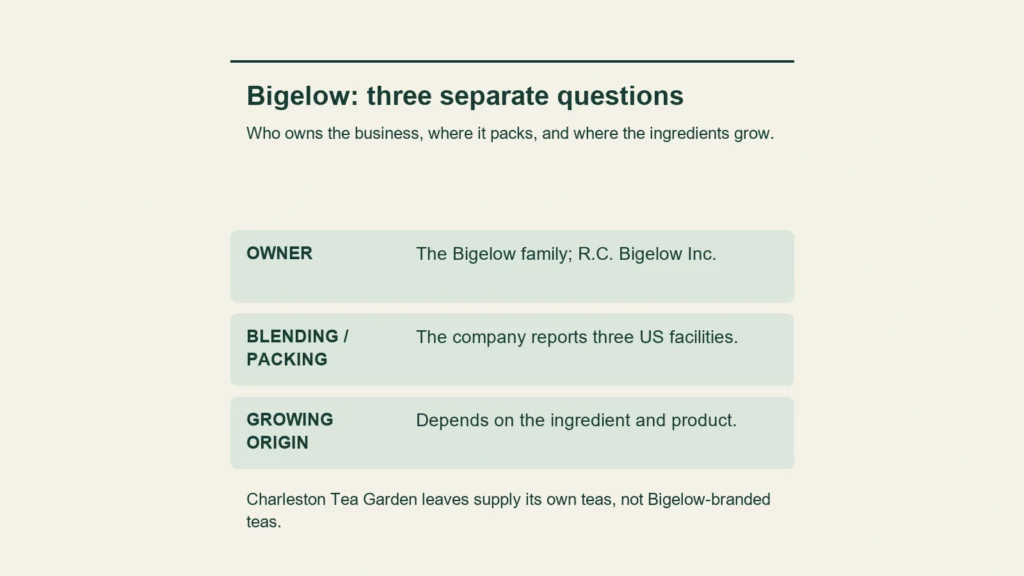
To understand the company behind a box, separate three questions: who owns the business, where the product is blended and packed, and where its ingredients were grown. The Charleston Tea Garden connection makes that distinction especially useful here.
Bigelow ownership at a glance
| Question | What the records say |
|---|---|
| Who owns Bigelow Tea? | The Bigelow family. [1] |
| What is the company called? | R.C. Bigelow Inc., Fairfield, Connecticut. [1] |
| Who runs it? | Cindi Bigelow, president and CEO since 2005. [2] |
| Who founded it? | Ruth Campbell Bigelow in 1945. [4] |
| Does Charleston supply Bigelow tea bags? | No; the garden describes a separate leaf supply. [3] |
The evidence for family ownership
Bigelow’s Canadian Bill S-211 report covers 1 July 2024 to 29 June 2025. Its company-structure section names the legal entity and states full family and women ownership. This is a dated company disclosure. [1]
The company’s current story page also says the business remains wholly family owned and operated. A September 2026 company press release repeats the family and woman-owned description. Together, these sources support the current ownership answer; they do not disclose the percentage held by each relative or the terms of any family trusts. [4] [5]
The sources identify the family as owner and Cindi as its executive leader. They do not establish that she personally holds every share, and the pages reviewed do not supply an individual shareholder register.
For readers comparing supermarket brands, Bigelow belongs in the family-owned part of the picture described in our guide to tea-brand ownership. That classification describes control of the business. It does not, by itself, establish better flavour, working conditions or environmental performance.
Three generations, with different roles
Ruth Campbell Bigelow founded the business in 1945 with the spiced black tea that became Constant Comment. The company’s account describes black tea blended with orange rind and sweet spices in her family kitchen. That origin explains why the founder’s name and the original blend remain central to the brand’s identity. It is the company’s history of its own beginnings, rather than an independently witnessed account of the first recipe. [4]
The leadership then passed through her son David C. Bigelow to her granddaughter Cindi. Cindi’s official biography dates her assumption of the leadership role to 2005, following two decades working in different parts of the business. The significant point for ownership is continuity of family leadership, not a suggestion that the product or business has stayed unchanged since 1945. [2]
The scale is now very different from a kitchen operation. In the company description attached to its September 2026 release, Bigelow reports annual production above 2.3 billion tea bags across three US blending and packaging facilities. That is a company-reported production figure, not audited revenue, the number of cups actually drunk or an independent measure of market share. [5]
Charleston Tea Garden and the leaf-origin question
Charleston Tea Garden’s FAQ dates the Bigelow family’s purchase to 2003 and describes its partnership with former owner William Barclay Hall. South Carolina’s Department of Agriculture also identifies the garden as owned by Bigelow Tea. The garden is on Wadmalaw Island, with tea plants grown on the property. [3] [6]
The crucial purchasing detail is the separate product stream. The garden says its harvested leaves go into Charleston Tea Garden teas, not Bigelow teas. Owning an American tea farm therefore does not make an ordinary box of Bigelow black tea a Charleston-grown product. A photograph of the garden on a company website cannot answer the sourcing question for a different box. [3]
Bigelow’s ingredient page describes black-tea sourcing from growing regions including India and Sri Lanka. It separately describes American-grown mint from the Pacific Northwest and bergamot relationships in Calabria, Italy. These are ingredient-specific accounts: the origin of mint in a herbal infusion cannot establish the origin of black tea in another blend. [7]
If growing origin is your priority, begin with the exact product name and its current label. Our guides to Assam tea and Ceylon tea explain two of the producing regions mentioned by Bigelow. They describe tea origins, rather than different owners of the Bigelow brand.
What certification adds to the ownership answer
B Lab’s directory lists Bigelow Tea as a Certified B Corporation, certified since April 2019. Its profile also describes the company as family owned. The certification record is useful corroboration of the business’s identity and certification status, but it is not a list of shareholders. B Lab is the certifying organisation, not Bigelow’s parent company. [8]
Bigelow’s FY2025 statement describes supplier-code requirements, possible audits and remediation or termination for non-compliance. These are stated controls, not independent proof of inspections at every farm or identical certification across all ingredients. [1]
A practical check for the box in front of you
- Identify the range. Record whether the box says Bigelow, steep by Bigelow or Charleston Tea Garden. Keep the exact blend name beside it.
- Separate company and crop. A family-ownership statement answers who controls the business. A packing statement answers where a production step occurred. Look separately for a claim about where the tea was grown.
- Check the ingredient concerned. Black tea, mint, chamomile and bergamot can have different origins within the same company’s range.
- Ask a specific sourcing question. If the label is silent, give customer service the product and batch details and ask about that ingredient. Do not treat the absence of an origin statement as evidence of a particular country.
Sources
- R.C. Bigelow Inc. — Canadian Bill S-211 report, FY2025, company structure and supply chain.
- Bigelow Tea — Cindi Bigelow biography, leadership role and succession.
- Charleston Tea Garden — FAQ, ownership relationship and separate tea-leaf supply.
- Bigelow Tea — The Bigelow Story, founder, original blend and family ownership.
- Bigelow Tea — September 2026 Community Challenge release, About Bigelow Tea section.
- South Carolina Department of Agriculture — Charleston Tea Garden, garden ownership and location.
- Bigelow Tea — Discover Our Ingredients, separate origin accounts for black tea, mint and bergamot.
- B Lab — Bigelow Tea certification profile, certification since April 2019.
Research checked on 5 November 2026. This article uses public company disclosures, the garden’s own explanations and the records linked above. It does not claim access to private shareholder records, an interview or a visit to the garden.
Last updated: 5 November 2026. Sources are linked in the text.