To clean a tea kettle, fill it halfway with water, add one to two tablespoons of citric acid (or use equal parts white vinegar and water), bring it to the boil, then leave it for 20 to 60 minutes. Pour it out, wipe away any loosened scale, and rinse. Boil and discard one kettle of fresh water before you make tea. In hard-water areas, do this about once a month.

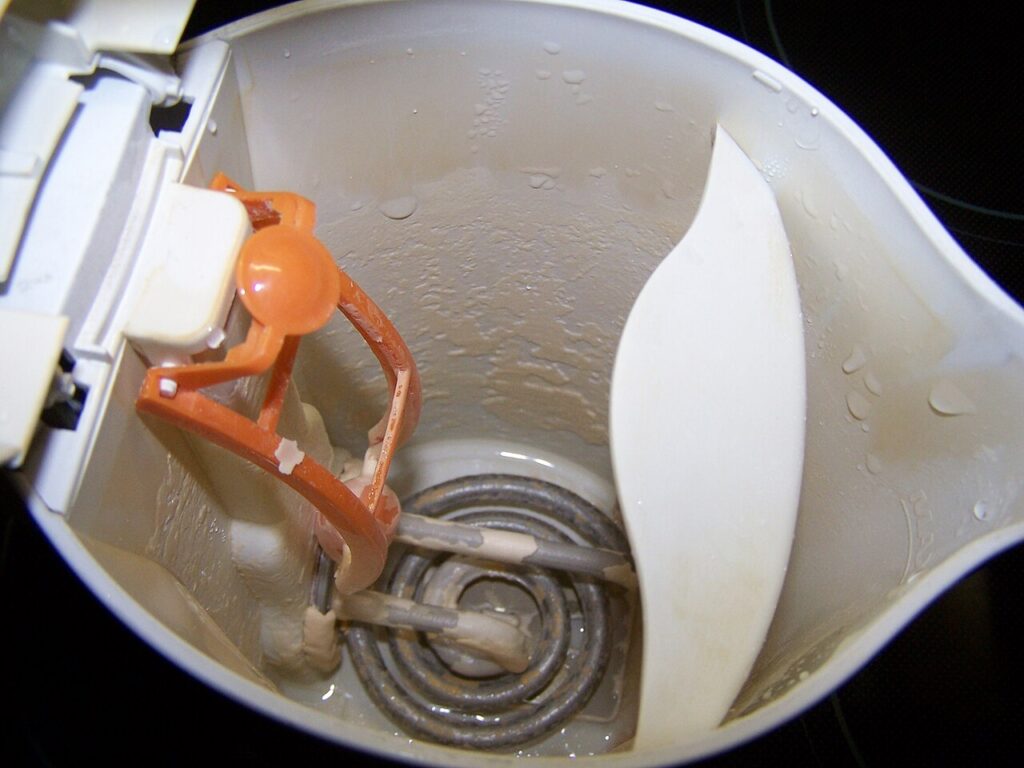
The white or beige crust inside a kettle is limescale. It is not dirt, and it is not a sign that the kettle is unsafe. It forms because tap water carries dissolved calcium and magnesium, and heating water pushes some of those minerals out of solution as solid carbonate. Every boil leaves a little more behind. Over weeks it shows up as flakes floating in your cup, a chalky film on the surface of your tea, and a kettle that takes longer to boil.
Because limescale is a carbonate, a mild acid dissolves it. That is the whole trick behind every method below. The choices are about which acid to use, how strong to make it, and which kettles need a gentler approach.
The quick method, step by step
This works for most stainless steel, glass and plastic electric kettles and for stovetop kettles.
- Empty the kettle and let it cool if you have just used it.
- Fill it about halfway with water. For an average 1.7-litre electric kettle, that is roughly 800 ml to 1 litre. Make sure the water covers every scaled surface, including the element.
- Add the descaler: one to two level tablespoons of citric acid powder, or replace half the water with white vinegar. For light scale, one tablespoon of citric acid is plenty.
- Bring it to the boil. Watch the first minute: the solution fizzes as the acid reacts with the scale and releases carbon dioxide. If it foams towards the spout, switch off and let it settle.
- Leave it to stand for 20 to 30 minutes for light scale, or up to an hour for a thick crust.
- Pour the solution away. Wipe out any softened scale with a soft cloth or a non-scratch sponge. Use a soft bottle brush for the spout and filter.
- Rinse two or three times with fresh water.
- Fill with fresh water, boil it and throw it away. This removes any taste of vinegar or citric acid. After vinegar, a second rinse-boil is worth doing.
If some scale remains, repeat with a fresh batch rather than scrubbing hard. Thick deposits often need two rounds. Never use steel wool or abrasive powders inside the kettle: they scratch stainless steel and glass, and rough surfaces give new scale more places to form.
Citric acid, vinegar or lemon: which descaler to use
All three work, because all three are acids that dissolve calcium carbonate. They differ in strength, smell and how much you need. The table below shows how much of each it takes, in theory, to dissolve 10 g of limescale. That is a heavy crust for a household kettle. The figures come from the chemistry of the reaction: two molecules of citric acid dissolve three of calcium carbonate, and two molecules of acetic acid (the acid in vinegar) dissolve one.
| Descaler | Amount to dissolve 10 g of scale (theory) | Pros | Cons |
|---|---|---|---|
| Citric acid powder | About 13 g (1 heaped tablespoon) | Strongest per spoonful; no smell; cheap in bulk | Can leave a thin white film of calcium citrate that needs a wipe |
| White vinegar (5% acetic acid) | About 240 ml | Already in most kitchens | Strong smell; needs extra rinse-boils; slower on thick scale |
| Fresh lemon juice | About 260 ml (5 to 6 lemons) | Pleasant smell | Expensive for the job; pulp needs rinsing out |
| Bottled lemon juice | About 340 ml | Convenient | Weaker and pricier than citric acid powder |
| Commercial kettle descaler | Follow the pack | Measured dose; often citric or sulphamic acid | Costs more than plain citric acid |
For most people, citric acid is the best choice. Gram for gram it does more work than vinegar, and it leaves no smell in the kettle. Food-grade citric acid is sold in supermarkets and online for baking and canning. Lemon juice is simply a dilute form of the same acid. Penniston and colleagues measured 1.44 g of citric acid per fluid ounce of fresh lemon juice, which works out at about 49 g per litre. You would need to squeeze a lot of lemons to match one spoonful of powder.
Vinegar is the fallback when you have nothing else. It takes longer on thick deposits because acetic acid is a weaker acid than citric acid. Plan on at least two rinse-boils afterwards.
How much limescale your water leaves behind
How often you need to descale depends almost entirely on how hard your water is. The US Geological Survey classes water by its hardness, measured as milligrams of calcium carbonate per litre: 0 to 60 mg/L is soft, 61 to 120 mg/L moderately hard, 121 to 180 mg/L hard, and more than 180 mg/L very hard. Your water supplier publishes the figure for your area.
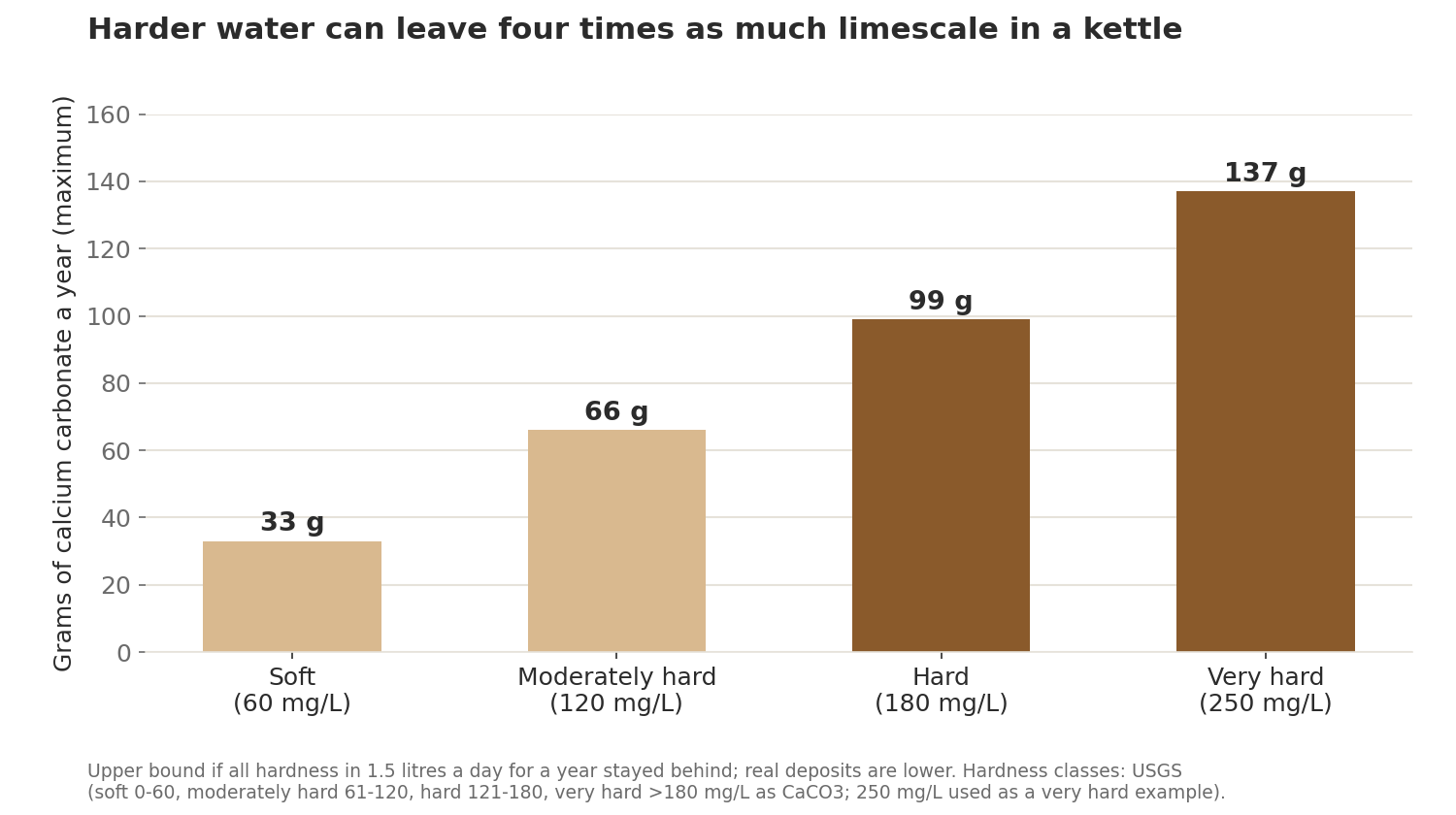
The chart shows the most scale a kettle could collect in a year if you boil 1.5 litres a day. Only part of the hardness actually drops out as scale, so a real kettle collects less. The comparison is the useful part. A kettle in a very hard-water town can build up four times as much as one in a soft-water area, which is why descaling advice ranges from monthly to every few months.
How often to descale a kettle
| Water hardness | mg/L as calcium carbonate | Suggested descaling |
|---|---|---|
| Soft | 0 to 60 | Every 3 to 6 months, or when you see scale |
| Moderately hard | 61 to 120 | Every 2 to 3 months |
| Hard | 121 to 180 | Monthly |
| Very hard | Over 180 | Every 2 to 4 weeks, especially if the kettle is used many times a day |
The kettle maker Russell Hobbs advises descaling “at least monthly”, and more often if you use the kettle more than five times a day. The company says regular descaling prolongs the life of the kettle and reduces boiling times, which cuts energy use. It also says to use only descalers that are suitable for plastic, and to follow the instructions on any commercial product.
Cleaning different types of kettle
Stainless steel and glass electric kettles
These take the quick method above without any problem. With glass kettles you can watch the scale dissolve, and it is easy to see when you are done. Wipe the outside with a damp cloth and a drop of washing-up liquid. Never put the base, the cord or the kettle body under running water or into a dishwasher unless the manual says you can.
Kettles with a removable filter
The mesh filter in the spout catches flakes and clogs quickly. Pull it out and soak it in the same citric acid solution for 15 minutes, then rinse it under the tap and brush it gently with an old toothbrush. A clogged filter is a common reason a kettle starts to pour slowly or splutter.
Stovetop and enamel kettles
Descale the inside the same way, bringing the solution to the boil on the hob. For burnt-on marks or grease on the outside of a stainless steel kettle, make a paste of bicarbonate of soda and a little water, rub it on with a soft cloth, then rinse. Enamelled kettles chip if you scrape them, so use only soft cloths and avoid bleach, which can dull the finish.
Cast iron tetsubin
A Japanese cast iron kettle is the exception to almost everything above. Makers of Nanbu tetsubin advise against soap, detergents and scrubbing inside the kettle. A thin mineral layer on the interior is wanted. It forms from repeated boiling of tap water and helps protect the bare iron from rust. Do not descale a tetsubin with vinegar or citric acid. An acid soak strips that layer and can start rust. Rinse it with hot water only, and dry it completely after each use by emptying it while hot and leaving the lid off. If rust spots appear, the traditional fix is to boil used green tea leaves in the kettle. The tannins in the leaves react with the rust and darken it into a stable coating.
A cast iron teapot with an enamel lining is a different object. It is for steeping tea, not for boiling water on a hob, and it should be hand-washed and never put on direct heat.
Is limescale in a kettle harmful?
No. Limescale is mostly calcium and magnesium carbonate, the same minerals in the water you drink. In its background review of water hardness, the World Health Organization found insufficient data to set a minimum or maximum level for these minerals and proposed no health-based guideline value. The problems are practical ones. The WHO notes that scale deposits in heated water applications coat surfaces and reduce the efficiency of heat transfer. In a kettle that means slower boiling, flaky tea and a filter that clogs.
The one metal worth knowing about is nickel. A 2000 study by the Danish Veterinary and Food Administration tested 26 electric kettles sold in Denmark and found that 10 released more than 50 micrograms of nickel per litre of water. The agency chose that threshold because lower levels were unlikely to trigger eczema in people with a nickel allergy. After talks with the regulator, the makers changed the construction of the kettles that failed. In a follow-up test of 10 more kettles, two still exceeded the limit and were withdrawn from sale. Lead and chromium were not released in significant amounts. If you have a nickel allergy, a kettle with a concealed element and a stainless steel or glass interior is the cautious choice.
How to keep a kettle clean for longer
- Empty the kettle after each use instead of letting water sit and reboil. Standing water leaves scale as it evaporates.
- Boil only the water you need. Less water through the kettle means less scale and less energy.
- Use filtered water in very hard-water areas. A jug filter with an ion-exchange cartridge lowers the hardness that forms scale, and many people find it improves the taste of tea too.
- Descale little and often. A monthly 20-minute citric acid soak takes less effort than chipping off a thick crust twice a year.
Water quality affects taste as much as it affects the kettle. Hard water can leave a dull film on black tea, and very soft water can taste flat. For the other half of a good cup, see our guide to brewing temperature and steep time and how to brew green tea, which is the tea most sensitive to over-hot water.
Frequently asked questions
How do I clean the outside of a stainless steel kettle?
Wipe it with a cloth dampened with warm water and a little washing-up liquid, then buff it dry along the grain to avoid streaks. For stubborn marks, use a paste of bicarbonate of soda and water. Unplug an electric kettle first and keep water away from the base and switch.
Can I use baking soda to descale a kettle?
Not effectively. Bicarbonate of soda is alkaline, and limescale needs an acid to dissolve. Baking soda is useful as a gentle scouring paste for stains on the outside, but citric acid or vinegar does the descaling.
Why does my tea have a film or scum on top?
That film forms when compounds in tea react with calcium carbonate in hard water. It is a sign of hard water, not of a dirty kettle, although scale flakes in the kettle make it worse. Filtered water and a descaled kettle usually reduce it. A slice of lemon lowers the pH of the tea and can clear the film as well.
How do I get rid of the vinegar smell after descaling?
Rinse the kettle, then boil a full kettle of fresh water and discard it. Repeat once or twice. Leaving the lid open for an hour also helps. Citric acid avoids the smell altogether.
Is it safe to drink water from a kettle with limescale?
Yes. The minerals in limescale are the calcium and magnesium already present in your tap water. Descaling is about taste, efficiency and the life of the kettle, not safety.
The bottom line
Limescale is calcium carbonate, and acid dissolves it. Half-fill the kettle, add a tablespoon or two of citric acid or swap half the water for white vinegar, boil, leave it for 20 to 60 minutes, then rinse and do one plain boil. Citric acid is stronger per spoonful and leaves no smell. Descale monthly in hard-water areas and every few months in soft ones. Keep acids out of a cast iron tetsubin, which relies on its mineral layer to stay rust-free.
Once your kettle is clean, keep your leaves fresh too. See how to store tea, or make a jug of cold brew tea that needs no kettle at all.
Sources
- U.S. Geological Survey. Hardness of Water. Water Science School.
- World Health Organization. Hardness in Drinking-water. Background document for development of WHO Guidelines for Drinking-water Quality. WHO/HSE/WSH/10.01/10/Rev/1, 2011.
- Russell Hobbs. How can I descale the kettle and how often should I do this? Customer help centre.
- Penniston KL, Nakada SY, Holmes RP, Assimos DG. Quantitative assessment of citric acid in lemon juice, lime juice, and commercially-available fruit juice products. J Endourol 2008;22(3):567-70.
- Berg T, Petersen A, Pedersen GA, Petersen J, Madsen C. The release of nickel and other trace elements from electric kettles and coffee machines. Food Addit Contam 2000;17(3):189-96.