Tea is a dried agricultural product, and the rules for keeping it fresh are the same as for any dried food: keep it dry, dark, cool, sealed, and away from strong odours. The details — container, shelf, refrigerator, freezer, time — change with the tea. Here is what actually works at home, with the published research on storage temperature and polyphenol loss.
Stale tea is rarely the result of a wrong container; it is the result of moisture, oxygen, light, heat and foreign smells working together to change the leaf. The good news is that the four enemies of fresh tea are all controllable at home. The bad news is that storage advice online is full of folklore that ignores basic food chemistry. This article works through the evidence and finishes with a practical decision table.
What actually ages tea
Four things change dried tea over time.
- Moisture. The single biggest lever. Dried tea is hygroscopic: it absorbs water from the air until it reaches an equilibrium with the room. Once the leaf moisture climbs above about 6%, enzymatic and microbial activity picks up, chlorophyll breaks down, and the cup goes flat or sour.
- Oxygen. Polyphenols oxidise slowly even in dry leaf. Green and white teas lose catechins faster than black teas because their polyphenol mix is less oxidised to begin with; this is part of why green tea needs more careful storage than a black breakfast blend.
- Light. UV and visible light break down chlorophyll and aroma compounds. A clear glass jar on a sunny counter is the worst case. A foil-lined pouch or an opaque tin protects against it.
- Heat. Every 10 °C rise in storage temperature roughly doubles the rate of polyphenol degradation. A 2024 study in Beverages on green tea found that samples stored at −20 °C retained 28.12 mg GAE/g of polyphenols after 90 days, while samples stored at 40 °C dropped to 25.58 mg GAE/g — a 9% loss that translates into a flatter, less antioxidant cup.
Added to those is a fifth, often-overlooked factor: foreign odour. Dried tea is hygroscopic and lipophilic at the same time — it both absorbs water and holds onto volatile aromatic compounds. Storing tea next to coffee, spices or cleaning products is the fastest way to ruin an otherwise good leaf.
A simple decision table for home storage
For most home drinkers, the rule is short: airtight, opaque, cool, dry, away from anything strongly scented. The rest is detail. The table below is a starting point; adjust for your climate, your kitchen and the volume of tea you actually go through.
| Tea | Best container at home | Best location | Realistic shelf life |
|---|---|---|---|
| Green tea (loose or sachets) | Airtight tin or jar with rubber seal, opaque if possible | Cool, dark cupboard, 15–22 °C; fridge only if very dry and well sealed | 6–12 months for best flavour, 18 months acceptable |
| White tea | Same as green tea | Same as green tea | 1–2 years, sometimes longer for cake-style storage |
| Yellow tea | Same as green tea | Same as green tea | 1–2 years |
| Oolong (light) | Airtight tin, opaque | Cool dark cupboard, 15–22 °C | 1–2 years |
| Oolong (dark / roasted) | Airtight tin | Cool dark cupboard | 2–3 years, sometimes longer |
| Black tea (CTC, orthodox) | Airtight tin or jar | Cool dark cupboard; refrigeration rarely needed | 2 years for orthodox, 1.5 years for CTC, longer for some pu-erh-style processing |
| Pu-erh (sheng, raw) | Original paper or breathable wrap, then a loose outer box | Cool, dark, well-ventilated shelf away from strong odours | Improves for years under proper “natural storage” conditions |
| Pu-erh (shou, ripe) | Same as sheng; less demanding | Same as sheng | Stable for years; flavour is a matter of taste |
| Flavoured or scented teas | Airtight tin, separate from plain teas | Cool dark cupboard | 6–12 months; aroma fades faster than the leaf itself |
| Matcha | Tin, original packaging, refrigerate after opening | Refrigerator (not freezer) once opened; bring to room temperature before opening | 2–4 weeks for best colour and umami after opening; longer if unopened and nitrogen-flushed |
| Iced-tea sachets / commercial blends | Original sealed packaging | Cool dark cupboard | Best-by date on the package is the practical ceiling |
How storage method changes freshness over time
The chart below compares three storage regimes for the same green tea across 24 months. An open paper bag on a counter is the worst case: the leaf picks up kitchen moisture and humidity cycles, picks up odours, and is exposed to light. The cup quality falls off in months. A sealed jar in a cupboard holds much more of the leaf’s aroma and colour through the first year. An opaque, airtight tin in a cool, dark place holds a usable cup for two years and beyond.
Inline SVG stripped by WordPress security policy (svg_uploads:false). Chart data preserved in surrounding prose.
Storage method comparison over 24 months: open paper bag drops to ~5; sealed jar in cupboard drops to ~55; airtight tin cool/dark drops to ~78.
Three caveats matter. First, the shape of each curve depends on the tea: green and white teas drop faster than black because their remaining polyphenols and chlorophyll are more reactive. Second, the curves flatten — the last 20% of cup quality is much harder to lose than the first 20%, and vice versa. Third, “freshness” here is a sensory score, not a chemical assay. Aroma and brightness are the first things to fade; body and basic tea character can linger long after.
A practical way to think about the curves is in three time bands. Months 0–3: any reasonable storage method keeps the leaf close to fresh; the differences between methods are small in the cup. Months 3–12: the differences open up; the open paper bag is in measurable decline, the sealed jar holds most of the leaf’s character, and the airtight tin is close to peak. Months 12–24: the open bag is essentially spent, the sealed jar is on a slow decline, and the airtight tin is the only method that still produces a recognisable cup. Most tea drinkers underestimate the third band — the difference between a cupboard tin and a counter pouch does not show up in the first month, but it shows up clearly in month 18.
Container choices that work
Airtight tins and jars with rubber seals
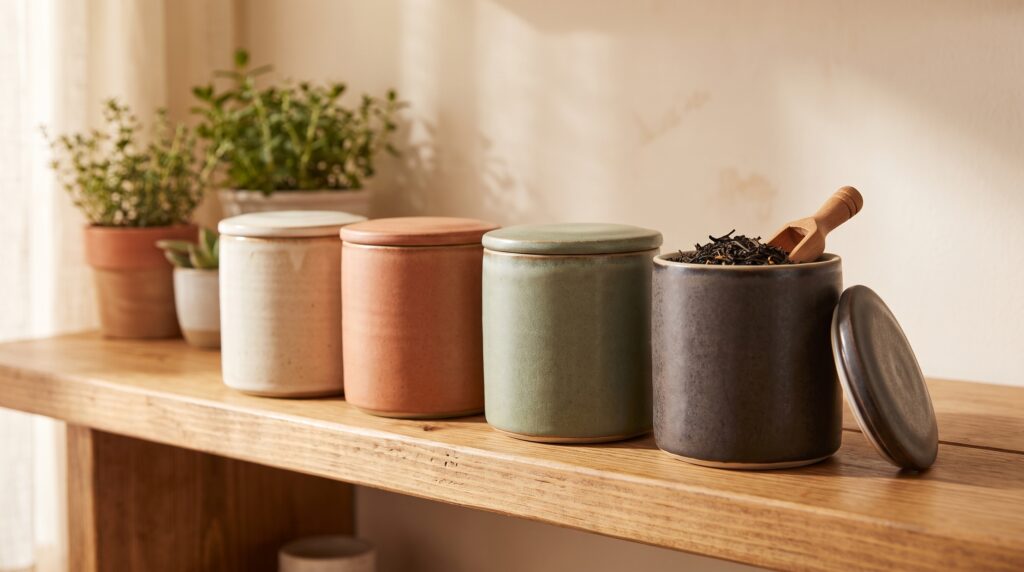
The single most useful upgrade. A tin or jar with a proper gasket (think Le Parfait-style glass jars with rubber clamps, or quality Japanese tea canisters) limits air exchange and protects against kitchen humidity. Glass is fine if the canister sits in a cupboard; in direct sun, choose opaque metal or ceramic.
Foil-lined pouches and nitrogen-flushed packs
Most commercial loose-leaf tea and matcha arrives in foil or metallised pouches, sometimes flushed with nitrogen. These are good as long as the seal is intact. Once opened, decant into a sealed tin. Cutting the top of a foil pouch and re-folding it is one of the most common ways people lose freshness quickly.
Wooden boxes and ceramic caddies
These look good but on their own are usually not airtight. They are fine for short-term display storage (a few weeks) or as outer shells for an inner bag. They are not the primary barrier against air, light and moisture.
Containers to avoid
Clear glass jars on a sunny countertop, unsealed tins, decorative wooden boxes without inner bags, and the original paper or cellophane wrapper after the first opening. These all expose the leaf to the four enemies at once. A tea bag in its paper envelope left on a kitchen counter for three weeks is the everyday version of the same problem.
Tea in the fridge
Usually no. A domestic refrigerator is a humid environment with a lot of aromatic food in it, and most teas are not packaged for that. Storing green tea in a fridge without a truly airtight seal can leave it wetter and smellier than the cupboard. The exception is matcha: once opened, refrigeration slows the loss of chlorophyll and theanine, which is why most Japanese matcha producers recommend refrigeration after opening. Keep matcha in its tin inside a sealed zip bag, and let the tin come to room temperature before opening so condensation does not form on the leaf.
For long-term bulk storage of green tea, a small dedicated dry-goods fridge or a low-temperature dry cabinet is a reasonable solution. If that is not available, buy smaller quantities more often and store in the cupboard.
Tea in the freezer
Freezing is sometimes used for very long storage of green tea in commercial settings. The 2024 Beverages study cited above found that green tea samples stored at −20 °C retained measurably more polyphenols than room-temperature samples over 90 days — the chemistry supports the practice in principle. At home, the moisture and condensation risk is usually larger than the benefit. If you do freeze, follow the rules: the leaf must be bone-dry, sealed in a moisture-proof bag with as much air removed as possible, and brought fully to room temperature before the bag is opened. Re-freezing and re-opening the same bag will damage the leaf faster than a cupboard.
Special cases
Pu-erh and aged teas
Sheng (raw) pu-erh is one of the few teas that is designed to change in storage. Under “natural storage” conditions — clean air, moderate humidity (around 60–75% relative humidity in traditional practice), stable temperature, good ventilation, and no strong odours , the leaves slowly change through continued microbial and enzymatic activity. The leaf is usually kept in its original paper wrapper inside a loose box or cloth bag. Sealing it in a plastic bag or storing it in an airtight jar stops the change. This is not an error, it is the design. For shou (ripe) pu-erh the change is less dramatic and good storage is mostly about keeping the leaf dry and ventilated.
Flavoured and scented teas
The added aroma compounds (bergamot, jasmine, vanilla, fruit pieces, spices) fade faster than the underlying leaf. Sealed storage helps, but expect noticeable aroma loss after 6 to 12 months regardless of container. Keep flavoured teas in a separate tin from plain teas, otherwise the plain tea picks up the flavour and the flavoured tea loses it.
Tea bags vs loose leaf
For long-term storage, individually wrapped tea bags (foil or paper-over-foil) hold freshness well because each cup is sealed until use. Once a packet is opened, the clock starts. Loose leaf ages faster once exposed, but the same airtight-tin rule applies. The difference is mostly the surface-area-to-volume ratio: a kilogram of black tea in a small tin keeps better than a kilogram spread across 200 opened tea bags.
A practical home routine
- Buy in volumes you can finish. A 50 g tin of green tea at one cup a day is roughly a month and a half. Beyond that, the cup quality is in measurable decline even in good storage.
- Decant opened pouches into a sealed tin within a week. Don’t trust the original foil as long-term storage.
- Keep plain and flavoured teas in separate tins. Aroma transfer is one of the fastest ways to ruin a delicate green.
- Store green, white, and matcha in the back of the cupboard. Away from the oven, the dishwasher and any window.
- Refrigerate opened matcha. Bring to room temperature before opening.
- Write the open date on the tin. A small label on the bottom of each tin is the cheapest freshness tracker available.
Commercial storage at the cupper’s bench
The four-enemies framework is consumer-side; on the professional cupping bench, the same constraints apply at higher resolution. Tea brokers and tasting rooms keep samples in nitrogen-flushed foil at 4°C, away from light, with humidity controlled to about 60%. The home approximation is the tin, the cupboard, the smaller pack, and the willingness to decant weekly rather than monthly. The professional setup is just the same idea, scaled up and instrumented.
Why some producers vacuum-seal at origin
Top-grade Japanese green teas are vacuum-sealed at the producing garden within hours of processing, then shipped refrigerated. The vacuum-seal removes oxygen, the fridge removes the heat that drives oxidation, and the timing removes the delay that lets the leaf respire. The home equivalent is the tin-and-cupboard routine, accelerated and instrumented. The vacuum-seal at origin is what lets a six-month-old sencha taste closer to fresh than a one-month-old sencha stored in paper.
Frequently asked questions
Tea spoilage and freshness
Old tea is rarely dangerous to drink, but it can be musty, flat, papery or sour. Visible mould or a strong off-odour are signs to discard the leaf. In normal home storage, tea “goes bad” in the sense of becoming uninteresting long before it becomes unsafe.
Decorative wooden storage
Only as a display shell around a sealed inner bag. On its own, a wooden box usually does not seal against air or moisture, and some woods release aromatic compounds that the tea will absorb.
Silica gel packets
Food-grade silica gel is a reasonable safety net in humid climates, especially for green tea and matcha. It is not a substitute for an airtight seal, and it should be the kind approved for food contact. Do not use loose desiccants from generic hardware packaging.
Vacuum-sealed storage
Yes for medium-term storage, especially when buying in bulk. A vacuum sealer removes most of the oxygen and keeps the leaf dry. Allow the sealed bag to come to room temperature before opening to avoid condensation.
Green tea hay flavour
That is the textbook staling flavour. The leaf has lost most of its volatile aroma and is now dominated by breakdown products of chlorophyll and catechins. It is a sign that the leaf has been exposed to too much air, light or heat, and it is a useful early warning to improve storage before the leaf goes truly flat.
The bottom line
Tea storage is not a complicated topic once the four enemies are named. Use an airtight, opaque container, keep it in a cool dark cupboard, do not store it next to strong-smelling food, and buy in volumes you can finish. Matcha, flavoured tea and pu-erh each have their own rules, but the principle is the same: keep the leaf dry, dark, cool and away from anything that is not tea. The published research is consistent on the four-enemy model, and the only contested point , the fridge for green tea , usually resolves into “no for most home drinkers, yes for matcha after opening”.
The single most useful habit is also the cheapest: write the open date on every tin. Most storage problems are not container problems, they are calendar problems. A 50 g tin of green tea opened today and forgotten for a year is a tin of paper. The same tin opened today, dated, and finished in two months is a tin of tea. Most of the storage advice below works because it forces a decision early: buy smaller amounts, decant quickly, write the date, finish the tin.
For the brewing ranges that protect the leaf’s polyphenols during extraction, see the brewing guide. For the freshness windows that matter for a daily black tea routine, see best tea for focus. For how processing changes the polyphenol mix in the first place, see green tea vs black tea.