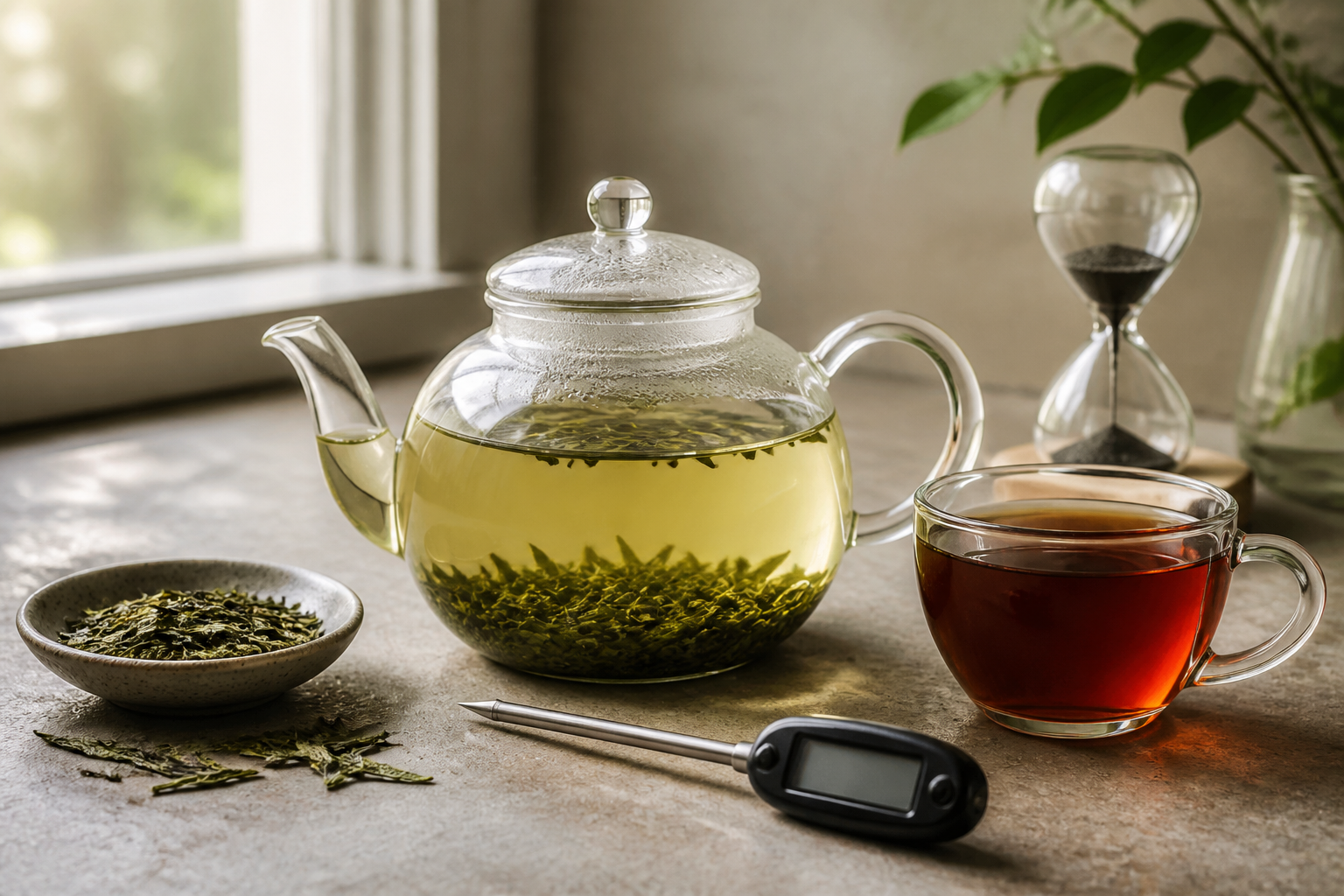
To brew green tea, use about 2 to 3 g of leaf (a level teaspoon) for every 200 ml of water, heated to 70 to 80°C, not boiling. Steep for 1 to 3 minutes, then pour off all the tea so the leaves stop brewing. Water that is too hot and a steep that runs too long are the two causes of bitter green tea, and research on brewing temperature shows why.

Green tea has a reputation for tasting grassy and harsh, and most of that is down to the kettle. Black tea is made to stand up to boiling water. Green tea is not oxidised, so its catechins, which are the source of its bitterness and astringency, are intact and extract fast in very hot water. Its sweet, savoury amino acids, above all L-theanine, dissolve well at lower temperatures. Cooler water gets you more of the flavour you want and less of the bitterness you don’t.
Green tea brewing chart by type
| Green tea | Water temperature | Leaf per 200 ml | First steep | Notes |
|---|---|---|---|---|
| Sencha (standard steamed) | 70 to 80°C | 3 to 4 g | 1 to 2 min | The everyday Japanese green tea |
| Fukamushi (deep-steamed) sencha | 70 to 80°C | 3 to 4 g | 30 to 60 s | Fine leaf, cloudy liquor, brews fast |
| Gyokuro | 50 to 60°C | 5 to 6 g | 2 min | Shaded tea; low heat keeps it sweet and savoury |
| Longjing (Dragon Well) | 75 to 85°C | 3 g | 2 to 3 min | Flat pan-fired Chinese leaf; nutty |
| Bi Luo Chun | 75 to 80°C | 3 g | 2 min | Delicate curled buds; add leaf after water |
| Gunpowder | 80 to 85°C | 2 to 3 g | 2 to 3 min | Tightly rolled pellets; sturdier |
| Genmaicha | 80 to 90°C | 3 to 4 g | 30 s to 1 min | Toasted rice tolerates hotter water |
| Hojicha | 90 to 100°C | 3 to 4 g | 30 s to 1 min | Roasted, low in bitterness |
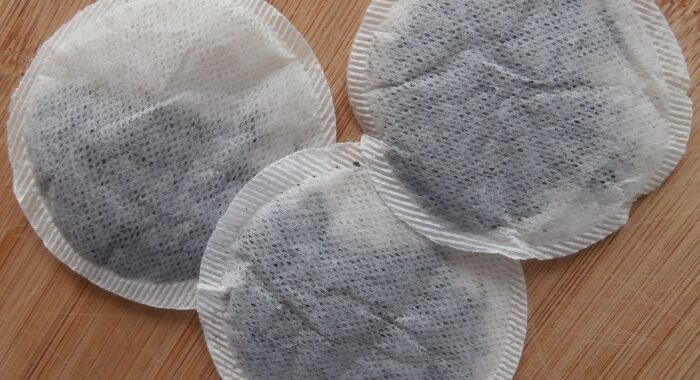
| Green tea bags | 75 to 80°C | 1 bag | 2 min | Fine leaf; do not squeeze the bag |
| Matcha | 70 to 80°C | 1 to 2 g in 60 to 80 ml | Whisk 15 s | Powder is drunk whole, not steeped |
Two patterns run through the table. The more delicate and shaded the tea, the cooler the water. Gyokuro, grown under shade to build up amino acids, sits at the bottom of the range. The finer the leaf, the shorter the steep. Deep-steamed sencha and tea bags break into small particles and release everything in under a minute, while rolled pellets need time to open. Roasted teas such as hojicha and genmaicha are the exceptions and take near-boiling water well.
How to brew green tea, step by step
- Weigh or measure the leaf. A level teaspoon of rolled or small-leaf green tea is about 2 to 3 g. Fluffy, large-leaf teas such as Longjing need a heaped spoon for the same weight.
- Heat fresh, cold water. Filtered water helps in hard-water areas, where minerals dull the flavour.
- Bring the water to 70 to 80°C. Use a kettle with a temperature setting, or see the cooling tricks below.
- Warm your teapot or cup with a splash of hot water and pour it out. A cold pot drops the temperature further.
- Add the leaf, pour the water over, and start a timer: 1 minute for most Japanese teas, 2 to 3 for Chinese teas.
- Pour off every drop. In a Japanese kyusu, the last drops are the most concentrated, so pour until the pot is empty. Leaving tea sitting on the leaves is how the second cup turns bitter.
- Taste, then adjust. If it is thin, add leaf. If it is bitter, lower the temperature before you shorten the time.
What hot water does to the taste
The clearest recent evidence comes from a 2025 study at the Tea Research Institute of the Chinese Academy of Agricultural Sciences in Hangzhou, published in Food Chemistry: X. The team brewed two grades of Longjing, a premium and a standard grade, at 70, 80, 90 and 100°C for 4 minutes. A trained panel of nine tasters scored each cup. As the water got hotter, the savoury “umami-mellow” taste of the premium tea fell from 8.10 to 5.60 out of 10. In the standard tea, bitterness rose from 3.13 to 5.17 and astringency roughly doubled, from 2.07 to 4.13. The panel rated 70°C best.

The chemistry explains it. Lower temperatures favoured the amino acids behind umami: L-theanine, L-aspartic acid and L-arginine. Higher temperatures pulled out more flavonols and their glycosides, which the researchers linked to bitterness and astringency.
Time matters as much as heat. A 2015 study of Turkish green tea in the Journal of Food Science and Technology brewed tea at 75, 85 and 95°C for between 1 and 45 minutes. EGCG, the main green tea catechin, peaked at 85°C after 3 minutes, and that sample also scored highest with the taste panel. Tasters preferred the 3- and 5-minute brews at every temperature. The 30- and 45-minute brews at 85 and 95°C scored very low for their bitter taste and dark colour. Turkish green tea is a sturdier leaf than Japanese sencha, which is why it handled 85°C well. The lesson carries over: find the right temperature for the leaf, then stop the steep on time.
How to get water to 80°C without a thermometer
A variable-temperature kettle is the simplest answer, but you do not need one. Three reliable methods:
- Add cold water. Mix three parts just-boiled water with one part cold tap water. By simple mixing arithmetic that lands close to 80°C. For gyokuro, go nearer to half and half.
- Pour between vessels. This is the Japanese yuzamashi method. Pour boiled water into the empty cups first, then from the cups into the teapot. Each transfer into a room-temperature vessel takes roughly 5 to 10°C off, and it pre-warms the cups too.
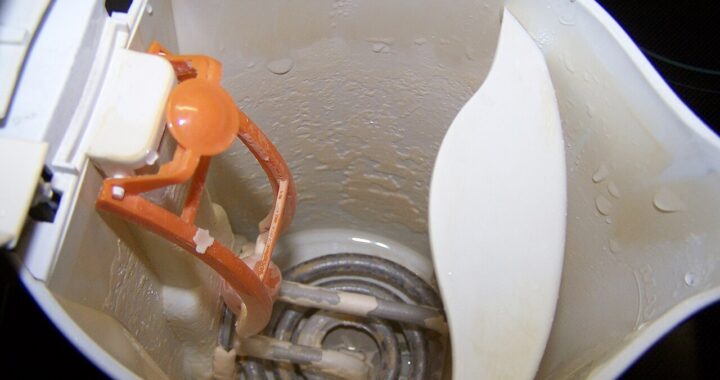
- Wait. Leave the kettle lid open after it boils. How fast the water cools depends on the kettle and how full it is, so time it once with a cooking thermometer and reuse that number.
The small bubbles that form before a full boil are another rough guide. The old Chinese names compare them to crab eyes, then fish eyes. Tiny bubbles on the bottom of a pan means you are well below boiling. A thermometer is still more reliable.
How many times can you re-steep green tea?
Good loose-leaf green tea gives two or three good infusions. For sencha, a common pattern is a 1-minute first steep, a very short second steep of 10 to 20 seconds at slightly hotter water, because the leaves are already open, and a third of 1 to 2 minutes. Chinese green teas such as Longjing are often brewed in a glass with the leaf topped up with water two or three times. Tea bags are designed for one steep; a second is usually thin and flat.
Do not keep wet leaves for hours between steeps. Brew your infusions within an hour or so, and store dry leaf airtight, cool and away from light. Our tea storage guide explains why green tea goes stale faster than black.
Iced and cold brew green tea
Green tea suits cold brewing better than any other tea. Cold water extracts much less caffeine and bitter EGCG. A study by Manami Monobe of the NARO Institute of Fruit Tree and Tea Science found cold-brewed sencha held about 20% of the EGCG and 50% of the caffeine of a hot brew. Our cold brew tea guide has ratios and times.
If you want iced green tea quickly, there is a middle route. Researchers at the University of Parma tested a short hot infusion followed immediately by ice, and compared it with hot and cold steeping. The flash-chilled method matched cold brewing for antioxidant power in a fraction of the time. For green and black teas it also gave the highest EGCG and gallic acid, about double the hot infusion. The quick cooling limits the breakdown of catechins that occurs in prolonged heat.
Common mistakes that make green tea bitter
| Mistake | What happens | Fix |
|---|---|---|
| Boiling water | Catechins and flavonols extract fast; sweetness is lost | Cool to 70 to 80°C |
| Steeping for 5 minutes or more | Bitter, dark, astringent cup | 1 to 3 minutes, then pour off |
| Leaving leaves in the mug | The tea keeps brewing as you drink | Use a strainer or basket and remove it |
| Too much leaf for the water | Harsh, heavy flavour | Start at 2 to 3 g per 200 ml |
| Squeezing the tea bag | Releases the most bitter, concentrated liquid | Lift the bag out and let it drain |
| Stale leaf | Flat, hay-like taste | Buy smaller amounts; store airtight |
Green tea and caffeine
A cup of green tea usually has less caffeine than black tea or coffee, but the range is wide. Gyokuro and matcha sit at the top, and hojicha and bancha at the bottom. Hotter water and longer steeps extract more of it. See our tea caffeine comparison for figures by type, and green vs black tea for how processing makes the two so different.
Frequently asked questions
Can you use boiling water for green tea?
You can, but it usually makes the tea bitter and astringent. The 2025 Longjing study found that 100°C water cut the savoury taste and raised bitterness compared with 70°C. Roasted green teas such as hojicha and genmaicha are the exceptions and can take near-boiling water.
How long should you steep green tea?
One to three minutes for most loose-leaf green teas: about 1 minute for Japanese sencha, 2 to 3 for Chinese teas such as Longjing, and around 2 minutes for tea bags. Fine, deep-steamed leaf needs as little as 30 seconds.
How much green tea should I use per cup?
About 2 to 3 g of leaf per 200 ml of water, which is a level teaspoon of most rolled or small-leaf green teas, or one tea bag. Gyokuro uses more leaf in less water.
Should you add milk to green tea?
It is not traditional, and milk masks the delicate flavour. A squeeze of lemon or a little honey is more common. Matcha lattes are the popular exception.
Why is my green tea brown?
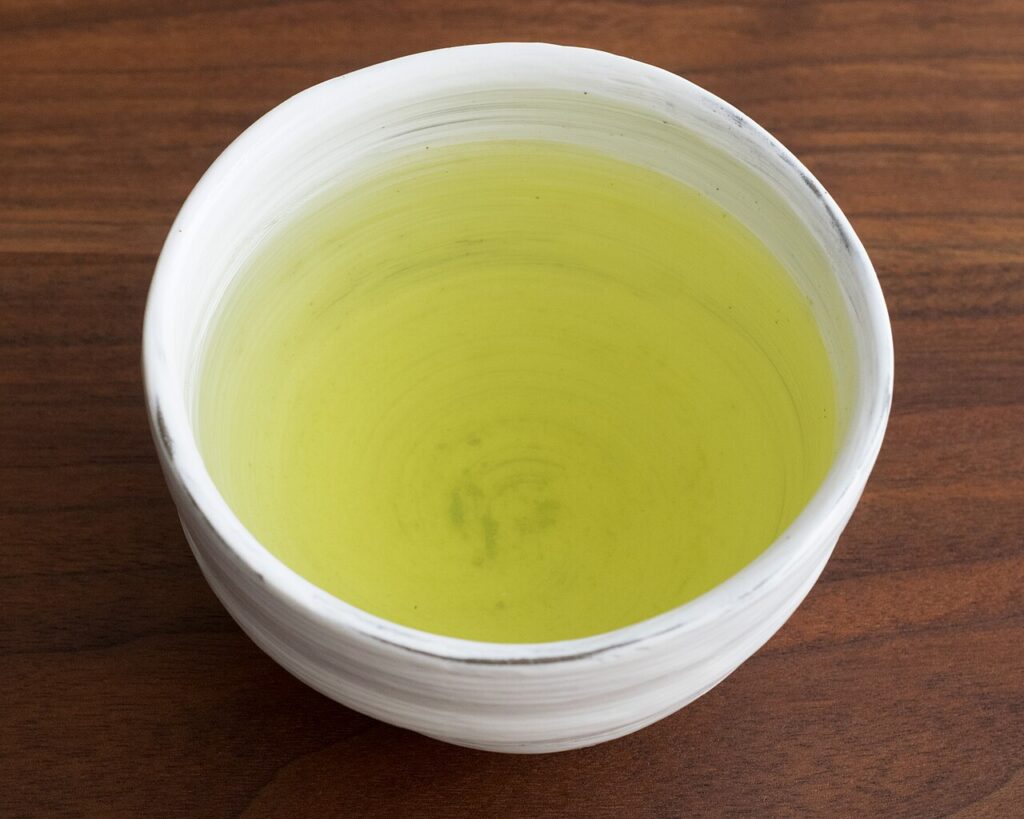
Brewed green tea should be pale green to gold. A brown cup usually means the water was too hot, the steep ran too long, the tea was left standing, or the leaf is old and oxidised. Hojicha is naturally brown because it is roasted.
The bottom line
Good green tea comes down to three numbers: about 2 to 3 g of leaf per 200 ml, water at 70 to 80°C, and a 1- to 3-minute steep that you end by pouring off all the tea. Taste research backs the cooler water. Brewing at 70°C instead of 100°C kept Longjing sweeter and savourier and made it markedly less bitter and astringent. Use cooler water for shaded teas such as gyokuro, hotter water for roasted ones, and re-steep good leaf two or three times.
For every other tea, see our brewing temperature and steep time guide. If you drink green tea for concentration, the best tea for focus covers the evidence on L-theanine and caffeine.
Sources
- Deng S et al. Elucidating the effect of brewing temperature on the sensory quality of Longjing tea based on multi-scale molecular sensory science. Food Chem X 2025;28:102635.
- Saklar S, Ertas E, Ozdemir IS, Karadeniz B. Effects of different brewing conditions on catechin content and sensory acceptance in Turkish green tea infusions. J Food Sci Technol 2015;52(10):6639-46.
- Lantano C, Rinaldi M, Cavazza A, Barbanti D, Corradini C. Effects of alternative steeping methods on composition, antioxidant property and colour of green, black and oolong tea infusions. J Food Sci Technol 2015;52(12):8276-83.
- Monobe M. Health functions of compounds extracted in cold-water brewed green tea from Camellia sinensis L. JARQ 2018;52(1):1-6.