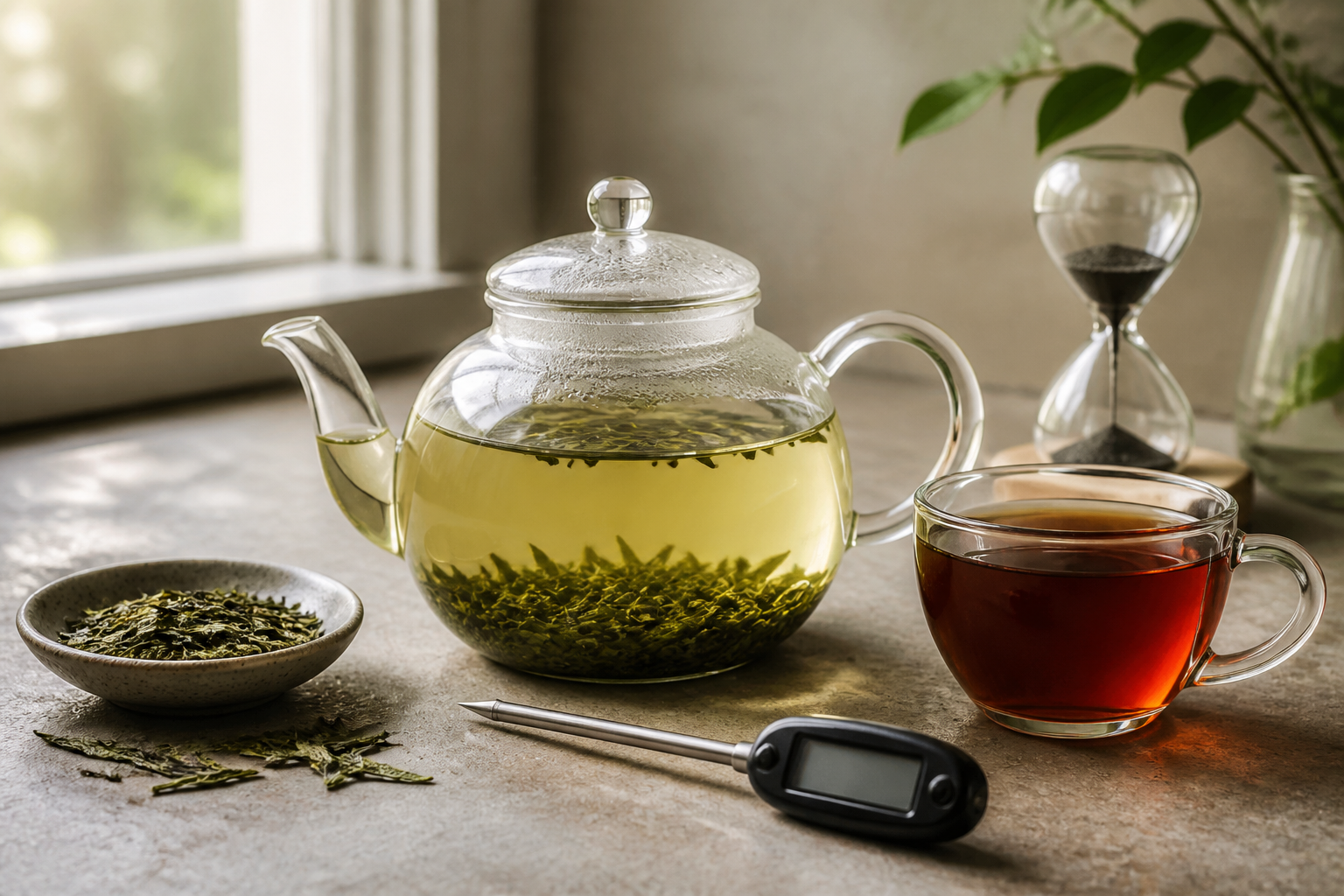
Green tea and black tea come from the same plant, but they end up in very different cups. Oxidation, leaf age and brewing conditions all change the chemistry, the flavour and the health claims that travel with them. Here is what the evidence actually supports — and what it does not.
Every true tea — green, black, white, oolong, yellow, pu-erh, matcha — is made from the leaves of Camellia sinensis. The differences between them come from how the leaf is processed after picking: how much it is withered, bruised, exposed to oxygen, heated and shaped. Brewing is the second transformation: water, temperature, time and dose draw different compounds out of the finished leaf.
That is why “green tea vs black tea” is really a comparison of two processing routes and two extraction regimes. The leaves are more alike than the cups suggest, and the cups are more different than the packaging usually admits.
Where green and black tea diverge
The defining step is enzymatic oxidation. When the leaf cell walls are broken, enzymes inside the leaf meet oxygen in the air and begin converting catechins (a family of polyphenols) into theaflavins and thearubigins. These are the orange-red pigments and astringent compounds that give black tea its colour, body and briskness. Green tea skips most of this step. The leaf is heated soon after picking — in a pan, by steaming, or in industrial dryers — which inactivates the enzymes and locks in the green colour and a different polyphenol mix. A widely cited review of tea chemistry by the US Department of Agriculture summarises the change as a shift from catechins toward complex theaflavins and thearubigins during oxidation.
Oxidation is not the only step that changes. Withering time, rolling intensity, moisture content, ageing and the specific cultivar all matter. Two black teas grown on opposite sides of Sri Lanka can have noticeably different cup profiles; a steamed Japanese sencha and a pan-fired Chinese longjing have very different green-tea profiles even though both skip oxidation.
It is worth pausing on what “oxidation” actually means here, because the word is used loosely in tea marketing. The reaction is enzymatic, driven by polyphenol oxidase (PPO) and peroxidase enzymes naturally present in the leaf. The same enzymes brown a cut apple. In tea, the reaction converts the four major catechins — epicatechin (EC), epigallocatechin (EGC), epicatechin gallate (ECG), and epigallocatechin gallate (EGCG) — into theaflavins and thearubigins. Theaflavins give black tea its brisk, bright, slightly astringent top note; thearubigins give it the deeper, maltier body and the darker colour. A black tea with more theaflavins (typically Ceylon and Darjeeling first flush) reads as brisk; one with more thearubigins (Assam, some Kenyan) reads as full-bodied and dark. The relative balance is set by cultivar, growing conditions and the specific oxidation parameters.
What this means in the cup
Because green tea keeps more of its native catechins (especially epigallocatechin gallate, EGCG), it tends to taste more vegetal, grassier, sometimes more astringent and more bitter. Black tea, with more theaflavins and thearubigins, generally tastes maltier, fuller and more “tea-like” in the Western sense. Oolong sits between the two. White tea is the least processed of the common styles. None of these are absolutes , brewing makes a bigger difference to the final cup than the processing category alone.
Caffeine: a smaller difference than people expect
Most published cup values for brewed green and black tea fall in a surprisingly narrow band. The USDA FoodData Central entry for brewed black tea lists roughly 47 milligrams of caffeine per 240 ml cup. The corresponding brewed green tea entry lists about 28 milligrams per 240 ml. Both numbers are averages across many samples and brewing methods.
The gap exists, but it is modest. A strong sencha brewed hot and long can easily out-caffeinate a quick, lukewarm black-tea bag. The leaf cultivar, particle size, leaf-to-water ratio, water temperature and steep time all matter as much as the colour of the dry leaf. A 2007 review of caffeine in tea and coffee concludes that preparation technique, plant variety and growing conditions produce more variation than the green-versus-black category alone. See Hindmarch and colleagues (2007) and a more recent 2024 review of tea composition and health for ranges that include oolong, white, pu-erh and matcha.
Inline SVG stripped by WordPress security policy (svg_uploads:false). Chart data preserved in surrounding prose.
Two side-by-side bar charts. Caffeine (mg/240ml cup): Green 28, Black 47, Oolong 38, White 30, Matcha 70. Polyphenols (mg/g dry leaf): Green 100, Black 60, Oolong 80, White 90, Matcha 110.
Matcha is a different category, because you consume the whole leaf. A single serving prepared from about 1 gram of matcha powder typically delivers 60 to 80 milligrams of caffeine , comparable to a single espresso and clearly higher than a standard cup of steeped green tea. The USDA entry for matcha powder is consistent with that range when calculated for a typical serving.
Where matcha fits
Matcha deserves its own H3 because it is the only major tea where you consume the leaf rather than steeping it. The cup therefore contains the full dose of caffeine, catechins, chlorophyll and L-theanine that was in the plant , not the fraction that diffuses out during a 2- to 5-minute steep. Per gram of leaf the polyphenol number is roughly comparable to a high-grade sencha; per cup, because you use 1 g of matcha powder for a single 60 to 80 ml bowl, the dose per cup is higher than a steeped green of equivalent leaf weight. Matcha is shade-grown for three weeks before harvest, which concentrates L-theanine in the leaf and produces the umami sweetness the cup is known for. It is processed green tea, but the consumption method changes the chemistry, the dose and the cup character enough that it is its own category rather than a sub-type of green tea.
Antioxidants: catechins vs theaflavins
The popular claim that “green tea has more antioxidants than black tea” is half right. It is true that green tea retains more catechins, the polyphenol family most often studied for antioxidant activity. It is also true that during oxidation those catechins are converted into theaflavins and thearubigins, which have different antioxidant profiles , they are not absent, they are transformed.
A 2014 comparative study of commercial green and black teas measured total polyphenols and several antioxidant assays across many samples. Both tea types showed strong antioxidant capacity in vitro, with the two processing styles producing different but overlapping profiles. See Bhardwaj and colleagues (2014). A separate 2017 study of infused tea from Iranian markets found that polyphenol content varied more by sample than by green-versus-black category. The lesson is consistent: the leaf, growing conditions and brewing are large variables; the broad category is one variable among several.
What changed in the cup, in chemical terms, is the mix of polyphenols rather than the total. A green tea retains the four major catechins in roughly the proportions they had in the fresh leaf. A black tea loses most of those catechins to theaflavins (a small fraction of the total polyphenol mass) and thearubigins (the larger fraction). Theaflavins are well-studied , they are roughly as potent as EGCG on a per-milligram basis in standard antioxidant assays, and they have their own pharmacology, particularly around vascular function. Thearubigins are less well-characterised chemically because they are larger, more heterogeneous molecules, but in vitro antioxidant assays show clear activity. The net effect is that “green has more antioxidants than black” is technically true for the specific catechins the green-vs-black marketing tends to measure, and misleading if it implies black tea is antioxidant-poor.
Headline numbers like “green has X% more antioxidants” usually overstate the difference and ignore that black tea’s theaflavins and thearubigins are themselves bioactive polyphenols.
A side-by-side at-a-glance table
| Attribute | Green tea | Black tea |
|---|---|---|
| Plant | Camellia sinensis | Camellia sinensis |
| Processing | Heated soon after picking to stop oxidation | Withered, rolled, fully oxidised, dried |
| Dominant polyphenols | Catechins, especially EGCG | Theaflavins and thearubigins |
| Caffeine per 240 ml cup | ~28 mg (USDA average) | ~47 mg (USDA average) |
| Typical flavour | Vegetal, grassy, sometimes astringent | Malt, dried fruit, brisk, fuller body |
| Typical brewing range | 75–85 °C, 2–3 min | 90–100 °C, 3–5 min |
| Common origins | China, Japan, Vietnam, India | Sri Lanka, India, Kenya, China, Indonesia |
Health claims and the evidence
The honest answer is that observational and laboratory evidence is positive for both, clinical evidence is mixed, and the difference between them is usually smaller than marketing language suggests. A 2020 Cochrane review of green tea for cardiovascular risk found some signals of benefit but emphasised the low quality and small size of most included trials. See the Cochrane review by Hartley and colleagues (2020). A 2014 review of black tea consumption and cardiovascular disease reported modest associations with reduced risk but again noted the limits of observational evidence. See Tang and colleagues (2014).
What this means in practice: drinking several cups of either green or black tea as part of a varied diet is a reasonable, low-risk habit that is consistently associated with modest health markers. It is not a medical treatment, and the choice between green and black is much less important than the habit itself. The European Food Safety Authority’s caffeine guidance — 200 mg as a single dose and 400 mg across the day for healthy adults , is a more relevant ceiling than which colour of leaf you pick. See the EFSA opinion on caffeine.
Which tea to drink
Pick by taste, time of day and what is in the cupboard, not by a single antioxidant number.
- Late afternoon or sensitive to caffeine. A lighter-brewed green or white tea is usually easier on sleep than a strong black tea. See the brewing guide for cooler temperatures that reduce extraction.
- With or after a meal. Black tea’s theaflavins hold up better with food; green tea’s catechins are more sensitive to pH and metal ions. Both are pleasant food pairings in different cuisines.
- Want a strong antioxidant cup without coffee-level caffeine. A brewed green tea at 80 °C for 2 minutes delivers a useful polyphenol load at roughly a third of a small coffee’s caffeine.
- Want a stronger caffeine lift with a fuller body. A black tea at 95 °C for 3–4 minutes, or a matcha whisked in hot water, is the more direct option.
- Just want a daily ritual. The tea you actually enjoy is the one you will keep drinking. The difference between green and black for a daily habit is much smaller than the difference between drinking any tea at all and not.
Underneath the category question is a simpler one: what kind of daily tea drinker are you? The answer is more useful than the green-vs-black framing because it predicts what you’ll actually keep in the cupboard. Most regular tea drinkers settle into one of three routines: an early-morning strong cup (black tea or matcha, with milk if they want), an all-day light ritual (multiple cups of green or oolong, no milk, brewing as a small morning practice), or a once-a-day comfort cup (a single brew in the late morning or afternoon, often a flavoured black or a herbal). None of those routines needs to be defended against the others; the chemistry supports any of them as a healthy daily habit, and the choice that lasts is the one that fits the day.
Oxidation chemistry, briefly
The green-versus-black distinction is enzymatic oxidation of leaf catechins. Green tea is steamed or pan-fired within hours of plucking, denaturing the polyphenol oxidase enzyme and locking the catechins in their unoxidised state. Black tea is rolled or crushed to break cell walls, exposing the enzymes to oxygen and converting the catechins into theaflavins and thearubigins, the orange-red pigments that give black tea its colour and a chunk of its body. Oolong sits between, with partial oxidation timed by the maker. The same plant, the same plucking standard, ends up as three very different drinks.
What the cup colour actually tells you
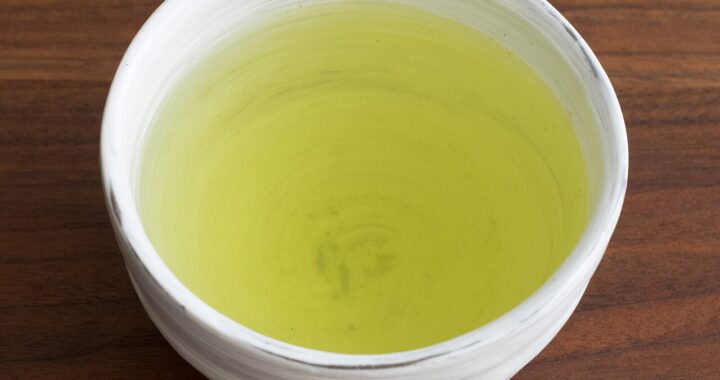
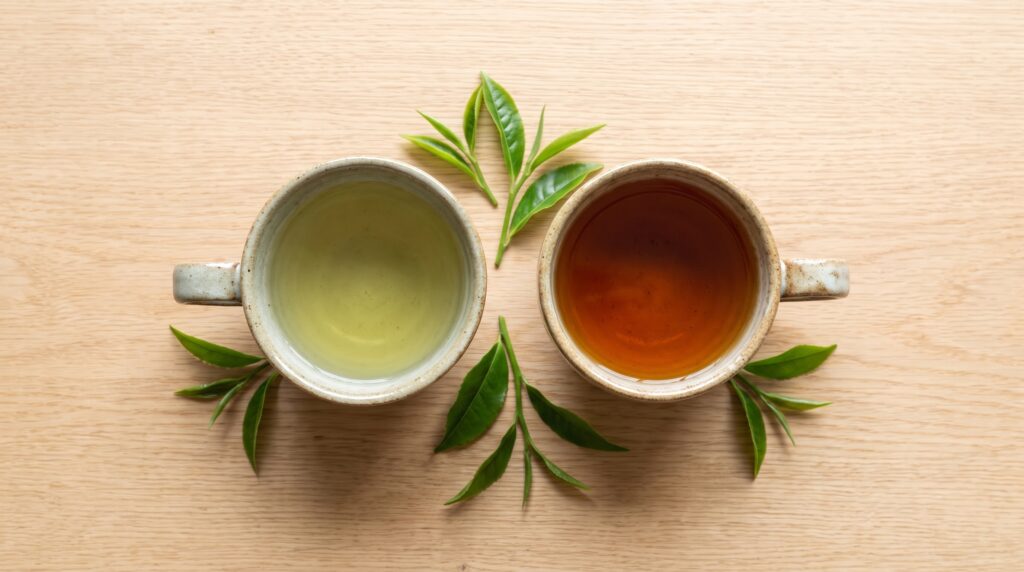
The amber of a black tea and the pale gold of a green tea are direct signals of theaflavin vs catechin content, but cup colour also tracks brew strength and water chemistry. A pale black tea may simply be a 60-second brew on a low-grade leaf; a dark green tea is almost certainly over-brewed or made with too much leaf. The reliable indicator is the leaf itself, not the cup, which is why tasting notes on premium green teas include both the brew colour and the wet-leaf appearance.
Frequently asked questions
Green tea vs black tea health claims
Both are associated with modest health markers in observational studies. Green tea retains more catechins; black tea contains theaflavins and thearubigins. The health effect of either is small compared to diet and lifestyle as a whole. The choice is better made on taste, caffeine tolerance and routine than on a single antioxidant figure.
Caffeine comparison green vs black
On average, yes. USDA values are around 28 mg per 240 ml cup for brewed green tea and 47 mg for brewed black tea. Brewing style changes this more than the leaf category does. A long, hot green-tea brew can out-caffeinate a quick lukewarm black-tea bag.
Milk and tea antioxidants
Studies of catechin bioavailability in humans have given mixed results. Some in-vitro work shows that casein and other milk proteins bind to tea polyphenols, but human studies of plasma antioxidant capacity after tea with milk have generally found smaller effects than the in-vitro experiments suggested. The composition of the tea and the proportions of milk and tea both matter. See a representative study on tea with milk.
Matcha vs green tea
Matcha is a shade-grown, stone-milled green tea. Because you consume the leaf rather than steeping and discarding it, the cup contains more of the leaf’s caffeine, catechins, chlorophyll and L-theanine. Per serving, the caffeine and polyphenol content of matcha is typically higher than a steeped green tea of the same weight.
Oolong classification
Neither. Oolong is partially oxidised, typically between 10% and 70%, which gives it a sensory range that overlaps with both green and black depending on style. A light, floral Tieguanyin is closer to green tea; a dark, roasted Wuyi rock oolong is closer to black.
The bottom line
Green and black tea start as the same plant, diverge in processing, and meet again in the cup. Caffeine and polyphenol content vary less between the two than brewing, leaf quality and dose vary within each. Pick the tea that fits your taste, time of day and routine, brew it well, and treat the broader health story as a small positive rather than a medical claim.
If a reader takes only one practical thing from this article, it should be this: the gap between green and black on a daily basis is smaller than the gap between brewed well and brewed badly within either category. A green tea brewed at 95 °C for 5 minutes tastes like a punishment; a black tea brewed at 80 °C for 2 minutes tastes like dishwater. Brew temperature and steep time change the cup more than the leaf category does, and the comparison table at the top of this article is a starting map, not a final rule.
For the next layer , how water temperature, time, leaf size and water composition change the cup , see the brewing guide. For a focused look at caffeine, L-theanine and tea that supports work, see the focus article.