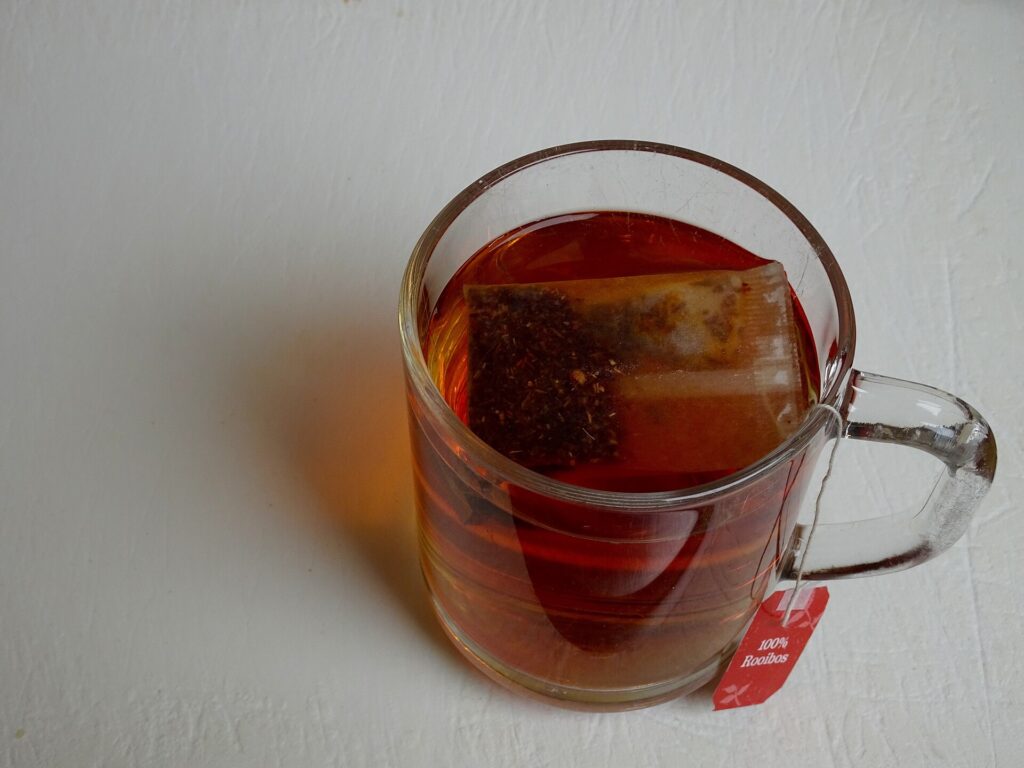
Rooibos is a South African herbal tea made from the needle-like leaves of Aspalathus linearis. It is naturally caffeine-free, low in tannins and hard to over-brew. Its best tested advantage is practical: in a 1979 trial, rooibos barely affected iron absorption while ordinary tea cut it by about 80%. Claims about heart health rest on a handful of small studies.

What rooibos is
Rooibos means red bush in Afrikaans, which is why British supermarkets often sell it as redbush tea. It is not related to the tea plant, Camellia sinensis. It is a shrubby legume that grows in the Cederberg mountains and surrounding districts north of Cape Town.
In 2021 the European Union registered Rooibos as a protected designation of origin. The name can now only be used in the EU for the dried leaves of Aspalathus linearis grown or wild-harvested in named municipalities of the Western and Northern Cape. It was the first African food to get the status, putting it alongside Champagne and Parma ham.

Red and green rooibos
| Red (traditional) | Green | |
|---|---|---|
| Processing | Cut, bruised, left to oxidise (“ferment”) in heaps, then sun-dried | Dried quickly without oxidation |
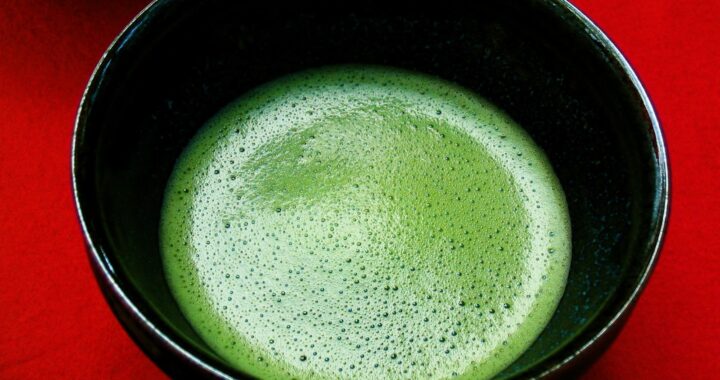
| Colour in the cup | Deep reddish-amber | Pale gold |
| Taste | Sweet, woody, a little like honey and vanilla | Lighter, grassier, more herbal |
| Where to find it | Every supermarket | Specialist tea shops |
Caffeine and tannins
Rooibos has no caffeine at all, so it can be drunk late at night without affecting sleep the way caffeine does. It is one of the most popular options in our caffeine-free tea guide, and a sensible evening swap for anyone following our tea for sleep advice.
It is also low in tannins, the compounds that make black tea bitter when it steeps too long. That is why rooibos can sit in the mug for ten minutes without turning harsh.
Rooibos and iron
Ordinary tea reduces how much iron the body absorbs from plant foods, as our tea and iron guide explains. Rooibos does not seem to. In a 1979 South African study, three groups of 10 healthy young men took a dose of iron containing a radioactive tracer, then drank rooibos, ordinary tea or boiled water. Two weeks later a whole-body scan measured how much iron they had kept.
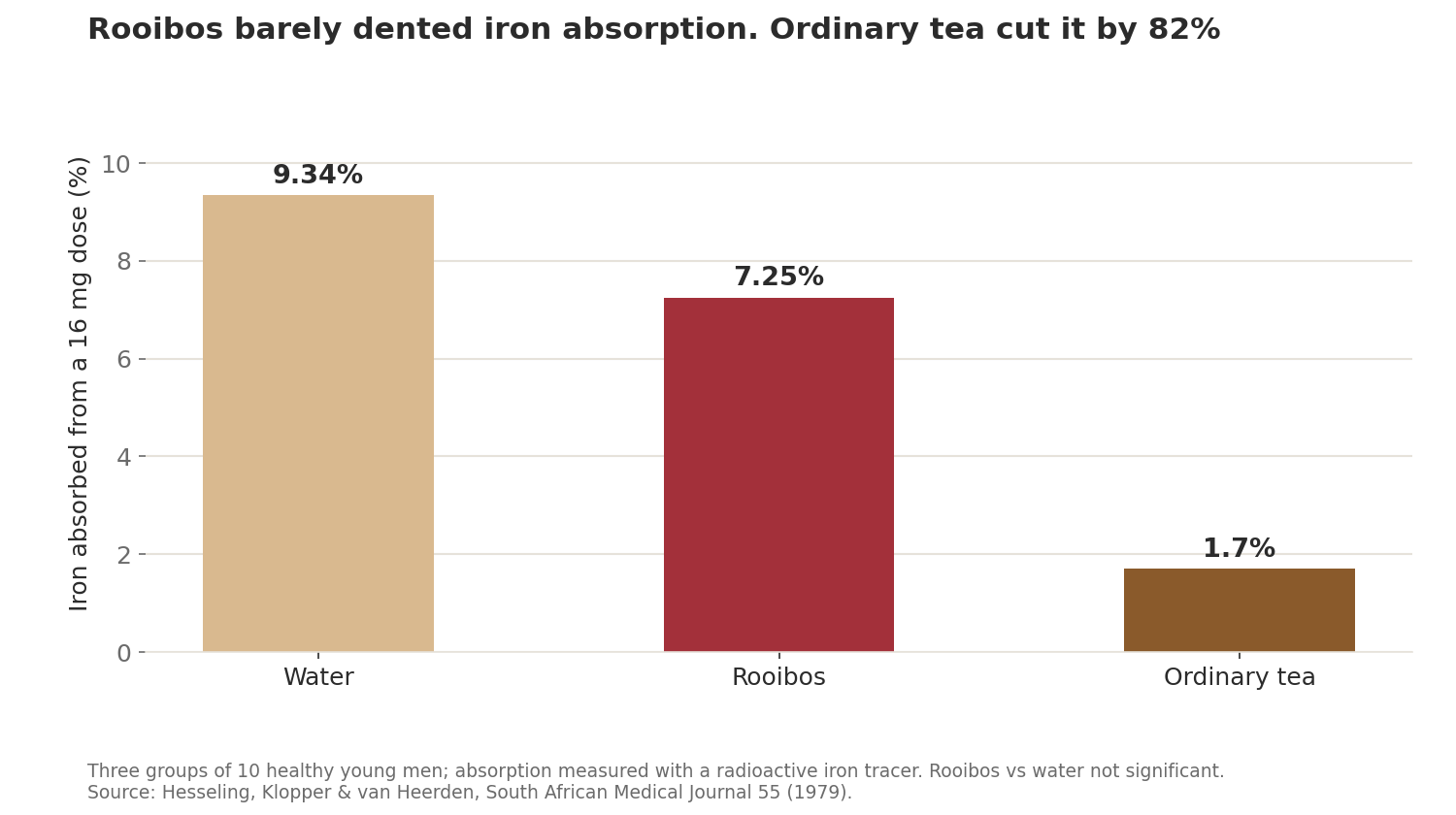
The water group absorbed 9.34% of the iron and the rooibos group 7.25%, a difference that could have been chance. The ordinary tea group absorbed 1.70%. The study was small and old, but it fits what is known about tannins. For anyone low in iron who wants a hot drink with meals, rooibos is the better choice.
Heart health and antioxidants
The best-known human study of rooibos and heart risk was published in 2011 by Jeanine Marnewick and colleagues at the Cape Peninsula University of Technology. Forty adults at risk of heart disease drank six cups of traditional rooibos a day for six weeks, then had a control period without it.
| Blood marker | Control period | After 6 weeks of rooibos |
|---|---|---|
| LDL (“bad”) cholesterol | 4.6 mmol/L | 3.9 mmol/L |
| HDL (“good”) cholesterol | 0.9 mmol/L | 1.2 mmol/L |
| Triglycerides | 1.7 mmol/L | 1.2 mmol/L |
Those are large changes, which is a reason for caution. There was no placebo drink and no blinding, so the volunteers knew what they were drinking and may have changed other habits. Six cups a day is also a lot.
A 2023 scoping review found 18 human studies of rooibos in total, with 488 participants between them. Taken together they suggest better lipid profiles, antioxidant status and blood sugar, but the authors stress that the studies are few, small and used different types and doses of rooibos. Most of the strong claims online come from animal and cell studies.
Safety
Rooibos has a long record as an everyday drink, and side effects are rare. There are a few published cases of liver injury linked to herbal teas containing rooibos. In one 2013 case report, a 52-year-old man developed acute hepatitis after drinking a tea that combined rooibos with buchu, another South African herb, and recovered after he stopped. It is not clear which herb was responsible. If you develop unexplained tiredness, dark urine or yellowing skin while drinking large amounts of any herbal tea, stop and see a doctor.
How to brew rooibos
- Amount: one teabag or about 1 heaped teaspoon of loose rooibos per mug.
- Water: freshly boiled. Unlike green tea, rooibos does not need cooler water.
- Time: at least 5 minutes. Longer gives a fuller, sweeter cup without bitterness.
- Milk: works well, and the milk-first debate matters less because the tea does not get bitter.
- Iced: brew it double-strength and pour over ice, or use our cold brew method.
- Blends: rooibos pairs well with vanilla, orange peel, cinnamon and hibiscus.
In South Africa a “red espresso”, made from finely ground rooibos in an espresso machine, is used for caffeine-free lattes and cappuccinos.
Quick answers
Does rooibos tea have caffeine?
No. It is naturally caffeine-free, not decaffeinated.
Is rooibos the same as redbush?
Yes. Redbush is the English translation of the Afrikaans name.
Can you drink rooibos every day?
Yes. Several cups a day is normal in South Africa. The main thing to watch for is the rare liver reaction described above.
Is rooibos good for sleep?
It has no proven sleep-inducing effect, but being caffeine-free makes it a better choice before bed than regular tea.
Last updated: 7 October 2026. Sources are linked in the text.
This article is general information, not medical advice. Talk to your doctor or pharmacist before using tea or herbs for a health condition, especially if you are pregnant, breastfeeding or take regular medication.