Tea and Iron Absorption, the Tannin Story — At a Glance
| Field | Value | Source |
|---|---|---|
| Iron types | Heme (animal sources) and non-heme (plant sources) | Standard nutrition science |
| Tea compounds that affect iron | Tannins (polyphenols), catechins (EGCG, etc.) | Multiple studies |
| Reduction in non-heme iron absorption | Up to 60-90% with strong black tea at mealtime | Multiple nutrition studies |
| Dose-response | 5mg tannins: −20% absorption; 25mg: −67%; 100mg: −88% | Nutritionist Resource review |
| Effect on heme iron | Minimal; tannins specifically target non-heme iron | Matchaful blog; USDA study |
| Timing matters | Tea WITH meal: large effect; tea 1hr+ after: minimal effect | USDA rat study (2004) |
| Who should care | Vegans, menstruating women, anaemia patients, children | Standard nutrition guidance |
| Mitigation | Vitamin C source (lemon, orange), separate timing, lower-tannin teas | Nutrition reviews |
Drinking tea with a meal can reduce non-heme iron absorption by up to 60-90% — a meaningful effect for anyone whose iron status is already marginal or who relies on plant-based iron sources. The mechanism is tannins (a class of polyphenols in tea) binding to non-heme iron in the digestive tract and forming insoluble complexes that the body cannot absorb.
This article walks through the iron-absorption science, who should care, the dose-response between tannin intake and iron reduction, the timing effects (tea with a meal vs tea between meals), and the practical mitigations (vitamin C, timing shifts, lower-tannin teas). It also distinguishes the effect on non-heme iron (plant sources) from the much smaller effect on heme iron (animal sources), which is the more useful framing for daily tea drinkers.

The Mechanism
Iron is absorbed in the small intestine through two distinct pathways: heme iron (from animal sources like red meat, fish, and poultry) and non-heme iron (from plant sources like legumes, leafy greens, fortified cereals, and tofu). Heme iron is absorbed at a rate of 15-35% regardless of other dietary factors. Non-heme iron is absorbed at a much lower baseline rate (5-12%) and is heavily influenced by “enhancers” and “inhibitors” in the same meal.
The major inhibitors of non-heme iron absorption are polyphenols (especially tannins), phytates (in whole grains and legumes), and calcium (in dairy). The major enhancers are vitamin C (ascorbic acid) and meat protein. Tea is a particularly potent inhibitor because of its high tannin content — a single cup of strong black tea can contain 100-200mg of tannins.
The mechanism is binding: tannins bind to non-heme iron in the digestive tract and form insoluble complexes that the body cannot absorb. The binding happens quickly, within minutes of the iron and tannin meeting in the stomach. The complexes pass through the digestive tract and are excreted.
The Evidence
The dose-response relationship between tannin intake and iron absorption is well-documented. Multiple studies have found:
5mg of tannins reduces non-heme iron absorption by approximately 20%. 25mg of tannins reduces absorption by approximately 67%. 100mg of tannins reduces absorption by approximately 88%. A single cup of strong black tea contains approximately 100-150mg of tannins, which puts a tea-drinking-with-meal pattern in the high-reduction range.
The USDA study on black tea and iron absorption in rats found that tea reduced iron uptake from the intestinal tract when the tea was given in the same meal with iron, but not when the tea was given separately. The mechanism is consistent with the tannin-iron binding described above.
A 2024 Kenyan study on black tea consumption and iron deficiency in women found the association was stronger with increasing consumption, longer brew time, and greater tea strength. This is consistent with the dose-response pattern and the timing effect.
Who Should Care
The tea-and-iron effect is real but the impact on any individual consumer depends on their iron status, dietary pattern, and tea consumption habits.
Vegans and vegetarians are at higher baseline risk of iron deficiency because the non-heme iron in plant sources is less bioavailable than the heme iron in animal sources. Adding tea with meals makes the absorption problem worse. The combination of plant-based diet and heavy tea consumption is a known risk factor for iron deficiency in clinical nutrition.
Menstruating women have higher iron requirements than non-menstruating women (about 18mg daily versus 8mg), and the iron loss each month makes the absorption rate more critical. Heavy tea drinking during meals is a known contributor to iron deficiency in this population.
Children and adolescents are at higher risk of iron deficiency because their iron requirements (per kilogram of body weight) are higher than adults. Tea is not recommended with meals for young children in most paediatric nutrition guidance.
Anaemia patients (diagnosed iron deficiency) need to maximise iron absorption, which means minimising inhibitors. The clinical guidance is to avoid tea with meals, take iron supplements with vitamin C, and have iron status monitored regularly.
Pregnant women have higher iron requirements and may be anaemic. The standard guidance is to take prenatal vitamins (which contain iron) separately from tea consumption, ideally with a 2-hour gap.
The Mitigations
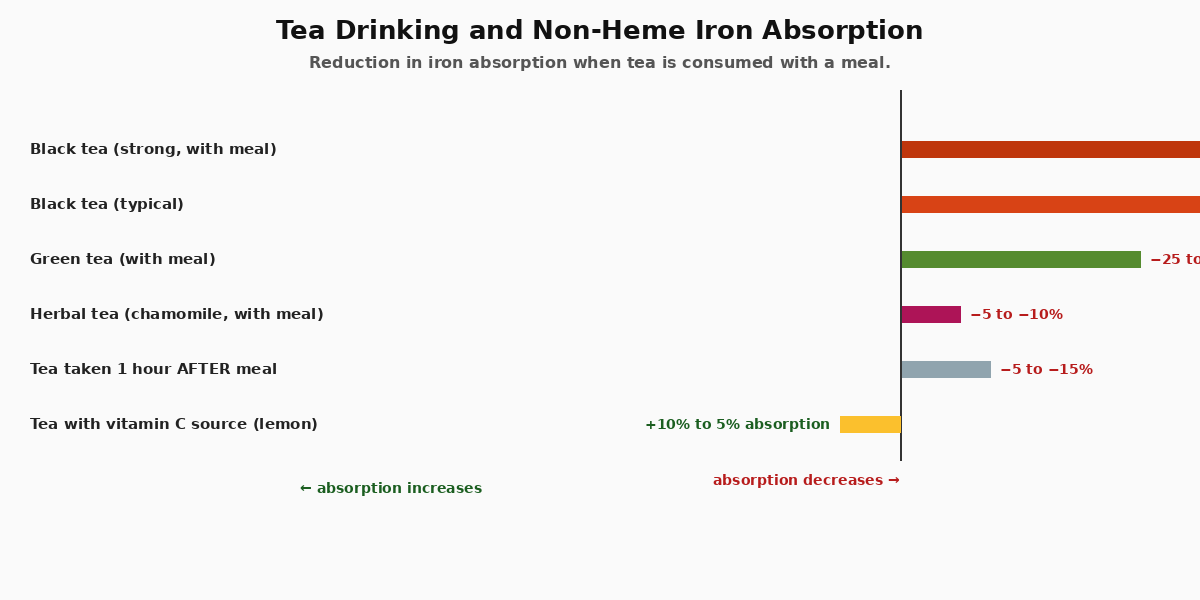
Vitamin C source (lemon, orange, citrus): Vitamin C is the most powerful enhancer of non-heme iron absorption. Adding lemon juice to tea, or drinking a glass of orange juice with the meal, can offset the tannin effect partially or fully. Studies have shown that a vitamin C source can reduce the tannin-driven iron absorption reduction by 50-100%.
Timing: drinking tea between meals (1+ hour after) rather than with meals reduces the tannin-iron interaction significantly. The USDA rat study found tea had no effect on iron absorption when given separately from the iron source.
Lower-tannin teas: green tea has lower tannin content than black tea (approximately 50-80mg per cup versus 100-150mg). Herbal tisanes (chamomile, rooibos, peppermint) have zero tannins. Switching to these options can reduce the iron-absorption effect.
Iron source matters: non-heme iron (plant sources) is heavily affected; heme iron (animal sources) is minimally affected. Eating red meat or fish with a meal that includes tea will absorb most of the iron normally; eating a plant-based meal with tea will absorb much less.
Cooking in cast iron cookware is a subtle intervention: studies have shown measurable increases in iron content of food cooked in cast iron, particularly for acidic foods like tomato sauce. This is a long-term strategy rather than a per-meal intervention.
The Cautions
The effect is specific to non-heme iron. Heme iron (from meat, fish, poultry) is minimally affected by tea consumption. Consumers who rely on plant-based iron sources are at higher risk; consumers who rely on animal-based iron sources are at lower risk.
The effect is timing-dependent. Tea with meals has the largest effect; tea between meals has minimal effect. The 1-hour-after-meal threshold is the standard guidance; 2 hours is the conservative threshold.
The effect is dose-dependent. One cup of tea per day has minimal effect on iron status; 4+ cups per day with meals can produce clinical iron deficiency over time in vulnerable populations.
Green tea is not a free pass. Green tea has lower tannins than black tea but still contains enough polyphenols to affect iron absorption. Studies on green tea and iron absorption have found significant reduction effects, just at smaller magnitudes than black tea.
Decaffeinated tea is not a free pass either. The decaffeination process targets caffeine, not polyphenols. Decaf tea has similar tannin content to regular tea and similar iron-absorption effects.
Fact-vs-Claim Verdict
| Claim | Verdict | Source / note |
|---|---|---|
| Tea reduces non-heme iron absorption by 60-90% | Strong (multiple studies) | Multiple nutrition studies; very high reduction at upper bound |
| Tannin dose-response: 5mg=−20%, 25mg=−67%, 100mg=−88% | Strong | Nutritionist Resource review citing original studies |
| Tea effect is on non-heme iron, not heme iron | Strong | Matchaful blog; USDA study; standard nutrition science |
| Vitamin C source offsets tannin effect | Strong | Multiple nutrition studies |
| Tea 1+ hour after meal has minimal effect | Strong | USDA rat study; standard clinical guidance |
| Vegans are at higher risk of iron deficiency | Strong | Standard nutrition epidemiology |
| Green tea has lower tannins than black tea | Moderate | Approximately 50-80mg vs 100-150mg per cup |
| Decaf tea has the same tannin effect | Strong | Decaffeination removes caffeine, not polyphenols |
| Cast iron cookware increases iron content of food | Moderate | Studies show measurable increase in acidic foods |
| Tea causes iron deficiency anaemia in regular tea drinkers | Moderate (observational) | Kenyan 2024 study found association; confounding factors |
| Herbal teas have no iron-absorption effect | Verifiable | Chamomile, rooibos, peppermint have zero tannins |
Iron deficiency prevalence and the practical threshold
Iron deficiency affects roughly a quarter of the world’s population, with higher prevalence in pre-menopausal women, infants, and adolescents. The 2020 WHO estimate puts anaemia from all causes at 30% of women aged 15-49 globally, and a non-trivial share of that is iron-driven. For these populations the tea-and-iron interaction is not academic; it is the difference between hitting a daily target and missing one by a wide margin.
The pragmatic rule of thumb, used in UK NHS dietary guidance for vegetarians and vegans, is to leave a 60-90 minute gap between any iron-containing meal and tea, and to take any iron supplement with vitamin C rather than with the morning cup. The US Academy of Nutrition and Dietetics gives the same advice in its position paper on vegetarian diets: separate tea and iron-rich foods.
One commonly overlooked source is the cooking water. Tea brewed into stews, broths, or porridge carries its tannins into the meal; so does tea used as a braising liquid. The interaction is dose-dependent, which is why the practical guidance treats tannin-rich black tea as the variable, not the iron content of the food itself.
Special cases: pregnancy, athletes, and the morning routine
Three populations face tighter margins than the general reader. Pregnant women in the UK NHS guidance are advised to keep daily caffeine under 200 mg, which puts four to five strong black-tea cups at the limit. Endurance athletes, by contrast, often use tea as a gentler pre-training caffeine source, partly because the L-theanine softens the spike-and-crash profile that some runners find jarring in coffee. Both groups benefit from the same practical habit: time the tea, not the iron.
A simple morning routine that closes the gap: take any iron supplement with a glass of orange juice, wait an hour, then drink the tea. This single sequencing change is the largest available lever for the iron-conscious tea drinker, and it costs nothing.
One final distinction: green and white teas contain broadly the same tannin profile as black tea, just at lower extraction levels, and the iron-interaction effect follows roughly the same dose-response curve. Switching from black to green does not solve the iron problem; switching from any tea to rooibos, chamomile, or peppermint does, since the herbal tisanes carry no tea-family tannins.
Iron needs rise in pregnancy, so timing tea away from meals matters more then. Our guide to which teas are safe during pregnancy covers caffeine limits too.
Frequently Asked Questions
The Effect of Tea on Iron Absorption
Drinking tea with a meal can reduce non-heme iron absorption by up to 60-90%. The mechanism is tannins (polyphenols in tea) binding to non-heme iron in the digestive tract and forming insoluble complexes the body cannot absorb. Heme iron (from animal sources) is minimally affected. The effect is dose-dependent (more tannins = more reduction), timing-dependent (tea with meals = much more effect than tea between meals), and mitigable (vitamin C source, timing shifts, lower-tannin teas).
Who Should Be Most Concerned
Vegans and vegetarians (relying on plant-based iron), menstruating women (higher iron requirements), children and adolescents (high iron requirements per body weight), anaemia patients (need maximum absorption), and pregnant women (high requirements and frequent anaemia). For each of these populations, the standard clinical guidance is to avoid tea with meals and take iron supplements with vitamin C sources separately from tea.
Tea with a Meal vs Tea Between Meals
Tea with a meal has the largest effect on iron absorption (up to 60-90% reduction in non-heme iron). Tea 1+ hour after a meal has minimal effect. The USDA rat study showed no effect when tea was given separately from the iron source. The 1-hour threshold is the standard guidance; 2 hours is conservative.
How to Offset the Tea-Iron Effect
Add a vitamin C source (lemon juice in the tea, orange juice with the meal) to offset the tannin effect. Drink tea 1+ hour after meals rather than with meals. Switch to lower-tannin teas (green tea, herbal tisanes). Eat heme iron sources (red meat, fish, poultry) at meals where you drink tea. Use cast iron cookware for cooking.
Does Decaf Tea Affect Iron Absorption
Yes, decaf tea has similar tannin content to regular tea and similar iron-absorption effects. The decaffeination process targets caffeine, not polyphenols. Switching from regular to decaf tea does not reduce the iron-absorption effect.
Does Green Tea Affect Iron Absorption
Yes, green tea has lower tannins than black tea but still contains enough polyphenols to affect iron absorption. Studies have found significant reduction effects from green tea, just at smaller magnitudes than black tea. Green tea is not a free pass for iron absorption.
The Best Tea Choice for Iron-Conscious Drinkers
Herbal tisanes (chamomile, rooibos, peppermint) have zero tannins and no iron-absorption effect , these are the safest choice for iron-conscious drinkers. Green tea brewed at lower temperatures and shorter steeping times reduces the effect. Black tea should be avoided with meals in vulnerable populations.
Sources
- USDA ARS , Tea and iron absorption study (2004) , Primary source for the rat study showing the timing effect (tea with meal reduces absorption; tea separately does not).
- Nutritionist Resource , Is your daily cuppa leaving you lower in iron? , Primary source for the dose-response figures (5mg=−20%, 25mg=−67%, 100mg=−88%) and the standard clinical guidance.
- NCBI PMC , The Impact of Tannin Consumption on Iron Bioavailability and Status: A Narrative Review , Primary source for the narrative review on tannins and iron bioavailability.
- Verywell Health , Can Drinking Tea Reduce Iron Absorption? , Secondary source for the Kenyan 2024 study and the coffee comparison.
- Matchaful , Spilling the Tea: Matcha and Iron Absorption , Secondary source for the matcha-specific tannin analysis.
What the labels don’t say
UK supermarket iron-labelling on tea is essentially absent, even though tea-iron interaction is one of the most commonly asked questions in retailer dietary advice. The EU food-information regulation requires iron content to be declared only on foods fortified with iron, not on naturally occurring tea. For a reader trying to budget iron, the practical answer is that the iron contribution of an 8 g teabag is negligible, and what matters is whether the tea was drunk with the meal.
One last useful piece of consumer guidance: brewing strength barely changes the iron-tannin picture. A weak cup and a strong cup, drunk with a meal, reduce iron absorption by roughly the same proportion. Brewing temperature and time are caffeine and flavour levers, not iron levers. For the iron-conscious reader the question is timing, not strength.
Last updated: 8 October 2026. Sources are linked in the text.