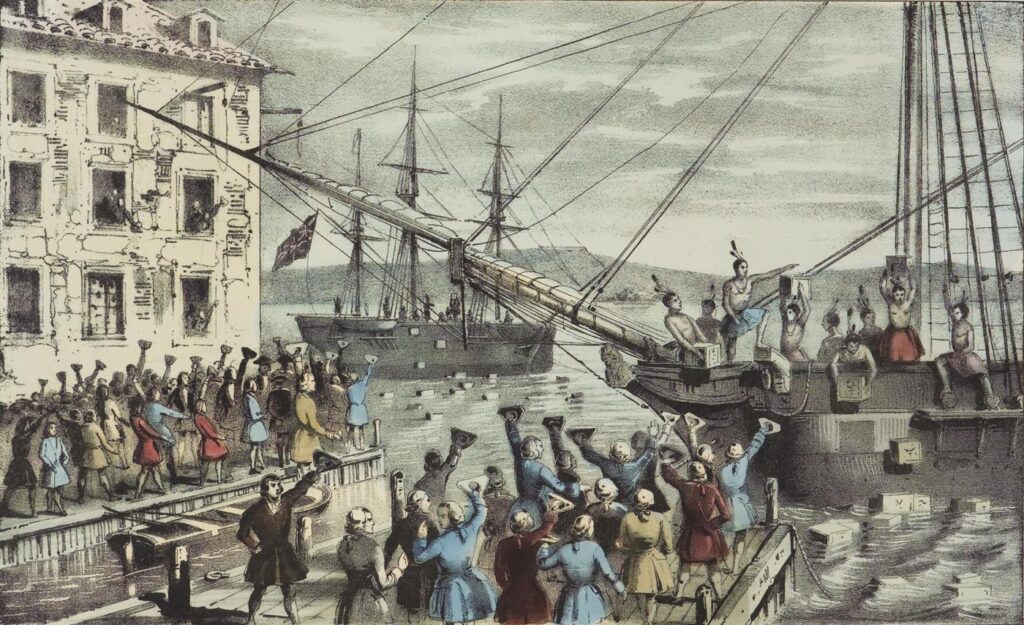
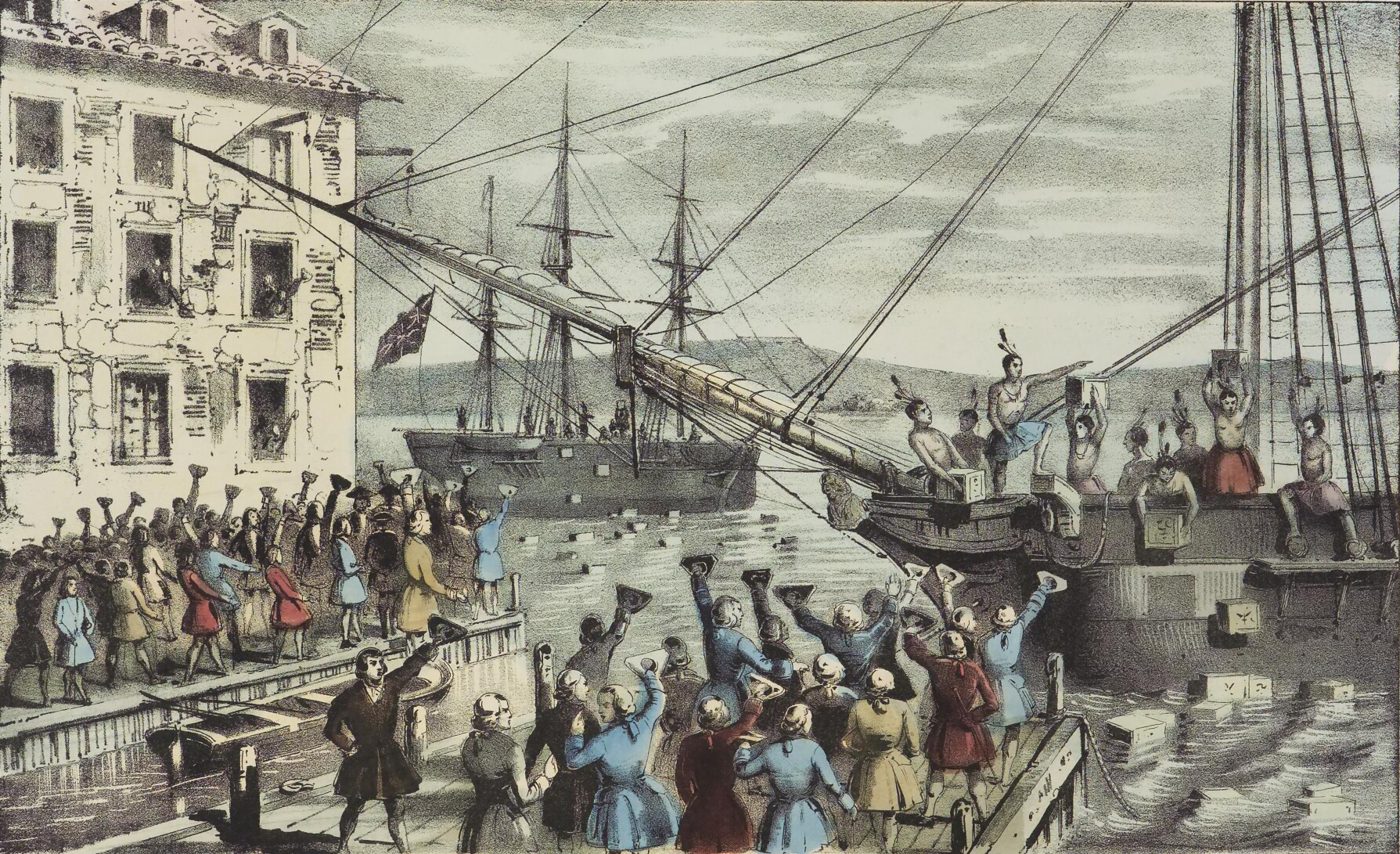
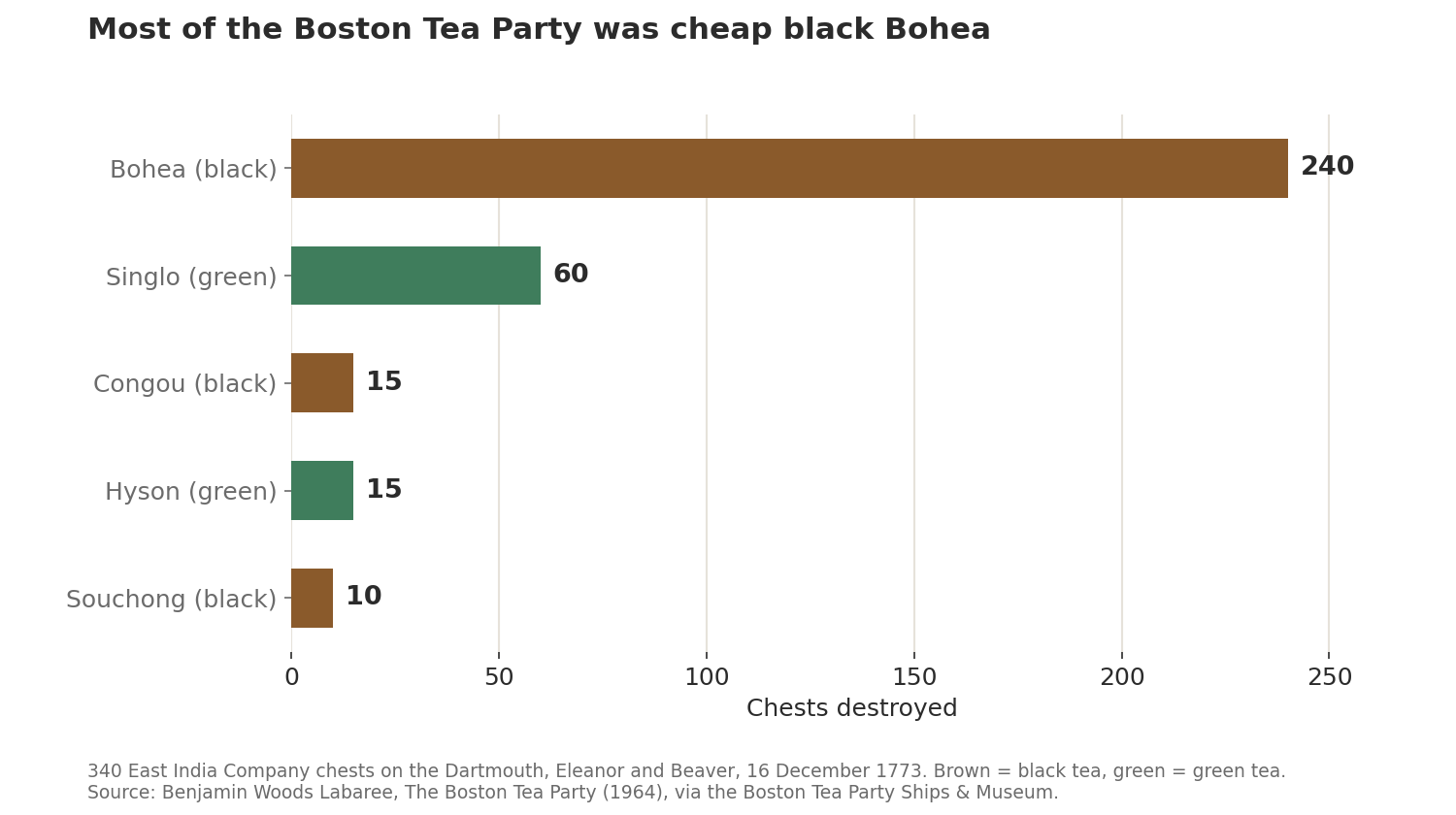
On the night of 16 December 1773, colonists in Boston broke open 340 chests of East India Company tea and emptied them into the harbour: more than 92,000 pounds, or about 46 tons. It was all Chinese tea of five kinds. Most of it, 240 chests, was Bohea, the cheapest black tea of the day. The rest was Singlo and Hyson green tea and Congou and Souchong black tea, and much of it had been picked two or three years earlier.
Everyone knows the Boston Tea Party was a protest about tax. Far fewer people know what was in the chests. The answer tells you a lot about what Americans were drinking in 1773, why the East India Company was desperate to sell it, and which of those teas you can still buy today.
The five teas at a glance
| Tea | Type | Chests | What it was |
|---|---|---|---|
| Bohea | Black | 240 | The everyday, low-priced black tea of the colonies |
| Singlo | Green | 60 | A late-picked, larger-leaf green tea that kept poorly |
| Congou | Black | 15 | A better-made black tea than Bohea |
| Hyson | Green | 15 | A young, spring-picked green tea; the premium choice |
| Souchong | Black | 10 | A black tea from the Wuyi Mountains, known for a smoky aroma |
You will sometimes see 342 chests quoted. The count used by historian Benjamin Labaree and by the Boston Tea Party Ships & Museum is 340, carried on three ships: the Dartmouth, the Eleanor and the Beaver. The East India Company put the loss at £9,659, which the museum estimates as more than $1.7 million today.
Why that tea was on those ships
By 1773 the East India Company was in financial trouble and sitting on about 17 million pounds of unsold tea in London warehouses. Parliament’s answer was the Tea Act, passed on 10 May 1773. It let the company ship tea straight to America and sell it through chosen merchants, and it removed duties paid in Britain. The colonial duty of three pence a pound, left over from the Townshend Acts, stayed.
The result was legal tea that could undercut the Dutch tea smuggled into the colonies. Price was not the objection. Colonists saw the act as a way to get them to accept Parliament’s right to tax them, and as a monopoly handed to a few merchants with connections to the royal government. When the ships reached Boston, the governor refused to let them leave without unloading, and the protesters refused to let the tea land.
The company filled its American cargoes from what it had in stock. According to the museum’s account, the tea had been plucked in 1770 and 1771 and stored in London before sailing in the late summer of 1773. Singlo in particular was included because the company had a lot of it and it needed to be sold before it went stale.
The five teas, one by one
Bohea (240 chests)
Bohea takes its name from the Wuyi Mountains of Fujian province in China, whose name was pronounced something like “Bu-yi” by traders. By the 18th century it had become the English name for the cheapest grade of black tea, wherever it came from. It was so common that “bohea” was used to mean tea in general.
John Adams used exactly that shorthand in his diary entry the next morning: “Last Night 3 Cargoes of Bohea Tea were emptied into the Sea.” He added: “This is the most magnificent Movement of all.” Seven chests in ten on the ships were Bohea, so he was mostly right.
Singlo (60 chests)
Singlo was a green tea named after the Songluo hills in Anhui province. It was picked later in the season than Hyson, so the leaves were bigger and coarser, and it spoiled faster. It was not widely known in the colonies. It was the second-largest tea on the ships largely because the company needed to get rid of it.
Congou (15 chests)
Congou comes from the Chinese gongfu, meaning made with skill or effort. It was a better-processed black tea than Bohea, with more care taken over rolling and firing. The name survives in some Chinese black teas sold today, and the style is close to what a modern drinker would recognise as a smooth Chinese black tea.
Hyson (15 chests)
Hyson was the premium green tea of the period, picked young in spring. The museum notes it was a favourite of George Washington and Thomas Jefferson. “Young Hyson” is still sold as a Chinese green tea, although modern versions will taste much fresher than anything in a chest that had been at sea for weeks after two years in a warehouse.
Souchong (10 chests)
Souchong was another Wuyi black tea, made from larger leaves further down the stem. The museum describes it as having a distinctive smoky aroma, the ancestor of today’s Lapsang souchong, which is dried over pinewood fires. It was the smallest part of the cargo.
What happened to the tea
Boston Harbor was shallow at low tide, and the tea did not all sink out of sight. Leaves washed up along the shore, and some people collected them as souvenirs. The Massachusetts Historical Society holds a small glass bottle of tea leaves gathered on the shore of Dorchester Neck on the morning of 17 December 1773, one of five relics of the night in its collection.
The protesters were careful to destroy only tea. According to the museum, the only other damage was a broken padlock, which was replaced the next day.
Can you drink Boston Tea Party tea today?
Yes, in approximate form. The museum sells a set of the five teas made by Oliver Pluff & Co, and GBH reported on the teas prepared for the 250th anniversary in 2023, sourced from the Chinese provinces that merchant records name. None of it is the same tea. Cultivars, processing and freshness have all changed since 1773, and tea of that era was often stale by the time it was brewed.
To taste the closest modern equivalents:
- For Bohea and Congou: a Chinese black tea from Fujian or a Keemun. Brew with water just off the boil for 3 to 4 minutes. See our brewing temperature and time guide.
- For Souchong: a Lapsang souchong. A little goes a long way.
- For Hyson and Singlo: a Chinese green tea sold as Young Hyson. Use cooler water, around 75 to 80°C, as in our green tea guide.
If you want to understand why the same plant made both the black and the green teas on board, our green vs black tea guide explains the processing. And if two-year-old tea sounds unappealing, this is what time and air do to tea.
Quick answers
What kind of tea was dumped in the Boston Tea Party?
Five Chinese teas: Bohea, Congou and Souchong (black) and Singlo and Hyson (green). Bohea made up 240 of the 340 chests.
How much tea was thrown overboard?
340 chests, weighing more than 92,000 pounds, or about 46 tons.
Was it green tea or black tea?
Both, but mostly black. 265 chests were black tea and 75 were green, so a little over three quarters of the chests held black tea.
Where did the Boston Tea Party tea come from?
China. It was shipped from London by the East India Company, which bought it in China, stored it in Britain and re-exported it to the colonies.