If you brew tea in a pot, put the milk in the cup first. If you brew with a teabag in a mug, add the milk last. That is the whole answer. The Royal Society of Chemistry backed milk first in 2003, because milk poured into very hot tea can scald. But a teabag needs water close to boiling, and cold milk at the bottom of the mug cools it before the tea has brewed.
Few kitchen arguments in Britain last as long as this one. George Orwell wrote in 1946 that there were probably two schools of thought on it in every family. Chemists, a standards body and a famous statistician have all weighed in since. Here is what each of them found, what British tea drinkers actually do, and whether the order changes anything beyond taste.
The chemistry case for milk first
In June 2003 the Royal Society of Chemistry published How to make a Perfect Cup of Tea, with notes from Dr Andrew Stapley, a chemical engineer at Loughborough University. His reasoning was about milk protein. Milk proteins start to denature, meaning they unfold and change, when milk goes above about 75°C.
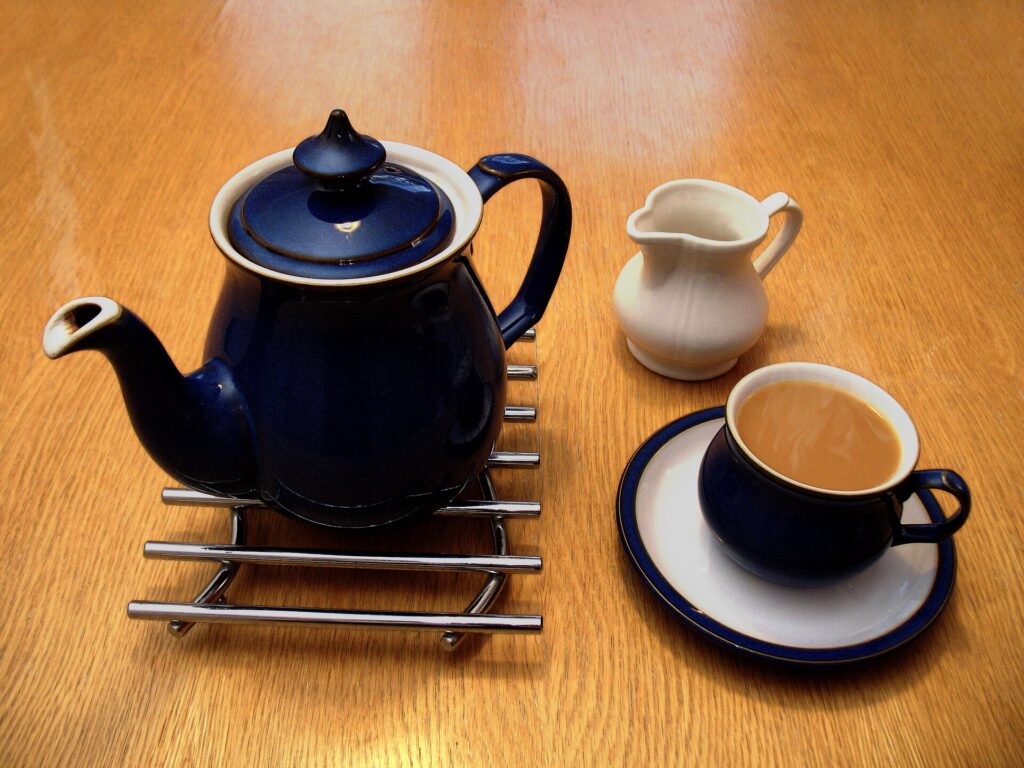
Pour a splash of milk into a cup of tea at 90°C or more, and the first drops separate from the rest of the milk and sit in very hot liquid long enough to change. Pour the tea onto milk already in the cup, and the milk warms up gradually as the two mix. Once they are mixed, Stapley noted, the whole cup should be below 75°C. He also advised fresh chilled milk rather than UHT, which has already been heat-treated and, in his words, tastes bad.
The key detail is often missed: the RSC method uses a warmed ceramic pot with loose leaf Assam, brewed for three minutes before any milk goes near it. Milk first works because the tea has already finished brewing in the pot.
Why milk first fails with a teabag
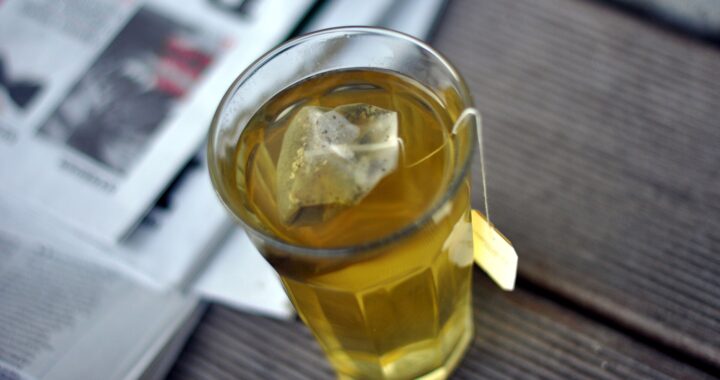
Most tea in Britain is now made with a bag in a mug. In a mug, the cup is also the brewing vessel. Black tea extracts best at or close to boiling (see our brewing temperature guide). A few centimetres of fridge-cold milk at the bottom of the mug pulls the water down by several degrees at once, and it keeps cooling while the bag steeps. The result is weaker, flatter tea.
So the two camps are both right, for different equipment. Pot: milk first is an option and protects the milk. Mug and bag: brew, squeeze or remove the bag, then add milk.
| How you brew | Milk order | Why |
|---|---|---|
| Loose leaf or bags in a teapot | Milk first or last | Tea is already brewed. Milk first keeps the milk from scalding, as the RSC advised. |
| Teabag in a mug | Milk last | Cold milk lowers the water temperature and slows extraction. |
| Tea for guests of unknown taste | Milk last | Each person can judge the colour and amount, as Orwell argued. |
| ISO 3103 tasting test | Milk first, unless your usual practice differs | The standard’s default. Milk added afterwards works best when the tea is 65 to 80°C. |
What the tea standard says
There is an international standard for making tea. ISO 3103 began as British Standard BS 6008 in 1980 and was last revised in 2019. It is a tasting method for comparing teas, not a recipe for your morning cup: 2 g of tea per 100 ml of freshly boiled water, six minutes for black tea, in a standard porcelain pot. For tests that use milk, it puts the milk in the bowl first. If milk goes in after, the standard says the best results come when the tea is between 65 and 80°C. The 1999 Ig Nobel Prize for Literature went to the British Standards Institution for this document.
Orwell’s case for tea first
In “A Nice Cup of Tea“, published in the Evening Standard on 12 January 1946, Orwell listed 11 rules. The tenth was tea first, and he called it one of the most controversial points of all. His argument was practical, not chemical: by putting the tea in first and stirring as one pours, one can exactly regulate the amount of milk, whereas one is liable to put in too much milk if one does it the other way round.
That point still holds. Tea strength varies with the leaf and the brewing time. Adding milk to tea lets you judge by colour. Adding tea to milk commits you to an amount before you can see the result.
What British tea drinkers actually do
Milk last has clearly won. In a YouGov survey from July 2018, 79% of Britons said the milk goes in last and 20% said first. The split is almost entirely about age, not class: only 4% of 18 to 24-year-olds chose milk first, against 32% of people aged 65 and over. Middle-class and working-class respondents gave almost the same answers.
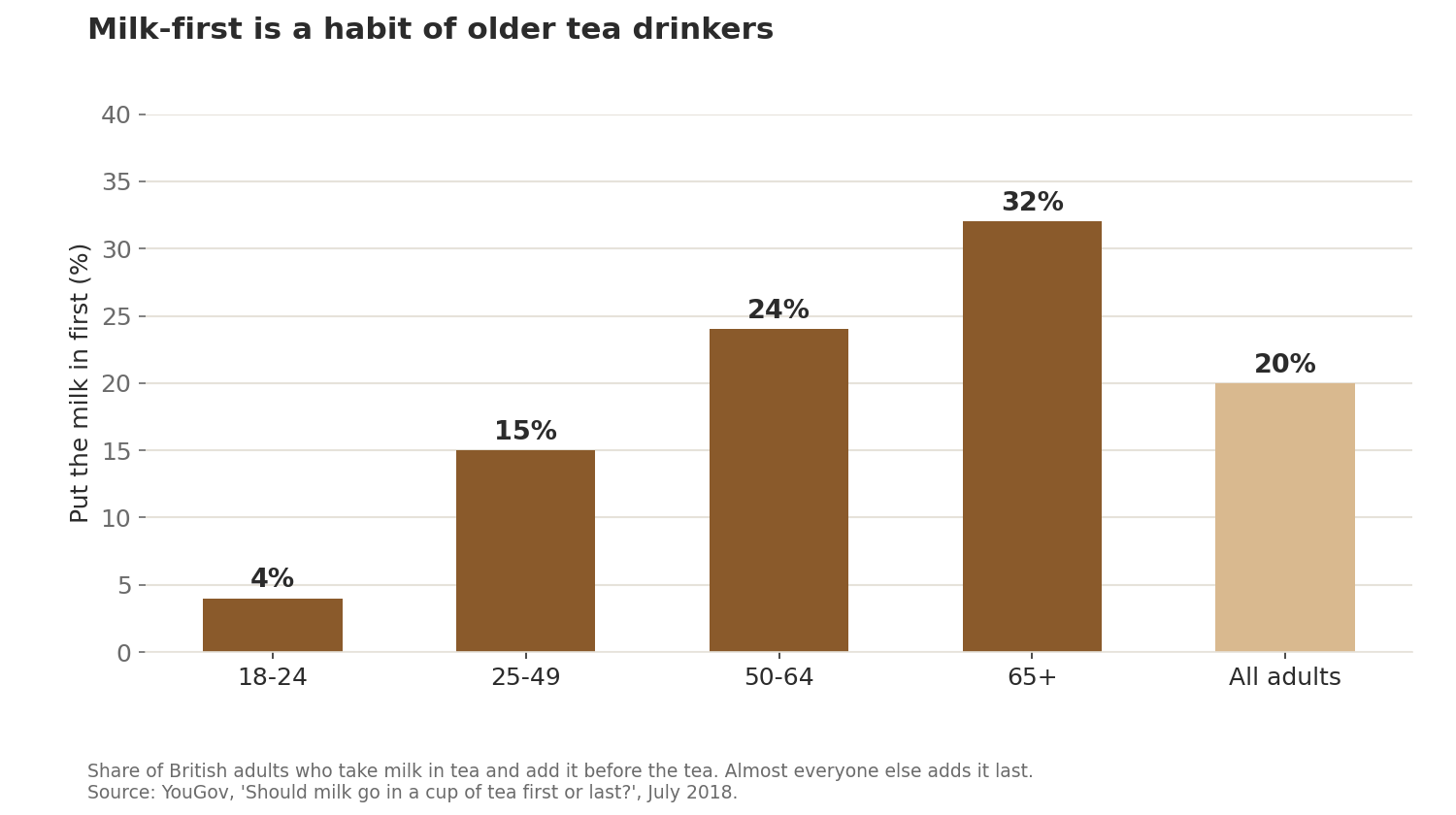
The age gradient fits the teabag explanation. Older drinkers grew up when the teapot was normal, and milk-first habits came with it. Younger drinkers learned with a bag in a mug, where milk last makes the better cup.
The china-cracking story
A popular explanation for milk first is that cheap porcelain could crack if boiling tea was poured straight in, so the milk went first to cool it. It is widely repeated, but hard to pin to any contemporary record. Treat it as folklore. The idea that milk first was lower class is similar: the YouGov data shows no class gap today.
The lady who could taste the difference
The debate helped create modern statistics. At the Rothamsted agricultural research station in the 1920s, the algae scientist Muriel Bristol said she could tell whether milk or tea had gone into her cup first. The statistician Ronald Fisher later turned the episode into the lady tasting tea experiment in his 1935 book The Design of Experiments.
His design used eight cups, four made each way, served in random order. There are 70 ways to choose which four cups were milk first, so a pure guesser has a 1 in 70 chance of getting all eight right. That idea, asking how likely a result is by chance alone, became the basis of the significance test. Accounts say Bristol identified the cups correctly, although Fisher’s book presents the test as a hypothetical.
Does milk change the health effects?
Possibly in the short term, but not in the long-term data. In a 2007 study in the European Heart Journal, 16 healthy women drank 500 ml of black tea, black tea with 10% skimmed milk, or hot water. Two hours later, plain tea had improved how well their arteries widened. Tea with milk had no effect. Lab tests pointed to casein, the main milk protein, binding to tea catechins.
The much larger UK Biobank study, which followed nearly half a million adults for about 11 years, found that people drinking two or more cups a day had a slightly lower risk of death. According to the National Cancer Institute, that association held regardless of tea temperature and whether people added milk or sugar. That matters in Britain, where YouGov found 80% of tea drinkers take milk. See our guide to how many cups of tea a day for the full figures.
Milk order makes no difference to any of this. Milk in the cup is milk in the cup. If you drink tea with meals and watch your iron levels, the tannins matter more than the milk.
How to make the cup either way
Teapot, milk first
- Warm the pot, add about one rounded teaspoon of leaf per cup, and pour on water that has just boiled.
- Brew three to four minutes.
- Put a splash of cold fresh milk in each cup, then pour the tea onto it through a strainer.
- Wait a minute or two. The RSC suggested drinking at 60 to 65°C.
Teabag in a mug, milk last
- Pour freshly boiled water onto the bag straight away.
- Steep three to five minutes, depending on how strong you like it.
- Press the bag gently against the side and take it out.
- Add milk slowly until the colour looks right, then stir.
If you are serving a full afternoon tea, bring milk to the table in a jug and let each person choose. That is the one approach both camps accept.
Quick answers
Is it correct to put milk in first?
It is correct with tea brewed in a pot, and the Royal Society of Chemistry recommended it. With a teabag in a mug, milk first gives weaker tea.
Why do some people say milk first is common?
It is an old class jibe. Survey data from 2018 shows middle-class and working-class drinkers choose milk first at almost the same rate, around one in five.
Last updated: 7 October 2026. Sources are linked in the text.
This article is general information, not medical advice. Talk to your doctor or pharmacist before using tea or herbs for a health condition, especially if you are pregnant, breastfeeding or take regular medication.