For most healthy adults, 2 to 5 cups of tea a day is a sensible range. In a study of nearly half a million UK adults, people drinking 2 or more cups a day had a 9 to 13% lower risk of death over 11 years than non-drinkers, and drinking more did not add to the benefit. The upper limit is set by caffeine: about 400 mg a day, which is roughly 6 to 10 cups of black tea. In pregnancy the limit is 200 mg, or about 2 to 3 cups.

What the UK Biobank study found
The biggest study of black tea and long-term health is a 2022 analysis of the UK Biobank, published in the Annals of Internal Medicine by researchers at the US National Cancer Institute. It followed 498,043 adults aged 40 to 69 who filled in a questionnaire between 2006 and 2010, for a median of 11.2 years.
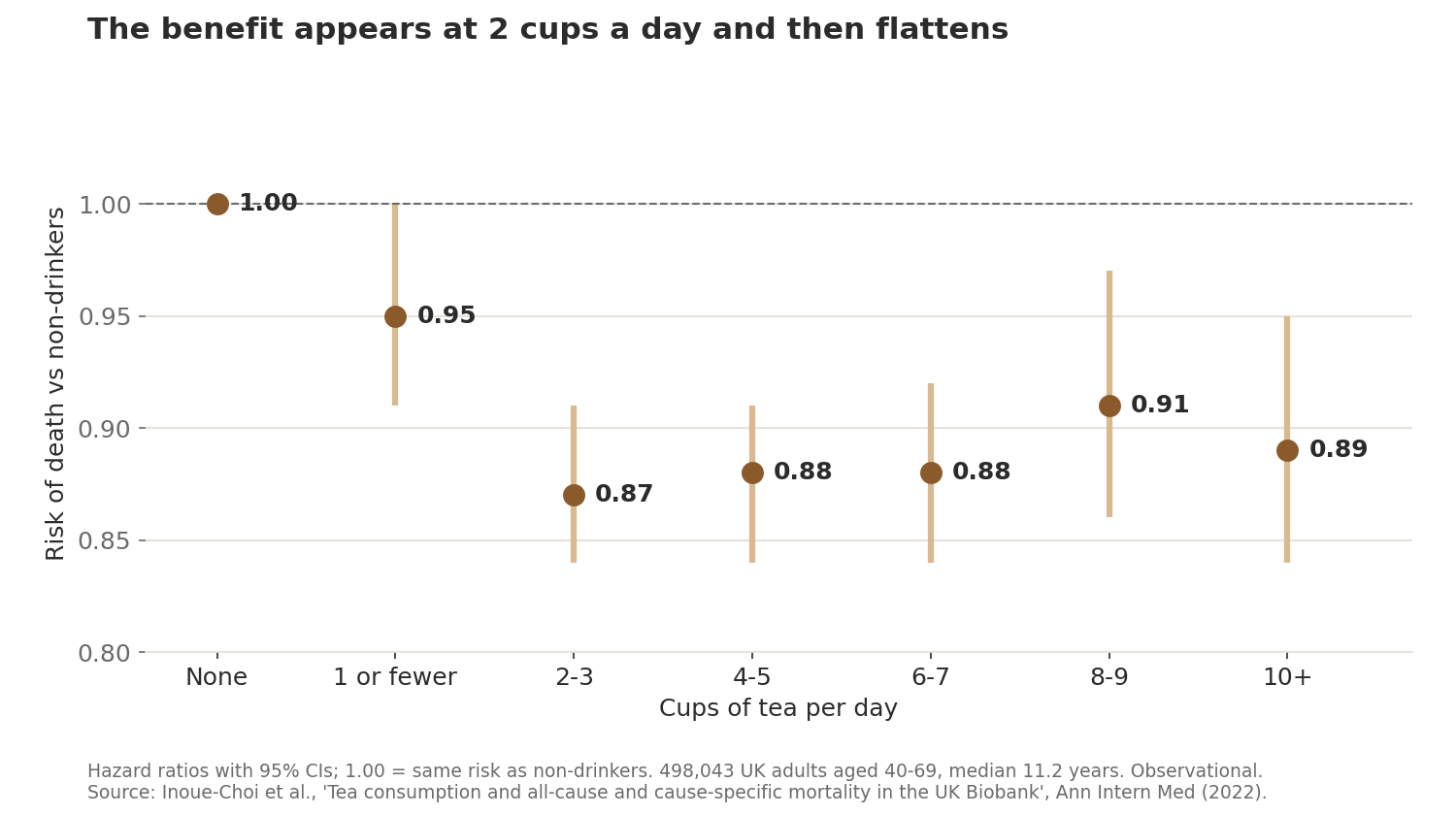
Compared with people who drank no tea, those drinking 2 to 3 cups a day had a 13% lower risk of dying during the study. The figure stayed between 9% and 12% lower all the way up to 10 or more cups. One cup or fewer was not clearly different from none. Tea drinkers also had lower death rates from heart disease and stroke.
According to the National Cancer Institute’s summary, the link held whether people drank their tea hot or cooler, with or without milk or sugar, and whatever their genes said about how quickly they process caffeine. For British readers who take milk, that matters: the result was measured in people drinking tea the way most of the UK does.
What this does and does not show
This was an observational study, not a trial. People who drink a few cups of tea a day may differ from non-drinkers in ways the researchers could not fully measure. The study also did not record cup size or how strong the tea was. The fair conclusion, as the authors put it, is that tea, even at high intakes, can be part of a healthy diet. It does not show that more tea makes you live longer, and the curve in the chart says the benefit, if real, does not grow beyond about 2 or 3 cups.
Where the upper limit comes from
For healthy adults, the ceiling is caffeine. The European Food Safety Authority sets safe intakes at up to 400 mg a day from all sources, and up to 200 mg in one sitting. How many cups that allows depends on the tea.
| Who | Daily caffeine limit | Cups of black tea (40 to 70 mg each) |
|---|---|---|
| Healthy adults | 400 mg (EFSA) | About 6 to 10 |
| Pregnant or breastfeeding | 200 mg (NHS, EFSA) | About 3 to 5, or 2 to 3 at the NHS’s 75 mg figure |
| People with IBS | No more than 3 caffeinated drinks (NHS) | 3, including coffee and cola |
| Children and teenagers | 3 mg per kg of body weight (EFSA) | About 2 for a 40 kg child |
Caffeine per cup varies a lot. Our tea caffeine guide puts a typical cup of black tea at 40 to 70 mg, and a strong Assam can reach 100 mg. The NHS pregnancy guidance uses a cautious 75 mg for a cup of black or green tea, which gives about two and a half cups a day. Green and white tea usually contain less than black.
Signs you are overdoing it
- Poor sleep. Caffeine has a half-life of several hours, so an afternoon mug is still partly in your system at bedtime. Switch to a caffeine-free tea after mid-afternoon, and see our tea for sleep guide.
- Jitters, a racing heart or anxiety. These usually mean too much caffeine at once. The 200 mg single-dose limit is about three strong mugs in quick succession.
- Headaches when you skip your usual cups. A sign of caffeine dependence. Cut down gradually, or swap some cups for decaf.
- Nausea on an empty stomach. Tea on an empty stomach upsets some people. Have it with or after food.
Other limits worth knowing
Iron
Tea’s tannins reduce how much iron you absorb from plant foods eaten at the same time. It is not a problem for most people, but if you are low in iron, vegetarian or vegan, drink tea between meals rather than with them. Our tea and iron guide covers how long to wait.
Oxalate and kidney stones
Black tea contains oxalate, which can form kidney stones. At normal intakes this is not a concern, but extreme amounts can be. In a 2015 case in the New England Journal of Medicine, a 56-year-old man in the US developed kidney failure after drinking about 16 glasses of iced tea a day, roughly a US gallon, which gave him over 1,500 mg of oxalate a day. If you have had calcium oxalate stones, ask your GP how much tea is right for you.
Fluoride
The tea plant takes up fluoride from soil, especially into older leaves. Normal tea drinking is fine, but bone disease from too much fluoride has been reported in people who drink very large amounts of strong tea for years, and in parts of China where compressed brick tea, made from older leaves, is drunk all day.
Tea still counts as fluid
A common worry is that several cups a day will dehydrate you. They will not. At normal amounts tea hydrates about as well as water, as our tea and hydration article explains. Four to six mugs a day count fully towards your fluid intake.
A sensible daily pattern
- 2 to 5 cups of regular tea, spread across the morning and early afternoon.
- No more than about 3 strong mugs in one go.
- Caffeine-free or decaf options after about 3pm if you sleep badly.
- Tea between meals rather than with them if your iron is low.
- Milk is fine. The UK data found the same association with or without it, and the order you add it makes no difference to your health.
Quick answers
Is 5 cups of tea a day too much?
For a healthy adult, usually not. Five cups of black tea is roughly 200 to 350 mg of caffeine, under the 400 mg limit. It is too much in pregnancy.
Is 10 cups of tea a day bad for you?
Ten strong cups can pass 400 mg of caffeine. The UK Biobank found no extra risk at 10 or more cups, but it did not measure cup size or strength, and very high intakes add oxalate and fluoride. Five or six is a more comfortable ceiling.
How many cups of tea a day in pregnancy?
The NHS limit is 200 mg of caffeine a day from all sources. At its figure of 75 mg a cup, that is about two and a half cups, with less if you also drink coffee or cola.
Does herbal tea count?
Herbal teas such as peppermint and rooibos contain no caffeine, so they do not count towards the caffeine limit. Some herbs have their own cautions.
Last updated: 7 October 2026. Sources are linked in the text.
This article is general information, not medical advice. Talk to your doctor or pharmacist before using tea or herbs for a health condition, especially if you are pregnant, breastfeeding or take regular medication.