Twinings is owned by Associated British Foods (ABF), the London-listed group that also owns Primark and Ovaltine. ABF bought the family firm in 1964. ABF itself is controlled by Wittington Investments, which is owned mainly by the Garfield Weston Foundation, one of Britain’s largest charities, and partly by the Weston family. Twinings is run from Andover in Hampshire. Its tea is packed there and in factories in Poland and China.
Who owns Twinings today?
| Level | Who | Notes |
|---|---|---|
| Brand | Twinings | Founded 1706, based in Andover, Hampshire |
| Owner | Associated British Foods plc | Owned Twinings since 1964, part of its grocery division |
| Controlling shareholder | Wittington Investments Ltd | Holds a controlling stake in ABF |
| Ultimate owners | Garfield Weston Foundation (about 79%) and Weston family | The foundation is a grant-making charity |
Associated British Foods is a FTSE 100 company. Shares trade on the London Stock Exchange, but control rests with Wittington Investments. The Garfield Weston Foundation owns 79.2% of Wittington’s share capital, and members of the Weston family own the rest. ABF’s chief executive is George G. Weston. Wittington also owns Fortnum & Mason and the furniture store Heal’s. So Twinings and Fortnum’s, two of London’s most famous tea names, ultimately share an owner while competing on the shelf.
Within ABF, Twinings sits in the grocery division alongside Ovaltine and a range of food brands. ABF’s other divisions include sugar, ingredients such as baker’s yeast, and Primark, which ABF has said it is exploring spinning off as a separate company. For how Twinings compares with the other big names, see our guide to who owns the big tea brands.
Is Twinings still family owned?
No. The Twining family ran the business for more than 250 years, but it has belonged to ABF since 1964. Family members have stayed involved with the brand. Stephen Twining, a tenth-generation descendant of the founder, has worked for the company as a public face of the brand, as he described in interviews. But ownership and control sit with ABF.
A short history of Twinings ownership
| Year | Event |
|---|---|
| 1706 | Thomas Twining, from Painswick in Gloucestershire, buys Tom’s Coffee House at 216 Strand, London |
| 1787 | The lion logo is created; it is the world’s oldest company logo in continuous use |
| 1837 | Queen Victoria grants Twinings its first Royal Warrant; it has supplied every monarch since |
| 1964 | Associated British Foods buys the family company |
| 1966 | Operations move to Andover, Hampshire |
| 1990s | Twinings acquires Jacksons of Piccadilly, another Earl Grey house |
| 2008 | Closure of the Nambarrie tea plant in Belfast announced |
| 2011 | Much of production moves to China and Poland; Andover keeps a smaller factory |
| 2023 | Lapsang souchong is delisted after more than two centuries |
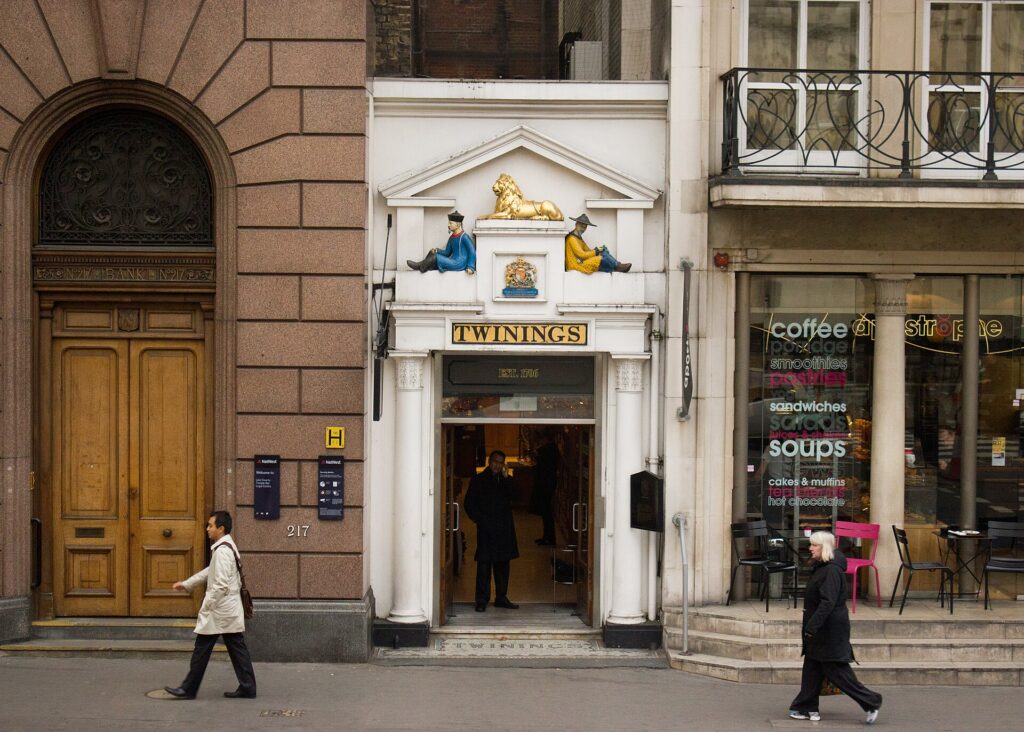
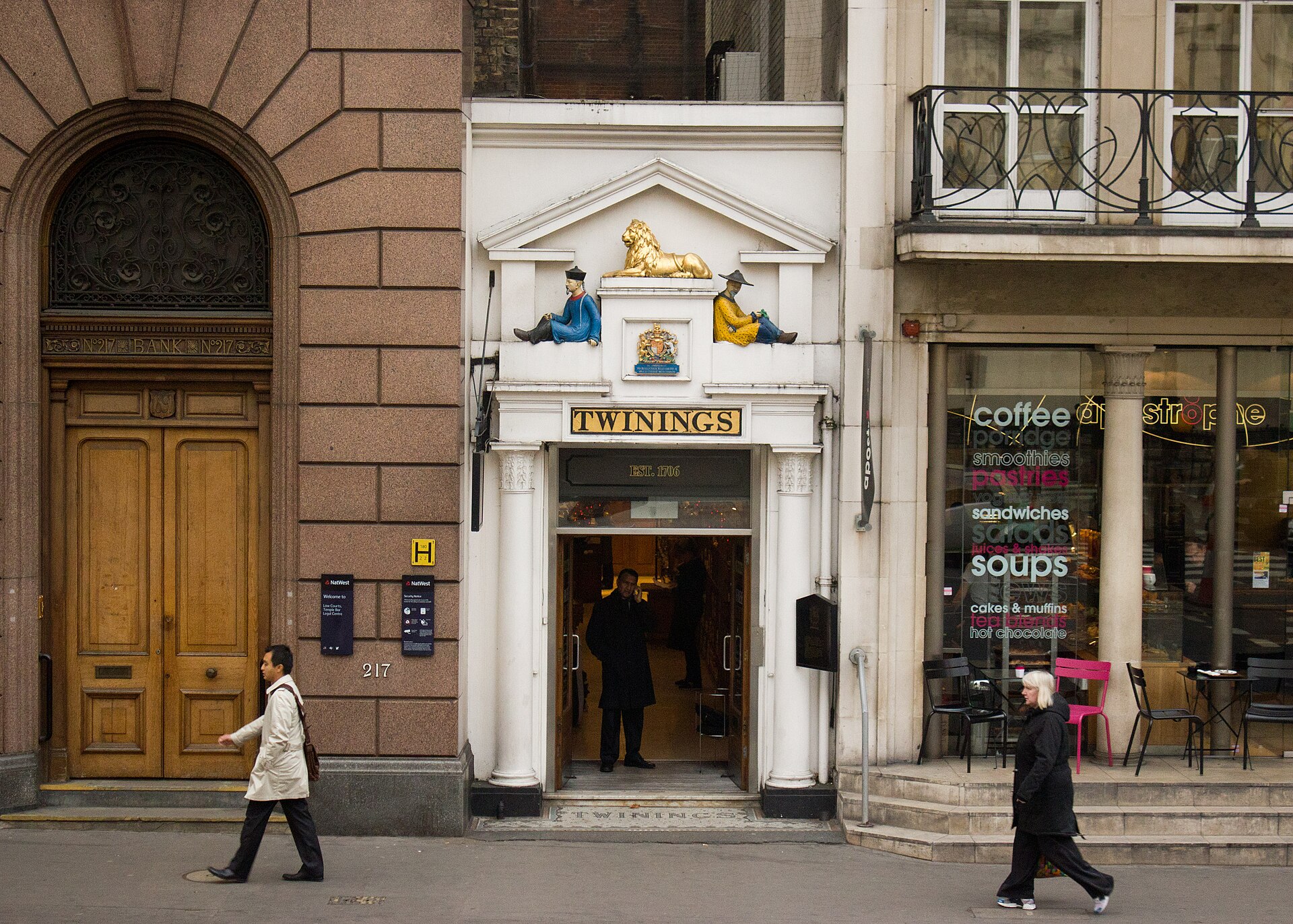
The shop on the Strand is still trading in the same spot, which makes Twinings London’s longest-standing ratepayer. It has a small museum at the back. Twinings says its Royal Warrant dates from Queen Victoria in 1837. Our history of Twinings goes deeper into the early centuries.
Visiting the Twinings shop on the Strand
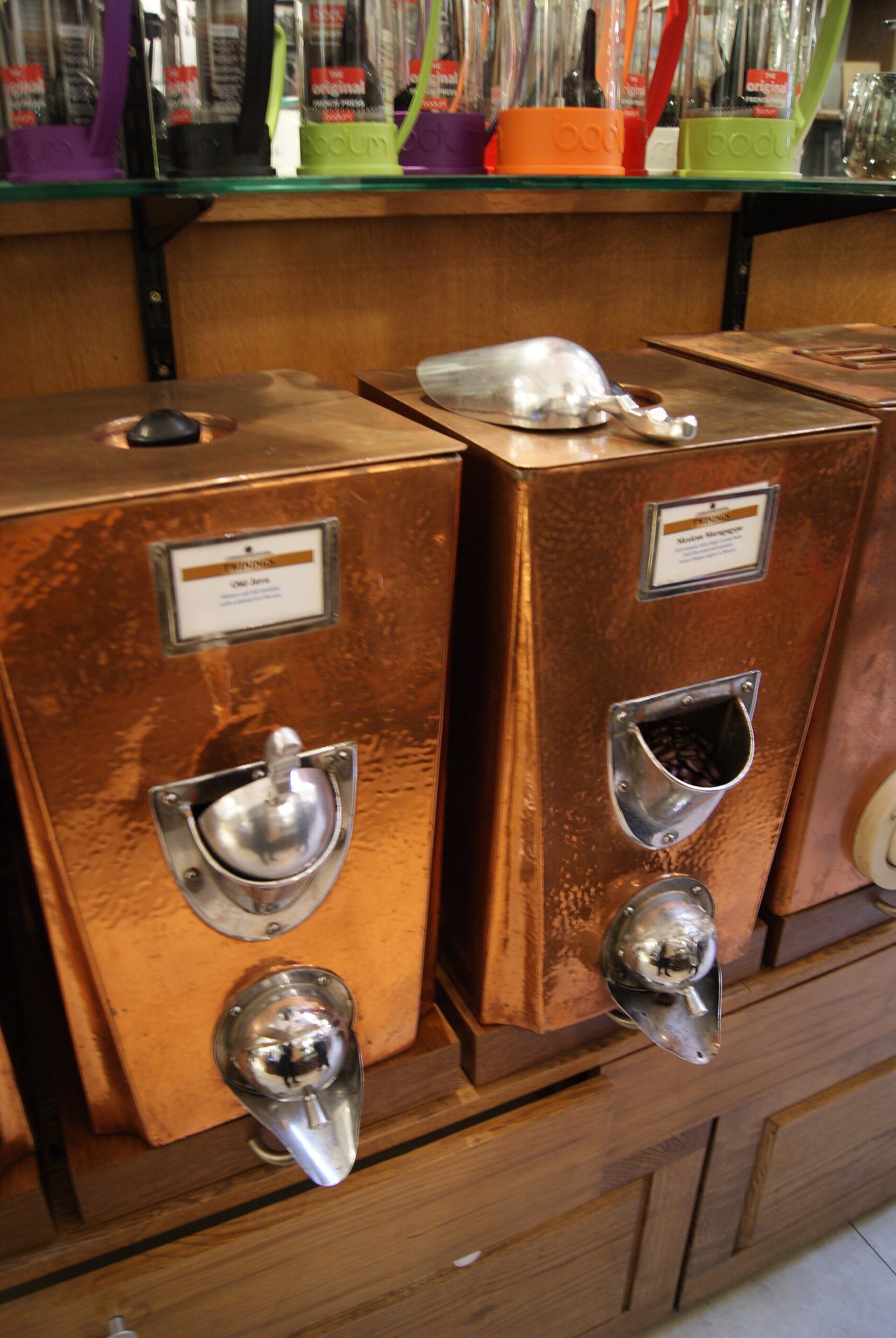
The original shop at 216 Strand, opposite the Royal Courts of Justice, is still open. It is a long, narrow room lined with tea, with a gilded lion and two Chinese figures above the door, taken from the 1787 logo. Visitors can taste teas at a counter, buy loose tea by weight, and see the small museum at the back, which displays old tea caddies, family portraits and the Royal Warrant Queen Victoria granted in 1837. It is one of the few places where you can still see how a Georgian London tea merchant traded.
What ABF ownership has meant for Twinings
Growth beyond Britain
Under ABF, Twinings grew from a London merchant into an international brand sold in more than 100 countries, with flavoured black teas, green teas, herbal infusions and cold infusions. Its association with Earl Grey became a selling point worldwide, helped by the purchase of Jacksons of Piccadilly in the 1990s.
Production moved abroad
In 2011, citing an efficiency drive, Twinings moved most of its production to China and Poland, keeping a reduced workforce in Andover. Three years earlier it had announced the closure of Belfast’s Nambarrie plant, a tea company with a history of more than 140 years.
Sourcing and ethics
Twinings is a founding member of the Ethical Tea Partnership and runs its own Sourced with Care programme. In 2018 it published a list of all its tea suppliers in India after campaigners pressed UK brands to reveal where they buy. Human rights groups track the company’s record as part of ABF. Our review of Sourced with Care looks at what the programme does and does not prove.
Products that disappeared
The most talked-about change was in 2023, when Twinings stopped selling lapsang souchong, a smoky tea it had sold since the 1700s and a favourite of Winston Churchill. It cited sourcing problems and replaced it with a blend called Distinctively Smoky, which fans attacked in the press. Our lapsang souchong guide explains the tea and where to find it now.
How Twinings compares with other tea owners
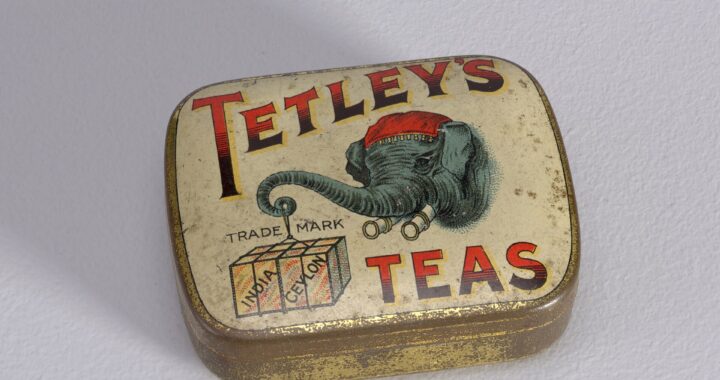
- Tetley belongs to India’s Tata Consumer Products. See who owns Tetley.
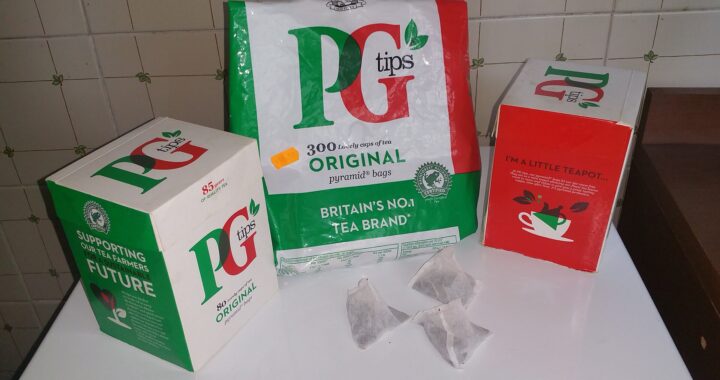
- Lipton and PG Tips belong to Lipton Teas and Infusions, controlled by private equity firm CVC. See who owns Lipton.
- Yorkshire Tea is still family owned by Bettys & Taylors. See the Yorkshire Tea story.
Of the big British names, Twinings is the one whose ultimate owner is largely a charity, through the Garfield Weston Foundation’s stake in Wittington. The foundation’s grants are funded largely by dividends that flow up from its holding.
Quick answers
Is Twinings a British company?
Yes. Twinings is headquartered in Andover, England, and its owner, Associated British Foods, is based in London. Much of its tea is now packed in Poland and China.
Is Twinings owned by Unilever or Nestlé?
No. Neither has ever owned Twinings. It has belonged to Associated British Foods since 1964.
Does Twinings still have a Royal Warrant?
Twinings has held a Royal Warrant since Queen Victoria granted one in 1837 and says it has supplied every monarch since.
Who owns Fortnum & Mason?
Wittington Investments, the same holding company that controls Associated British Foods and, through it, Twinings.
How should I store Twinings loose tea?
In an airtight tin away from light, heat and strong smells. Our tea storage guide explains how long each type keeps.
Where is Twinings tea made?
Twinings is headquartered in Andover, Hampshire, which still has a factory. Since 2011 much of its production has been in Poland and China.
Who owns Jacksons of Piccadilly?
Twinings bought Jacksons of Piccadilly, a rival London tea house also linked with Earl Grey, in the 1990s. So it belongs to Associated British Foods too.
How old is Twinings?
Twinings dates from 1706, when Thomas Twining opened his shop on the Strand, making it more than 300 years old. It has traded from the same address ever since.
Sources
- Associated British Foods: ownership, Wittington Investments and the Garfield Weston Foundation.
- Twinings: history, logo, production moves and lapsang souchong.
- Twinings. 100 years of monarchy and democracy, on its Royal Warrant.
- TeaTime Magazine. Meet the tenth-generation Twining.
- The Spectator. On the end of Twinings lapsang souchong.
Last updated: 8 October 2026. Sources are linked in the text.