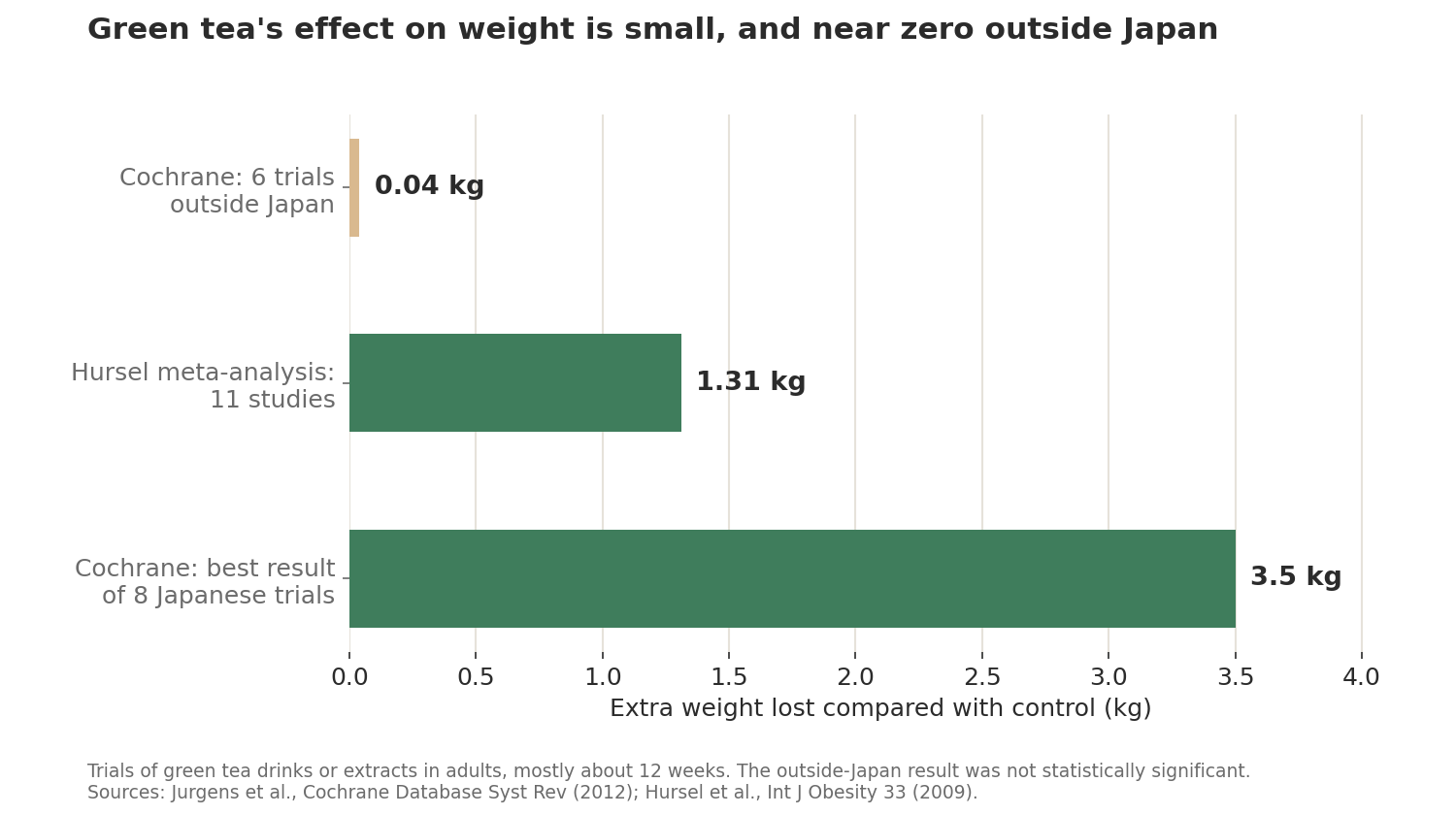
Green tea does not cause meaningful weight loss on its own. A Cochrane review of 14 trials found that outside Japan, people given green tea preparations lost just 0.04 kg more than people who were not, a result indistinguishable from zero. Japanese trials showed more, but they were too different from each other to combine. Green tea is still a good zero-calorie drink. Concentrated green tea extract pills carry a real risk of liver damage.
Why green tea was expected to work
Green tea contains two things that could, in theory, help. Caffeine slightly raises the number of calories the body burns. Catechins, especially EGCG (epigallocatechin gallate), may prolong the effect of the hormone noradrenaline, which is involved in fat burning. Green tea keeps more catechins than black tea because the leaves are not oxidised, as our green vs black tea guide explains.
Short lab studies found small increases in energy use after catechins and caffeine. The question is whether that becomes lost weight over months. That needs longer trials.
The Cochrane review
Cochrane reviews are designed to pool all the good-quality trials on a question. The 2012 Cochrane review on green tea and weight, led by Tamara Jurgens, included randomised trials lasting at least 12 weeks in overweight or obese adults. The trials used green tea drinks or extracts. The results split into two groups.
| Trials | People | Extra weight lost vs control | Verdict |
|---|---|---|---|
| 6 outside Japan | 532 | 0.04 kg on average | No meaningful difference, not statistically significant |
| 8 in Japan | 1,030 | 0.2 to 3.5 kg, depending on the trial | Favoured green tea, but trials too different to combine |
The picture was the same for waist size and body mass index: close to zero outside Japan. The reviewers concluded that green tea preparations produced a small, statistically non-significant weight loss that is unlikely to matter clinically. Two trials of keeping weight off after a diet ranged from a 0.6 kg gain to a 1.6 kg loss, with no clear effect.
Why the Japanese results were better
Nobody knows for certain. The Japanese trials differed from each other and from the Western ones in the drinks tested, the doses and the volunteers’ usual diets. Habitual caffeine intake may also change the response.
That last idea comes from an earlier meta-analysis by Rick Hursel and colleagues at Maastricht University, which pooled 11 studies of catechins, usually taken with caffeine. It found an average extra loss of 1.31 kg. People with low habitual caffeine intake lost 1.60 kg more than controls. People who already had more than 300 mg of caffeine a day, roughly four to seven cups of black tea, lost only 0.27 kg. That comparison did not quite reach statistical significance, so it is a hint rather than a proven effect.
Even the more favourable figure is about 1.3 kg over three months. For comparison, a sustained daily deficit of a few hundred calories from diet alone would usually do more.
The real risk: green tea extract pills
Weight-loss supplements often contain concentrated green tea extract. In 2018 the European Food Safety Authority reviewed the safety of green tea catechins. It found that trials of supplements providing 800 mg or more of EGCG a day showed a significant rise in liver enzymes, a sign of liver stress. Supplements on the market provided anywhere from 5 to 1,000 mg of EGCG a day.
| Source | EGCG per day |
|---|---|
| Typical EU green tea drinker | 90 to 300 mg |
| Heavy green tea drinkers | Up to 866 mg |
| Supplements on sale | 5 to 1,000 mg |
| Level linked to liver enzyme rises in trials | 800 mg or more, as a supplement |
EFSA concluded that brewed green tea, prepared the traditional way, is generally safe at normal intakes. It noted rare liver reactions to infusions too, probably individual sensitivity. The concern is concentrated pills, where one capsule can deliver as much EGCG as several cups of tea. If you take a green tea extract and develop dark urine, yellowing skin or eyes, or pain under the right ribs, stop and see a doctor.
Where green tea does help
- As a swap. Unsweetened green tea has almost no calories. Replacing one sugary drink or a large milky coffee a day saves more energy than any catechin effect.
- As a pre-exercise drink. The caffeine can make exercise feel easier. Our tea for focus guide covers how green tea’s caffeine and L-theanine combine.
- For hydration. Several cups a day count towards your fluid intake.
How to drink it for the best cup
If you drink green tea because you enjoy it, brew it so it does not taste bitter: water at 70 to 80°C, 2 to 3 g of leaf per 200 ml, 1 to 3 minutes. Our green tea brewing guide has times by type. Green tea has less caffeine than black tea per cup (see our caffeine guide), but it still counts towards the daily limits in our cups of tea a day guide. Like other tea, it reduces iron absorption from meals, so drink it between meals if your iron is low.
Quick answers
How much green tea should I drink to lose weight?
No amount of green tea has been shown to cause meaningful weight loss outside Japanese trials of high-catechin drinks. Two to four cups a day is a reasonable amount to enjoy, not a weight loss dose.
Does green tea burn belly fat?
The Cochrane review found waist size changed by about 0.2 cm outside Japan, which is no meaningful change.
Is matcha better for weight loss?
Matcha contains more catechins and caffeine per cup because you drink the powdered leaf. No long-term trial shows it causes more weight loss than ordinary green tea.
Are green tea diet pills safe?
Not reliably. EFSA linked supplement doses of 800 mg EGCG or more a day to signs of liver stress. Brewed tea is the safer way to drink it.
Last updated: 7 October 2026. Sources are linked in the text.
This article is general information, not medical advice. Talk to your doctor or pharmacist before using tea or herbs for a health condition, especially if you are pregnant, breastfeeding or take regular medication.