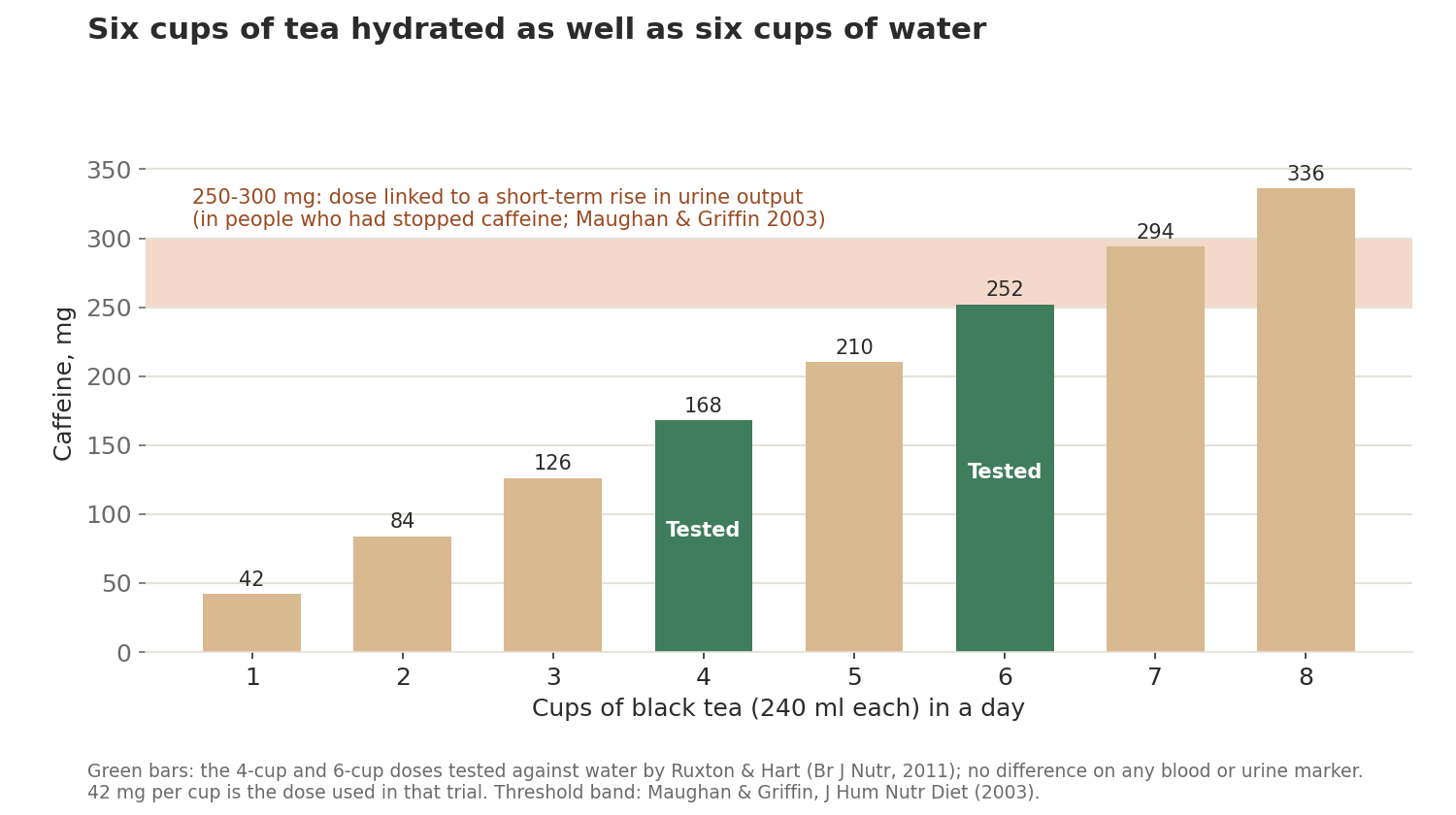
No. In normal amounts, tea does not dehydrate you. A controlled trial found that six mugs of black tea a day kept men as well hydrated as six mugs of water, and a larger study found hot and iced tea produced no more urine than water. Caffeine only raises urine output at doses of roughly 250 to 300 mg at once, which is five or more cups of tea, and mostly in people who have stopped drinking caffeine.
The idea that tea dries you out comes from a real fact stretched too far. Caffeine is a mild diuretic: at a high enough dose it makes the kidneys pass more water for a few hours. From there it is a short step to the rule many people still repeat, that a cup of tea “doesn’t count” towards your fluids, or even that you need a glass of water to cancel each cup out.
That rule does not survive contact with the studies that tested it. The trials below measured what happens to blood and urine when people drink tea instead of water, and the results are consistent.
The short answer, by drink
| Drink | Net effect on hydration | Main evidence |
|---|---|---|
| Black tea, 4 to 6 mugs a day | Same as water | Ruxton & Hart, 2011 (randomised trial) |
| Hot tea or iced tea, 1 litre at once | Same urine output as water | Maughan et al., 2016 |
| Green, white and oolong tea | Same as black tea; similar or lower caffeine per cup | Caffeine dose research |
| Herbal tea (chamomile, rooibos, mint) | Same as water; no caffeine | No stimulant to act on the kidneys |
| Dandelion “tea” | May increase urination | Clare et al., 2009 (extract, not tea) |
| Very strong tea or matcha drunk in a large burst | Short rise in urine output possible | Maughan & Griffin, 2003 |
The trial that tested tea against water
The most direct test is a randomised controlled trial by Carrie Ruxton and Victoria Hart, published in the British Journal of Nutrition in 2011. Twenty-one healthy men came in on four separate days. On two days they drank black tea, either 4 or 6 mugs of 240 ml each, made from tea bags with a splash of semi-skimmed milk. On the other two days they drank the same amounts of boiled water. The tea delivered 168 mg of caffeine on the 4-mug days and 252 mg on the 6-mug days.
Food was controlled, the men stayed at rest, and they had avoided caffeine for 24 hours beforehand, which is the condition most likely to show a diuretic effect. The researchers took blood six times over 12 hours and collected all urine for 24 hours. They found no significant difference between tea and water on any measure, including urine volume, urine concentration and blood markers such as sodium, potassium and osmolality. Their conclusion: black tea “offered similar hydrating properties to water”.
One detail matters for weighing that result. The study was funded by the Tea Advisory Panel, which is itself supported by the UK Tea Council, the tea industry’s trade body. Funding does not make a result wrong, but it is a good reason to check it against other work. The next two studies had no tea-industry money. They had drinks-sector funders of their own, named below, and three groups with different funders reached the same answer.
Tea in the beverage hydration index
In 2016, a team led by Ronald Maughan at Loughborough University, with Bangor and Stirling universities, published a randomised trial in the American Journal of Clinical Nutrition that compared 13 common drinks, funded by a grant from the European Hydration Institute. Seventy-two men each drank a litre of still water and a litre of three other drinks, on separate occasions, over 30 minutes. The team then collected their urine for four hours.
Hot tea and iced tea produced the same amount of urine as water. So did coffee, cola, diet cola, lager, orange juice, sparkling water and a sports drink. Only three drinks did better than water: an oral rehydration solution, full-fat milk and skimmed milk. The sodium, protein and energy in those drinks slow how fast fluid leaves the body. The researchers turned the results into a “beverage hydration index”. On that index, tea sits alongside water, not below it.
When caffeine does make you pass more water
Caffeine’s diuretic effect is real, but it has a threshold and it fades with habit. A 2003 review by Maughan and Griffin in the Journal of Human Nutrition and Dietetics gathered every relevant study published from 1966 to 2002. It found that a large single dose, at least 250 to 300 mg of caffeine, causes a short-term rise in urine output. The authors put that at 2 to 3 cups of coffee or 5 to 8 cups of tea. Even that effect showed up mainly in people who had gone without caffeine for days or weeks.
Regular tea and coffee drinkers build up what the review calls a “profound tolerance” to the diuretic effect. At the amounts found in normal servings of tea, coffee and soft drinks, the authors found no diuretic action at all. They concluded that there is “no clear basis” for avoiding caffeinated drinks when you are worried about fluid balance.
Coffee, which carries more caffeine per cup, points the same way. In a 2014 crossover study in PLOS ONE, 50 regular coffee drinkers drank four 200 ml cups of coffee a day for three days, and water on a separate three days. Total body water, 24-hour urine volume and blood markers did not differ between the two. The study was funded by the Institute for Scientific Information on Coffee, a coffee-industry-backed body. If a stronger caffeinated drink passes that test, a weaker cup of tea has even less reason to fail it.
Green tea, matcha, iced tea and decaf
The studies above used black tea, but the logic carries over, because caffeine is the only part of tea with a meaningful effect on the kidneys. A typical cup of green, white or oolong tea has about the same caffeine as black tea or less. Our tea caffeine comparison covers the ranges by type. Decaf tea and caffeine-free herbal teas are hydrating for the same reason water is. The best caffeine-free teas are a full alternative if you want the ritual without the stimulant.
Matcha is the one to watch. You drink the whole ground leaf, so a strong bowl, or several made in a row, can reach the caffeine levels that the 2003 review linked to extra urine. Iced tea hydrates as well as hot tea. With sweetened bottled iced tea, the concern is the sugar, not the fluid.
The one herbal exception
Dandelion is the herbal tea most often sold as a “water pill”. There is some human data behind it. In a small 2009 pilot study in the Journal of Alternative and Complementary Medicine, 17 volunteers took a fresh-leaf dandelion extract three times in one day. They urinated more often after the first dose and passed more urine relative to what they drank after the second. The third dose changed nothing. That was a concentrated ethanol extract, not a mug of dandelion tea, and the study had no placebo group. It does show why “herbal” does not always mean “neutral” for fluid balance.
How to count tea towards your fluids
In the UK, the NHS suggests aiming for 6 to 8 cups or glasses of fluid a day, and says water, lower-fat milk and sugar-free drinks “including tea and coffee, all count”. In practice:
- Count every cup of tea as fluid, including black, green, herbal and decaf.
- Keep caffeine in context. Most healthy adults can drink five or six cups of regular tea spread across a day without any effect on hydration.
- If you are caffeine-sensitive, pregnant or taking medicines that interact with caffeine, the limit that matters is caffeine itself, not hydration. Ask your doctor or pharmacist.
- For sport in heat or recovery from illness, water, milk or an oral rehydration solution hold fluid better than tea because of their sodium and protein content.
Frequently asked questions
Does tea dehydrate you more than coffee?
No. A cup of tea usually has less caffeine than a cup of coffee, and neither drink dehydrates regular drinkers at normal intakes. The 2016 hydration-index trial found tea and coffee both produced the same urine output as water.
Why do I need the toilet more after drinking tea?
Mostly because you drank more fluid. A mug of tea is 240 ml or more of water, and your kidneys pass extra fluid whatever form it arrives in. If you rarely have caffeine, a strong cup can add a small, short-lived extra effect, but you do not lose more fluid than the tea provided.
Does tea count as water intake?
Yes. The NHS counts tea and coffee as part of your daily fluid intake. The trials above found no difference in hydration markers between tea and the same volume of water.
Does green tea dehydrate you?
No. Green tea usually has similar or less caffeine per cup than black tea, which already matched water in a controlled trial. Very strong matcha drunk in quantity is the only green tea that approaches the 250 to 300 mg caffeine dose linked to extra urine output.
Can tea make dehydration worse when you are ill?
Weak or moderate tea still adds fluid. With vomiting or diarrhoea, though, you are losing salts as well as water, and an oral rehydration solution replaces both. Tea does not. Use tea as a comfort drink alongside proper rehydration, not instead of it.
The bottom line
Tea hydrates you. Controlled trials put four to six mugs of black tea level with the same amount of water, and hot and iced tea matched water in the largest drink-by-drink comparison. Caffeine only increases urine output at around 250 to 300 mg in one go, mostly in people who have stopped caffeine, and regular drinkers become tolerant to it. Count your tea as fluid, and keep an eye on total caffeine for sleep and sensitivity reasons, not hydration.
If the caffeine is what you want to cut, decaffeinating tea at home explains what works and what does not. For evening cups, see the best tea for sleep. For a cold jug that stays smooth in summer, see how to make cold brew tea.
Sources
- Ruxton CH, Hart VA. Black tea is not significantly different from water in the maintenance of normal hydration in human subjects. Br J Nutr 2011;106(4):588-95. Funded by the Tea Advisory Panel.
- Maughan RJ et al. A randomized trial to assess the potential of different beverages to affect hydration status: development of a beverage hydration index. Am J Clin Nutr 2016;103(3):717-23. Funded by the European Hydration Institute.
- Maughan RJ, Griffin J. Caffeine ingestion and fluid balance: a review. J Hum Nutr Diet 2003;16(6):411-20.
- Killer SC, Blannin AK, Jeukendrup AE. No evidence of dehydration with moderate daily coffee intake. PLOS ONE 2014;9(1):e84154. Funded by the Institute for Scientific Information on Coffee.
- Clare BA, Conroy RS, Spelman K. The diuretic effect in human subjects of an extract of Taraxacum officinale folium over a single day. J Altern Complement Med 2009;15(8):929-34.
- NHS. Water, drinks and your health.
This article is general information, not medical advice. If you have a kidney, heart or other medical condition that affects how much fluid you should drink, follow your clinician’s guidance.