White tea is the least processed tea from Camellia sinensis. The leaves and buds are only withered and dried. It is often sold as a low-caffeine, extra-healthy choice, but lab analyses show neither claim holds up. Dry white tea is at the high end for caffeine, and its antioxidant levels overlap with green tea’s. What it does offer is a gentle, sweet cup that is hard to make bitter.

What is white tea?
White, green, oolong and black teas all come from the same plant. What separates them is processing. Green tea is heated soon after picking to stop the leaf’s enzymes from browning it. Black tea is rolled and fully oxidised. White tea skips both steps. The leaves are spread out to wither for many hours, losing most of their water, and then dried gently. A little oxidation happens along the way, but far less than in oolong. Our green tea vs black tea guide explains how oxidation changes the leaf.
White tea comes traditionally from northern Fujian province in China, especially the counties of Fuding and Zhenghe, where plant varieties with large, downy buds were bred for it. The name comes from those fine silver-white hairs, not from the colour of the tea, which brews pale gold. White tea is now also made in Yunnan and Henan in China, and in India, Sri Lanka, Nepal and Kenya.
There is no legal definition of white tea. Food chemists at the Technical University of Braunschweig in Germany pointed out that the label can mean a region, a plant variety or a method, depending on who is selling it. In practice, most people mean tea made by withering and drying without heat-fixing or rolling.
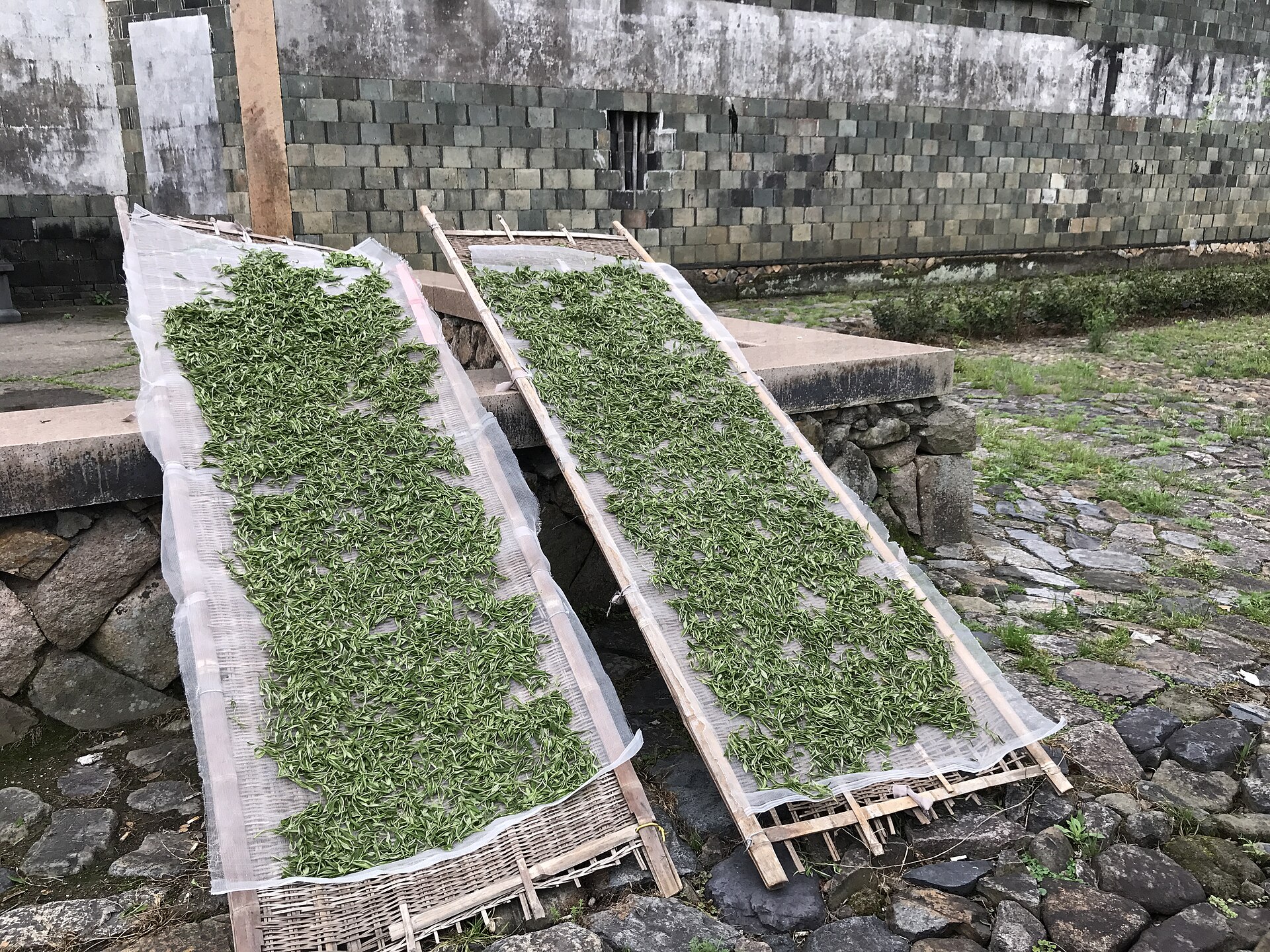
The main types of white tea
| Name | What is picked | Taste |
|---|---|---|
| Silver Needle (Bai Hao Yin Zhen) | Unopened buds only | Delicate, honeyed, melon, very light body |
| White Peony (Bai Mu Dan) | A bud and one or two young leaves | Floral and fruity, fuller than Silver Needle |
| Tribute Eyebrow (Gong Mei) | Smaller buds and leaves, later in spring | Fruity, slightly woody |
| Longevity Eyebrow (Shou Mei) | A bud and three or four larger leaves | Darker, sweeter, hay and dried fruit |
| Aged white tea | Usually White Peony or Shou Mei, often pressed into cakes | Mellow, dates, honey, herbal |
Buds are picked first, in early spring. The later pickings, with more open leaf, are cheaper but not worse. Many people prefer the rounder flavour of White Peony or Shou Mei to the subtlety of Silver Needle.
How much caffeine is in white tea?
This is the most common misunderstanding about white tea. It is often described as the lowest-caffeine tea. The Braunschweig chemists who reviewed the data found the opposite: all the figures they had showed caffeine at 4 to 5% of the dry leaf, which is at the top of the range for tea. They called claims that white tea is low in caffeine scientifically incorrect.
The reason is the buds. Young buds and the first leaves carry more caffeine than older leaves. A 2026 study of tea leaf development confirmed that caffeine and other alkaloids are concentrated in buds and young leaves and fall as the leaves mature. Since the finest white teas are mostly buds, they start with plenty of caffeine.
What reaches your cup depends far more on how you brew it. When US researchers measured 20 brewed teas, white, green and black teas ranged from 14 to 61 mg of caffeine per serving, with no clear pattern by type. Steeping time made a bigger difference. White tea’s whole, unbroken buds and the cooler water often used for it may release caffeine more slowly than a broken-leaf black tea bag in boiling water. A long or repeated steep can still add up to as much as any other tea. Our tea caffeine comparison has figures for every major type.
If you want less caffeine, white tea is not the answer. A true caffeine-free herbal tea is, or see our guide on whether you can decaffeinate tea at home.
White tea benefits
Antioxidants
White tea contains the same families of polyphenols as green tea, mainly catechins such as EGCG. Marketing has claimed it holds three, five or even ten times more. The German review did the arithmetic. Green and black teas usually contain 10 to 20% total polyphenols. Three times that would be 30 to 60%, and ten times would be more than the leaf itself, which is impossible. Measured polyphenol levels in white tea are comparable to green and black tea.
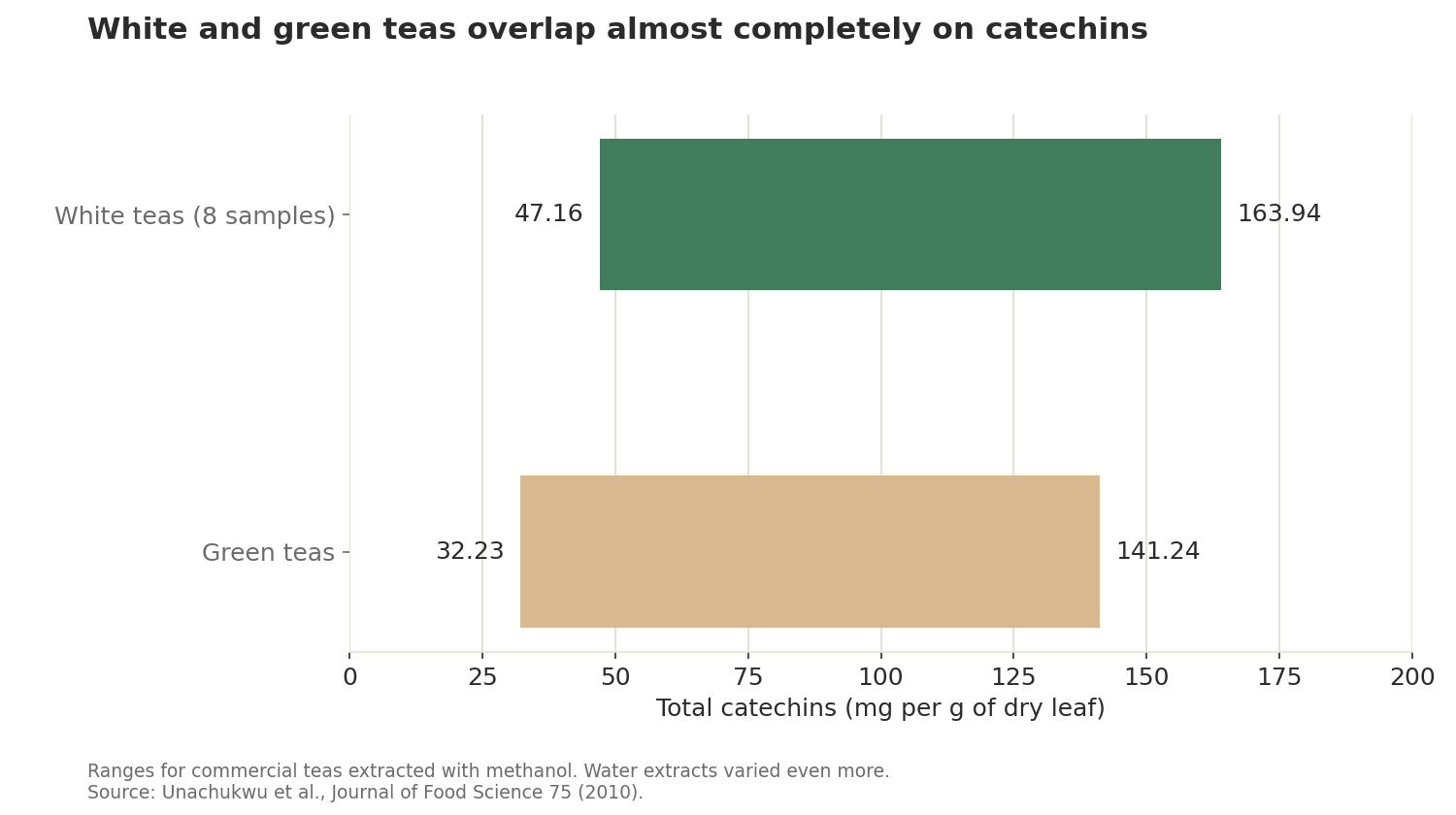
A careful study at the City University of New York tested eight commercial white teas against green teas. Catechin levels varied more than tenfold within each type, and the ranges overlapped almost completely. Some white teas matched some green teas, but the white teas showed lower overall antioxidant capacity. The authors concluded that any ranking of tea types by catechins is unreliable unless you know the exact tea and its source.
Heart, weight and long-term health
Large population studies linking tea to lower heart disease and death mostly track green or black tea. White tea drinkers are too few to study separately, and there are no meaningful human trials of white tea for weight, blood pressure or cholesterol. Because white tea shares green tea’s chemistry, any benefits are likely to be similar. Our guide to green tea and weight loss explains why those benefits are modest.
Focus and calm
Like all true teas, white tea pairs caffeine with L-theanine, an amino acid linked to relaxed alertness. Theanine levels in white and green teas overlap widely. White tea’s soft flavour makes it an easy afternoon cup, and it fits the approach in our best tea for focus guide. It still contains caffeine, though, so it is not a bedtime drink. For that, see the best tea for sleep.
What about skin and anti-ageing?
White tea extract appears in many skin creams, and some lab studies show its polyphenols can protect skin cells from damage. Those studies apply the extract directly to cells or skin. Drinking white tea has not been shown to change how your skin ages.
Aged white tea
In Fujian, a saying holds that white tea is “one year tea, three years medicine, seven years treasure”. White Peony and Shou Mei are often pressed into cakes and stored for years, and the flavour slowly turns from fresh and floral to mellow, with notes of dates and honey.
Chemists have measured what changes. A 2024 analysis of white teas stored for different lengths of time found that catechins, dimeric catechins and amino acids fell during storage, while caffeine and a group of compounds formed from catechins and theanine rose. A 2026 review of aged teas noted that flavour and possible benefits do not keep improving forever, and that most claims about aged tea’s health effects come from lab and animal studies. Aged tea is a pleasure, not a medicine. Pressed and aged tea is more famous in the form of pu-erh, which follows a different process.
How to brew white tea
White tea is forgiving. Bitterness comes mainly from very hot water and long steeps, and whole buds release their flavour slowly, so it is hard to ruin.
| Tea | Leaf per 250 ml | Water | Western steep |
|---|---|---|---|
| Silver Needle | 3 to 4 g (2 heaped tsp, it is bulky) | 75 to 85°C | 4 to 6 minutes |
| White Peony | 3 g | 80 to 90°C | 3 to 5 minutes |
| Shou Mei | 3 g | 90 to 95°C | 3 to 4 minutes |
| Aged white cake | 3 to 4 g, broken from the cake | 95 to 100°C | 2 to 4 minutes, or simmer briefly |
- Warm the pot or cup with hot water, then pour it away.
- Add the leaf. Silver Needle is light and fluffy, so measure by weight if you can.
- Pour water at the right temperature. If you have no thermometer, let a boiled kettle stand with the lid open for 3 to 5 minutes.
- Steep, then pour off all the tea so the leaves are not left sitting in water.
- Re-steep with slightly hotter water and a minute longer each time.
- For gongfu brewing in a small pot or gaiwan, use about 5 g per 100 ml and steeps of 30 to 60 seconds. White Peony often gives six or more good infusions.
- White tea makes excellent cold brew. Use 5 g per litre of cold water and leave it in the fridge for 8 to 12 hours.
- More on matching water to leaf in our tea brewing temperature and steep time guide. The approach is close to brewing green tea.
Buying and storing white tea
- Look at the leaf. Good Silver Needle is plump, unbroken and covered in silver down. White Peony should show whole buds and leaves, not dust.
- Check the origin and harvest year. Fresh white tea is best within a year or two. Aged tea should say when it was made.
- Be wary of health claims. A seller promising ten times the antioxidants of green tea is not reading the science.
- Store it dry and dark. Fresh white tea fades like green tea. Cakes meant for ageing need stable, dry conditions away from smells. Our tea storage guide covers both.
Quick answers
Does white tea have less caffeine than green tea?
Not reliably. Dry white tea often has as much caffeine as green tea or more, because it is rich in buds. A cup brewed with cooler water may contain a little less, but the overlap is large.
Is white tea healthier than green tea?
There is no good evidence that it is. Both contain similar polyphenols, and the amounts vary more between individual teas than between the two types.
How many cups of white tea a day is safe?
Three to five cups is well within caffeine limits for most healthy adults. During pregnancy, keep total caffeine under 200 mg a day. Our how many cups of tea a day guide has more detail.
What does white tea taste like?
Light, sweet and smooth, with notes of honey, melon, hay or flowers, and very little bitterness. Aged white tea is darker and tastes of dried fruit. If you like lightly oxidised oolong, try White Peony next.
Can you add milk to white tea?
You can, but it masks the delicate flavour that makes white tea worth buying. A slice of lemon or nothing at all works better.
Sources
- Engelhardt and Hilal. Weißer Tee, koffeinfrei und besser als alle anderen? Technical University of Braunschweig, 2008 (German).
- Unachukwu et al. White and green teas: variation in phenolic, methylxanthine and antioxidant profiles. Journal of Food Science, 2010.
- Chin et al. Caffeine content of brewed teas. Journal of Analytical Toxicology, 2008.
- Chen et al. Chemical variations in white teas with different producing areas and storage durations. Food Chemistry X, 2024.
- Liu et al. Transcriptomic and biochemical analyses of leaf development in Camellia sinensis. Frontiers in Plant Science, 2026.
Last updated: 8 October 2026. Sources are linked in the text.
This article is general information, not medical advice. Talk to your doctor or pharmacist before using tea or herbs for a health condition, especially if you are pregnant, breastfeeding or take regular medication.