The best tea to stay awake is a strong black tea such as Assam, or a thick bowl of matcha. A 250 ml mug of black tea carries about 75 mg of caffeine, roughly half a mug of filter coffee. Brewing matters more than the label, so use more leaf and a longer steep when you need the lift. Stop about six hours before bed, and if you are drowsy at the wheel, no tea replaces pulling over for a short nap.

Which tea keeps you awake best?
Caffeine is what keeps you awake. It blocks adenosine, a chemical that builds up in the brain the longer you are awake and makes you feel sleepy. So the tea that works best is simply the one that puts the most caffeine in your cup, at the right time of day.
The table below ranks common teas by caffeine per typical serving. Most figures come from Japan’s Ministry of Health, Labour and Welfare, which publishes caffeine per 100 ml of brewed tea from the national food composition tables, along with the brewing method used. We converted them to a 250 ml mug. Other rows come from laboratory studies listed at the end.
| Drink | Typical serving | Caffeine (approx.) |
|---|---|---|
| Filter coffee, for comparison | 250 ml mug | 150 mg |
| Black tea, strong brew | 250 ml mug | 75 mg |
| Thick matcha (koicha) | 4 g of powder | 64 mg |
| Sencha green tea | 250 ml mug | 50 mg |
| Oolong tea | 250 ml mug | 50 mg |
| Hojicha (roasted green tea) | 250 ml mug | 50 mg |
| Everyday matcha | 2 g of powder | 32 mg |
| Genmaicha (green tea with rice) | 250 ml mug | 25 mg |
| Ripe pu-erh | 150 ml cup, 3 g leaf | 24 mg |
| Yerba mate, bottled drinks (not tea) | 1 serving | 31 to 70 mg |
| Tea bags: white, green or black | 6 to 8 oz cup | 14 to 61 mg |
| Chamomile, peppermint, rooibos | Any | 0 mg |
Two things stand out. Tea gives a moderate dose, so even the strongest mug sits well below filter coffee. And the ranges overlap so much that a strong green tea can beat a weak black one. Our full tea caffeine comparison goes into more detail on each type.
Why the brew matters more than the tea
A 2008 study at the University of Florida, by Chin and colleagues, tested 20 commercial teas brewed in different ways. White, green and black teas ranged from 14 to 61 mg of caffeine per serving, with no clear pattern by type. What changed the result was how long the tea steeped. Herbal teas had no detectable caffeine.
The Japanese figures show the same thing. The black tea value assumes 5 g of leaf in 360 ml of boiling water for 1.5 to 4 minutes. Sencha used 10 g in 430 ml at 90°C for just one minute. Use more leaf, hotter water or a longer steep and you extract more caffeine. To get the most from a cup:
- Use two tea bags, or about 3 g of loose leaf, per mug.
- Brew black tea with water just off the boil.
- Steep for 4 to 5 minutes rather than 2. The tea will be stronger and more bitter, so a splash of milk helps.
- Choose small, broken leaf or CTC tea (the round granules in most tea bags). It releases caffeine faster than large whole leaves.
The teas worth reaching for
Strong black tea
For most people, an ordinary strong black tea is the easiest choice. Assam, the malty base of most breakfast blends, is built for a strong, fast brew and stands up to milk. Our guide to Assam tea covers its caffeine in more detail, and Darjeeling is the lighter, more fragrant alternative. The NHS uses 75 mg as its estimate for a cup of tea, which matches the Japanese tables. If you are deciding between styles, our green tea vs black tea guide compares them.
Matcha
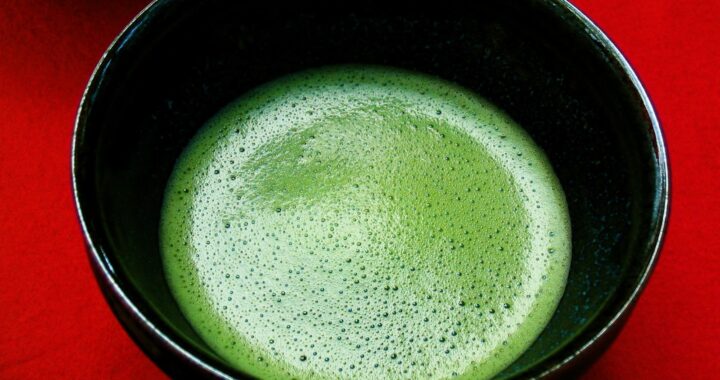
Matcha is powdered green tea, so you drink the whole leaf rather than an infusion. A Czech laboratory analysis measured 16.1 mg of caffeine per gram. A normal bowl or latte uses about 2 g, around 32 mg, but thick koicha made with 4 g doubles that to about 64 mg. Brands vary a lot: a 2024 study of 11 matcha teas found large differences between origins and harvests. Our matcha vs coffee comparison looks at whether it really gives smoother energy.
Green tea, oolong and hojicha
Sencha and oolong both come in at about 20 mg per 100 ml in the Japanese tables, or about 50 mg per mug. Hojicha, a roasted green tea often sold as a gentle evening drink, has the same figure. Roasting does not remove much caffeine, so hojicha is not a good choice late at night.
Pu-erh
Fermentation changes most of the chemistry of ripe pu-erh, but not its caffeine. A 2022 study at Yunnan Agricultural University found that microbes transformed nearly every other compound during fermentation, and a 150 ml cup brewed from 3 g still had about 24 mg. Brewed gongfu style, with lots of leaf and many short infusions, the total across a session can be much higher.
White tea
White tea is often sold as a low-caffeine option, but the Florida tests found no reliable difference from green or black tea. Bud-heavy white teas such as Silver Needle can be high in caffeine. Our white tea guide explains why.
Yerba mate and guayusa
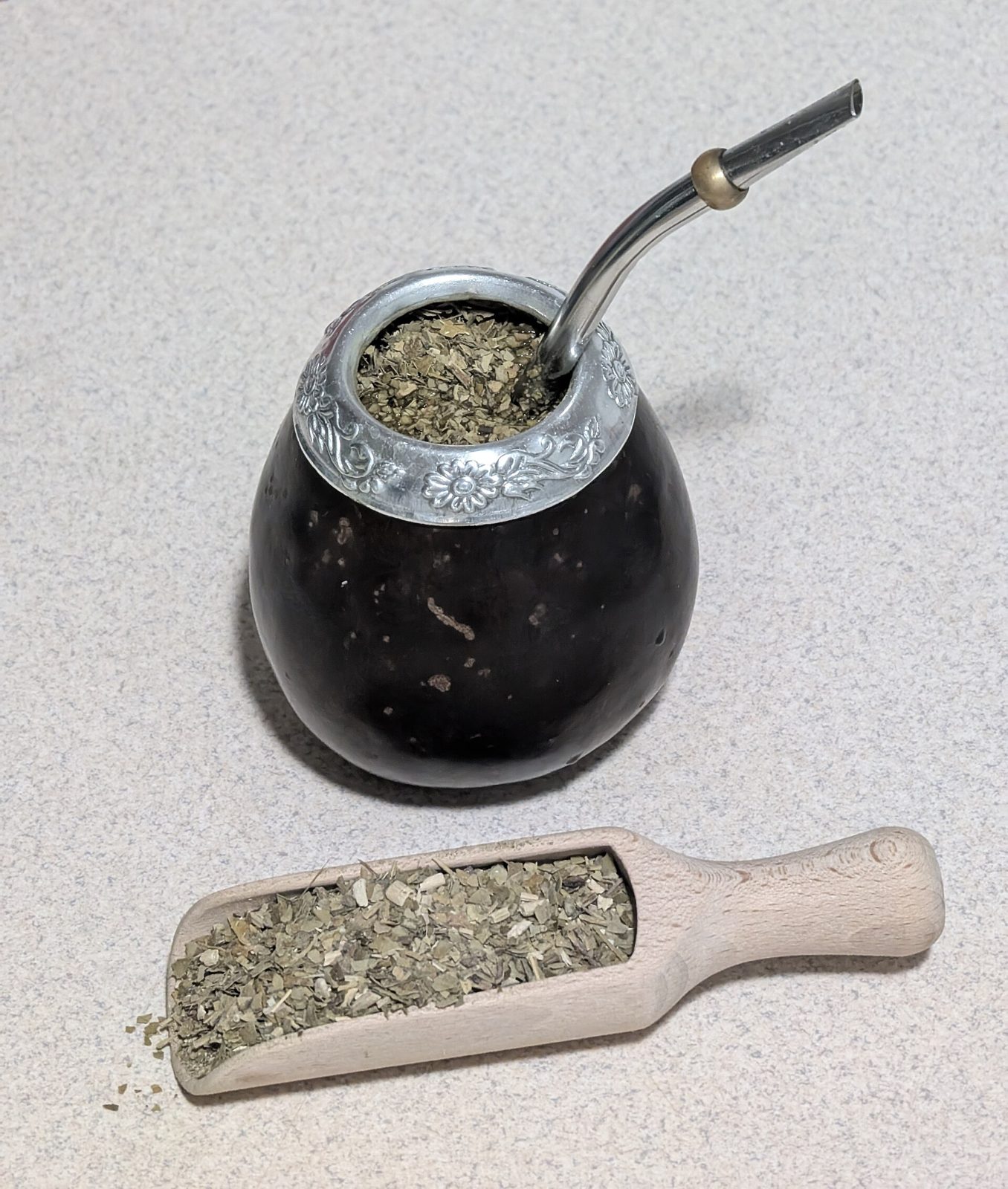
These are not tea. Yerba mate is made from Ilex paraguariensis, a South American holly, and guayusa from its Amazonian relative Ilex guayusa. Both contain caffeine. A 2023 study of 11 bottled yerba mate drinks found 31 to 70 mg per serving. Traditional mate is stronger still, because the gourd is packed with leaf and refilled many times. A 2010 Brazilian study found that cold-water terere extracted about 2.5 times more caffeine and related compounds than hot chimarrao. Guayusa is a traditional Ecuadorian stimulant, according to a 2025 review, but reliable per-cup figures are scarce.
Does tea actually make you more alert?
Yes, in controlled trials. In two double-blind studies published in 2011, people given real black tea made from tea bags were more accurate on an attention-switching task and rated themselves more alert than when they drank a placebo tea with matching colour and flavour. A 2010 trial gave 44 young adults 40 mg of caffeine with 97 mg of L-theanine, the calming amino acid in tea. It improved accuracy on the same kind of task and reduced self-reported tiredness.
In a 2000 crossover trial at the University of Surrey, 30 volunteers drank tea, coffee or water four times a day. Caffeinated drinks kept alertness steady through the day. Tea gave a similar alerting effect to coffee despite containing less caffeine, and it was less likely to disrupt sleep. All caffeinated drinks still delayed sleep in a dose-dependent way.
One caveat: all three studies were carried out or co-authored by scientists from Unilever, which then owned Lipton and PG Tips. The findings fit the wider caffeine research, but they are not independent. If your goal is calm concentration rather than staying awake, our guide to the best tea for focus looks more closely at L-theanine.
When to drink tea to stay awake
Timing matters as much as strength. According to a 2017 review of caffeine safety, caffeine peaks in saliva about 45 minutes after you drink it and in the blood after about two hours. Its half-life in adults is 3 to 7 hours, so half of an afternoon dose may still be working at bedtime. Smoking roughly doubles the rate at which the body clears caffeine, while heavy drinking slows it.
In a 2013 sleep study, 400 mg of caffeine taken six hours before bed still cut total sleep by more than an hour when measured with a home sleep monitor. That is a large dose, about five mugs of black tea at once, but the European Food Safety Authority notes that even 100 mg can affect sleep in some adults when taken close to bedtime. A practical plan:
- Have your strongest cup in the morning, or 30 to 45 minutes before you need to be sharp.
- Top up with smaller cups rather than one huge dose. That was the pattern in the Surrey tea study.
- Stop caffeinated tea about six hours before you plan to sleep.
- Switch to caffeine-free herbal tea in the evening. Our best tea for sleep guide lists the options.
Staying awake on a night shift
Caffeine is one of the few aids with trial evidence for shift workers. A Cochrane review of 13 trials found that caffeine reduced errors and improved attention, memory and perception compared with placebo in people with jet lag or shift work. None of the trials measured injuries, so it is not proof that caffeine prevents accidents.
Drink your stronger tea early in the shift, then taper off so the last cup is about six hours before you expect to sleep.
A caffeine nap can help with a slump. In a 2003 Japanese study, people who took 200 mg of caffeine just before a 20-minute midday nap felt less sleepy and performed better for an hour afterwards than with a nap alone. Caffeine takes about as long to reach the brain as the nap lasts, so you wake as it starts working.
Tea and driving when tired
Tea can help a tired driver for a short time, but it cannot replace sleep. In a classic British simulator study, 12 sleepy drivers took a 30-minute break before a dull two-hour afternoon drive. Compared with placebo, 200 mg of caffeine cut lane drifting and other incidents to 34%. Caffeine plus a nap of under 15 minutes cut them to 9%.
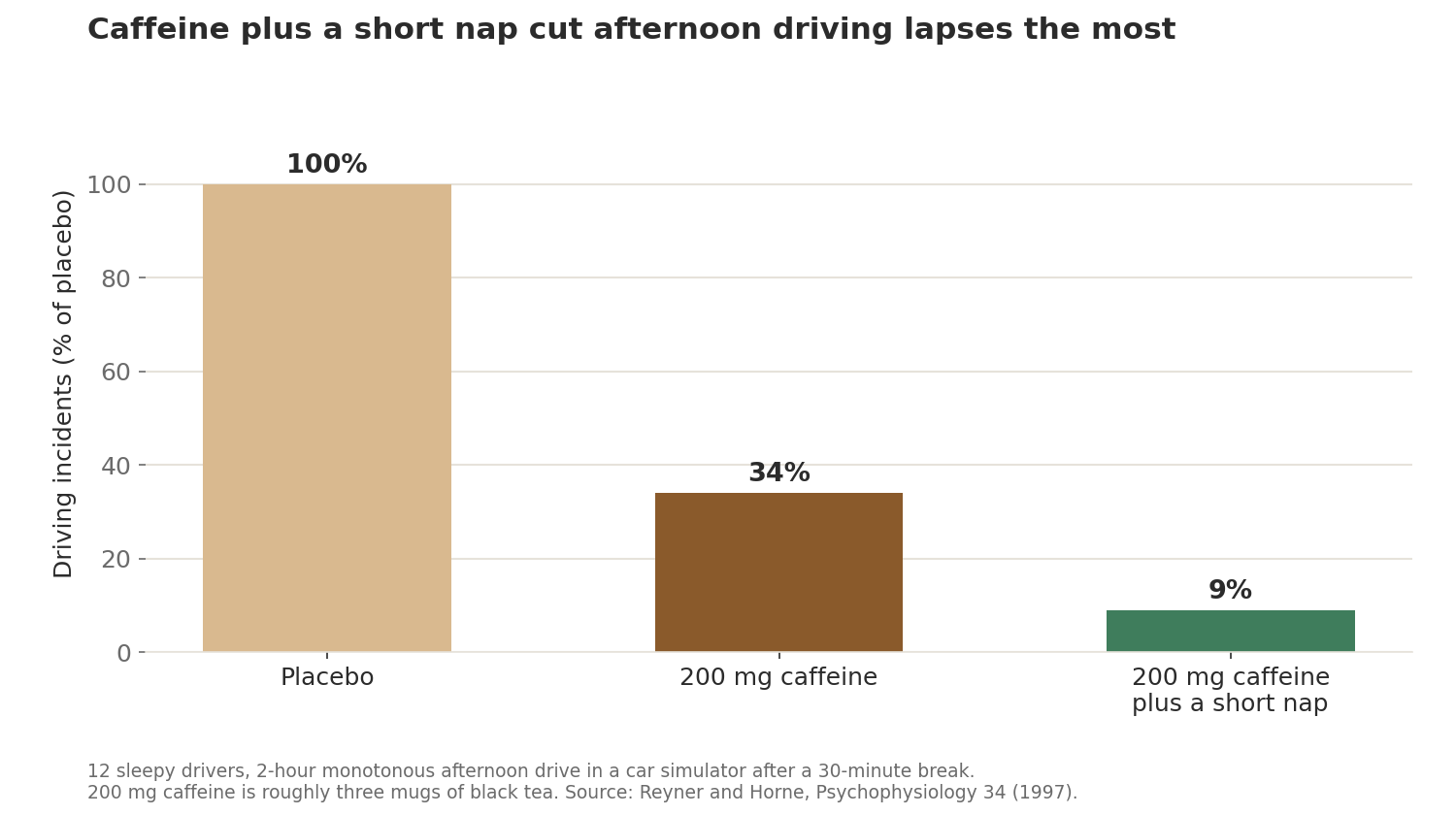
Two warnings come with that result. First, 200 mg is about three mugs of strong black tea, far more than one cup. Second, the effect wears off. In a follow-up study of early-morning drivers, 200 mg of caffeine helped for around two hours after a short night, but only for about 30 minutes after no sleep at all.
The Highway Code advises not starting a journey tired, avoiding long drives between midnight and 6am, and taking a break of at least 15 minutes every two hours. If you feel sleepy, stop somewhere safe. Tea and a short nap can get you to the next stop, not through the night.
How much tea is too much?
The EFSA and the US Food and Drug Administration both treat up to 400 mg of caffeine a day as safe for most healthy adults. EFSA adds that single doses up to 200 mg do not raise safety concerns. For black tea at 75 mg a mug, 400 mg is a little over five mugs, counting any coffee, cola or energy drinks too.
The limits are lower in pregnancy. The NHS advises no more than 200 mg a day, about two and a half mugs of tea. People who are sensitive to caffeine, have heart rhythm problems or take medicines that interact with it should check with a pharmacist. Our how many cups of tea a day guide has more on safe amounts.
Signs you have overdone it include jitters, a racing heart, an upset stomach and poor sleep, which leaves you more tired the next day. Cutting back suddenly can also cause withdrawal headaches, as our article on whether tea can cause headaches explains.
Quick answers
Which tea has the most caffeine?
Thick matcha and strongly brewed black tea such as Assam usually come out on top among true teas. A 250 ml mug of black tea has about 75 mg, and 4 g of matcha about 64 mg. Yerba mate, which is not tea, can be stronger when brewed the traditional way.
Is green tea or black tea better for staying awake?
Black tea, usually: about 30 mg per 100 ml in the Japanese tables against 20 mg for sencha. A long, hot green tea steep can still match a weak black tea.
How long does tea keep you awake?
You will feel it within about 45 minutes, and with a half-life of 3 to 7 hours the effect fades slowly. Stop about six hours before bed.
Can tea keep you awake as well as coffee?
It gives a smaller dose, roughly half a mug of filter coffee per mug of strong tea. In the Surrey trial, tea kept people about as alert as coffee across the day and disrupted sleep less. For a big, fast boost, coffee is stronger.
Is there a caffeine-free tea that keeps you awake?
No herbal tea has good evidence for keeping you awake. Peppermint feels refreshing, but it has no caffeine. If you need to stay alert without caffeine, daylight, a short walk or a 15 to 20-minute nap work better than any herb.
Sources
- Ministry of Health, Labour and Welfare, Japan. Caffeine in foods Q&A, with values from the Standard Tables of Food Composition in Japan 2015 (Japanese).
- Chin et al. Caffeine content of brewed teas. Journal of Analytical Toxicology, 2008.
- Koláčková et al. The effect of in vitro digestion on matcha tea active components and antioxidant activity. Antioxidants, 2022.
- Jakubczyk et al. Exploring the influence of origin, harvest time, and cultivation method on matcha teas. Foods, 2024.
- Deng et al. Mellow and thick taste of pu-erh ripe tea based on chemical properties. Foods, 2022.
- Novel ICP-OES-based method for 15 elements in yerba mate drinks, with caffeine. Molecules, 2023.
- Meinhart et al. Methylxanthines and phenolics content extracted during the consumption of mate beverages. Journal of Agricultural and Food Chemistry, 2010.
- Guayusa (Ilex guayusa Loes.), ancestral plant of Ecuador. Molecules, 2025.
- De Bruin et al. Black tea improves attention and self-reported alertness. Appetite, 2011.
- Giesbrecht et al. The combination of L-theanine and caffeine improves cognitive performance and increases subjective alertness. Nutritional Neuroscience, 2010.
- Hindmarch et al. A naturalistic investigation of the effects of day-long consumption of tea, coffee and water on alertness, sleep onset and sleep quality. Psychopharmacology, 2000.
- Temple et al. The safety of ingested caffeine: a comprehensive review. Frontiers in Psychiatry, 2017.
- Drake et al. Caffeine effects on sleep taken 0, 3, or 6 hours before going to bed. Journal of Clinical Sleep Medicine, 2013.
- Ker et al. Caffeine for the prevention of injuries and errors in shift workers. Cochrane Database of Systematic Reviews, 2010.
- Hayashi et al. The alerting effects of caffeine, bright light and face washing after a short daytime nap. Clinical Neurophysiology, 2003.
- Reyner and Horne. Suppression of sleepiness in drivers: combination of caffeine with a short nap. Psychophysiology, 1997.
- Reyner and Horne. Early morning driver sleepiness: effectiveness of 200 mg caffeine. Psychophysiology, 2000.
- European Food Safety Authority. Caffeine topic page and 2015 scientific opinion.
- US Food and Drug Administration. Spilling the beans: how much caffeine is too much?
- NHS. Foods to avoid in pregnancy: caffeine.
- The Highway Code, rule 91. Driving when you are tired.
Last updated: 9 October 2026. Sources are linked in the text.
This article is general information, not medical advice. Talk to your doctor or pharmacist before using tea or herbs for a health condition, especially if you are pregnant, breastfeeding or take regular medication.