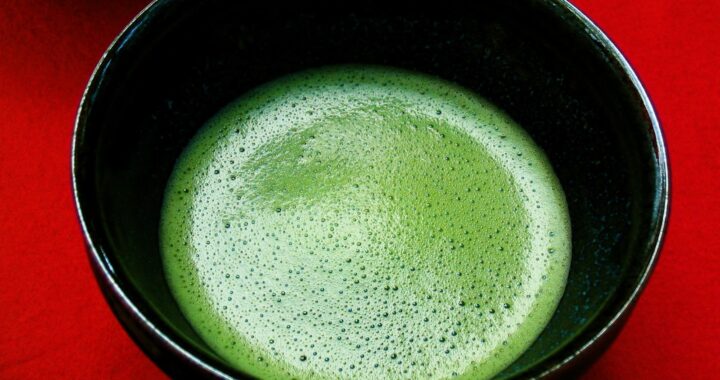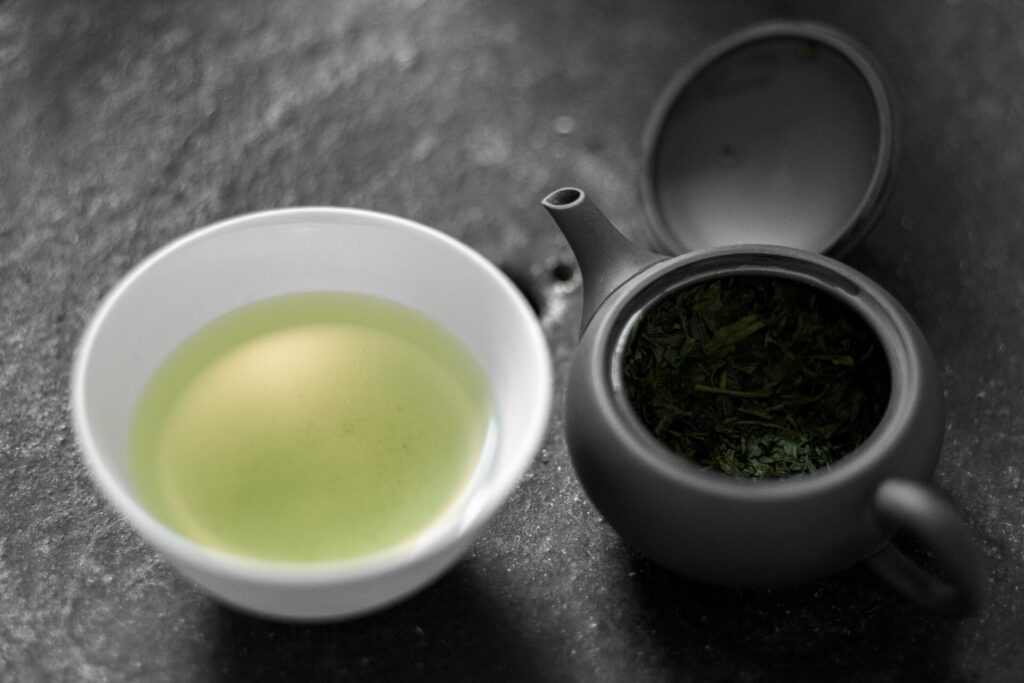
L-theanine is an amino acid found almost only in the tea plant. An ordinary cup of green or black tea gives you roughly 10 to 15 mg of it, while a cup of shade-grown gyokuro or a bowl of top-grade matcha can give 40 to 80 mg. Trials that found sharper attention used about 100 mg or more, nearly always alongside caffeine. So tea does deliver theanine, but most everyday cups give far less than the doses that were tested.
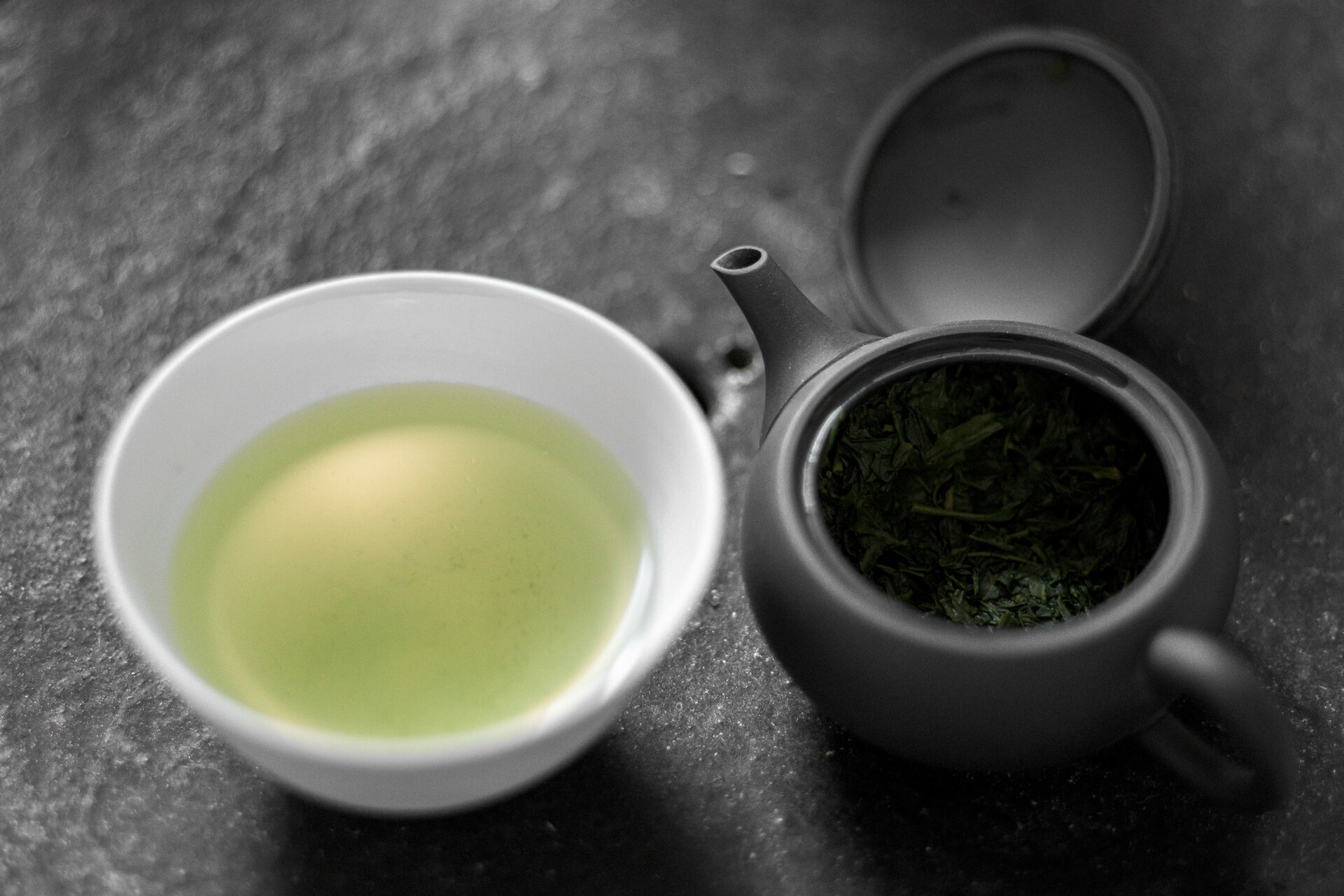
What is L-theanine?
L-theanine (often just called theanine) is a free amino acid. It does not build proteins the way most amino acids do. In the tea plant, Camellia sinensis, it is the most abundant free amino acid and a big part of the savoury, brothy taste the Japanese call umami. Tea makes theanine mainly in its roots and then moves it up to the young shoots. A 2021 study on tea plants traced how this works and how shading changes it.
Once you drink it, theanine is absorbed quickly. In a 2012 crossover study, 12 volunteers took 100 mg of theanine either as capsules or in green tea. Blood levels peaked about 0.8 hours later after both, and the overall uptake was comparable. The body then breaks most of it down into ethylamine and glutamic acid. In other words, the theanine in a cup of tea is as available to your body as the theanine in a pill. The real difference is how much you get.
Theanine became famous because of how it seems to pair with caffeine. Caffeine sharpens you up, and theanine is often said to take the jittery edge off. That idea explains a lot of the appeal of tea over coffee, which we look at in matcha vs coffee. The rest of this guide checks how much theanine is really in your cup and what the trials show.
How much L-theanine is in a cup of tea?
The best recent figures come from a 2025 study that brewed six types of tea the way people do at home: 2 g of tea in 200 ml of water. After two minutes at 80°C, black and green tea each gave about 12 to 13 mg of theanine per cup. White and oolong gave under 2 mg, and pu-erh about 3 mg. Steeping for five minutes instead of two raised the amount in green, white and black tea, but going on to ten minutes added little more. Water temperature made no real difference to theanine, though it did to caffeine.
An older Hungarian study of 37 shop-bought teas measured the leaf itself. White, green and oolong averaged about 6 to 6.6 mg of theanine per gram of tea, and black tea 5.1 mg. Pu-erh had almost none, because its microbial ageing breaks the theanine down. The authors also found huge variation within each type, so the tea colour on the label tells you little about the theanine inside.
| Tea and serving | L-theanine per serving | Source |
|---|---|---|
| White tea, 2 g in 200 ml, 2 min | about 1.8 mg | Ayakdaş 2025 |
| Oolong tea, 2 g in 200 ml, 2 min | about 1.8 mg | Ayakdaş 2025 |
| Pu-erh tea, 2 g in 200 ml, 2 min | about 3.1 mg | Ayakdaş 2025 |
| Black tea, 2 g in 200 ml, 2 min | about 12 mg | Ayakdaş 2025 |
| Green tea, 2 g in 200 ml, 2 min | about 13 mg | Ayakdaş 2025 |
| First-flush sencha, 6 g in 170 ml at 70°C, 1 min | about 44 mg | Unno 2026 |
| Low-grade matcha, 2 g of powder | about 17 mg | Unno 2026 |
| Top-grade matcha, 2 g of powder | about 83 mg | Unno 2026 |
The sencha number shows how much brewing style matters. Japanese brewers use far more leaf than a typical Western mug, here 6 g for just 170 ml. That one change multiplies the theanine. The same applies to caffeine, which our tea caffeine chart covers type by type. For more on how leaf, time and heat change the cup, see our guide to brewing temperature and steep time.

Why shade-grown tea has more theanine
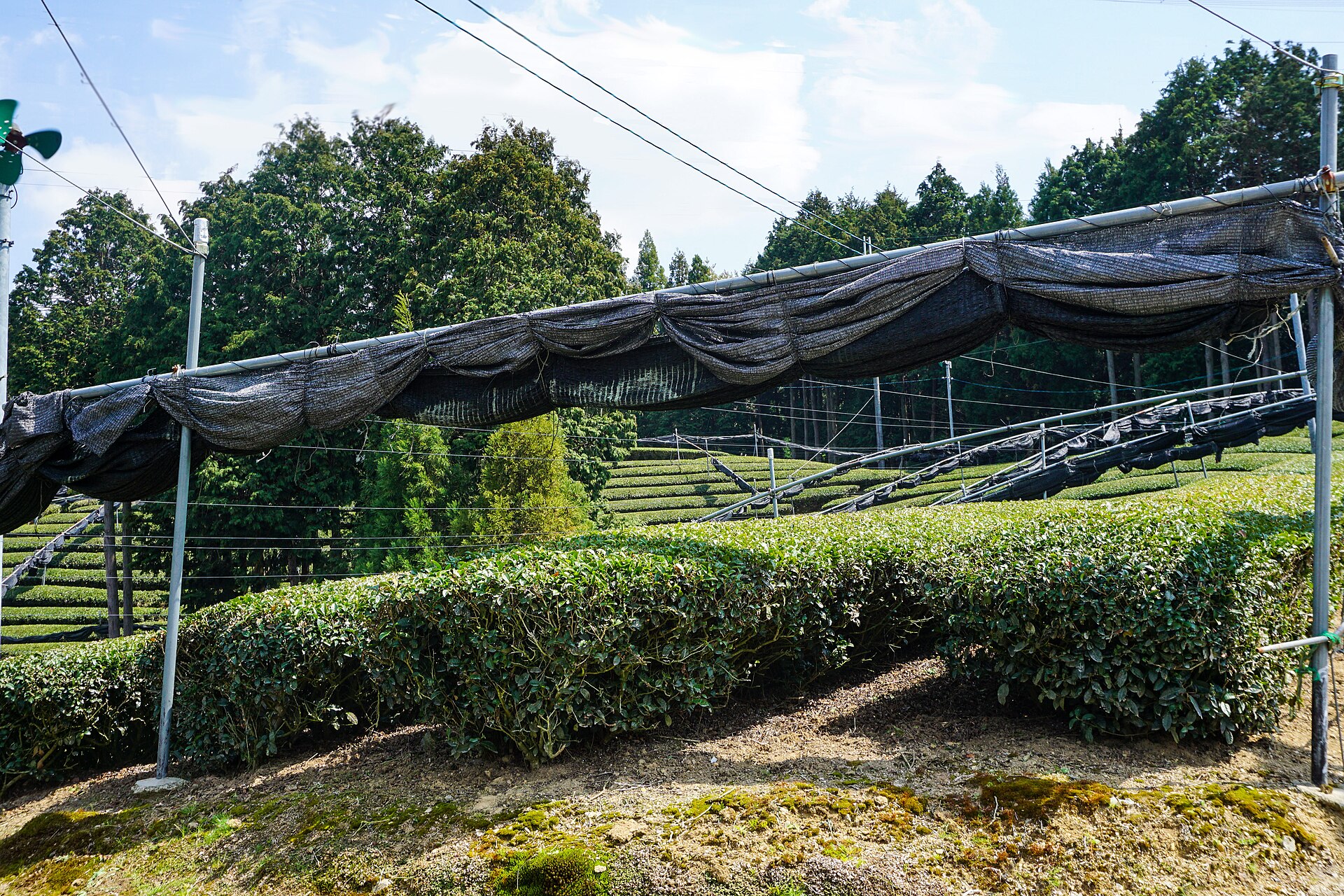
The richest teas for theanine are Japanese teas grown in the shade. For gyokuro, tencha (the leaf ground into matcha) and kabusecha, farmers cover the bushes with dark netting or straw for the last few weeks before harvest, blocking about half the sunlight or more.
In strong sunlight the leaf breaks down more of its theanine and builds more catechins, the bitter and astringent compounds tea is also known for. Cut the light and the young leaf keeps more theanine and makes fewer catechins. A 2026 review from Japanese tea researchers gives typical leaf levels of about 20 mg per gram for gyokuro, 10 mg for sencha and 5 mg for bancha. A batch of gyokuro they tested held 31 mg per gram. Timing matters as much as shade. First-flush sencha picked early in spring had 20.4 mg per gram, while late-season bancha had just 3.3 mg.
Matcha varies enormously. The same review compared commercial matcha sold in Japan. High-theanine brands averaged 41.4 mg per gram, while low-theanine brands had just 8.5 mg, about one fifth as much. Low-grade powders also had more EGCG and other catechins, which make them more bitter. Matcha sold outside Japan in their sample looked like the low-grade group. A bright green colour and a sweet, brothy taste are rough signs of a high-theanine powder. If you want to brew loose Japanese green tea properly, our green tea brewing guide gives the leaf amounts and temperatures.
Does L-theanine with caffeine improve focus?
This is where the evidence is strongest. Several placebo-controlled trials gave people theanine and caffeine together and tested their attention.
- Haskell and colleagues, 2008. 27 adults took 250 mg of theanine, 150 mg of caffeine, both, or a placebo. The combination gave faster reaction times, better working memory and sentence checking, and lower ratings for tiredness and headache. Theanine on its own did not help, and it actually raised headache ratings and lowered accuracy on a mental subtraction task.
- Owen and colleagues, 2008. 27 adults took 50 mg of caffeine with or without 100 mg of theanine. Adding theanine improved the speed and accuracy of switching between tasks and made people less easily distracted on a memory test.
- Giesbrecht and colleagues, 2010. 44 young adults took 97 mg of theanine with 40 mg of caffeine, a ratio close to a strong cup of tea. Accuracy at task switching and self-rated alertness both improved, and tiredness fell. Visual search, choice reaction time and mental rotation did not change.
A 2025 meta-analysis of 50 randomised trials found small to moderate benefits for theanine plus caffeine on attention and mood within the first two hours, but the confidence intervals were wide. The authors said more research is needed with real tea, at the doses people actually drink. A 2026 meta-analysis of 31 trials found that a single 200 mg dose of theanine alone sped up choice reaction time. Its effect on acute stress was modest and rested mostly on studies with a high risk of bias. A smaller 2025 meta-analysis of five trials called the cognitive effects of theanine on its own promising but not conclusive.
Notice the doses. The combination trials used 97 to 250 mg of theanine, which is the theanine in roughly 8 to 20 ordinary cups of black tea. Only shaded teas like gyokuro and good matcha get close to those amounts per serving. An earlier EEG study found that 50 mg of theanine raised alpha brain waves, a sign of relaxed alertness, compared with placebo. That is the most direct hint that tea-level doses do something. For the teas we would pick for a working afternoon, see the best tea for focus and the best tea to stay awake.
L-theanine for sleep and stress
The best-known sleep trial is the Hidese study from 2019. Thirty healthy Japanese adults took 200 mg of theanine a day or a placebo for four weeks, then swapped. Compared with placebo, theanine improved three parts of a standard sleep questionnaire: how long it took to fall asleep, how often sleep was disturbed, and the use of sleep medication. Scores for depression, anxiety and overall sleep quality also fell over the theanine period, and verbal fluency and some executive function scores went up.
That is encouraging but small, and 200 mg a day is far more than tea provides. It also clashes with the main problem of drinking tea at night, which is the caffeine. A cup of black or green tea contains both, and the caffeine wins out for most light sleepers. If you want tea before bed, a caffeine-free herbal tea such as chamomile or lemon balm is a better choice. Our guide to the best tea for sleep compares the evidence for each.
Herbal teas such as chamomile contain no theanine at all, because theanine comes from the tea plant. Decaf green tea is another evening option, but we found no good published data on how much theanine survives decaffeination, so treat any claim on the pack with care. Removing caffeine at home does not work well either, as our test of decaffeinating tea at home explains.
What regulators say
In the European Union, health claims on food must be approved first. In 2011 the European Food Safety Authority assessed claims for L-theanine from tea on improving cognitive function, relieving psychological stress, keeping sleep normal and easing menstrual discomfort. It concluded that a cause and effect relationship had not been established for any of them, so these claims cannot be used on tea or supplements sold in the EU.
In 2018 EFSA did approve a claim that black tea improves attention, but it put the effect down to caffeine. EFSA’s caffeine safety opinion considers up to 400 mg of caffeine a day safe for healthy adults and up to 200 mg a day in pregnancy. If you are pregnant, our guide to teas during pregnancy covers this in more detail.
Tea or a supplement?
Theanine supplements usually come in 100 mg or 200 mg capsules, the same range as the trials. If you want the trial dose, tea alone will rarely get you there unless you drink shaded Japanese tea. The 2026 meta-analysis reported no serious side effects in 31 trials, but most lasted only a few weeks and there is little data for pregnancy, children or people on medication. Check with a pharmacist or doctor before taking capsules alongside other treatments.
If you would rather get your theanine from a cup, these steps help:
- Choose green or black tea over white tea, oolong or pu-erh, which tested lowest per cup.
- Pick shaded Japanese teas such as gyokuro, kabusecha and good-quality matcha for the highest amounts.
- Use more leaf. Doubling the tea roughly doubles the theanine.
- Steep for three to five minutes. Theanine kept coming out up to five minutes in the 2025 study.
- Add more water to the same leaves. Japanese tests found most of the theanine comes out in the first two infusions.
Remember that each of these steps raises the caffeine too. For a fuller look at how the two main tea families compare, read green tea vs black tea.
Quick answers
Which tea has the most L-theanine?
Shade-grown Japanese teas. Gyokuro has about 20 to 31 mg per gram of leaf, and top-grade matcha about 41 mg per gram. Ordinary green and black teas have around 5 to 7 mg per gram.
How much L-theanine is in a cup of green tea?
About 12 to 13 mg in a 200 ml cup made with 2 g of leaf, according to a 2025 study. A Japanese-style brew with much more leaf can give 40 mg or more.
Does black tea have L-theanine?
Yes. A 200 ml cup of black tea had about 12 mg in the same study, almost the same as green tea. Oxidation does not destroy much of it. Pu-erh is the exception, with very little.
Is the L-theanine in tea enough to calm you down?
Probably not on its own. Most trials used 100 to 250 mg, and the clearest effects were on attention when taken with caffeine. An EEG study found changes in brain activity at 50 mg, which matcha or gyokuro can provide.
Does L-theanine cancel out caffeine?
No. Trials show the two together improve attention more than caffeine alone, and some report fewer headaches and less tiredness. Theanine does not stop caffeine from keeping you awake.
Do herbal teas contain L-theanine?
No. Theanine is made by the tea plant, Camellia sinensis. Chamomile, peppermint, rooibos and other herbal infusions have none, unless it has been added as an ingredient.
Sources
- Ayakdaş G, Ağagündüz D. Determination of L-theanine and caffeine contents in tea infusions with different fermentation degrees and brewing conditions. Foods, 2025.
- Boros K, Jedlinszki N, Csupor D. Theanine and caffeine content of infusions prepared from commercial tea samples. Pharmacognosy Magazine, 2016.
- Unno K, Kameoka Y, Nakamura Y. Compositional diversity and functional interactions of bioactive compounds in Japanese green tea: focus on matcha, sencha, and gyokuro. Molecules, 2026.
- Yang T, et al. Shading promoted theanine biosynthesis in the roots and allocation in the shoots of the tea plant. Journal of Agricultural and Food Chemistry, 2021.
- Scheid L, et al. Kinetics of L-theanine uptake and metabolism in healthy participants are comparable after ingestion of L-theanine via capsules and green tea. Journal of Nutrition, 2012.
- Haskell CF, et al. The effects of L-theanine, caffeine and their combination on cognition and mood. Biological Psychology, 2008.
- Owen GN, et al. The combined effects of L-theanine and caffeine on cognitive performance and mood. Nutritional Neuroscience, 2008.
- Giesbrecht T, et al. The combination of L-theanine and caffeine improves cognitive performance and increases subjective alertness. Nutritional Neuroscience, 2010.
- Nobre AC, Rao A, Owen GN. L-theanine, a natural constituent in tea, and its effect on mental state. Asia Pacific Journal of Clinical Nutrition, 2008.
- Hidese S, et al. Effects of L-theanine administration on stress-related symptoms and cognitive functions in healthy adults: a randomized controlled trial. Nutrients, 2019.
- Payne ER, et al. Effects of tea or its bioactive compounds L-theanine or L-theanine plus caffeine on cognition, sleep, and mood in healthy participants: a systematic review and meta-analysis. Nutrition Reviews, 2025.
- Gerolymos C, et al. Cognitive and affective effects of L-theanine: a systematic review and meta-analysis of 31 randomized trials. Molecular Psychiatry, 2026.
- Mátyus RO, et al. The effect of L-theanine on cognitive performance based on the systematic review and meta-analysis of randomized placebo-controlled clinical trials. Journal of Clinical Medicine, 2025.
- EFSA Panel on Dietetic Products, Nutrition and Allergies. Scientific opinion on the substantiation of health claims related to L-theanine from Camellia sinensis (tea). EFSA Journal, 2011.
- EFSA Panel on Dietetic Products, Nutrition and Allergies. Black tea and improvement of attention: evaluation of a health claim. EFSA Journal, 2018.
- EFSA Panel on Dietetic Products, Nutrition and Allergies. Scientific opinion on the safety of caffeine. EFSA Journal, 2015.
Last updated: 11 October 2026. Sources are linked in the text.
This article is general information, not medical advice. Talk to your doctor or pharmacist before using tea or herbs for a health condition, especially if you are pregnant, breastfeeding or take regular medication.