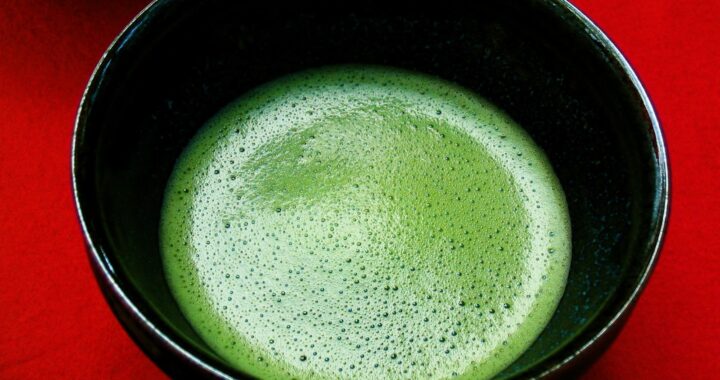
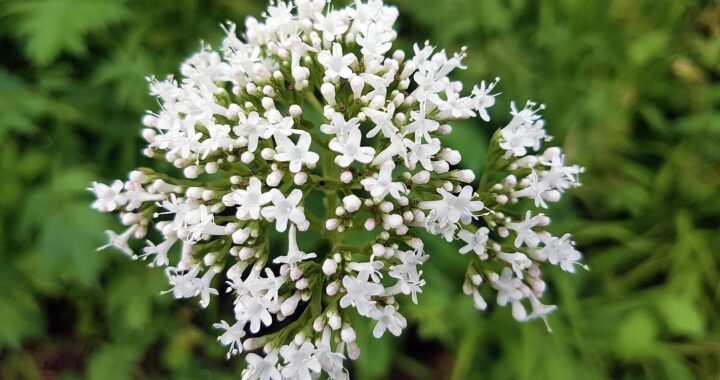
Echinacea tea is made from the root, leaves or flowers of purple coneflower, a North American wildflower. It is one of the most popular herbal remedies for colds, but the evidence is weak. A Cochrane review of 24 trials found no clear benefit for treating a cold, and at most a small reduction in the chance of catching one. Only one small trial has tested echinacea as a tea. It is safe for most adults for a week or so, but it is not for children under 12, people allergic to the daisy family, or anyone with an autoimmune condition.
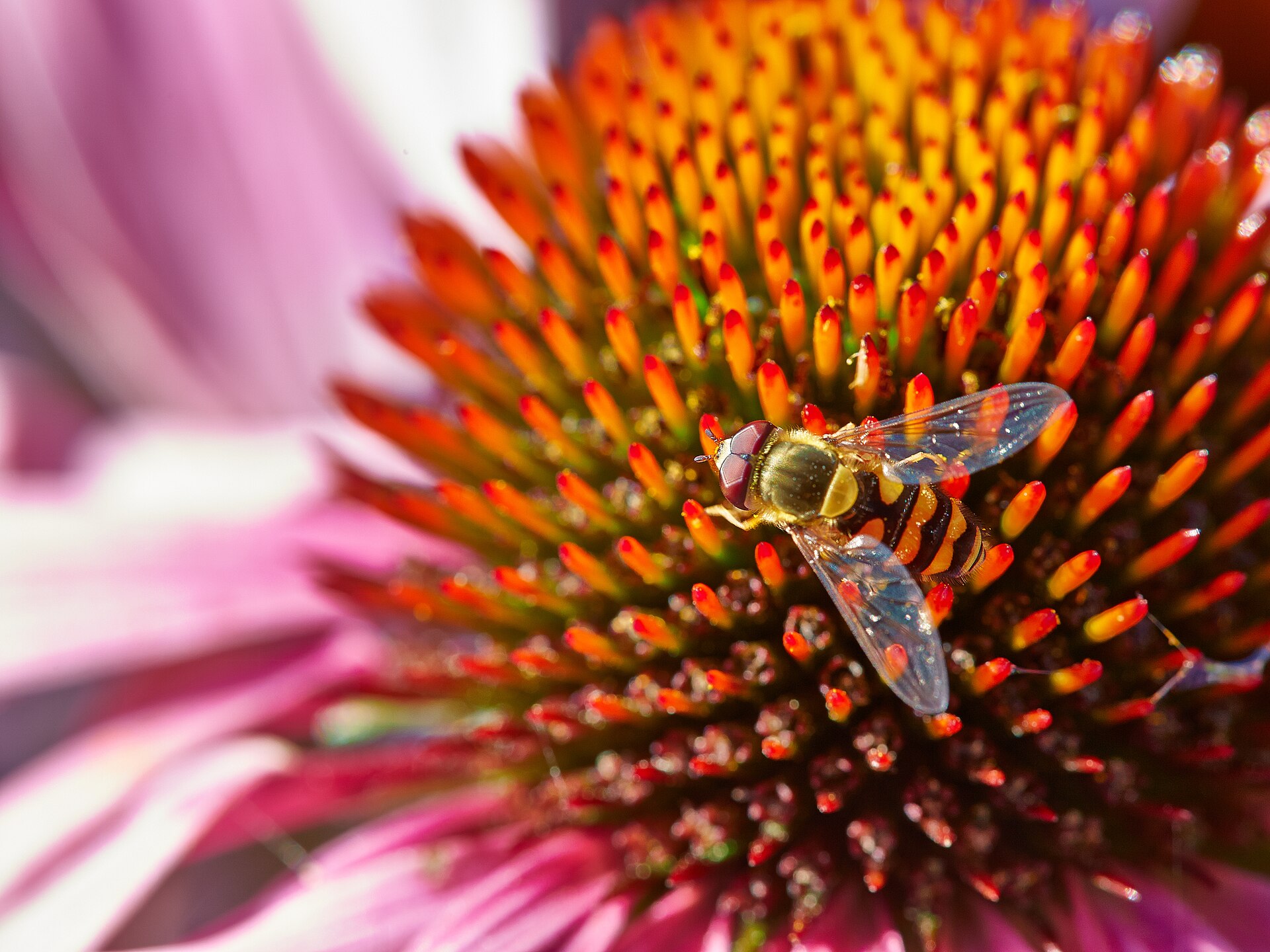
What is echinacea tea?
Echinacea is a group of perennial plants in the daisy family, related to sunflowers, ragweed and chamomile. According to the US National Center for Complementary and Integrative Health (NCCIH), they are native to the area east of the Rocky Mountains, and Native Americans used Echinacea purpurea for respiratory infections, toothache and snakebite. Today echinacea is sold mainly as a remedy for colds, on the idea that it stimulates the immune system.
Like other herbal infusions it contains no tea leaves and no caffeine, which is why it appears in our guide to caffeine-free teas. The taste is earthy and grassy, a little like hay, and blends that use the root can leave a mild tingling feeling on the tongue. Most commercial teas mix echinacea with stronger flavours such as lemongrass, mint, ginger or rooibos.
Which echinacea is in your tea?
The word echinacea on a box can mean three different species, and either the parts above ground (called the herb) or the root. These are chemically different, which is one reason studies disagree. The Cochrane reviewers point out that most buyers, and many doctors, do not realise how much echinacea products vary.
| Species | Common name | Parts used | EU regulatory status |
|---|---|---|---|
| Echinacea purpurea | Purple coneflower | Fresh herb, root | Herb juice: well-established use for short-term prevention and treatment of colds. Root: traditional use only |
| Echinacea angustifolia | Narrow-leaved coneflower | Root | Traditional use for supportive treatment of colds, including as a herbal tea |
| Echinacea pallida | Pale purple coneflower | Root | Traditional use for relief of cold symptoms |
Note the gap between the products that have the most research and what goes into a tea bag. The one form the European Medicines Agency (EMA) accepts as having well-established use is the pressed juice of fresh E. purpurea herb, taken in millilitre doses. Only the narrow-leaved coneflower root monograph gives a dose for tea.
What the Cochrane review found
The best summary of the evidence is the 2014 Cochrane review by Karsch-Völk and colleagues. It pooled 24 double-blind, placebo-controlled trials with 4,631 people, testing many different echinacea products. The products were too different to combine into a single main result, so the authors looked at each trial and then did exploratory pooling.
- Treating a cold. Seven trials reported how long colds lasted. Only one found echinacea shortened them.
- Preventing a cold. None of the 12 prevention comparisons was statistically significant on its own, but they leaned the same way. Pooled after the fact, they suggested a 10% to 20% lower risk of catching a cold.
- Side effects. Drop-outs and side effects were similar to placebo, with a trend towards more people stopping because of side effects in the prevention trials.
The authors concluded that echinacea has not been shown to help treat colds, and that any preventive effect is “of questionable clinical relevance”. The same team summarised the findings in JAMA the following year with the same bottom line. NCCIH puts it this way: echinacea may slightly reduce your chances of catching a cold, but it is still unclear whether it can shorten one.
A 2024 meta-analysis of 30 trials was more positive, reporting fewer respiratory infections and less antibiotic use. Its strongest results came from alcohol extracts of freshly harvested E. purpurea, not from teas. The best known of those extract trials, a four-month study of 755 adults, reported fewer colds with daily use of such an extract.
A closer look at one big trial
Some of the clearest data come from a 2010 trial in Wisconsin led by Bruce Barrett, one of the Cochrane authors. It gave 719 people with a new cold either no pills, placebo pills, or echinacea tablets equal to 10.2 g of dried root on day one and 5.1 g a day for four more days. That is far more echinacea than a few cups of tea. Some people knew they were getting echinacea; others were blinded.
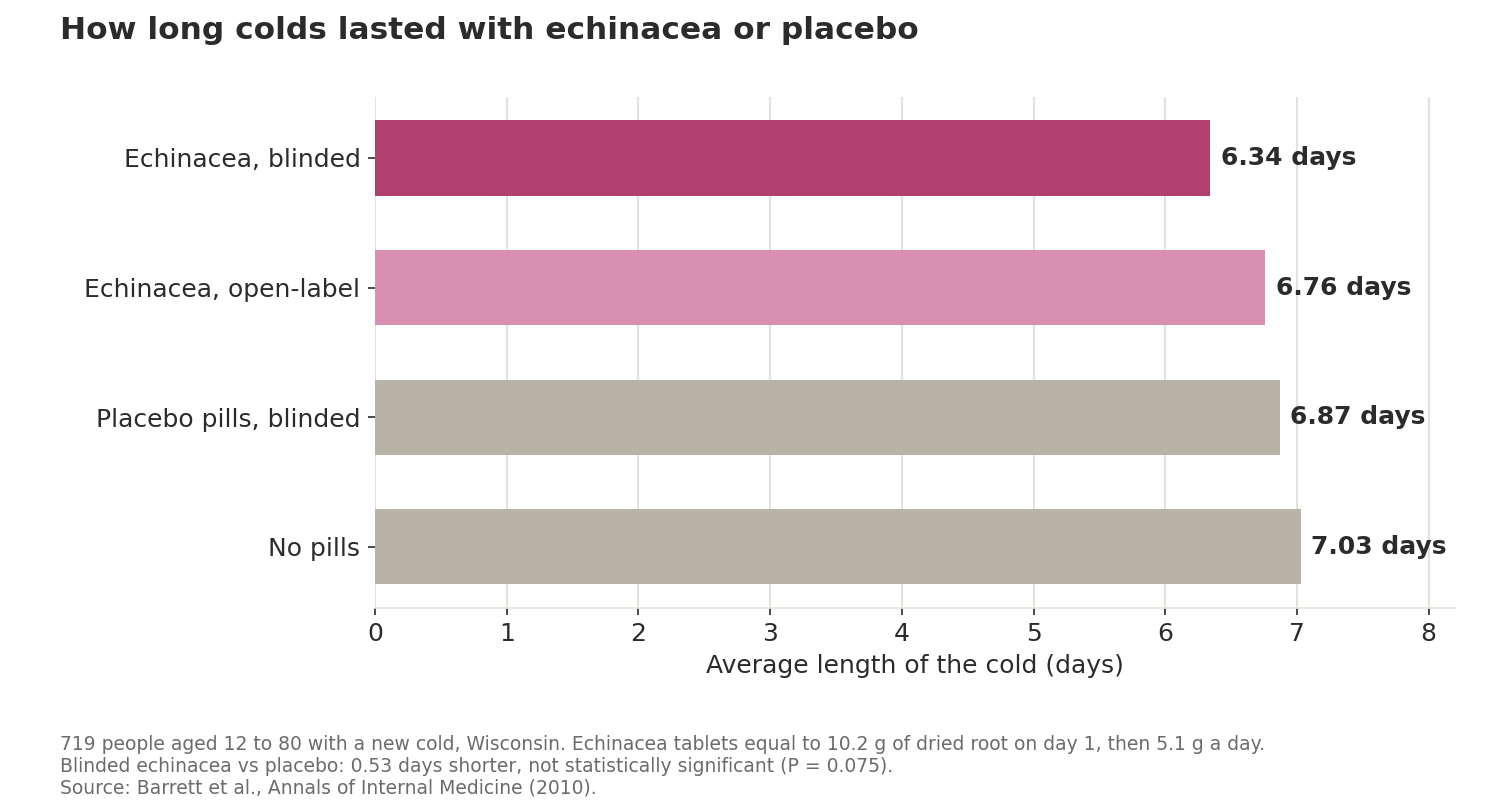
Colds treated with blinded echinacea were about half a day shorter than with placebo, but the difference was not statistically significant, and neither was the small fall in severity. The authors concluded the results do not support echinacea substantially changing the course of a cold. Notice too that the no-pill group did worst of all: simply taking something seems to make people feel a little better.
The only trial of echinacea tea
One study has tested echinacea as a tea. In 1999, 95 people who were just starting a cold or flu were randomly given either a commercial echinacea tea (Echinacea Plus) or a placebo tea. They started on five to six cups a day and cut down to one cup a day over five days. The echinacea group reported that their symptoms were less severe and cleared up sooner, and nobody reported side effects.
It is an encouraging result, but a thin one. The trial was small, outcomes came from a single questionnaire filled in 14 days later, and the abstract does not mention any lab test to confirm a cold or flu. We could find no repeat of it in the years since, while larger trials of stronger echinacea products have mostly come up short.
Echinacea and children
Echinacea is not a good choice for young children. In a trial of 407 children aged 2 to 11, published in JAMA in 2003, E. purpurea did not shorten colds (median nine days in both groups) or make them milder. Rashes, however, appeared during 7.1% of colds treated with echinacea against 2.7% with placebo, which may have been allergic reactions. All four EMA monographs advise against use under 12 years, and NCCIH recommends talking to a child’s doctor first.
Who should avoid echinacea tea
NCCIH says short-term use of E. purpurea products is likely safe for most adults. The most common side effects are stomach pain and nausea. The EMA monographs list these cautions:
- Daisy-family allergy. Do not use it if you are allergic to plants in the Asteraceae family, such as ragweed, chrysanthemums, marigolds or chamomile. People with atopic conditions such as asthma, eczema or hay fever have a possible risk of severe allergic reactions and should check with a doctor first.
- Immune conditions. Not recommended with autoimmune diseases such as lupus, multiple sclerosis or rheumatoid arthritis, with HIV, tuberculosis or blood disorders of the white cells, or if you take drugs that suppress the immune system.
- Long-term use. The monographs are written for use from the first signs of a cold, with a doctor’s advice if symptoms last more than 10 days. It is not meant to be drunk all winter.
- Pregnancy and breastfeeding. NCCIH notes limited data suggesting extracts may be safe for up to seven days in early pregnancy, but little is known about breastfeeding. Our pregnancy tea guide covers the options.
- Medicines. There are theoretical concerns about interactions with immunosuppressants and caffeine, and conflicting evidence on drugs processed by the liver. Ask a pharmacist if you take regular medication.
Also see a doctor if you have a high fever, trouble breathing, or symptoms that get worse.
How to make echinacea tea
The EMA narrow-leaved coneflower root monograph gives the only official tea dose, and it makes a sensible guide for root-based teas.
- Use 1 g of dried, cut echinacea root per 150 ml cup. For a tea bag, follow the box.
- Pour on boiling water, cover and steep for at least 10 minutes. Alternatively simmer the root in the water for 10 minutes, as a decoction. Our brewing temperature guide explains why herbs need hotter water than green tea.
- Drink up to three cups a day, starting at the first signs of a cold.
- Stop after 10 days at most, and sooner if the cold has cleared.
If you grow purple coneflower, you can dry the leaves and flowers for tea, but be sure of the plant’s identity and that it has not been sprayed. On its own echinacea tastes earthy, so try it with honey and lemon, a slice of fresh ginger, peppermint or rooibos. Keep loose echinacea in an airtight tin away from light and heat, as in our tea storage guide.
For a scratchy throat, warm drinks with honey have better evidence than echinacea; see our best tea for a sore throat. For the bigger picture on teas and colds, our guide to the best tea for immunity compares green tea, elderberry, ginger and others.
Quick answers
Does echinacea tea work for colds?
Probably not much. Reviews find no clear evidence it shortens a cold, and at most a small reduction in the risk of catching one. The one trial of echinacea tea was positive but small and has never been repeated.
Does echinacea tea have caffeine?
No. Pure echinacea tea is caffeine-free. Some blends add green or black tea, so check the label.
Can I drink echinacea tea every day?
It is meant for short-term use at the start of a cold, for up to 10 days. Daily use through the winter is not what the European monographs describe.
Is echinacea tea safe for kids?
It is not recommended for children under 12. A large trial in children found it did not help, and rashes were more common with echinacea.
What does echinacea tea taste like?
Earthy and slightly bitter, with a grassy, hay-like note. Root teas can make the tongue tingle. Blends with lemongrass, mint or ginger are easier to drink.
Sources
- Karsch-Völk et al. Echinacea for preventing and treating the common cold. Cochrane Database of Systematic Reviews, 2014.
- Karsch-Völk, Barrett and Linde. Echinacea for preventing and treating the common cold. JAMA, 2015.
- Lindenmuth and Lindenmuth. The efficacy of echinacea compound herbal tea preparation on the severity and duration of upper respiratory and flu symptoms. Journal of Alternative and Complementary Medicine, 2000.
- Barrett et al. Echinacea for treating the common cold: a randomized trial. Annals of Internal Medicine, 2010.
- Taylor et al. Efficacy and safety of echinacea in treating upper respiratory tract infections in children. JAMA, 2003.
- Jawad et al. Safety and efficacy profile of Echinacea purpurea to prevent common cold episodes. Evidence-Based Complementary and Alternative Medicine, 2012.
- Gancitano et al. Echinacea reduces antibiotics by preventing respiratory infections: a meta-analysis (ERA-PRIMA). Antibiotics, 2024.
- National Center for Complementary and Integrative Health. Echinacea. Fact sheet.
- European Medicines Agency, HMPC. Community herbal monograph on Echinacea angustifolia DC., radix. EMA/HMPC/688216/2008.
- European Medicines Agency. European Union herbal monograph on Echinacea purpurea (L.) Moench, herba recens. EMA/HMPC/48704/2014.
- European Medicines Agency. European Union herbal monograph on Echinacea purpurea (L.) Moench, radix. EMA/HMPC/424583/2016.
- European Medicines Agency. European Union herbal monograph on Echinacea pallida (Nutt.) Nutt., radix. EMA/HMPC/737380/2017.
Last updated: 11 October 2026. Sources are linked in the text.
This article is general information, not medical advice. Talk to your doctor or pharmacist before using tea or herbs for a health condition, especially if you are pregnant, breastfeeding or take regular medication.