Lavender tea is an infusion of the dried flower buds of English lavender. It is caffeine-free and has a long traditional use for stress and sleep, which European regulators accept as traditional use rather than proven benefit. The strongest lavender research is on a concentrated oil capsule called Silexan, not on tea. Only one controlled trial has tested the tea itself, in new mothers, and its benefits faded within weeks. A cup or two is a pleasant, low-risk evening drink, but it is not a treatment for anxiety or insomnia.

What is lavender tea?
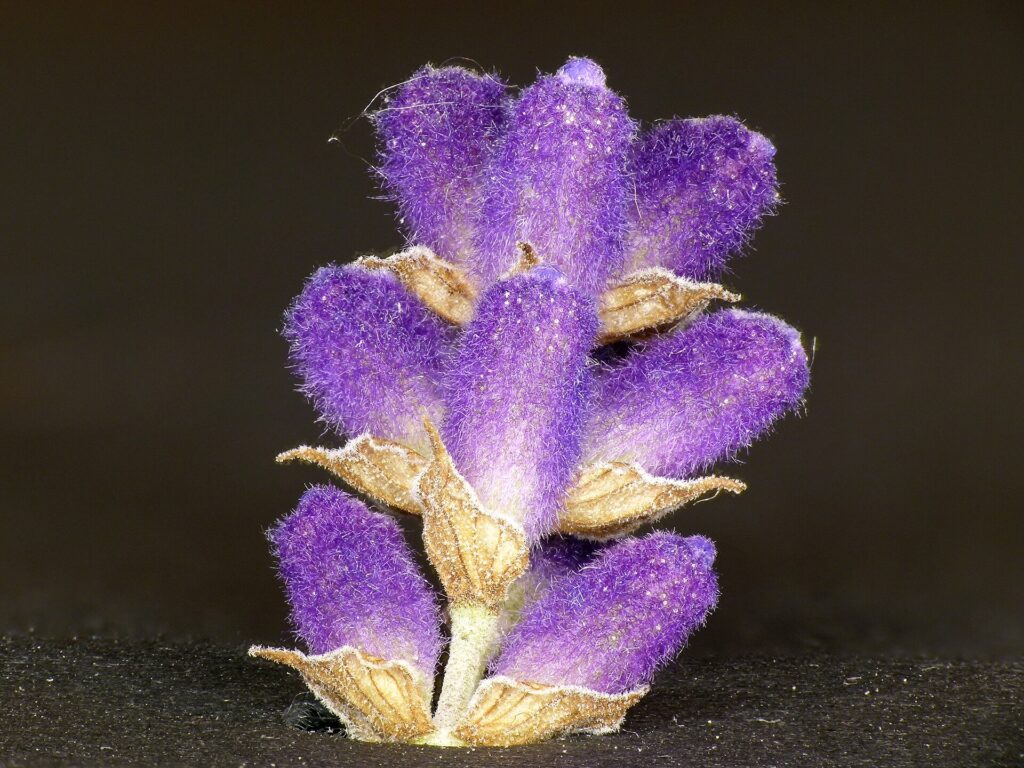
Lavender tea is made by steeping the dried flowers of Lavandula angustifolia, often called English or true lavender, in hot water. Despite the name it is not a true tea, because it contains no leaves of the tea plant, so it has no caffeine. That puts it on our list of caffeine-free teas alongside chamomile, rooibos and peppermint.
The plant is a small evergreen shrub from the Mediterranean, and the US National Center for Complementary and Integrative Health (NCCIH) notes that its name comes from the Latin lavare, to wash, a nod to its long use in bath water and soaps. The part used for tea is the flower, harvested just as the buds open and then dried. The scent comes from an essential oil stored in tiny glands on the flowers. Its main components are linalool and linalyl acetate, the same compounds that give bergamot its floral note in Earl Grey.
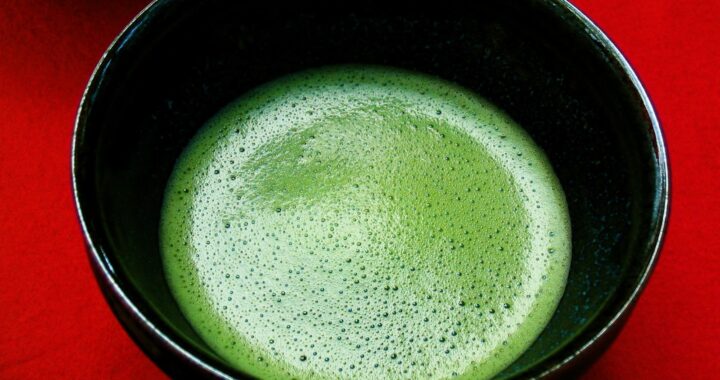
The cup itself is pale gold to light green, with a strong floral smell and a slightly bitter, camphor-like finish if it is steeped too long. Many people prefer lavender in a blend rather than on its own.

What European regulators say
The European Medicines Agency (EMA) reviews herbal medicines through its Committee on Herbal Medicinal Products. Its monograph on lavender flower classes it as a traditional herbal medicinal product “for relief of mild symptoms of mental stress and exhaustion and to aid sleep”. That label matters. It means the use is accepted on the basis of long-standing use and plausibility, not because clinical trials have shown it works. The EMA does not grant lavender flower the stronger “well-established use” status.
The monograph also sets a dose for tea: 1 to 2 g of dried flower in 150 ml of boiling water, up to three times a day, for adolescents and adults. It does not recommend use in children under 12, or during pregnancy and breastfeeding, because there are not enough safety data. It also warns that lavender may impair the ability to drive or use machines. You can read the full set of documents on the EMA lavender flower page.
The only trial of lavender tea
In 2015, nurse researchers in Taiwan tested lavender tea in 80 new mothers who were sleeping poorly in the weeks after giving birth. Half were asked to drink one cup of lavender tea a day for two weeks, taking time to smell the aroma before drinking. The other half had normal postnatal care and no tea.
After two weeks, the tea group reported less fatigue and fewer symptoms of depression, and scored higher on bonding with their babies. Those three differences were statistically significant. The abstract does not report a significant improvement in sleep quality, even though poor sleep was the reason the women were recruited. By the four-week check, two weeks after the tea stopped, the two groups were the same on all four measures.
There are good reasons to read this result with caution:
- No placebo. The control group got nothing, so a warm, pleasant daily ritual could explain the difference as easily as anything in the lavender.
- No blinding. Everyone knew which group they were in, and all the outcomes were self-reported questionnaires.
- Systematic assignment. Women were allocated to groups in a fixed order rather than truly at random.
- Short-lived effect. The gains were gone two weeks after stopping.
NCCIH sums up this kind of evidence plainly: small early reports suggest oral lavender or lavender tea “might reduce symptoms of depression in some people”, but the research is preliminary. Anyone with persistent low mood after birth should talk to a midwife or doctor, because postnatal depression is common and treatable.
Silexan, the lavender capsule with real trials
Most headlines about lavender and anxiety come from trials of Silexan, a standardised lavender oil made by distilling the flowers, sold in capsules of 80 mg. It is licensed as a medicine in Germany and several other countries. The evidence here is much stronger than for tea.
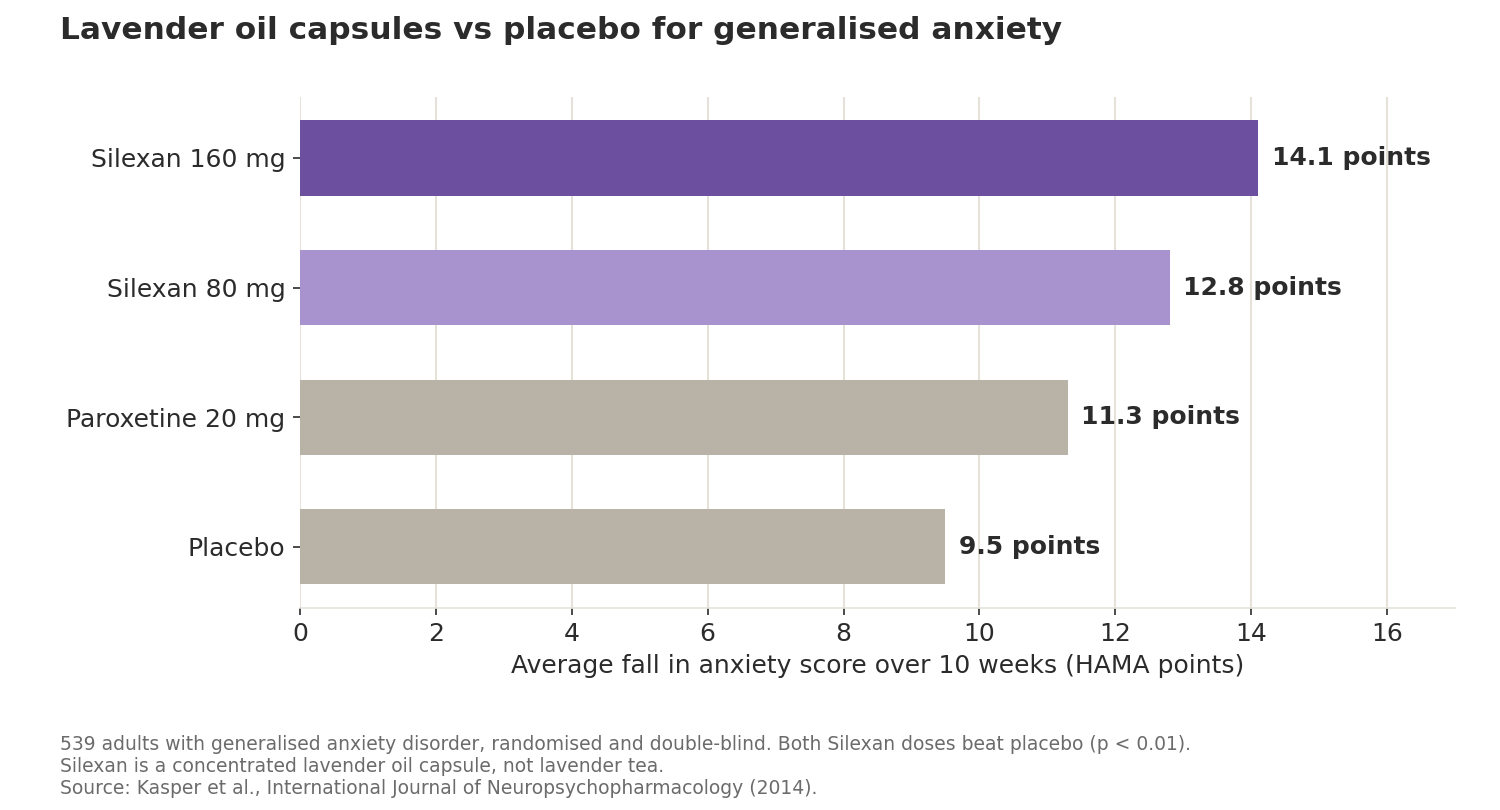
The largest trial, published in 2014, randomised 539 adults with generalised anxiety disorder to 160 mg or 80 mg of Silexan, 20 mg of the antidepressant paroxetine, or a placebo, once a day for ten weeks. Anxiety was rated on the Hamilton Anxiety Scale (HAMA), where higher scores mean worse anxiety. Both Silexan doses beat placebo. The chart shows the average fall in score for each group.
An earlier, smaller study compared Silexan with lorazepam, a benzodiazepine, and found similar falls in anxiety over six weeks. A 2023 meta-analysis of five placebo-controlled trials with 1,213 patients found that 80 mg a day consistently reduced anxiety, with side effect rates no different from placebo. Sleep improved too. An analysis of one 212-patient trial found that about 98% of the sleep benefit was explained by lower anxiety, so the capsule does not seem to work as a sedative.
There are caveats. NCCIH points out that much of this research was funded by the manufacturer and that the trials had limited diversity. The most common side effect reported with oral lavender oil is burping, sometimes with a lavender taste.
Why a cup of tea is not a Silexan capsule
It is tempting to assume that tea made from the same plant will do the same job. The chemistry says otherwise. Essential oils do not dissolve well in water, and much of the scent escapes as steam. When Austrian researchers measured how much lavender oil ends up in an infusion, they found the flowers they tested held 5.1% oil by volume, but the tea extracted only about 0.7%, or 13.9% of what was in the flowers. The mix also changed: the tea contained less linalyl acetate and more linalool oxides than the original oil.
Applying those figures to the EMA tea dose gives a rough idea of the gap. It is an estimate, because oil content varies between harvests and brewing methods.
| Lavender tea (2 g in 150 ml) | Silexan capsule | |
|---|---|---|
| Form | Dried flowers steeped in hot water | Distilled lavender oil in a soft capsule |
| Lavender oil per dose | About 12 mg (estimate) | 80 mg |
| Standardised? | No, varies by crop and brewing | Yes, fixed composition |
| Placebo-controlled trials | None | At least five, over 1,200 patients |
| EMA status | Traditional use only | Not covered by the flower monograph |
| Main documented benefit | Short-term mood and fatigue in one small study | Reduced anxiety over 6 to 10 weeks |
So even three cups a day deliver well under half the oil in a single 80 mg capsule, in a different chemical mix. The Silexan results cannot be borrowed to support lavender tea. Do not try to close the gap by adding lavender essential oil to drinks. Essential oils are concentrated and many are not made for eating.
Does lavender tea help you sleep?
There is no good trial that answers this for tea. Most sleep studies use lavender oil, usually inhaled from a diffuser or pillow. A 2026 meta-analysis of 11 trials with 628 adults found that lavender essential oil improved sleep quality with a moderate effect size, but the authors called the studies limited in number and quality. A 2018 systematic review looked for studies comparing Silexan with inhaled lavender for sleep and found none at all.
What the tea does offer is a caffeine-free, sweet-smelling ritual, and the smell is the one part of lavender with some evidence behind it. If you want a herbal sleep tea with more research, our best tea for sleep guide compares the options. Chamomile and lemon balm both have small human trials, and valerian has the most studies, with mixed results.
Lavender tea side effects and safety
Lavender is widely used in food, and NCCIH says it is likely safe in the amounts normally eaten. For tea and other oral products, keep these points in mind:
- Stomach upset and headache. NCCIH lists diarrhoea, headache, nausea and burping as possible effects of oral lavender products.
- Drowsiness. The EMA warns that lavender may impair driving. Be careful combining it with sleeping pills, sedating antihistamines, alcohol or other calming herbs, and tell your surgeon if you use it before an operation.
- Pregnancy and breastfeeding. The EMA does not recommend lavender tea because of missing safety data. Our guide to teas in pregnancy lists better-studied choices.
- Children. Not recommended under 12 years by the EMA.
- Allergy. Lavender belongs to the mint family. Stop if you notice a rash, itching or swelling.
You may also have read that lavender can cause breast growth in boys. This comes from a 2007 report of three boys whose breast tissue grew while they used skin products containing lavender and tea tree oils, and shrank after they stopped. Lab tests found weak oestrogen-like activity in both oils. A 2023 review counted twelve such cases in total, all linked to skin products, not tea, and concluded that a causal link has not been proven. There are no reports tied to drinking lavender tea.
How to make lavender tea
- Use culinary-grade dried Lavandula angustifolia, not flowers from a florist or a garden that may have been sprayed.
- Weigh 1 to 2 g of buds per 150 ml cup, the EMA dose. Start at the low end, because lavender turns soapy and bitter quickly.
- Pour on freshly boiled water, as the EMA monograph describes. Our brewing temperature guide explains why herbal teas take hotter water than green tea.
- Cover the cup to keep the aromatic oil from escaping with the steam, and steep for 5 to 10 minutes.
- Strain and drink. A little honey or lemon softens the floral edge.
Lavender works well in blends. Try it with chamomile for a classic bedtime mix, with lemon balm for a brighter cup, or with peppermint after a meal. A pinch in black tea gives a lavender Earl Grey style. For summer, steep it in cold water in the fridge overnight, as in our cold brew guide; the flavour comes out gentler and less bitter. Store dried lavender in an airtight tin away from light, as our tea storage guide explains, because the aroma fades within a year or so.
Quick answers
Does lavender tea have caffeine?
No. Pure lavender tea is made only from flowers and is naturally caffeine-free.
Is it safe to drink lavender tea every day?
For most healthy adults, one to three cups a day is in line with the EMA dose. Check with a doctor first if you are pregnant, breastfeeding, take sedating medicines or have surgery coming up. If you use it for stress that does not improve, get advice rather than drinking more.
Does lavender tea help with anxiety?
There is no good evidence for the tea. The trials showing an effect on anxiety used Silexan, a concentrated oil capsule, which contains several times more lavender oil than a cup of tea.
When should I drink lavender tea?
In the evening, 30 to 60 minutes before bed, if you are using it as part of a wind-down routine. Avoid it before driving if it makes you drowsy.
What does lavender tea taste like?
Floral and herbal, with a slightly bitter, soapy note if it is too strong or steeped too long. Using less lavender and blending it with chamomile, lemon balm or black tea makes it easier to enjoy.
Sources
- European Medicines Agency, HMPC. Community herbal monograph on Lavandula angustifolia Miller, flos. EMA/HMPC/734125/2010.
- National Center for Complementary and Integrative Health. Lavender. Updated fact sheet.
- Chen and Chen. Effects of lavender tea on fatigue, depression, and maternal-infant attachment in sleep-disturbed postnatal women. Worldviews on Evidence-Based Nursing, 2015.
- Kasper et al. Lavender oil preparation Silexan is effective in generalized anxiety disorder, a randomized, double-blind comparison to placebo and paroxetine. International Journal of Neuropsychopharmacology, 2014.
- Woelk and Schläfke. A multi-center, double-blind, randomised study of the lavender oil preparation Silexan in comparison to lorazepam for generalized anxiety disorder. Phytomedicine, 2010.
- Dold et al. Efficacy of Silexan in patients with anxiety disorders: a meta-analysis of randomized, placebo-controlled trials. European Archives of Psychiatry and Clinical Neuroscience, 2023.
- Seifritz et al. Beneficial effects of Silexan on sleep are mediated by its anxiolytic effect. Journal of Psychiatric Research, 2019.
- Tschiggerl and Bucar. Volatile fraction of lavender and bitter fennel infusion extracts. Natural Product Communications, 2010.
- Shen et al. The sleep-enhancing effect of lavender essential oil in adults: a systematic review and meta-analysis. Holistic Nursing Practice, 2026.
- Greenberg and Slyer. Effectiveness of Silexan oral lavender essential oil compared to inhaled lavender essential oil aromatherapy for sleep in adults: a systematic review. JBI Database of Systematic Reviews, 2018.
- Henley et al. Prepubertal gynecomastia linked to lavender and tea tree oils. New England Journal of Medicine, 2007.
- Braunstein and Braunstein. Are prepubertal gynaecomastia and premature thelarche linked to topical lavender and tea tree oil use? touchREVIEWS in Endocrinology, 2023.
Last updated: 11 October 2026. Sources are linked in the text.
This article is general information, not medical advice. Talk to your doctor or pharmacist before using tea or herbs for a health condition, especially if you are pregnant, breastfeeding or take regular medication.