Lemon balm tea is a caffeine-free herbal tea made from the leaves of Melissa officinalis, a lemon-scented plant in the mint family. In randomised trials, lemon balm extracts reduced anxiety and stress more than placebo, and one dose made people calmer under pressure. The evidence for sleep is weaker and mostly comes from blends with other herbs. Most studies used capsules, so a cup of tea is a milder version of what was tested.

What is lemon balm?
Lemon balm is a leafy perennial herb native to southern Europe, the Mediterranean and western Asia, and now grown in gardens worldwide. It belongs to the mint family, alongside peppermint and spearmint, and shares their square stems and soft, crinkled leaves. Rub a leaf and it smells strongly of lemon. That scent comes from essential oils such as citral and citronellal.
The compound researchers focus on most is rosmarinic acid, a polyphenol found in the leaves in much larger amounts than the oils. It dissolves well in hot water, so it ends up in the tea. A 2025 review notes that rosmarinic acid slows an enzyme that breaks down GABA, the brain’s main calming chemical messenger. That is a plausible reason for the herb’s relaxing reputation, though it comes mainly from lab work.

Lemon balm for anxiety and stress
This is the best-supported use. The research is promising but small, and almost all of it tests standardised extracts rather than tea.
The pooled evidence
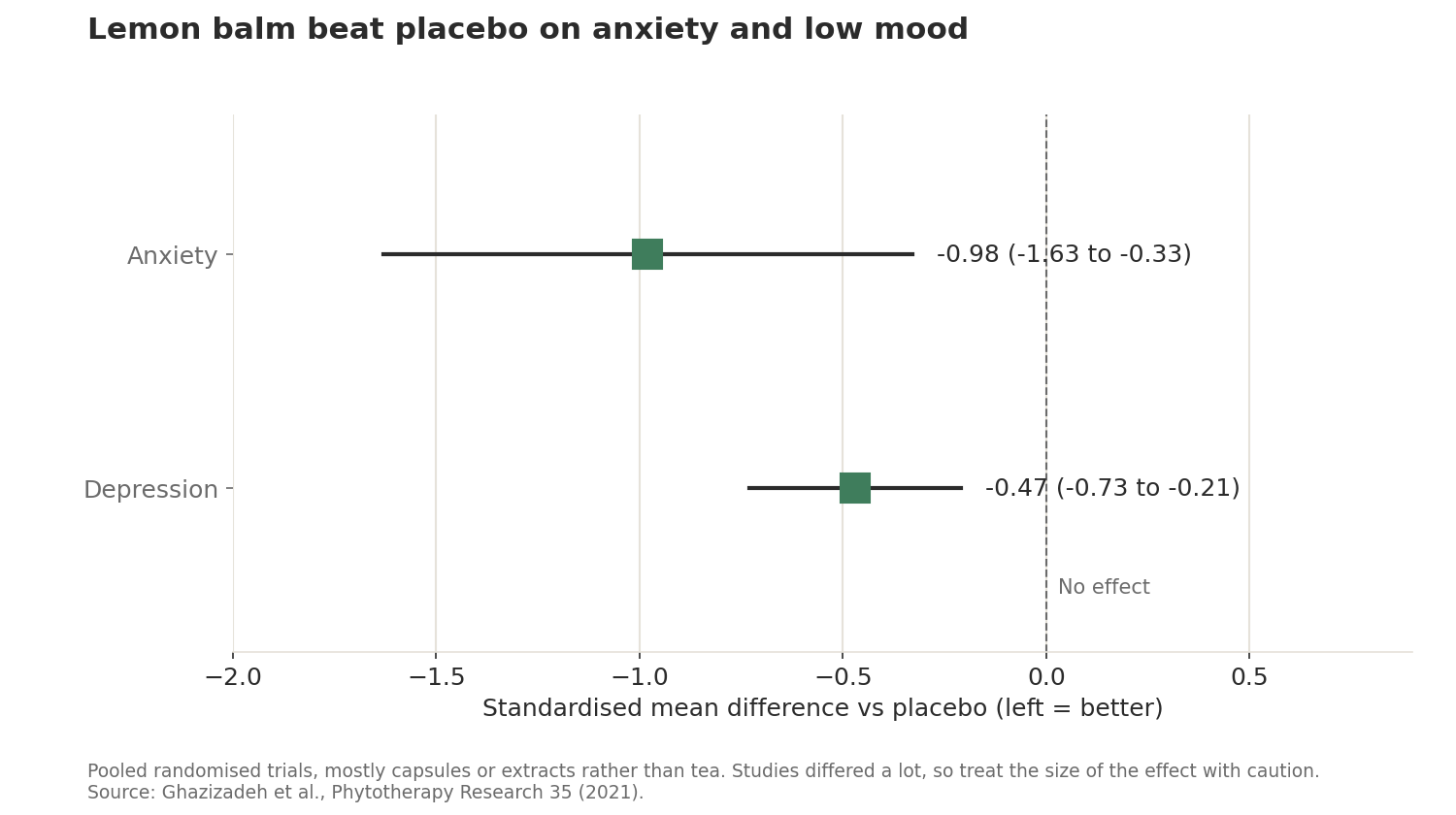
A 2021 meta-analysis combined randomised trials of lemon balm in people with symptoms of anxiety or depression. Lemon balm improved anxiety scores clearly more than placebo, and depression scores to a lesser degree, without serious side effects. The effect was strongest in short-term use. The authors warned that the trials were few and very different from each other, so the size of the benefit is uncertain.
Calm under pressure
One of the most quoted experiments was run at Northumbria University in England. In a double-blind crossover study, 18 healthy volunteers took a single dose of lemon balm extract, 300 mg or 600 mg, or a placebo, then completed a stressful multitasking test. After the 600 mg dose they rated themselves calmer and less alert. After 300 mg, they did maths problems faster without losing accuracy. The study was small, but it suggests lemon balm can take the edge off acute stress within an hour.
Longer trials
- In a 2023 randomised trial, 100 adults with emotional distress or poor sleep took 400 mg of a lemon balm extract or placebo daily for three weeks. The lemon balm group improved on anxiety, stress, mood and quality of life.
- In a 12-week trial in Iran, 60 people with type 2 diabetes and depressive symptoms took 700 mg of extract or a placebo. Depression and anxiety improved with lemon balm, but sleep quality did not.
- An earlier open-label pilot study gave 20 stressed volunteers 600 mg a day for 15 days. Anxiety fell by 18% and insomnia by 42%. There was no placebo group, so part of that is likely expectation.
A 2024 review from the University of Reading summed it up fairly. Lemon balm shows promise as a calming herb with mild anti-anxiety and antidepressant effects, but it needs larger, more robust trials. It is not a treatment for an anxiety disorder or depression. If anxiety is affecting your daily life, talk to your doctor.
Lemon balm tea for sleep
Lemon balm is a classic bedtime herb, and the European Medicines Agency recognises it as a traditional remedy for mild stress and to aid sleep. That status rests on long use, not on proof from trials.
The clinical evidence for sleep is thinner than for anxiety. Most positive studies tested lemon balm combined with other herbs. A 2018 trial in people with insomnia found a blend of lemon balm and another mint-family herb, Nepeta menthoides, improved insomnia severity, anxiety and depression after four weeks. Reviews also describe benefits from lemon balm with valerian in menopausal women. Studies of lemon balm alone show mixed results for sleep. The diabetes trial above found no change.
The most likely benefit is indirect. If worry keeps you awake, a calming, caffeine-free ritual can help you wind down. Our best tea for sleep guide compares lemon balm with chamomile, valerian and other options.
Other uses
Digestion
The EMA also lists lemon balm as a traditional remedy for mild digestive complaints, including bloating and wind. Like peppermint, it has a long history after meals, but good trials of lemon balm on its own are lacking. Our best tea for bloating guide ranks the herbs with better evidence.
Focus and memory
Small studies have found lemon balm can improve mood and some measures of attention, and the 300 mg result in the stress study hints at sharper thinking under pressure. The effect is subtle. For daytime focus, a tea with L-theanine is a better-tested choice, as our best tea for focus explains.
Antioxidant effects
One of the few studies of actual lemon balm tea was a trial among 55 hospital radiology staff in Iran. They drank lemon balm infusion, 1.5 g in 100 ml, twice a day for 30 days. Blood markers of antioxidant defence rose and markers of oxidative damage fell. There was no comparison group, so the result is a starting point rather than proof.
Lemon balm vs other calming teas
| Tea | Best evidence for | Strength of evidence | Notes |
|---|---|---|---|
| Lemon balm | Anxiety and acute stress | Moderate, mostly extracts | Mild lemon flavour, may cause drowsiness |
| Chamomile | Sleep quality | Moderate, mostly extracts | Daisy-family allergy risk |
| Valerian | Subjective sleep quality | Mixed, product quality varies | Earthy smell many dislike |
| Lemon balm with valerian | Sleep | Limited | Common in sleep blends |
Lemon balm stands out for daytime worry and stress, when you want to feel calmer without feeling sedated. Chamomile has slightly better support for sleep quality. Valerian is the classic sleep herb, and a 2020 meta-analysis of 60 studies found it can improve subjective sleep quality. The authors added that results vary with the quality of the extract. Many bedtime blends combine lemon balm with one or both of these. That matches the combinations that have done best in trials.
How to make lemon balm tea
| Form | Amount per cup (200 to 250 ml) | Steep |
|---|---|---|
| Dried leaf | 1.5 to 3 g, about 1 to 2 heaped teaspoons | 5 to 10 minutes, covered |
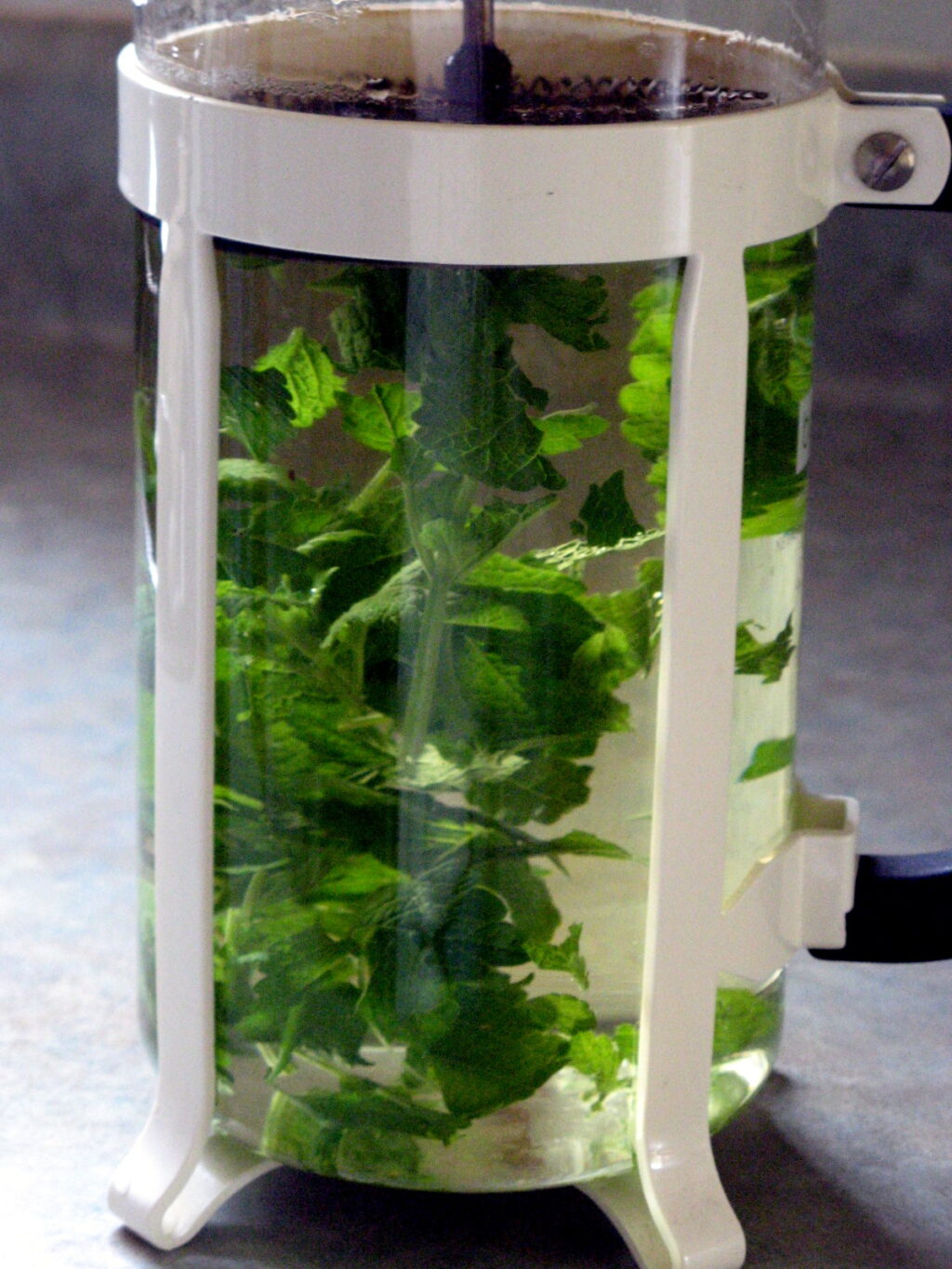
| Fresh leaf | A small handful, about 10 to 15 leaves, torn | 5 to 10 minutes, covered |
| Tea bag | 1 to 2 bags | 5 to 7 minutes, covered |
- Tear or lightly bruise fresh leaves to release their oils. Dried leaf can go straight in.
- Pour freshly boiled water over the leaves.
- Cover the cup or pot with a saucer. The lemon scent comes from volatile oils that escape with the steam.
- Steep for 5 to 10 minutes. Longer gives a stronger, slightly more herbal cup.
- Strain, and add honey or a slice of lemon if you like.
- Blends that work well. Lemon balm with chamomile for bedtime, with peppermint after dinner, or with a little lavender for a floral cup.
- Iced lemon balm tea. Brew it double strength, cool it and pour over ice, or leave fresh leaves in cold water in the fridge overnight, as with cold brew tea.
- Grow your own. Lemon balm grows easily in a pot or bed and spreads quickly. Pick leaves before the plant flowers for the best flavour, and cut it back often.
- Drying and storing. Hang small bunches somewhere warm, dark and airy for a week, then store the crumbled leaves in an airtight jar away from light. The scent fades within a year, as with any loose tea. See our storage guide.
Side effects and safety
Lemon balm tea is well tolerated by most adults. The EMA lists no known side effects at traditional doses. A few cautions still apply.
- Drowsiness. The EMA warns it may impair your ability to drive or use machinery. Take care if you combine it with alcohol, sleeping tablets or other sedating medicines, and ask a pharmacist first.
- Thyroid conditions. In lab studies from the 1980s, freeze-dried lemon balm extract blocked thyroid-stimulating hormone from binding to thyroid tissue. There is no evidence that tea affects the thyroid in people, but if you have a thyroid condition or take thyroid medicine, check with your doctor before drinking it daily.
- Pregnancy and breastfeeding. The EMA does not recommend lemon balm because safety has not been established. Our guide to tea during pregnancy lists better-studied options.
- Children. The EMA does not recommend medicinal use under 12 because of a lack of data.
- Variety. Germany’s BfR found traces of plant toxins called pyrrolizidine alkaloids in some herbal teas, including lemon balm tea. Rotating between different teas keeps any one source low.
If stress or poor sleep lasts more than two weeks despite home remedies, the EMA advises seeing a doctor. That is good advice for any herbal remedy.
Quick answers
Does lemon balm tea have caffeine?
No. Lemon balm is an herb, not a true tea, so it is naturally caffeine free and fine to drink in the evening. It is one of the picks in our best caffeine-free tea guide.
How fast does lemon balm work?
In the stress study, a single dose made people feel calmer within an hour. The longer trials measured changes over two to twelve weeks.
Can I drink lemon balm tea every day?
Yes, one to three cups a day matches the traditional dose for adults. Take breaks now and then, and see a doctor if symptoms last more than two weeks.
Is lemon balm the same as lemongrass or lemon verbena?
No. They all smell of lemon, but they are different plants. Lemongrass is a tropical grass, and lemon verbena is a shrub. Only lemon balm has the research described here.
Does lemon balm help headaches?
It is a traditional remedy for tension headaches linked to stress, but there are no good trials. Our best tea for headaches guide covers teas with stronger evidence.
Sources
- Ghazizadeh et al. Lemon balm for depression and anxiety, a meta-analysis. Phytotherapy Research, 2021.
- Kennedy et al. Attenuation of laboratory-induced stress after acute administration of Melissa officinalis. Psychosomatic Medicine, 2004.
- Bano et al. Calming effect of a Melissa officinalis extract in adults with emotional distress and poor sleep. Frontiers in Pharmacology, 2023.
- Safari et al. Melissa officinalis for depression and anxiety in type 2 diabetes. BMC Complementary Medicine and Therapies, 2023.
- European Medicines Agency. Melissae folium herbal monograph.
- Mathews et al. Clinical efficacy and tolerability of lemon balm in psychological well-being. Nutrients, 2024.
Last updated: 8 October 2026. Sources are linked in the text.
This article is general information, not medical advice. Talk to your doctor or pharmacist before using tea or herbs for a health condition, especially if you are pregnant, breastfeeding or take regular medication.