The best tea for anxiety is chamomile, followed by lemon balm and passionflower. All three have small randomised trials showing less anxiety than placebo or, for passionflower, a similar effect to a prescription sedative. Lavender and green tea have weaker evidence. The catch is that nearly every trial used concentrated extracts, not a cup of tea, so a mug is a gentler version of what was tested. Just as important is what you cut back on, because the caffeine in ordinary tea and coffee can make anxiety worse.
Can tea really help with anxiety?
It can help a little, and for some people that little is worth having. Anxiety ranges from ordinary worry before an exam to generalised anxiety disorder (GAD), a long-term condition in which people feel anxious about many things most days. The NHS says GAD is best treated with talking therapy, usually cognitive behavioural therapy, and sometimes with medicine. A calming tea is not a substitute for either.
What tea can offer is two things. The first is the herbs themselves. Chamomile, lemon balm and passionflower contain compounds that act on the brain’s calming GABA system in laboratory studies, and each has at least one human trial behind it. The second is the habit. Stopping for five minutes to brew and sip something warm is a small, repeatable break, and that ritual is part of why people feel better after a cup. Trials cannot fully separate the two, which is one reason the effects look modest.
The best teas for anxiety, ranked
We ranked each tea by the quality of the human evidence, not by tradition or marketing. Most of these trials are small and short, so treat the table as a guide to where the evidence is strongest, not as proof.
| Tea | Best evidence | Form tested | Verdict |
|---|---|---|---|
| Chamomile | Two US trials in GAD, plus a 2019 meta-analysis | Extract capsules | Best supported, modest |
| Lemon balm | 2021 meta-analysis of randomised trials | Mostly extracts | Promising, short term |
| Passionflower | Small trial vs oxazepam; Cochrane says too few trials | Extract drops | Promising, thin |
| Lavender | Two small unblinded tea trials | Tea, and oil capsules | Weak for tea |
| Green tea (L-theanine) | Theanine tablets eased stress scores | 200 mg tablets | Weak for tea |
| Black tea | Faster cortisol recovery after stress | Tea, 4 cups a day | Interesting, one trial |
| Valerian | Cochrane found one trial, no clear benefit | Extract | Not shown |
1. Chamomile
Chamomile has the best evidence of any tea for anxiety. In a 2009 trial at the University of Pennsylvania, 57 adults with mild to moderate GAD took chamomile extract or placebo for eight weeks. Scores on the Hamilton Anxiety Rating Scale, the standard clinician-rated measure, fell more with chamomile, and every secondary measure moved in the same direction. The authors called the effect modest.
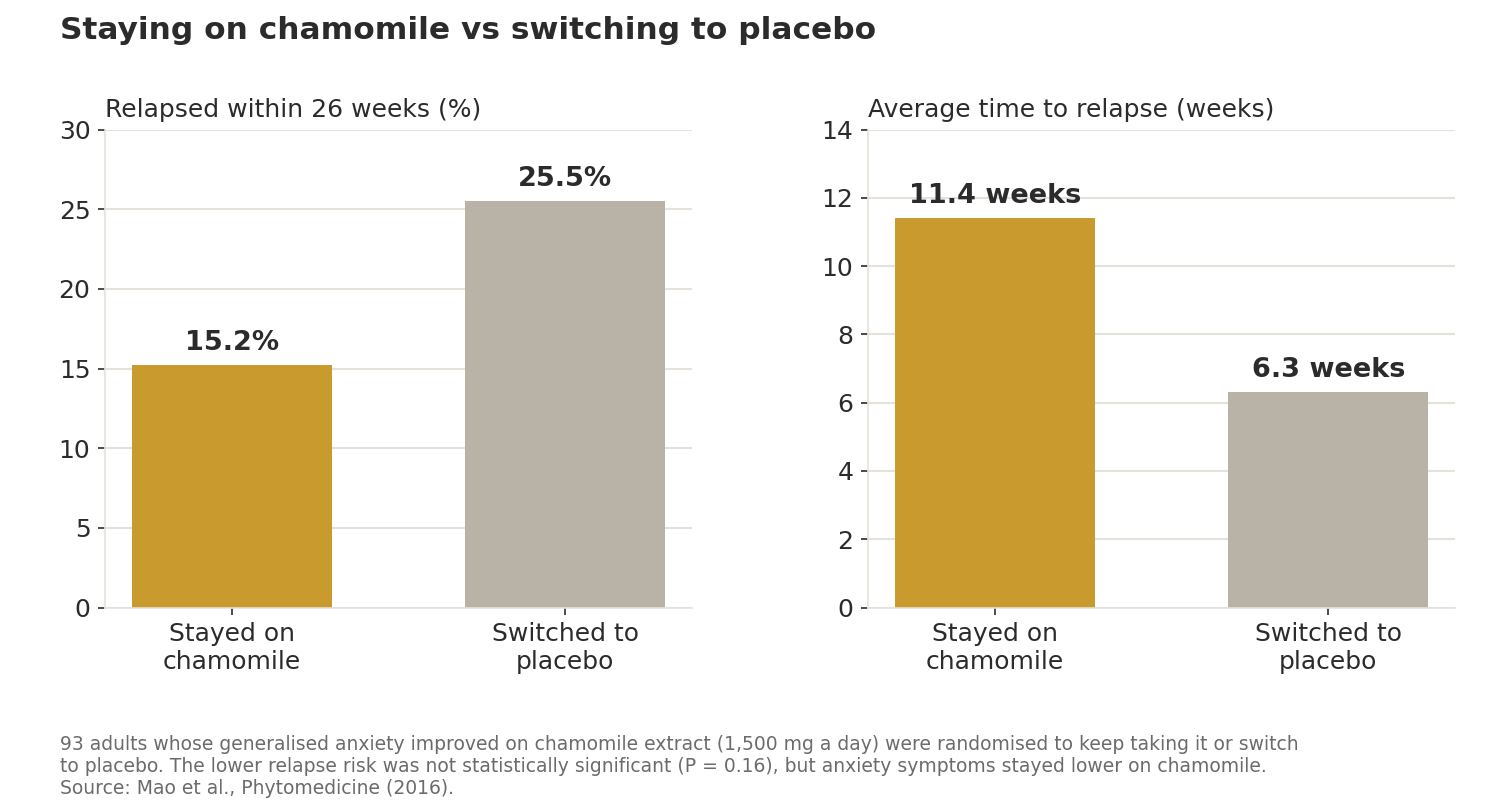
The same team then ran a longer trial in 179 people with moderate to severe GAD. Everyone took 1,500 mg of chamomile extract a day for 12 weeks, and 93 who improved were then randomly kept on chamomile or switched to placebo for six months. Fewer people relapsed on chamomile, 15.2% against 25.5%, though with so few people that difference could have been chance. Anxiety symptoms stayed clearly lower in the chamomile group, and side effects were rare in both.
A 2019 meta-analysis pooled 12 chamomile trials. It found a small but clear improvement in GAD scores after two and four weeks, and a clearer gain in sleep quality, but no reliable effect on short-term anxiety in people without a diagnosis. Chamomile flowers contain apigenin, a flavonoid that binds to the same brain receptors as some anti-anxiety drugs in laboratory work. Whether a cup of tea delivers enough of it has not been measured. Our guide to chamomile tea covers the sleep research and how to brew it.
2. Lemon balm
Lemon balm is a lemon-scented herb in the mint family. A 2021 meta-analysis of randomised trials in people with symptoms of anxiety or depression found that lemon balm lowered anxiety scores clearly more than placebo, with the strongest effect in short-term use and no serious side effects. The authors warned that the trials were few and varied a lot.
One of the best-known studies shows the acute effect. In a 2004 crossover experiment in 18 healthy volunteers, a single 600 mg dose of lemon balm extract made people rate themselves calmer during a stressful computer task. Most of this research used capsules, so a cup of lemon balm tea is a milder dose. It tastes pleasant, which makes it an easy daily habit.
3. Passionflower
Passionflower has a striking result from one small trial. In a 2001 pilot study, 36 outpatients with GAD took either passionflower extract or the prescription sedative oxazepam for four weeks. Both worked, with no clear difference at the end, and passionflower caused fewer problems with work performance, though oxazepam acted faster. A Cochrane review later concluded that there were too few trials to draw firm conclusions. Our passionflower tea guide covers the newer surgery and sleep trials. It is not suitable in pregnancy.
4. Lavender
Lavender’s strongest research is on a concentrated oral oil capsule, not on tea. The tea studies are small and had no placebo. In a 2015 Taiwanese study of 80 new mothers, one cup a day for two weeks eased fatigue and depression scores, but the benefit had gone by four weeks. A 2020 Iranian trial in 60 older adults, using 2 g lavender tea bags twice a day for two weeks, reported lower anxiety and depression scores than no treatment. Neither study could rule out the effect of expecting to feel better. Our lavender tea article explains the difference between the tea and the capsules.
5. Green tea and L-theanine
Green tea contains L-theanine, an amino acid often sold as a calming supplement. In a 2019 Japanese trial, 30 healthy adults took 200 mg of theanine a day for four weeks, and their anxiety, depression and sleep scores improved compared with placebo. But an ordinary cup of green or black tea gives roughly 10 to 15 mg of theanine, as our guide to L-theanine in tea explains, so you would need well over a dozen cups. Green tea also contains caffeine, which works against the calming effect for anxious people.
6. Black tea
One UK trial tested real black tea. In a 2007 study at University College London, 75 men drank four cups a day of either black tea or a caffeinated placebo drink for six weeks, then did stressful tasks in the lab. The stress itself felt much the same, but the tea drinkers had lower levels of the stress hormone cortisol afterwards and felt more relaxed. It is one trial in men only, and black tea contains caffeine, so it is a curiosity rather than a recommendation.
Not recommended: valerian
Valerian is sold for both sleep and anxiety, but a Cochrane review found only one eligible trial in anxiety, with 36 patients, and it showed no clear difference from placebo. Valerian also has a strong, earthy smell many people dislike. Our valerian tea article covers its better-studied, but still mixed, use for sleep.
Caffeine and anxiety
For many anxious people, the most useful change is not adding a calming tea but cutting caffeine. The NHS advises people with GAD not to drink lots of coffee, tea, cola or energy drinks, because caffeine can disrupt sleep and make anxiety harder to control. The effect is strongest in panic disorder. A 2022 meta-analysis found that about half of people with panic disorder had a panic attack after a large dose of caffeine, roughly five cups of coffee in one go, compared with under 2% of healthy volunteers.
A cup of black tea has about 47 mg of caffeine on average, according to our black tea caffeine figures, and green tea a little less. The European Food Safety Authority considers up to 400 mg a day safe for most adults, but people with anxiety often feel jittery at much lower doses. If you notice a racing heart or restlessness after tea, try switching your afternoon and evening cups to caffeine-free herbs. Our list of the best caffeine-free teas and the caffeine content of every tea type can help you choose.
How to use tea for anxiety
- Make it strong enough. Use 2 to 3 g of dried herb, about a heaped teaspoon or one to two bags, per cup.
- Cover it while it steeps. Steep chamomile, lemon balm and lavender for 5 to 10 minutes under a lid or saucer so the aromatic oils stay in the cup. Our brewing guide has times for other teas.
- Drink it regularly. The chamomile and lemon balm trials gave the herbs daily for weeks, not as a single emergency dose.
- Use the ritual. Sit down, put your phone away and take slow breaths while it cools. The NHS recommends calming breathing exercises for anxiety.
- Blend for taste. Chamomile with lemon balm, or peppermint for brightness, are easy combinations. Rooibos makes a caffeine-free swap for black tea with milk.
If evenings are your worst time, these same teas double as a wind-down drink. Our ranking of the best tea for sleep compares them for that job.
Safety and side effects
These teas are safe for most adults in normal amounts, but a few groups should take care:
- Daisy family allergy. Chamomile is related to ragweed and mugwort, and NCCIH notes that people allergic to those plants can react to it.
- Pregnancy and breastfeeding. Avoid passionflower, and ask your midwife before using herbal teas regularly. Our guide to tea in pregnancy lists safer options.
- Sedating medicines. Calming herbs may add to the effect of sleeping tablets, benzodiazepines, some antidepressants and alcohol. Ask a pharmacist first.
- Blood thinners. Chamomile may interact with warfarin.
- Prescribed treatment. Never stop an anxiety medicine because you have started a herbal tea. Talk to your doctor first.
When to see a doctor
The NHS suggests seeing a GP if anxiety is affecting your daily life or causing you distress. Get urgent help if you have thoughts of harming yourself. In the UK you can call Samaritans free on 116 123, and in the US you can call or text 988. Talking therapy has far stronger evidence than any tea, and many people use both.
Quick answers
What is the best tea for anxiety?
Chamomile has the most evidence, from two US trials in generalised anxiety disorder and a 2019 meta-analysis. Lemon balm and passionflower come next.
How fast does chamomile tea work for anxiety?
A warm cup can feel soothing within minutes, but the trial benefits built up over two to eight weeks of daily use.
Is green tea good for anxiety?
Only partly. It contains calming L-theanine but also caffeine, and a cup has far less theanine than the doses tested. Decaf green tea is a better choice if caffeine bothers you, or you can try to decaffeinate tea at home.
Can tea cause anxiety?
Caffeinated tea can. Black, green, oolong and white tea all contain caffeine, which can trigger jitters and, in people with panic disorder, panic attacks.
Can I drink calming tea every day?
Yes, for most adults. The chamomile trial ran safely for months, though it used capsules. Stop and seek advice if you notice side effects.
Sources
- Amsterdam JD et al. A randomized, double-blind, placebo-controlled trial of oral Matricaria recutita (chamomile) extract therapy for generalized anxiety disorder. Journal of Clinical Psychopharmacology, 2009.
- Mao JJ et al. Long-term chamomile (Matricaria chamomilla L.) treatment for generalized anxiety disorder: a randomized clinical trial. Phytomedicine, 2016.
- Hieu TH et al. Therapeutic efficacy and safety of chamomile for state anxiety, generalized anxiety disorder, insomnia, and sleep quality: a systematic review and meta-analysis. Phytotherapy Research, 2019.
- Ghazizadeh J et al. The effects of lemon balm (Melissa officinalis L.) on depression and anxiety in clinical trials: a systematic review and meta-analysis. Phytotherapy Research, 2021.
- Kennedy DO, Little W, Scholey AB. Attenuation of laboratory-induced stress in humans after acute administration of Melissa officinalis (lemon balm). Psychosomatic Medicine, 2004.
- Akhondzadeh S et al. Passionflower in the treatment of generalized anxiety: a pilot double-blind randomized controlled trial with oxazepam. Journal of Clinical Pharmacy and Therapeutics, 2001.
- Miyasaka LS, Atallah AN, Soares BG. Passiflora for anxiety disorder. Cochrane Database of Systematic Reviews, 2007.
- Chen SL, Chen CH. Effects of lavender tea on fatigue, depression, and maternal-infant attachment in sleep-disturbed postnatal women. Worldviews on Evidence-Based Nursing, 2015.
- Bazrafshan MR et al. The effect of lavender herbal tea on the anxiety and depression of the elderly: a randomized clinical trial. Complementary Therapies in Medicine, 2020.
- Hidese S et al. Effects of L-theanine administration on stress-related symptoms and cognitive functions in healthy adults: a randomized controlled trial. Nutrients, 2019.
- Steptoe A et al. The effects of tea on psychophysiological stress responsivity and post-stress recovery: a randomised double-blind trial. Psychopharmacology, 2007.
- Miyasaka LS, Atallah AN, Soares BG. Valerian for anxiety disorders. Cochrane Database of Systematic Reviews, 2006.
- Klevebrant L, Frick A. Effects of caffeine on anxiety and panic attacks in patients with panic disorder: a systematic review and meta-analysis. General Hospital Psychiatry, 2022.
- NHS. Generalised anxiety disorder in adults.
- NHS. Treatment for generalised anxiety disorder (GAD).
- National Center for Complementary and Integrative Health. Chamomile.
- European Food Safety Authority. Caffeine.
Last updated: 17 October 2026. Sources are linked in the text.
This article is general information, not medical advice. Talk to your doctor or pharmacist before using tea or herbs for a health condition, especially if you are pregnant, breastfeeding or take regular medication.